
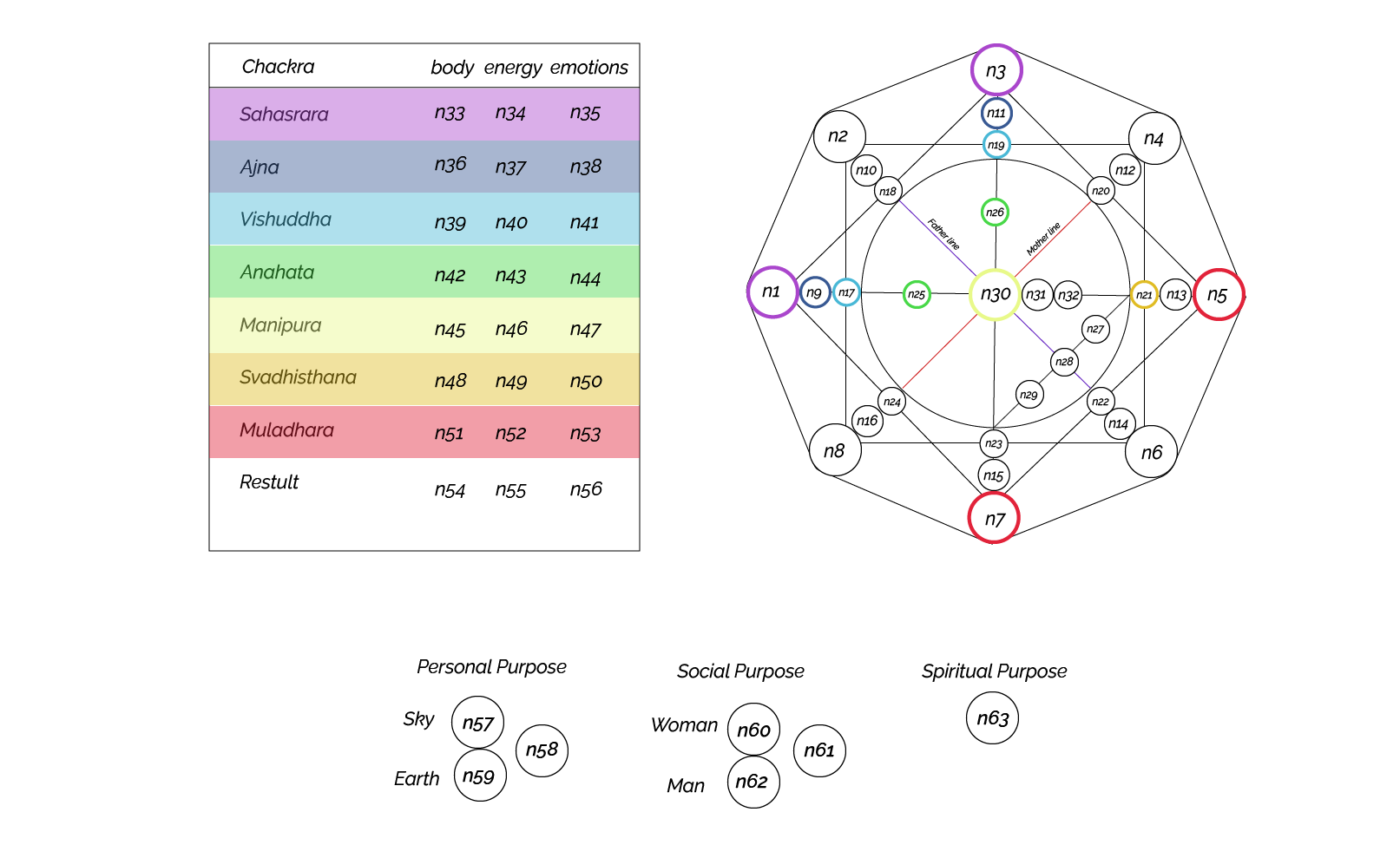
Lessons and Issues That the Couple Brings and Faces n9
Energy 1
You or your partner (or both) may have felt that your parents were distant, or focused only on themselves, leaving you to fight for their attention. You were expected to be the best at everything, and you tried to meet those expectations, believing that this would earn you their affection and attention. If you have siblings, you may have found yourself competing for your parents’ love. While childhood cannot be relived, it is possible to heal these past wounds by caring for your parents and accepting them as they are. It is crucial to develop attentiveness, warmth, tolerance, and the ability to be accepted, treating others as equals.
Energy 2
Your child may find it difficult to discern when parents are being honest or withholding information, especially if they have witnessed inconsistencies in family behavior. For example, although taught to respect elders, they may have seen their parents struggle to get along with older relatives. This can create confusion, and in an effort to gain parental approval, the child may have suppressed their true emotions and desires, trying to meet the expectations of others. Encourage your child to trust their intuition and express their feelings openly. Teach them the importance of not hiding discomfort and communicating honestly. By fostering self-confidence and authenticity, your child will learn to stay true to themselves and build genuine connections with others, trusting both their inner voice and the guidance they receive.
Energy 3
For a woman:
In your childhood, your mother played a dominant role and was very strict. She didn’t trust men, so she took on all the responsibilities, including those that would normally fall to men. Because of this, you may not have had the example of a loving, protective, and carefree mother. This can create challenges in your adult life, both in your relationship with your mother and as a mother to your own children. There may even be experiences of rejection of motherhood or female happiness. To improve your life now, it’s important to forgive your mother and love her unconditionally. Strive to become a mother who unconditionally loves her children and learn to delegate responsibilities, asking for help when needed. Strive to be gentler, more generous, and build trustworthy and harmonious relationships. Embrace your feminine role, nurturing wisdom and creativity in all aspects of life, whether raising children or cultivating projects. Learn to combine roles as daughter, mother, and sister, and be a muse – even to yourself.
For a man:
Your mother played a strong role in your childhood, often suppressing you with her authority. She didn’t trust men and took on responsibilities that would normally belong to men. Her difficulties relating to men may have led her to treat you harshly, which may have impacted your sense of masculine dignity. To heal your inner boy, it’s important to accept and unconditionally love your mother, recognizing that her actions were the best she could do at the time. Learn to respect women, help them, and show your best masculine qualities. Leave behind the tyrant role; true masculinity is not about belittling women or pressuring partners into decisions like abortion. To become a true man, you must embody strength and justice, power and protection, showing aggression only in the pursuit of goals, not within the home. Take responsibility for yourself and your family, and become a compassionate provider for your loved ones.
Energy 4
For a woman:
Your parents had a unique dynamic, with your mother being a strong and authoritative figure, and your father being the more passive partner. Your mother had trust issues with men and took on all the responsibilities, which influenced your own behavior. You tend to take on responsibilities that would be considered masculine and have difficulty accepting help. It’s important that you embrace your femininity and gentleness, especially within your family. Communicate respectfully, particularly with your father, husband, and children. You can demonstrate your leadership skills at work, but always remember that your primary role is as a woman.
For a man:
Your parents had an interesting relationship, with your mother being a strong and authoritative figure and your father being the weaker partner. Your mother, distrustful of men, took on all the responsibilities. This caused you to develop a broken behavioral pattern, where you have difficulty taking responsibility and may act aggressively, believing it demonstrates strength. To become a real man, you must work on yourself, learning to lead without resorting to humiliation or harsh tactics. It’s important to communicate respectfully with other men and improve your relationship with your father. Ultimately, you need to focus on raising and leaving a legacy for your children.
Energy 5
One or both of your parents valued discipline and order, expecting good academic performance from you. There were strict rules and limitations in the house, such as schedules and inflexible expectations. Their behavior may have involved moralizing, arrogance, constant advice, and high demands for structure, routine, and education. This environment may have led to your parents’ divorce or the breakdown of family relationships. As an adult, you may unconsciously replicate similar dynamics in your own relationships, marked by dictatorship, excessive control, and rigid demands for order. To break this pattern, accept your parents as they are. Focus on strengthening, not weakening, your family ties. Respect your elders, honor family traditions, and create your own. Strive to become the head and protector of your family, teaching others through inspiration, not moralizing.
Energy 6
In childhood, you or both parents may have felt a lack of love, believing that other parents were better and that yours didn’t show affection in the right way. As a result, you may now exhibit pride and strive to be perfect, constantly trying to be better than others. You may feel undervalued or unloved, leading to a dependent relationship where you rely on others for validation and emotional support. To overcome this, focus on learning to love and accept yourself for who you are, gaining confidence that doesn’t depend on the opinions of others or external circumstances. Work on improving your relationships with your parents and loved ones, seeking to create harmony without idealizing anyone. Let go of perfectionism, but also learn to appreciate the good and beautiful qualities in others.
Energy 7
As a child, one or both of your parents disregarded your personal space and often projected their own shortcomings onto you. They pressured you to achieve goals that were important to them, frequently using aggressive methods. As a result of this upbringing, you may have developed a combative approach to the world, feeling impatient and always expecting the worst, ready for conflict at any moment. To grow, focus on becoming a positive leader—someone who guides, shows possibilities, and inspires without resorting to judgment or pressure. Learn to motivate others without humiliating them and to respect the personal boundaries of those around you.
Energy 8
You or both of your parents may have treated you unfairly, and now proving your point has become very important, to the point of leading to legal disputes with close relatives. However, you may also be avoiding taking responsibility towards your parents by neglecting your obligations and failing to keep your promises. It is essential that you understand the deeper laws of life, exploring the cause-and-effect relationships between events and people’s actions. Stop judging your parents or others. Work to let go of outdated beliefs that no longer serve you. Focus on being as honest and logical as possible, striving to explain the essence of things. In any situation, instead of prohibiting, try to reach agreements, encourage reflection, and foster open discussions.
Energy 9
You, or both of your parents, may have given you little attention, distanced themselves from you, or, conversely, overstepped your boundaries. As a result, you may have tried to leave your family early and create your own, hoping for different dynamics. It’s possible that, despite your efforts, you are repeating the same mistakes your parents made. To live differently, learn to appreciate earthly pleasures and recognize the importance of material success. Trust in the wisdom of children and keep your heart open. Make room in your life for love and friendship, and allow yourself to express your emotions.
Energy 10
You, or both of your parents, may have viewed you as lazy or incapable, constantly pressuring you, directing your actions, and doubting your abilities. Without realizing it, they may have hindered your development by not allowing you to gain independence and self-awareness. Now, you may be living according to the expectations of others and dismissing your own inner guidance as “nonsense.” You may believe that success only comes through rigid discipline and hard work, but in reality, you have the ability to turn a passion into a profession. By doing so, you will enjoy what you do, achieve financial success, and avoid burnout. Trust your intuition and the support of the universe more. It’s important to find inner harmony and remain at peace, regardless of external circumstances. Let go of the need for excessive control and the belief that “the mind knows best,” as this can block your luck. Adopt the principle that 20% of the effort can generate 80% of the results and learn to follow the feeling of ease and flow. When you live according to your true needs and without stress, it will positively impact those around you, creating an atmosphere of optimism and good fortune.
Energy 11
You or both of your parents may have placed high expectations on you, often aggressively, pushing you to always be busy and better than others. As a result, you have become a very energetic and motivated person, setting high expectations for others. However, you may have difficulty relaxing and become irritable when forced to slow down. You may suppress others, compete, and experience workaholism followed by periods of exhaustion, where you start many things but have difficulty finishing them. It is crucial to find the right balance between work and rest. Pay attention to your body’s signals and listen to your inner response more often. Start by responding to basic needs such as eating, drinking, and going to the bathroom promptly. Prioritize your time wisely and avoid overloading yourself with a single task. To succeed in all areas of life, learn to set priorities and delegate responsibilities. Focus on managing your emotions, strength, and energy, instead of trying to suppress others or constantly proving your success. Make time to recharge, especially through nature, and allow yourself to relax. Accept people for their abilities, acknowledge your own strengths, and avoid comparing yourself to others. By appreciating both your potential and that of others, you will be able to assess yourself more accurately.
Energy 12
It’s very likely that one or both of your parents had a distorted understanding of parent-child love due to certain circumstances. Although they tried their best, they also expected something in return that, in their view, would demonstrate their love. As a result, you may have felt deprived of love during childhood, and even today, you may find yourself seeking validation and affection by helping others. Subconsciously, you expect something in return, but often don’t receive it, which can lead to disappointment or manipulative sacrifice. You have difficulty saying no to others, compromising your own needs and becoming unhappy in the process. It’s necessary to learn to love yourself and stop sacrificing yourself completely for others. Help others only when you truly feel it’s right and when their need is genuine, without harming yourself in the process. Practice selfless giving, but from a place of spiritual fulfillment, not need, and without expecting anything in return. Don’t allow your kindness to be taken advantage of. Respect others’ boundaries and avoid unwanted “rescue” behaviors. It’s crucial to recognize the difference between those who genuinely need help and those who are demanding or manipulative, making you feel guilty for not helping. Understand that these people may not have learned to set personal boundaries, so they unintentionally violate the boundaries of others. Assert your own boundaries firmly but calmly, without feeling guilty. Refusing to do something with composure may initially irritate others, but this usually happens because they were taught to do things they don’t want to do, due to their upbringing. Furthermore, focus on creative thinking and prioritize what you love to do.
Energy 13
You or both of your parents may have been raised in a conservative family where change was rare, which makes it intimidating for you now. You have difficulty taking risks or accepting new, positive, and fresh experiences. You cling strongly to outdated views and lifestyles, fearing the loss of the people you love. As a result, you may act distant, trying to protect yourself from emotional pain, especially with your parents, and often repeat this pattern with others. To overcome these childhood fears, it’s important to appreciate life in all its phases and understand the natural cycles of birth, growth, aging, and death. Let go of your fixation on the past and allow change into your life with acceptance. Embrace life’s transitions with inspiration and ease, and when you begin new chapters, do so with a sense of excitement. To reach a higher level and invite success into your life, you must make room for it. It’s valuable to step outside your comfort zone and try something new from time to time. Even if something initially seems strange or inconvenient, approach it positively, as the greatest opportunities often arise from crises or challenges. Be a source of encouragement for others, uplifting them with your words instead of discouraging them.
Energy 14
If one or both of your parents struggled with alcoholism, this may have fostered deep resentment toward them, which has only grown over time, especially due to their inability to help you discover or nurture your talents. As a result, you may feel overly sensitive, taking things personally and struggling with self-confidence, which can hinder your success and happiness. To find peace and happiness, you need to reconnect with your inner self, love your inner child, and allow yourself to show vulnerability from time to time. Focus on building warm and patient relationships within your family and work on accepting others as they are. It’s important to maintain balance in your life, avoiding excesses such as excessive indulgence in alcohol, food, or other stimulants. Embrace your creative potential and think outside the box. Nurture your natural talents and gifts, and dedicate time to exploring the deeper meanings of life. Study the timeless laws of the universe and trust in its wisdom. Return to faith, to self-knowledge, and cultivate an inner strength based on love, truth, and justice. Treat others with the same kindness and warmth you would like to receive, fostering gentleness and compassion within yourself.
Energy 15
It is highly likely that one or both of your parents led rather tumultuous lives, and now you may find yourself surrounded by people with similar addictive behaviors, such as alcoholism, gambling, or infidelity. You may frequently act with a sense of superiority or aggression, taking pride in your achievements. However, when these successes are absent, you may feel frustrated by the accomplishments of others, often focusing on their failures. To elevate your life to a new level, it is essential to recognize and accept the darker aspects of your own behavior. Embrace spiritual growth and limit your indulgence in sensory pleasures. Shift your focus to recognizing the good in others and treat them with humility, without pride, envy, or jealousy of their success. Take time to reflect on yourself, being objective about both your strengths and weaknesses. Instead of denying or hiding your flaws, accept them as part of who you are. Work to transform pride into the ability to appreciate the merits of others, greed into generosity, aggression into humility, and jealousy into self-confidence and independence. By doing so, you will be able to free yourself from harmful dependencies. It is also important to focus on the positive qualities within yourself and others. Avoid manipulating others by exploiting their weaknesses. Instead, recognize their strengths and cooperate with them, allowing everyone to shine. Celebrate the success of others and look for the positive side in every situation.
Energy 16
Both of you share an extraordinary mission as natural spiritual leaders. Therefore, in your youth, one or both of you may have felt frustrated by your parents’ reluctance to evolve, their lack of strength, and their pessimistic view of life. In response, you may have turned to exploring the limits of the body—whether through tattoos, extreme sports, or indulgence in substances like alcohol and drugs—as an act of protest. While most people inevitably inherit certain traits from their parents, their development can be hampered by both self-pity and over-attachment to material things. Life has a way of taking away what you hold most tightly, and your reactive aggression to life’s challenges can damage relationships with those closest to you. This path, though challenging, is designed to strengthen you. Only a resilient spirit can truly become a mentor and guide others. While it’s important to appreciate the rewards of your hard work, avoid becoming overly attached to them. Learn to manage your emotions and redirect your aggression into something constructive, for it is a powerful energy that only you can transform into creativity. Your journey will teach you perseverance and determination. Through each obstacle, your character will be forged, providing you with valuable experience for future growth. Above all, cultivate optimism, regardless of the challenges you face. There is always a solution—often more than one—and each difficult situation offers a chance for personal growth and spiritual awakening. Treat each life lesson as an opportunity for renewal and use each experience to strengthen your skills, abilities, and wisdom. Embrace these transformative lessons, for they are stepping stones to a brighter and more empowered future.
Energy-17
You may find yourself living an ordinary life, not accessing your creative potential. In childhood, perhaps one or both of your parents placed high expectations on you but didn’t offer the support you needed. They may have dismissed your interests, seeing them as unimportant or a waste of time, energy, and money—even though they likely had the best intentions. This lack of validation may have led you to carry their pride and disrespect into adulthood, which now prevents you from reaching your full potential. To overcome this, you need to stay true to yourself and nurture your creative abilities. Commit to hard work and pursue your goals without expecting external support or recognition. Your talent is a gift, not the result of exceptional human qualities, and should be shared with the world, not hidden or exalted above others. Learn to follow your own dreams and trust your abilities. Focus on doing what you love, instead of what is considered “right,” fashionable, or socially acceptable. Develop your natural talents and interests, allowing your passion to transform into a thriving and successful business. With dedication and energy, you can build the confidence needed to excel in your field of expertise—whether as a specialist, sought-after professional, or artist. Commit yourself fully to what excites you, and the rewards will come naturally, making the effort more enjoyable as you grow in success and fulfillment.
Energy 18
You, or both of you, may have a deep fear of loneliness and losing loved ones. This likely began in childhood when your worried parents surrounded you with overprotection. Their constant worry and attempts to shield you from harm were intended to protect, but in reality, this anxiety may have attracted the situations they feared. Their fear also led them to underestimate your abilities, and you inherited this tendency to worry excessively. It’s important to understand that thoughts are powerful and can manifest in reality. Your fears, if left unchecked, can easily become your reality, so it’s crucial to monitor your thoughts carefully. You possess unique abilities to control energy, thoughts, and even materialize your desires. The gift of transforming thoughts into reality is powerful and demands conscious attention. Every thought, whether positive or negative, has the potential to materialize quickly, so it’s essential to focus on thoughts that align with your desires and goals. By becoming master of your life, you can accept responsibility not only for your actions but also for your thoughts and desires. This understanding will help you realize that your ability to manifest isn’t magic – it’s simply the natural workings of universal laws. To truly harness this power, it’s essential to cultivate a holistic approach to life, without clinging to past fears or worrying about things that haven’t happened yet. Healing your fears and working on your subconscious is key to your growth. You can benefit from studying psychology or deepening self-understanding, at least for personal development. By becoming more integrated and trusting in who you are, you will overcome the constant fear and uncertainty that currently hold you back.
Energy 19
You, or both of you, may find yourselves emotionally dependent on parental approval and judgment, a pattern that likely developed in childhood. There may have been resentment or frustration when they weren’t as successful or financially stable as you hoped. Along with their love, you may have been surrounded by excessive attention and care, which, while well-intentioned, may have led to an over-reliance on their validation. To heal these childhood hurts, it’s important to establish yourself in society. Get involved in multiple projects that allow you to contribute and help others. Don’t shy away from multitasking, as it can be an enriching experience for you. You may also be drawn to jobs that involve children, where you can make a positive impact. Living with abundance is essential, but equally important is managing your feelings, especially guilt or self-criticism, which have no place in your heart. Learn to distribute your energy effectively across the various areas of your life without overburdening yourself with a single commitment. In this way, your energy will be balanced, and you will find more fulfillment and harmony. It’s also important to stop smothering your loved ones and partners with excessive care. Instead, allow them the space to make their own decisions and take responsibility for their own lives. This approach will not only demonstrate your love and trust in them, but will also allow them to grow in their own way, free from the pressure of your “I know what’s best” orientation.
Energy 20
You, or both of you, likely have a complicated relationship with your parents, filled with frequent conflicts and unresolved resentments. These issues may have led to situations where you’ve distanced yourself from them, perhaps to the point where communication is minimal or completely cut off. You may have wanted to escape home in childhood, and significant life events, such as your marriage or the birth of your children, may have occurred without your family’s involvement. Such resentment and family conflicts can eventually lead you to situations where life forces you to seek help from your parents, despite the estrangement. To avoid this, it’s important to work on forgiving your parents and avoiding conflict. Part of your karmic journey involves being able to accept their point of view, even if it goes against your own beliefs. Taking on the role of peacemaker within your family will help bridge gaps, heal old wounds, and resolve conflicts that arise. You should strive to heal ancestral issues through your actions, strengthen family unity, raise children with care, and offer love and attention to each member. Acceptance is crucial – embracing all members of your family, including those who left, moved out, were rejected, or even punished. All these individuals are part of your history, whether you acknowledge them or not. You cannot find your true path in life without accepting all aspects of yourself. Forgiving your parents is the first step. Through this forgiveness, you will learn to love selflessly, which is the most enriching gift we can give and receive. Focus on self-knowledge, spiritual growth, and developing your intuitive abilities. This path will help you achieve inner peace and create stronger, healthier relationships with your family in the future.
Energy 21
A closed mind can be a major obstacle for you, hindering progress and the achievement of significant success, whether on a material level (such as dealing with loans or debts) or a spiritual level (such as outdated beliefs, fears, and self-imposed limitations). Your parents may have imposed restrictions on you during childhood and possibly continue to do so, using aggression or manipulating illnesses—real or imagined—to keep you close to them. To overcome these barriers, it is necessary to learn to live in harmony with yourself and develop trust in the universe and its signs. It is crucial to broaden your thinking, step outside your comfort zone, and embrace openness to new experiences. Engage in travel, explore different languages and cultures, and expand your worldview. Cultivate an attitude of unconditional love and acceptance for the world around you. Connect with people from all walks of life with respect and curiosity, appreciating the richness of diverse perspectives. Instead of imposing your own opinions on others, allow yourself to absorb the best that the world has to offer, integrating it into your life, mindset, and habits. This open mind will allow for growth, bringing new opportunities and perspectives. It will also be beneficial for you to create a loving and welcoming family environment, possibly with many children, as this will contribute to a full and expansive life experience.
Energy 22
You, or both parents, grew up in a rigidly controlling environment where your personal boundaries weren’t respected—likely because your parents didn’t even grasp the concept. This may have led to behaviors in adulthood where you might be somewhat irresponsible, breaking promises and failing to meet your obligations. Since you didn’t have the opportunity to learn how to set appropriate boundaries in childhood, it’s crucial that you begin to respect both your own boundaries and those of others. It’s also important to open yourself up to the world, embrace freedom, and explore your creative potential without overcomplicating things. Move more, travel, engage with new cultures and people different from yourself. Live in alignment with your desires and pursue your ambitions. Your current struggles often stem from self-imposed limitations, so learning to let go of those limits is fundamental. While learning to live with more freedom, it’s essential to extend that freedom to others as well. Avoid interfering in their choices, moralizing, or giving unsolicited advice. Instead, approach life with a simpler mindset, adopting a more relaxed attitude towards challenges. Face difficult situations with optimism and humor. If you don’t make these changes, life will continue to present increasingly complex lessons and difficulties for someone who hasn’t yet developed resilience in the face of unexpected challenges.
Raising children as a couple n17
Energy 1
Your child may feel neglected by you, so it’s essential to offer them unconditional love and support, simply for who they are. Building a relationship of trust is fundamental to preventing them from harboring resentment that could affect their adult life. Make sure you dedicate enough time to them—children perceive situations differently than adults and may feel neglected, even if you believe they aren’t. Avoid pressuring them to always be the best or fostering sibling rivalry, if there are other children. Every child should feel equally loved, respected, and secure. Your child has the potential to achieve their dreams, possessing strong intuition from birth. They instinctively understand how to reach their goals, but success will depend on their ability to think broadly, make independent decisions, and take action. Encourage them to go beyond dreams and into execution. Common parenting mistakes to avoid include demanding perfection, prioritizing achievement over effort, being overly critical, or limiting their ability to make decisions and take responsibility. Your son teaches you the power of directing your thoughts and words toward creation, not destruction. He encourages cooperation over competition, friendship over rivalry, and the pursuit of mutual understanding.
Energy 2
Your child is highly perceptive and will quickly notice when you are being insincere. If your words contradict your actions—for example, telling him not to swear while you use profanity, or insisting on respect for elders while behaving rudely—he will feel deceived and confused. This inconsistency can lead him to suppress his true emotions and desires, focusing instead on pleasing others. Over time, he risks losing touch with what he truly wants and with his own identity, adapting to external expectations instead of living authentically. To avoid this, engage in open conversations about your feelings, share your own experiences, and nurture a warm and trusting relationship. Avoid double standards and dishonesty—your child needs to see integrity in your actions to feel safe and confident. Transparency and trust will help him grow into a balanced and self-assured individual. Mistakes to avoid include lying, hypocrisy, distrust, and trying to fit into an unrealistic image of a “perfect parent” based on social expectations or trends. Your child teaches you the importance of truth, even when it’s difficult. He reminds you to openly acknowledge problems, seek support when needed, and express emotions honestly, without suppressing feelings or fearing conflict.
Energy 3
For a daughter: A mother has a profound influence on her daughter’s development. A girl thrives when she sees her mother as a feminine, happy, and self-loving woman—gentle, fulfilled, and open to receiving help. This example shapes her ability to embrace her future roles as daughter, mother, and caregiver without difficulty. The mother should delegate responsibilities, trust the men in her life, and practice self-care, rather than sacrificing herself. By fully embracing her feminine essence, she becomes a role model for her daughter, who will naturally adopt these qualities. Parents should be generous, trust their children, and avoid excessive control.
Mistakes to avoid: A mother taking on traditionally masculine roles, competing with men, neglecting self-care, or excessively sacrificing herself for her daughter. A father being overly passive or irresponsible.
What the daughter teaches: She helps her mother embrace femininity, generosity, and the ability to trust, ask for help, and love unconditionally. She teaches her father to be strong, wise, protective, and responsible, reinforcing his role as provider and guide.
For a son: The mother plays a fundamental role in shaping her son’s identity as a man. If she insists on doing everything alone and demonstrates distrust of men, she may unconsciously damage his self-esteem. A boy needs to feel strong and needed—simple gestures, such as letting him carry bags or accompany her home, reinforce his sense of purpose. Without this, he may grow up believing that men are underestimated and try to assert himself in harmful ways. It is essential that the mother loves herself, sets an example of self-respect, and teaches her son to honor women.
Mistakes to avoid: Undermining his dignity, creating a negative image of women, excessive control, or neglecting self-care.
What the son teaches: He helps his mother embrace femininity, generosity, and the ability to trust, while teaching his father to be strong, wise, protective, and compassionate, fostering unconditional love within the family.
Energy 4
For a daughter: In this family, the mother has a dominant and authoritarian nature, often overshadowing the father. If she continues to take on all the responsibility alone without addressing her inner attitudes, her daughter may develop a distorted view of relationships. The mother should serve as a role model of femininity, confidence, and emotional flexibility, showing her daughter the power of gentleness, care, and cooperation. She should work through past hurts, especially those related to her own father, and allow the men in her life to support her. This will help her daughter form healthy relationships with men in the future. Parents also need to take responsibility for their own lives and their daughter’s life, ensuring she doesn’t grow up overly dependent or passive.
Mistakes to avoid: Resentment towards men, taking on masculine roles, disrespecting one’s father or men in general, being overly controlling, or neglecting personal responsibility.
What the daughter teaches: She helps her mother embrace her feminine nature, to trust instead of control, and to forgive men. She teaches both parents to respect and value the men in their lives, reinforcing constructive and balanced relationships.
For a son: In this family, the mother’s strong personality may overshadow the father, shaping an unhealthy perception of masculinity in the son. If she doesn’t recognize this and continues to do everything alone, her son may struggle with responsibility and confidence in his own role as a man. To avoid this, the mother should embody gentleness, ask for and accept help from men, and create an atmosphere of warmth and trust. Letting go of past hurts—especially regarding her own father—will allow her son to develop a strong and balanced sense of identity. Parents should also be role models, demonstrating responsibility instead of allowing him to fall into a victim mentality or passivity.
Mistakes to avoid: Resentment towards men, taking on masculine responsibilities, devaluing or disrespecting the father, being overly controlling, or failing to teach responsibility.
What the son teaches: He encourages his mother to embrace her femininity and let go of control, while teaching both parents the importance of respect and trust in relationships with men. Through his presence, he helps shift the family dynamic from tension to harmony, inspiring healthier perceptions of masculinity and emotional connection.
Energy 5
Raising this child requires balance—parents may have a tendency to be overprotective, setting rigid rules and high expectations, both for the child and for each other. This can create tension in the family, even leading to difficulties in the parents’ relationship due to a lack of compromise. To foster a healthy dynamic, parents/couples must learn to respect each other’s perspectives, find a middle ground, and soften their approach. A strong foundation of trust and communication is essential, both between parents and with the child. Instead of imposing rigid rules, parents should lead by example, showing the values they wish to transmit, rather than simply dictating them. It is also crucial to avoid over-controlling the child—allowing them independence, respecting their opinions, and letting them make decisions will help develop confidence and autonomy. By doing so, parents can prevent their child from becoming overly rigid or dictatorial in their own relationships in the future. Encouraging family traditions, seeking compromises, and providing guidance without excessive authority will create a more harmonious upbringing.
Mistakes to avoid: Ignoring family traditions, disregarding the child’s point of view, unwillingness to compromise, excessive control, and the inability to allow the child to be independent when necessary.
What the child teaches: This child encourages parents to embrace different perspectives, keep an open mind, and release the need to impose their beliefs on others. They remind parents that life is full of diverse truths, and that flexibility leads to growth. By trusting in fate, intuition, and allowing space for choices, parents can create a richer and more fulfilling family life.
Energy 6
Your child may feel neglected or unloved, perceiving parental affection as conditional or insufficient. To nurture their emotional security, you should offer unwavering love and care, express your feelings openly, and prioritize physical affection—frequent hugs will reassure them that they are valued simply for who they are. This deep support will help the child grow into a confident individual, embrace their talents, and form healthy, loving relationships in the future. Avoid molding them to fit unrealistic ideals or prioritizing external perfection over inner qualities. Instead, teach them to appreciate the beauty in imperfection and embrace uniqueness. Encouraging perfectionism can hinder their progress, generating doubt instead of motivation. Your child may also struggle with idealizing people and situations, placing excessive weight on appearances or words instead of actions. They will teach parents the importance of seeing things as they truly are, without projecting unrealistic expectations. Making hasty decisions or entering relationships can lead to disillusionment, reinforcing the need for discernment and self-knowledge. This parent-child dynamic serves as a mutual lesson in balance—learning to love deeply without losing clarity, and understanding that true satisfaction comes from authenticity, rather than unattainable ideals.
Energy 7
Your child may feel the weight of parental expectations, as you may unknowingly impose your own unfulfilled dreams and ambitions on them. This pressure can manifest in an authoritarian or forced manner, disregarding their personal desires and choices. As a result, your child may develop a defensive and combative outlook, constantly anticipating mistakes or obstacles. To foster a healthier dynamic, it’s essential to respect their personal boundaries, acknowledge their interests, and inspire them, rather than imposing demands. Encouraging leadership qualities with genuine praise and offering unwavering support—especially during times of failure—will help build their confidence. Instead of focusing solely on mistakes, guide them toward solutions and future improvements to cultivate resilience and self-esteem. Your child may struggle with rigid expectations, both of themselves and others, as they absorb a meticulous and high-standard approach from you. They will teach you patience, reminding you that not everyone possesses the same natural talents or progresses at the same pace. Embracing people with their flaws, rather than exerting excessive control, will strengthen the relationship. Learning to lead with encouragement, rather than rigid authority, will prevent you from encountering equally inflexible individuals. By demonstrating calmness, flexibility, and tolerance, you will create an environment where your child thrives through motivation, rather than pressure.
Energy 8
Your child may develop a deep sensitivity to justice, feeling wronged when promises are broken or commitments are not kept. This feeling of betrayal can shape their future, making them determined to prove they are right—even to the point of legal disputes. To avoid this, you must be honest, keep your word, and acknowledge their perspective. A child who feels cheated may struggle with guilt or the need to justify their thoughts and actions unnecessarily. Taking full responsibility for their choices and facing challenges honestly will create a foundation of trust and emotional security. Your child will teach you the importance of recognizing cause-and-effect relationships in life. Avoid dishonesty, neglecting obligations, or disregarding their point of view, as these actions can erode trust. Instead of issuing rigid prohibitions, engage them in rational discussions, promoting critical thinking and observation. Leading by example is crucial—respecting the truth, honoring agreements, and acting with integrity will reinforce their belief in justice. Instead of focusing on proving justice, he will learn that everything follows the law of cause and effect, helping him navigate life with clarity and wisdom.
Energy 9
Your child may struggle to find harmony in their relationship with you, feeling neglected or overwhelmed by excessive attention. This imbalance can create a strong desire to leave home early in search of independence. To avoid this, it’s crucial to establish a connection of trust and balance where they feel supported and respected. Teaching them about personal boundaries—what is acceptable in relationships and what is not—will help develop a healthy sense of identity. Providing them with their own space, such as a private room or a quiet retreat, will reinforce their need for autonomy while maintaining emotional closeness. Furthermore, showing genuine, but not intrusive, interest in their life will encourage open communication. Your child may find it difficult to express emotions, making it essential that you model healthy ways of processing feelings, demonstrating love, and dealing with negativity. Distrust of others, excessive suspicion, or a lack of spiritual and emotional growth can weaken the connection between you. By respecting their privacy and acknowledging their wisdom, you will strengthen your bond. This child will teach you the value of establishing and maintaining personal boundaries, a skill that will enhance both family dynamics and relationships in general. Without clear boundaries, emotional and psychological well-being can suffer, resulting in difficulties at work and in personal life. Learning to balance openness with self-protection will foster a stable and rewarding relationship.
Energy 10
Your child may be perceived as lazy or unambitious, but in reality, he is deeply attuned to his own rhythm and inner guidance. For him, feeling relaxed and aligned with his true desires is essential. Instead of imposing rigid expectations or forcing activities on him, you should encourage his natural exploration, allowing him the time and freedom to discover hobbies and passions that truly bring him joy. Pressuring him with authority or making decisions for him can stifle his intuition, leaving him directionless and resentful in the future. Instead, empowering your child to make his own choices will help develop confidence and trust in his instincts. It is also crucial to avoid instilling limiting beliefs about success, especially the idea that financial prosperity only comes through hard and relentless work. This child thrives in a state of tranquility and confidence, naturally aligning with opportunities when he follows his intuitive flow. He may perceive signs and synchronicities that guide him, and instead of ignoring or mocking them, you should nurture his ability to recognize and trust these signs. Your son will teach you the importance of inner harmony and the power of working with the natural flow of life, instead of fighting against it. He embodies the principle that 20% effort can yield 80% of the results when aligned with the right energy. Learning to embrace flexibility, trust the universe, and release unnecessary stress will not only benefit your son but also create a more positive and prosperous environment for everyone around him.
Energy 11
Your child may grow up under immense pressure as you place high expectations on them and demand exceptional achievements. The belief that they must always be ahead—ten steps, not just one—can lead them to a relentless pursuit of success. However, this constant race can leave them struggling to balance work and rest, living under chronic stress, and expecting the same exhausting standards from others. Over time, they may develop a tendency to suppress others in pursuit of high performance. To support their well-being, nurture their potential according to their own unique desires, rather than imposing your own ambitions. Emphasize the importance of rest and recovery, teaching that success is not just about effort but also about balance. A gentle and flexible approach to parenting will foster a healthier mindset. Managing your own emotions is essential—physical punishments or displays of aggression, even in the name of discipline, can be particularly harmful. Furthermore, avoiding workaholism and chronic fatigue will help prevent these patterns from being passed on. Your child will teach you the importance of work-life balance, helping you understand the value of prioritization. They will encourage you to delegate responsibilities, trust others, and recognize both your own abilities and the strengths of those around you. Instead of focusing on weaknesses, they will inspire you to see people for their talents and potential. Learning to support, rather than criticize, will foster a more positive and rewarding dynamic, both within and outside the family.
Energy 12
Your child may feel a lack of genuine affection because your love is expressed conditionally—offered with the expectation of good behavior, high achievements, or adherence to your standards. This approach can lead him to internalize the belief that love must be earned, resulting in a lifelong pattern of seeking approval from others at the expense of his own well-being. Over time, he may have difficulty setting boundaries, feeling obligated to please others while neglecting his own needs. To foster a healthier dynamic, offer unconditional love and care without manipulation or emotional bargaining. Respect his personal space, allow him to make his own choices, and never force him to participate in activities he doesn’t enjoy. Teaching him to say “no” when necessary will be crucial for his self-respect and emotional balance. Be an example—prioritize your own well-being so he learns that self-care is not selfishness, but essential. This child has a natural inclination to help and serve others. If nurtured properly, this energy can be channeled into creativity and meaningful contributions to the world. However, he also needs to learn the difference between genuine generosity and being taken advantage of. Teaching him to recognize and set firm boundaries will protect him from manipulative or overly demanding people. His ability to say “no” easily may initially seem frustrating, as it challenges ingrained beliefs about duty and obligation. However, this trait is a valuable lesson—it reminds you to act authentically and generously, rather than out of social pressure. By adopting this perspective, you can break free from restrictive patterns and cultivate a more balanced and rewarding relationship with your child and the world around you.
Energy 13
Parents may hold conservative viewpoints, making them cautious about change. This can foster a fear of change in their child, limiting their openness to new opportunities. If a child seems distant or cold, it’s often because they subconsciously fear losing their family. It’s crucial that parents/couples embrace change on all levels—physically, by letting go of outdated possessions, and mentally, by abandoning limiting beliefs. Parents should openly discuss the cycles of life, including death, without resorting to myths, and teach their child to value the present moment. Mistakes to avoid: instilling fear of change, avoiding conversations about death, or clinging to outdated beliefs. Parents should learn from their child how to embrace change, leaving behind old habits and welcoming new experiences. By doing so, they open themselves to new opportunities and create space for success. The child will teach the adults the value of stepping outside their comfort zones, accepting challenges, and finding growth in difficult times.
Energy 14
The parents of this child may face problems with addictions, such as alcohol, or other harmful habits that disrupt family harmony. This can cause the child to feel neglected and frustrated by their parents’ failure to meet their emotional needs. To avoid this, adults should rid themselves of these negative behaviors and create a meaningful, balanced, and fulfilling life, which will positively influence the child. It is crucial that parents/couple offer consistent love and support, believing in the child’s talents and abilities to help them build self-esteem and confidence. Patience is key, especially in allowing the child to develop at their own pace, without irritation or rudeness. A balanced approach to nutrition is also important, as overly strict restrictions can lead to unhealthy eating habits and weight problems. Mistakes to avoid: doubting the child’s abilities, stifling their creativity, being impatient or rude if they are slow, and imposing severe dietary restrictions. This child has much to teach adults about seeing creative potential in everything and thinking outside the box. It is important for parents to delve into the meaning of life, embrace the wisdom of the Universe, and cultivate a sense of inner truth, love, and justice. They should treat others as they would like to be treated and be open to learning both from their child and from the world around them.
Energy 15
The child grows up in a family where the parents may demonstrate a dominant and aggressive nature, struggling with emotional control. There may be harmful addictions or turbulent relationships marked by intense arguments, jealousy, and betrayals. By witnessing these behaviors, the child may repeat the same patterns in their own life. To avoid this, it is essential that the parents/couple overcome their addictions and focus on spiritual growth. They need to take responsibility for their emotions, manage them consciously, and treat everyone equally. It is also important to guide the child to see the good in others, showing kindness, generosity, and forgiveness. Mistakes to avoid: failing to recognize positive qualities in people, holding grudges, exhibiting aggression or manipulation, and neglecting personal growth—both spiritual and physical. This child teaches adults the importance of self-reflection and objectively evaluating their own characteristics. Parents should accept both their positive and negative qualities, working to improve themselves, transforming flaws into strengths—transforming pride into the ability to appreciate others, greed into generosity, aggression into humility, and jealousy into healthy self-esteem. By doing so, they can free themselves from destructive vices. Focusing on the positive qualities in themselves and others, while avoiding manipulation or exploitation of weaknesses, will lead to healthier and more cooperative relationships. Encouraging strengths in people and fostering a sense of collaboration can be far more rewarding.
Energy 16
Children may feel frustrated by their parents’ resistance to growth, change, and learning new skills, as their life’s mission is to transmit spiritual wisdom. In response, the child may engage in rebellious behaviors during adolescence, such as experimenting with their body through tattoos, alcohol, or extreme physical challenges. To avoid this, parents/couples should cultivate a close and trusting relationship with the child, show interest in their opinions, and seek their advice. It is also crucial that parents manage their emotions, avoiding aggression and physical punishment. They should not project their dissatisfaction with life onto the child, who needs to learn to see the world through love, not judgment. Furthermore, parents should work on their own self-development and personal growth, learning new skills and avoiding self-pity. Mistakes to avoid: worrying excessively about material things, using aggression or physical punishment as a response to damaged property, and failing to recognize crises as opportunities for growth. Pessimism, weakness, and resistance to development should be avoided. The child teaches perseverance and determination. Under the influence of children, adults will learn to radically change their perspective and approach life’s challenges creatively. Difficult situations offer valuable lessons, and through them, parents can gain experience for further personal and spiritual growth. There is always a way forward, and each challenge can lead to purification and improvement. Every lesson should be seen as an opportunity for renewal, strengthening, and the development of new skills.
Energy 17
Children require parental support to unlock and develop their talents. Without this guidance, they may carry unresolved frustrations into adulthood due to their untapped creative potential. Parents should believe in their children and help them find activities they enjoy that foster the growth of their talents. It is essential to offer moral support and respect the child’s individuality from an early age, as this nurtures the self-esteem and confidence necessary for future success. Instead of comparing them to other talented children, parents should focus on discovering and cultivating the child’s unique abilities. While success is within reach, the child will need to work hard and be persistent. Parents play a crucial role in offering encouragement at the right time, but they must also ensure that the child remains grounded, avoiding arrogance and maintaining humble and egalitarian relationships with others, even after achieving great success. Mistakes that parents/couples should avoid: not supporting the development of the child’s talent, not believing in their abilities, comparing them to others, or imposing excessive demands. Children teach adults to pursue their passions and believe in themselves. It’s important to follow what you love, not what is expected or fashionable. Adults can develop their natural talents and passions, turning a hobby into a rewarding career. With the right mindset and energy, they can become experts, artists, or specialists in their chosen fields. True success comes from fully dedicating oneself to what excites and inspires, allowing oneself to forget the effort and time invested in mastering one’s craft.
Energy 18
Parents can be overprotective of their child, which can lead to dependency and a heightened fear of losing loved ones. To avoid this, it’s important for parents to demonstrate healthy love, care, and a positive mindset. The child needs to feel that adults trust their abilities. The environment in which the child lives plays a significant role in their emotional state, so maintaining a cozy and organized home is crucial. The child has a strong ability to materialize thoughts, therefore, it’s important to maintain a positive mindset. Parents/couples should encourage the child to trust their intuition and regularly ask questions like “What do you feel?” or “What do you think?” to guide them in this process. Mistakes parents should avoid: thinking negatively, doubting the child’s abilities, rejecting their sensitivity, and not believing in their intuition or prophetic dreams. It’s also important not to neglect self-care, the comfort of home, or let the fear of loss take over. The child may possess unique abilities, including the power to control thoughts, energy, and matter, with a great talent for materializing their desires. Parents should support the child in developing this gift and believe in their potential. The child teaches the importance of being mindful of their thoughts, as they can manifest quickly, both good and bad. By mastering their thoughts and actions, they will recognize that the laws of the Universe guide their abilities, and this is not just magic. It is vital to maintain a balanced character, focus on the present, and look to the future with optimism.
Energy 19
Excessive attention and “overprotection” can lead a child to become dependent on their parents and constantly seek approval. Instead, it’s important to encourage independence, decision-making skills, and the ability to take on responsibilities. Parents should maintain their own interests and hobbies, ensuring their own personal fulfillment. The child should also be encouraged to engage in an active social life, participate in extracurricular activities, and explore various hobbies. Volunteer work and charitable activities can help channel the child’s energy into meaningful contributions to society. Parents/couples should build a trusting relationship and help the child cope with feelings, especially guilt and shame, as they may be particularly sensitive to these emotions. Mistakes to avoid: overprotection, imposing guilt, pettiness, and stifling leadership qualities. The child will teach adults how to manage energy efficiently, allowing it to flow into various areas of life in a rewarding way. It is essential that adults give the child the freedom to make their own decisions, rather than stifling their growth with excessive attention. Allowing others to take responsibility for their own lives is a powerful way to demonstrate trust and love, rather than imposing your own vision of how their lives should be.
Energy 20
Parent-child relationships can often be strained, making it essential for parents to offer unconditional love and support under any circumstances. It’s important to instill family values and maintain connections with all relatives, seeking common ground with each one. If parents/couples don’t adjust their beliefs and actions, resentment and conflict can arise, affecting the entire family dynamic. Parents serve as role models for healing ancestral patterns and should focus on helping relatives through difficult times, seeking compromises and making decisions that benefit everyone. Disagreements should be avoided, especially in front of the child. Even relatives who may cause discomfort or pain should be accepted without hostility. Parents shouldn’t shield the child from the truth about these people, as knowing the family history is vital to the child’s sense of identity. Understanding their roots is essential, as each ancestor is part of them. Spiritual growth and connection with family are fundamental. Mistakes to avoid: not listening to the child, avoiding conflict resolution, holding grudges, or rejecting family ties. The child will help adults embrace true love, reconciliation, and family unity. By teaching acceptance and forgiveness, the child encourages stronger family bonds and helps foster a deeper connection between relatives. It is important to prioritize these relationships and invest time in improving family dynamics.
Energy 21
Parents/couples may try to restrict the child, impose many prohibitions, and demonstrate aggression. Financial issues, such as disputes or debts, may also arise in the family. To foster a healthy relationship, parents must learn to trust the child and allow them to lead their own life. It is crucial not to keep the child overly dependent or manipulate them, for example, by invoking health problems as a reason for control. Parents should encourage big dreams and work with the child to visualize grand goals, ensuring that there are no perceived barriers to achieving them. This helps avoid narrow-minded thinking and promotes openness. It is important for adults to embrace new ideas, eliminate limiting beliefs, and be willing to travel and explore new concepts. A mindset of self-love and love for the world should be cultivated, believing that the universe supports one’s dreams. Mistakes to avoid: restricting the child’s dreams, limiting their freedom, or demonstrating aggression. The child will teach parents the power of unconditional love and acceptance of the world. Open and curious, children often become a “bridge” between their parents and the wider world, showing interest in people, cultures, and customs. For parents, expanding their own horizons, learning, and embracing travel can enrich their lives. It is important to treat everyone with respect and understanding, accepting differences without imposing personal beliefs.
Energy 22
Parents/couples can impose rigid control over the child, inadvertently overstepping their personal boundaries and triggering rebellious behaviors. To avoid this, adults should respect the child’s freedom, trust them, and offer support. Parents should also work to broaden their own worldview, letting go of limiting beliefs and studying psychology. Engaging in creative activities together can foster closer and more trusting communication. It is important to teach the child to face life’s challenges with lightness and humor while pursuing their passions. By setting an example, parents should demonstrate responsibility and the importance of fulfilling obligations. Family trips and active tourism can broaden horizons, encourage creativity, and help overcome fears and limiting beliefs. Mistakes to avoid: restricting the child’s freedom, neglecting irresponsible behaviors, and failing to honor commitments. This child will guide adults to live more freely, breaking down rigid structures and internal limits. Parents should allow more freedom for themselves and others, refraining from imposing their views or lecturing. Children will also teach adults to simplify life, face challenges with optimism, and approach situations with humor. If this is not embraced, life will continue to present lessons and difficulties for those who struggle to adapt to unexpected changes.
Karma Material for Couples n5
Energy 3
Financial energy is hampered by immaturity in money management. Even if one partner works, it often seems like a casual side job rather than a stable, long-term source of income. Earnings are treated separately—one partner’s money remains personal, while the other’s income is considered shared. Material growth stagnates when the couple avoids taking on greater responsibilities or sacrifices creative and daring ideas for financial security. Wealth remains elusive when financial worries dominate all decisions, indefinitely postponing shared goals without real monetary progress. There may also be a tendency to abuse authority for financial gain—pressuring or deceiving others, including employees, to obtain profit. Overspending and living beyond one’s means further increases instability. Furthermore, income declines in partnerships where men disrespect women or women dominate men. Mistrust, reluctance to support each other, excessive control, and an inability to delegate—even within the relationship—also impede financial well-being.
Energy 4
Financial growth is hampered by immaturity in financial matters. One partner may work, but their income is unstable and treated as personal, while the other’s income is shared. Excessive control and dominance further restrict prosperity. When money becomes the sole focus, postponing dreams and career advancement, wealth stagnates. Years pass with postponed goals and no real financial progress. A balanced partnership requires the man to provide and the woman to nurture, fostering mutual respect, shared responsibilities, and joint financial efforts—caring for the family, managing the home, and building assets together. A home rich in children, animals, and plants is beneficial. Abusing power for financial gain, such as exploiting employees, also hinders prosperity. Partnerships suffer when men disrespect women or women dominate men. Mistrust, lack of support, and refusal to delegate further block abundance. Success lies in long-term vision—focusing on creating a legacy, not just day-to-day survival. Strategic planning ensures wealth that lasts for generations.
Energy 5
Prosperity comes through knowledge, structure, discipline, and respect for tradition. Strong family values play a crucial role. Wealth is blocked when partners have conflicts with their parents, reject family life, or prioritize quick money over growth and stability. Excessive attachment to children, controlling their choices—especially career decisions—also limits abundance. Financial setbacks arise from broken agreements, dishonesty, and rushing into lucrative deals without proper documentation. Fraud, tax evasion, corruption, and unethical practices further block prosperity. Rigid thinking, narrow beliefs about money, and resistance to change create stagnation. Success requires adaptability, creativity, and a willingness to learn from others. Every person, including your partner, is a teacher—embracing this mindset leads to growth and financial stability.
Energy 6
Wealth flows through communication, aesthetics, and self-love, which extends to others. However, financial abundance is blocked when love is sacrificed for money—as in transactional marriages, selfish relationships, or manipulation through victimization and self-pity. Material success suffers when external beauty is prioritized over inner values or when destructive behaviors—such as envy, control, or possessiveness—are mistaken for love. Distorting love through toxic beliefs or manipulation, including love magic, also hinders prosperity. Rejecting one’s own desires, fearing choices and responsibilities, or remaining in harmful relationships—whether due to dependency or excessive perfectionism—destroys financial energy. True abundance comes from embracing love in its purest form, both for oneself and for others.
Energy 7
Prosperity in a partnership comes through goal setting, ambition, movement, and teamwork. Leadership within a like-minded group also strengthens financial well-being. However, wealth is blocked by aggressiveness, excessive competition, and a “life is a battle” mentality. Creating unnecessary struggles hinders progress—transform destructive energy into creativity instead. Suppressing a partner, impatience, and overworking lead to burnout; balance is key. Acknowledge achievements instead of constantly demanding more of yourself. Disorganization, lack of planning, and scattered efforts also obstruct success. Structure tasks by priority, maintain order, and plan together. Stagnation and passivity drain financial energy—stay active, engage in movement, and let inspiration flow through action.
Energy 8
Wealth flows through understanding balance, karma, and justice. Legal literacy and recognizing cause-and-effect relationships are fundamental—blaming external factors blocks prosperity. This energy brings risks of financial disappointment—expecting one outcome but getting another. Problems with banks, permits, and financial documentation can arise, especially when trying to cut costs to save money. Careful planning is crucial in investments—without a clear budget, savings can be wasted. Avoid oversharing finances in business and always secure written agreements before starting projects. Financial stagnation also stems from an intense pursuit of justice. Life operates with cause and effect—every event has a reason, often rooted in past actions or ancestral karma. Instead of resisting, study these lessons, release resentment, and avoid rigid thinking. Overly defending your interests obscures objectivity. Refusing to acknowledge mistakes or take responsibility leads to repeated financial setbacks. Learn from experiences, acknowledge personal responsibility, and apply the same standards to yourself that you expect from your partner.
Energy 9
Prosperity flows through the exchange of knowledge, teaching, and deep spiritual and intellectual connections. Engaging in meaningful discussions, self-reflection, and shared wisdom strengthens financial well-being. Wealth is blocked by intellectual arrogance—seeing oneself as superior and looking down on others. This mindset attracts frustrating interactions and leads to conflict where others feel diminished. True wisdom should be shared with humility; approach people as equals. Rejecting material pleasures—money, possessions, or body care—also interrupts abundance. Sacrificing too much in the name of knowledge, extreme frugality, or neglecting physical needs creates imbalance. Invest in yourself, especially in your health and well-being. Emotional barriers such as distrust, isolation, and fear of relationships further hinder prosperity. Healing past wounds, opening your heart, and embracing connections bring personal and financial growth. See life as full of opportunities, not limitations, and cultivate relationships with openness and acceptance.
Energy 10
Prosperity flows to this couple through divine support and universal guidance. The key is to trust the flow—to learn to relax and align with it. A lack of clear goals blocks material success. Define what you truly want, set motivating goals, and take action. Without movement, life stagnates. Waiting for external forces to act on your behalf leads to missed opportunities. Spin your own Wheel of Fortune through action, creativity, and engagement with the world. Going against your natural flow creates resistance, both internally and externally. Avoid living according to the expectations of others—follow your own desires, not those imposed by family or society. Recognize and pursue what genuinely resonates with you. A healthy mindset about money is crucial. Obsessively pursuing wealth, living under stress or fear regarding finances, or fixating on earnings blocks abundance. The more you stress, the further you get from the flow of prosperity. Instead, seize life’s opportunities, celebrate small victories, and trust the process. Success is also hindered by passivity—waiting for luck, depending on others, or shifting responsibility to someone else. Trust yourself, take responsibility for your journey, and move forward with confidence.
Energy 11
Material prosperity in this partnership is fueled by a balance between inner strength and physical resilience, along with unwavering confidence in one’s own abilities. This energy possesses great financial potential, but it can be blocked by excessive stress regarding money—either hoarding it or spending it recklessly. To maintain a steady financial flow, partners must learn to spend and earn with ease and gratitude, without attachment or fear. Suppressing others, impatience, and the urgency for immediate results also hinder abundance. A structured and patient approach is essential—prioritizing tasks, planning, and maintaining order in daily activities. Organizing and simplifying finances contributes to stability. Equally important is integrating rest into routines, as timely breaks prevent burnout and increase productivity. Stagnation, laziness, and lack of movement can obstruct material well-being. Engaging in physical activities or sports not only revitalizes energy but also transforms destructive tendencies into creativity, opening doors to new financial opportunities.
Energy 12
Material well-being in this energy comes through creativity, compassion, and generosity, with an emphasis on prioritizing oneself before giving to others. Challenges arise when pity replaces genuine support, creating a parental dynamic in relationships. Establishing firm boundaries and allowing the partner to resolve their own financial difficulties promotes mutual growth. Complaining, victimhood, and excessive sacrifice without reciprocity create blockages. To avoid burnout, help others from abundance, not scarcity. Fear of expressing unique ideas, reluctance to accept help, and an imbalance between giving and receiving hinder financial flow. Overcoming stagnation requires releasing outdated patterns and accepting change. Open communication, avoiding manipulation, and engaging in acts of charity together strengthens financial energy and prevents excessive dependence on one another.
Energy 13
Material wealth in this energy comes through transformation and moments of crisis, where challenges become opportunities for growth. Stagnation and lack of progress hinder prosperity, requiring constant renewal at work or even complete career changes. Incomplete tasks and a scattered approach to responsibilities create further obstacles. Financial instability arises from impulsive spending and disorganized finances, demanding balance. Excess of things—both physical and mental—blocks abundance, making organization essential. Fear of change, attachment to the past, and outdated beliefs slow the flow of finances. Facing fears logically and embracing the unknown promotes progress. Reckless risks, negligence in work, finances, or health further hinder material success.
Energy 14
Material success in this energy comes through balance between emotions and logic, achieving harmony and engagement in creative and soulful work. Doubt about one’s own talents, neglect of creative expression, and distrust of intuition hinder prosperity. Learn to appreciate the beauty in simplicity and transform routine tasks into creative endeavors. Extremes of behavior—oscillating between frugality and reckless spending, discipline and indulgence, calmness and aggression—create instability. Align heart and mind, instead of dismissing inner desires due to financial worries. Impulsiveness, immaturity, and a sense of entitlement block abundance, as does impatience. True wealth comes from gratitude and presence in the moment. Susceptibility to addictions also interrupts the material flow. Cultivate moderation, self-discipline, and spiritual strength. Purify negativity through rituals with water, forgiveness, and meditation to restore balance and invite abundance.
Energy 15
Material success in this energy comes through intuition, sensuality, embracing desires, and mastering self-sabotage against destructive temptations. Financial instability can arise from reckless spending, risky investments, or one partner compensating for the other’s financial shortcomings. Inadequate financial planning, extravagance, and impulsive spending create obstacles, as does the pursuit of prestige and external validation. Recognizing true desires is crucial. Falling into dishonest gains, greed, or manipulative behaviors can result in financial losses. Challenges with money, power, and indulgences test a person’s integrity—choosing wisdom over temptation leads to growth. Denying one’s dark side causes imbalance; instead, acknowledging and channeling it constructively is important. Repressed sexuality, lack of pleasure, and a tendency to control hinder abundance. Generosity and support for others open the flow of wealth.
Energy 16
Material success in this energy comes through enlightenment, self-discovery, and detachment from excessive material obsessions. It requires the destruction of outdated structures and the reconstruction of new paths. Stagnation, resistance to spiritual growth, and reluctance to embrace change hinder abundance. Expanding perspectives through self-help books, financial education, and diverse interactions is crucial. Fear of transformation and attachment to old beliefs attract difficulties that aim to force necessary changes. Chaos in finances, disorganization, and lack of structure interrupt progress. Implementing planning, organization, and eliminating excess is essential. Scattered focus and passivity also block prosperity—overcoming inertia through prioritization and disciplined action.
Energy 17
Material success flows through intuition, reading subtle signs, and creating beauty. Trusting the universe allows knowledge and opportunities to come naturally. However, pride disrupts this energy—believing that one’s own work is superior to that of others leads to failure and loss of recognition. True success comes from seeing others as equals. Excessive spending on status symbols, following societal expectations instead of genuine desires, also hinder financial growth. Disbelief in one’s own talents, low self-esteem, and dedication to unstimulating work block abundance. Strengthening one’s sense of self-worth and aligning oneself with rewarding activities are essential for maintaining prosperity.
Energy 18
Material success arises through intuition, visualization, and deep self-awareness. However, negative thinking, fear, and limiting beliefs block the flow of finances—what you focus your attention on tends to materialize. Worries about losing money, theft, or scarcity reinforce these realities. Discipline your thoughts and challenge subconscious beliefs that reject wealth. Hidden benefits of financial struggle, such as avoiding responsibilities, can also hinder abundance. Trust your intuition when making investments—if something feels wrong, it probably is. Obsessing over negativity, resentment, envy, and anger further restricts prosperity. Instead of focusing on changing others, take responsibility for your own financial growth and well-being.
Energy 19
Material success comes through generosity, healthy self-interest, and uplifting others. Financial instability can arise from impulsive spending, irritability about expenses, or an excessive focus on self-gain. True abundance flows when wealth benefits not only oneself but also others—charity, mentorship, and creating opportunities bring greater rewards. Pride, arrogance, and the tendency to dominate or belittle others hinder prosperity. Instead, share your energy constructively, guiding and inspiring those around you. Feelings of guilt about financial success block abundance; instead of criticizing yourself, channel resources into meaningful contributions. Vanity, excessive attention, and reluctance to take on greater responsibilities also create obstacles. Embrace leadership roles and large-scale projects—like the sun, your purpose is to shine for many, not just a select group. Negative thoughts and resentments should be released, as they counteract your natural brilliance. Practice forgiveness and spread positivity without expecting anything in return — your true power lies in being a beacon of warmth and guidance.
Energy 20
Material prosperity for this energy flows through a strong connection with higher powers, deep intuitions, and ingrained family values. Financial growth is tied to healing ancestral wounds, honoring family ties, and fostering unity within the lineage. Rejecting or distancing oneself from family and its wisdom can block abundance. Understanding and embracing family history—without judgment—helps unlock its hidden resources and support. Criticism, resentment, or unresolved issues with parents can hinder material success, making forgiveness and acceptance essential. Family-focused practices, therapy, and meditation can help release limiting beliefs inherited from past generations, such as rigid views on wealth or hard work. Breaking free from ingrained financial patterns requires conscious transformation. Superficial materialism and resistance to spiritual growth can also obstruct prosperity. Embracing deep intuition and complex understanding of situations improves financial well-being.
Energy 21
Wealth flows through expansion—embracing new opportunities, respecting boundaries, and accepting diversity in all its forms. Success comes from dreaming big while steadily moving forward, step by step. Impatience and the desire for immediate results can hinder financial growth, leading to stagnation instead of continuous progress. Practicing gratitude daily attracts prosperity, while dissatisfaction blocks abundance. Fear of leaving the familiar, clinging to past regrets, and resistance to globalization limit opportunities. A strong desire for expansion activates a powerful energy flow, aligning life with abundance. Hostility, intolerance, and resentment towards external factors—such as the state or social changes—further disrupt financial stability. Embracing global trends, self-development, and broad thinking opens doors. Parental beliefs about money, fear of repeating past mistakes, and hidden benefits of remaining stagnant should be addressed. Paying off debts eliminates limitations and frees oneself from passivity, routine, and indecision. Growth requires an open mind, gradual steps, and trust in the path that life unfolds.
Energy 22
Wealth flows through curiosity, enthusiasm, and a fearless acceptance of the unknown. A carefree attitude toward life and money—balancing spending and saving—is fundamental. Obsession, financial extremes, and rigidity create blockages. Maintaining a financial safety net while allowing oneself enjoyment is crucial. Fear of change, creative stagnation, and fixation on stability hinder prosperity. A flexible and open mindset welcomes new opportunities—whether in career changes, relationships, or relocation. Excessive attachment to work, people, or routines leads to stagnation, draining energy. Letting go and trusting intuition unlocks insights and new paths. Abundance is restricted by rigid rules, self-imposed limitations, and extreme behaviors—be it reckless irresponsibility or excessive caution. Finding balance, remaining adaptable, and embracing the fluidity of life are essential for financial success.
Spiritual purpose for couples n63
Energy 3
This represents the highest level of connection, where both partners evolve into their most complete selves. It signifies a deep fusion of souls—so profound that even separation cannot break the bond between them. Each person recognizes the lessons, growth, and qualities acquired through the relationship. Despite life’s challenges, the connection remains effortless, enjoyable, and free from rigid expectations. The couple values richness, beauty, and comfort, finding harmony in enjoying life’s pleasures, raising children, and building material stability. Physical intimacy plays a fundamental role, fostering ease of understanding and agreement.
Energy 4
This connection is so profound that, even if the partners follow different paths, the bond remains unbreakable. Each person recognizes the lessons, growth, and qualities they have developed through the relationship. True unity is achieved when both let go of ego and control, understanding that the relationship exists beyond individual desires. Harmony comes from embracing a shared purpose and seeing the big picture, rather than focusing solely on personal gain.
Energy 6
This represents the highest level of connection, where both partners fully awaken as individuals while achieving a profound fusion of souls. Unlike previous phases, this bond is marked by constant awareness, allowing them to experience true unity in every moment. There are no obligations—only gratitude and complete acceptance of each other’s choices. Even if they separate, the connection remains intact. Growth comes from recognizing the lessons, qualities, and experiences gained from each other. True harmony is found in unconditional love, self-acceptance, and seeing the other as divine. The relationship thrives on pleasure, tenderness, and deep physical intimacy, with unwavering mutual support and unity.
Energy 9
This represents the highest level of connection, where both partners evolve into their most complete selves through a true fusion of souls. Unlike previous phases, this bond is marked by continuous awareness, allowing them to experience complete unity without obligations—only gratitude and full acceptance of each other’s choices. Even in separation, the connection remains unbreakable. Growth comes from recognizing the lessons, experiences, and qualities gained from each other, while letting go of ego and control. Balance is key—harmony is found by aligning emotions with reason, spirituality with material stability. Partners should embrace the love, prosperity, and joys of earthly life without sacrifice. Their greatest strengths lie in deep understanding and the ability to enjoy each other’s company, far from social expectations. Passion is secondary; instead, the relationship thrives through a profound connection at the soul level and mutual vision.
Energy 12
This represents the highest level of connection, where both partners fully develop as individuals while achieving a deep fusion of souls. Unlike previous stages, this bond is marked by constant awareness, allowing them to experience unity effortlessly, without obligations—only gratitude and complete acceptance of each other’s choices. Even in separation, the connection remains unbreakable. Growth comes from recognizing the lessons, experiences, and qualities gained from each other, while embracing the divine essence within themselves and their partners. At this stage, they break free from social expectations, the need for approval, and the drive to win love through external validation. Unconditional love and forgiveness become the foundation—first towards themselves, then towards their partner and loved ones. Their purpose is to embody and share deep self-acceptance and love, for one can only give what one already possesses. The relationship values friendship, mutual support, and deep emotional connection. Harmony is achieved when both partners understand not only their own needs but also those of the other. They learn to detach themselves from material attachments without regret or sacrifice. True balance comes from serving and uplifting one another from a place of inner fulfillment.
Energy 15
This represents the highest level of connection, where both partners evolve into their most complete selves through a true merging of souls. Unlike previous phases, this bond is marked by a profound awareness in every moment, allowing them to experience unity effortlessly. There are no expectations—only gratitude and total acceptance of each other’s choices. Even in separation, the connection remains unbreakable. Growth comes from recognizing the lessons, experiences, and qualities gained from each other, while letting go of ego and control. This relationship is a path to inner strength and self-mastery. Partners are called to develop willpower, resist material attachments, and overcome addictions or temptations. Their purpose is to see both the light and the shadow in people, using this vision for good. They should bring innovative solutions to the world, guide others towards prosperity, and refine their own character. True harmony comes from embracing unconditional love in daily life while maintaining detachment from material possessions. Generosity, both physical and spiritual, is fundamental. The couple thrives on passion, intensity, and a vibrant shared experience. Emotional understanding and creative collaboration strengthen their bond, while the ability to give each other space without losing attraction ensures lasting harmony.
Energy 18
This represents the highest level of connection, where both partners evolve into their most complete selves through a profound merging of souls. Unlike previous stages, this bond is rooted in constant awareness, allowing them to experience unity effortlessly. There are no obligations—only gratitude and complete acceptance of each other’s choices. Even apart, the connection remains unbreakable. Growth comes from recognizing the lessons, experiences, and qualities gained from each other, while letting go of ego and control. At this stage, it is essential to understand the deeper forces of justice, cause and effect, and the power of thought. Partners are encouraged to develop their ability to shape reality through visualization, creativity, and intuition. Meditation, esoteric studies, and a focus on positive manifestations lead to personal and spiritual growth. They are called to share their creative and healing gifts with the world, using their wisdom to uplift others. The couple values family, human warmth, and romance. True harmony comes when fears and illusions are released, creating a stable and nurturing home, filled with love, hospitality, and the joy of fulfilling each other’s desires. Children, shared traditions, and a sense of unity strengthen the bond, making your relationship a sanctuary of emotional and spiritual abundance.
Energy 21
This represents the highest level of connection, where both partners evolve into their most complete selves through a profound merging of souls. Unlike previous phases, this bond is rooted in constant awareness, allowing them to experience unity effortlessly. There are no obligations—only gratitude and full acceptance of each other’s choices. Even in separation, the connection remains unbreakable. Growth comes from recognizing the lessons, experiences, and qualities gained from each other, while letting go of ego and control. The couple’s mission is to unite, inspire, and spread peace and love beyond their relationship. They are called to think broadly, embrace diversity, and break free from social limitations. Travel, cultural exchange, and open-mindedness play a key role in their journey. Their purpose is to foster connections, act as peacemakers, and guide others spiritually and mentally. Creativity, charity, and healing are central to their path, expanding their impact to benefit not only themselves but the world. Their bond thrives on shared interests and a constant search for new horizons. Harmony arises when they intuitively understand each other, grow together, and explore life beyond conventional boundaries. Their relationship remains open, free from social judgment, and deeply rooted in mutual development and expansion.
Second purpose of couple n61
Energy 3
At this stage, the partners have achieved both internal and external stability within the relationship. There is no longer a need to prove anything to each other; they understand each other deeply, often communicating without words and intuitively sensing each other’s emotional state. Financial prosperity becomes a focal point as the couple builds wealth and abundance in both business and domestic life. They successfully expand a proven model of achievement developed over the years. Their home thrives with abundance, securing an inheritance for their children and providing care and attention to elderly relatives.
Energy 4
This couple’s social fulfillment and self-expression revolve around achieving shared material goals, stability, and career growth, with each partner actively supporting the other’s development. Their journey often involves building something substantial together—be it a home, a business, or collaborative projects—where mutual assistance plays a key role. Their social purpose is defined by the distribution of roles, seeking prosperity, abundance, growth, and even influence within specific areas, without guilt for pursuing material wealth. They learn to generate income as a unit, building resources for the family while generously contributing to others through acts of charity and compassionate support, without creating dependency. Financial stability is essential, but they avoid making material wealth the sole focus. For the relationship to flourish, the man is encouraged to embody true masculine qualities such as responsibility, decisiveness, strength, and purpose (the Emperor). Meanwhile, the woman is encouraged to cultivate feminine qualities such as gentleness, adaptability, wisdom, and emotional intelligence (the Empress). Achieving this balance is the essence of their shared social purpose.
Energy 5
This couple thrives in unity, existing in a shared space where envy, superiority, and competition have no place. After overcoming significant crises and extreme states, they have achieved a stable and harmonious connection, seen by others as a cohesive and reliable unit within society. Both partners recognize and respect each other’s intelligence and awareness without resorting to control or condescension. Instead, they channel their wisdom creatively and generously, sharing their knowledge beyond the relationship itself. Common values have been established and are naturally reflected in their interactions and contributions to the wider community. Their journey emphasizes mutual respect, deep understanding, and genuine appreciation. Trust is built by recognizing and celebrating each other’s strengths, offering support without imposing demands, and understanding that the rejection of help is not a failure but a boundary to be respected. Creating a unified system of spiritual and life values allows both partners to unlock their inner potential. This requires encouragement for each other’s intellectual and spiritual growth. Often, these couples face differences in age, social status, or cultural backgrounds. However, these differences serve as lessons in equality, teaching them to interact with genuine respect for each other’s perspectives and values. The couple’s purpose is to continually seek and fulfill their true calling, supporting each other and others along the way. Once self-understanding is achieved, they are encouraged to cultivate wisdom and act according to principles of justice, ethics, and higher truths. In their daily lives and at work, they strive to establish and maintain fair norms and standards.
Energy 6
At this stage, the partners share a harmonious space where competition, envy, and superiority have no place. They have overcome major crises and extremes, finding balance and emotional stability in their connection. Their purpose is to inspire others, surrounding them with beauty, joy, and a sense of celebration. This requires embracing reality without judgment and offering unconditional love—not just receiving it. They are encouraged to value people beyond outward appearances and to release attachment to external factors. Maintaining a positive mindset, being true to themselves, and growing independently of social expectations are essential. They should strive to live according to their own principles and inner guidance, rather than seeking external approval. Self-confidence and freely sharing love with those who appreciate it are key aspects of their journey. They should avoid seeking perfection, recognizing that they are already valued for their uplifting presence, contagious optimism, and vibrant energy. It is important to reflect on the relationship patterns they observed in their parents’ families. Identifying and breaking past destructive cycles can significantly improve the relationship itself.
Energy 7
This couple’s journey is about adaptability and teamwork, where the partners understand the concept of interchangeability. They are willing and able to take on each other’s roles when necessary, even if it challenges traditional social norms—such as a father taking parental leave if it benefits the family’s well-being. Their strength lies in flexibility and cooperation, moving forward as a united bloc toward shared goals. To fulfill their purpose, they must remain proactive and open to new possibilities, embracing progress and change. Cultivating mindfulness and learning to regulate internal impulses—whether thoughts or emotions—is crucial. They must strive to flow naturally with life’s processes, avoiding impatience, anxiety, and unnecessary hesitation in decisions. Travel and exploration play a key role in their development. By engaging in new experiences, researching unexplored areas, and making unprecedented discoveries, they gain valuable insights. Often, these revelations come from stepping outside the familiar environment, even traveling far from home. The knowledge acquired can then be refined and adapted to improve their reality. Their purpose goes beyond personal growth; they are encouraged to generously share their discoveries and experiences. The goal is to spread their wisdom in a way that respects and aligns with the needs and perspectives of others, contributing positively to the community at large.
Energy 8
At this stage, the couple functions as a harmonious and unified entity, where competition, envy, and superiority are absent. After overcoming major crises and extremes, they have achieved lasting balance and stability. Others see them as a strong and cohesive unit within society—complementary partners who support each other fluidly. When one partner loses balance, the other instinctively restores that balance, often through intuitive and energetic perception, without conscious effort. Their deep connection allows them to read each other’s emotional state and offer support naturally. This partnership excels at identifying the underlying causes of challenges or conflicts. They are skilled at recognizing when they are repeating behavioral patterns inherited from their parents. Once identified, they consciously choose to move away from these harmful patterns, seeking to build a relationship rooted in genuine understanding and mutual growth.
Energy 9
At this stage, the couple exists in harmonious unity, free from envy, competition, or feelings of superiority. Having overcome past crises, they have established a stable and balanced connection that others perceive as a resilient and complementary partnership. Despite their unity, both partners maintain their individuality and rich inner worlds. Their shared purpose is to bring warmth, guidance, and comfort to those around them. They possess a natural ability to offer wise advice, provide emotional support, and genuinely listen. Through their knowledge and personal experiences, they seek to uplift others, not through material help, but through healing words and compassionate understanding. They are encouraged to be careful with their words, ensuring that their speech inspires, comforts, and empowers, rather than causing harm. Their mission is to nurture faith, hope, and love within others, promoting kindness and harmony with all living beings on Earth.
Energy 10
This couple enjoys a harmonious and unified existence, free from rivalries, envy, or power struggles. After overcoming past crises and extremes, they have effortlessly achieved a state of balance and joy. Others perceive them as a resilient and complementary unit, composed of two self-sufficient individuals who seem perpetually fortunate. Their relationship thrives on creativity, freedom, and spontaneity. They frequently work in creative fields, rejecting rigid schedules and choosing to live at their own pace rather than following social norms. This carefree and positive approach allows them to embrace life’s adventures, explore new possibilities, and cultivate friendships with their children from an early age. The hallmark of their connection is a deep resonance of psychic vibrations, where each partner intuitively understands the other’s emotional state. Their unity seems like a true affinity of souls. Financial success and social fulfillment come naturally to them, seemingly effortlessly. Their value system shifts toward prioritizing the present moment, embracing the philosophy that “tomorrow” brings no fear. Together, they understand and embody the art of trusting the Universe, living in harmony with its flow.
Energy 11
At this stage, the couple shares a harmonious and unified space where competition, envy, or feelings of superiority are absent. After navigating past crises and extreme states, they have reached a state of balance and mutual understanding. Others see them as a stable and self-sufficient unit—complementary partners who are also strong and creative individuals. The purpose now is to interact with others in a polite and respectful manner, avoiding criticism or demands, and accepting the choices of others. They seek to engage as equals, promoting cooperation rather than exerting control. Their strength lies in their ability to care for their physical well-being, cultivate inner resilience, and help others do the same. They possess immense energy, efficiency, and creative potential. Together, they can inspire and energize others, helping people unlock their talents, guiding them to success, and instilling confidence. They use their combined power to ignite passion and encourage others to reach their full potential.
Energy 12
At this stage, the couple exists in a balanced and harmonious space, where neither partner feels the need to compete or feel superior. After overcoming past crises and extreme situations, they have reached a place of calm and stability. Others see them as a strong and cohesive unit—complementary, self-sufficient, and compassionate individuals. Their social purpose is to bring more kindness, mercy, and compassion to the world. They should lead by example, teaching others to be open, loving, and generously altruistic with their light, support, and help. A key task for this couple is learning emotional control and how to build relationships with people from different backgrounds, cultures, and beliefs. Most importantly, they must find balance between their inner and outer worlds, using their intuition to help others understand and address their challenges. However, if they do not learn to balance helping others with their own needs, they risk constantly sacrificing themselves, which can lead to a loss of purpose, apathy, and failures in both business and relationships. Unresolved inner dissatisfaction and the victim role can eventually cause physical illness. To be truly effective in helping others, they must first fill themselves with resources and share from a place of abundance.
Energy 13
Grow together on a spiritual level—this is what unlocks a deeper, more meaningful love between you. Release harmful patterns, face past wounds with honesty, and create room for true emotional healing. Take the time to truly hear and understand each other’s feelings and desires, without judgment or fear. Embrace change instead of resisting it—it’s an essential part of your journey. Keep both your environment and your mind clear, so stagnant energy can leave and transformation can enter.
Avoid getting stuck in the same cycles. Your relationship is meant to grow and transform, and you’ll experience many phases of life together. Don’t hold on to what no longer serves you—when you let go, you make space for something better.
You are here to dive into life’s deeper mysteries together—exploring questions about existence, the universe, and how to turn challenges into growth and light.
Be courageous. Take chances. Be present for one another during important moments. Support each other when it’s time to make bold moves. Evolve side by side, and never forget to remind each other how important you are.
And when difficulties arise, don’t turn away in anger. Communicate. Seek understanding. Focus on the good. And if your paths ever separate, let it be with respect and gratitude—not conflict.
Energy 14
At this stage of development, the partners maintain a strong sense of unity, free from competition, envy, or superiority. Major crises are behind them, and they have achieved stability and balance. Others perceive them as a stable and harmonious couple—complementary partners who are creative and sensitive in their relationship. After individual healing, their purpose is to help others heal as well. They guide people toward emotional and spiritual healing, helping them overcome attachments, dependencies, and extreme behaviors. They encourage others to find peace and authenticity within themselves. Their task is to see and nurture the good in others, fostering genuine connections and encouraging reconciliation and harmony in their social circles. This couple’s creative potential is central to their mission. They must immerse themselves in beauty, using their creativity to inspire others and express themselves freely, even through mistakes. They have been blessed with the energy to create and heal through artistic expression, helping people awaken to their inner beauty and spiritual growth. By showing others how to appreciate the beauty in everyday life, they teach people to transform ordinary moments into creative processes. Through their connection, they possess the power to heal the souls and bodies of others, even through simple and sincere conversations.
Energy 15
At this stage, the partners maintain a strong sense of unity, without competition, envy, or feelings of superiority. Having overcome past challenges, they have achieved stability and balance. Others see them as a stable, active, and passionate couple—complementary partners who are self-sufficient, confident, and successful in attracting wealth. The couple’s purpose is to help others recognize and address their darker qualities, transforming them into strengths. They guide people to build willpower, unlock their potential, and achieve success, often leading by example. Their role is to strengthen the spirit of others, offering support and encouragement while allowing others to grow at their own pace. They possess vast potential and should use it for their own growth and for the benefit of others. It is important to remember that what is sent out into the Universe will return in abundance. They have the task of being open, loving, and respectful, with the goal of helping, not harming. Even when confronted with negativity or falsehood, they should offer guidance and support to lead others toward positivity and light. The couple should help others appreciate the simple joys of life and practice both attachment and detachment—understanding when it’s time to let go and respecting the freedom of others. They should be forgiving, defuse aggression, and show others how to avoid the dangers of temptation. Through their example, they teach the importance of compassion, wise management of people, and balancing the interests of all involved. By acknowledging the faults in others, they also remember to look within themselves and find the divine qualities in themselves and others.
Energy 16
At this stage, the partners maintain a strong and unified bond. They share a space where there is no competition or feelings of superiority, and they no longer face major crises. Having overcome extremes, they have achieved balance and stability. Others see the couple as a solid and complementary unit, happy and content in each other’s presence, indifferent to external material wealth. The couple’s task is to channel the power created within their union towards transformation, not destruction. They must direct their energy toward creating something new and meaningful. Emotional intelligence plays a crucial role here—by controlling impulses and understanding underlying emotions, they avoid acting rashly. Their goal is to consider each step carefully, fostering spiritual awakening and the ability to enjoy life and each other, regardless of material circumstances. It is important to clear physical and mental spaces, eliminating what is unnecessary or outdated, but without blindly destroying things. Instead, they should focus on preserving what is lasting and use their collective energy to build something valuable and new. This can include literal construction projects, such as building a house, or more abstract endeavors, such as reviving or creating moral and ethical values.
Energy 17
At this stage, the partners maintain a close and harmonious bond. They share a unified space where there is no jealousy or superiority, and they have already overcome major crises and extreme emotions. They have achieved a state of balance and stability, being perceived by others as a solid and complementary unit. They are also seen as brilliant and creative individuals who inspire admiration. Their purpose is to help others discover their talents and guide them on their path through knowledge, intuition, and example. The couple can serve as spiritual mentors, helping people overcome discouragement, sadness, and hopelessness simply by living with positivity and purpose. They are able to uplift others and guide them to their own potential. The couple’s goal is to discover and nurture their own talents, while also helping others recognize and develop theirs. By supporting and believing in the creativity of others, they inspire growth. Their purpose is to share their talents with the world, becoming a source of inspiration and guiding others towards their own creative success. Ultimately, they seek to become a shining example of open-heartedness and show others the path to achieving their creative potential.
Energy 18
At this stage, the partners maintain a close and balanced relationship, sharing a unified space. There is no sense of competition or superiority, and past crises and extreme situations have been overcome. The couple has achieved a state of stability and balance, being seen by others as a harmonious and complementary unit, deeply connected by love. Their purpose is to help others confront and work through their fears, guide them towards their true path, and help them discover and use their talents. They offer healing through kind words and energy, bringing light and positivity to those around them. The couple assists others in shedding negativity, overcoming addictions, and achieving spiritual awakening. They help people see situations clearly, using their creative and healing abilities to help others. After finding their own comfort, they focus on creating comfort for others. They are attentive to the needs of those around them and are skilled at providing support at the right time. Their mission is to create a welcoming and nurturing environment anywhere, to combat fears and illusions, and to help people return to reality and overcome challenges.
Energy 19
At this stage, the couple shares a strong and unified space, free from competition or feelings of superiority. They have overcome past crises and achieved a state of balance and stability. Others see them as a stable and complementary unit—together, they are seen as beautiful, joyful, and purposeful individuals. For the couple, it is important to move through life together, remaining active, traveling, and engaging with others. They thrive in the spotlight, as a radiant and “sunny” couple. Their task is to unleash their power, express emotions openly, and spread joy. They should use their wisdom to help others, becoming trustworthy, fair, and generous individuals. Social activity is where they draw their strength, and they should find a wide range of ways to shine, spreading their energy without focusing too much on a single thing. If prosperity has been lost within the family, the goal is to restore it and teach other family members how to thrive. This includes being hospitable, generous, and creating an environment of abundance. The couple’s mission is to bring light, warmth, and joy to others, inspiring and motivating them to grow in all areas of life: family, finances, social involvement, and creativity. They are dedicated to helping people develop, earn money, and see the potential in others. Their greater mission is to bring growth to the planet, inspiring people and creating positive social change through their interactions and projects. Their goal is to become a source of light and warmth, working for the common good, engaging in charitable efforts, and inspiring others by example.
Energy 20
In their development, the couple remains intimately connected, sharing a unified space, without feelings of superiority or envy between them. Past crises are behind them, and they have achieved a state of stability and balance. To others, they appear as a solid and complementary unit—interconnected and harmonious individuals. The couple’s purpose is to heal the family lineage of negative patterns, avoiding the repetition of past mistakes, while honoring and integrating the lessons of their ancestors. They are tasked with elevating their family to a new level, building a thriving and strong family. Their role includes helping relatives reconcile, strengthening family ties, and supporting one another. Strength comes from their connection to the family, and they are meant to guide others through family tasks and challenges. Together, they are destined to bring new information and energies to people, expanding beyond their own country to heal and help others resolve family karma issues and unresolved problems. They act as channels for new knowledge, helping others discover their place and purpose in the world. Their insights are often conveyed through intuition, allowing them to see complex life situations and choose the most harmonious path for themselves and others. They possess the ability to heal the lives of others, clarify the essence of their problems, and provide the right guidance. Through their wisdom, they can help others identify recurring family issues and offer advice on navigating and correcting difficult situations.
Energy 21
In their development, the couple remains intimately connected, without any sense of superiority or envy between them. Past crises are behind them, and they have achieved stability and balance. To others, they appear as a unified and stable entity, a complementary pair with global ambitions. Their purpose is to engage in peacekeeping efforts around the world, uniting people and participating in large-scale global initiatives. They are tasked with broadening their horizons, acquiring knowledge about other cultures, learning languages, and interacting with international communities. Their goal is to help others grow and expand, whether through spiritual practices, global travel, or working with international organizations. They are also dedicated to environmental sustainability, advocating for eco-friendly lifestyles and healing the planet. Travel is fundamental to their mission. They must explore the world together, interacting with diverse cultures, ideas, and people, serving as diplomats who bring unity and understanding. Their purpose is to act as peacemakers, reconciling differences and promoting equality among all people. They must work to unite cultures, beliefs, and innovations, promoting global cooperation. Their mission is to promote unity through positive actions and active involvement in global peace initiatives. They must remain open-minded, detached from material possessions, and strive to unite people without division—whether by nationality, ethnicity, spirituality, or politics. They are called to rise above conflict, judgment, and aggression, accepting the personal choices of others with respect and unconditional understanding.
Energy 22
In their development, the partners remain intimately connected, without any sense of superiority or envy. They share a balanced space, having overcome past crises and extremes, and now embody stability and harmony. To others, they are seen as a unified and stable entity—complementary, joyful, and free partners. Their mission is to embrace freedom in all its forms and extend that freedom to others. They must cultivate personal freedom, joy, and enlightenment, incorporating forgiveness and awareness into their lives. By living this way, they inspire others to do the same. Their focus is on global and expansive projects that benefit people, the planet, and the environment. They have the task of spiritually awakening others, helping people become conscious and enlightened, and teaching how to live freely and joyfully, embracing travel, exploration, and expansion. Their role is to guide others toward liberation from limitations and encourage a life of pleasure, joy, and fun. Travel is crucial for them, as they must avoid becoming restricted or tied to one place. Without movement and freedom, life can seem empty and unsatisfying. They should encourage others to break free from material attachments, helping them recognize the potential for growth and prosperity beyond limitations. They are meant to be examples of optimism, joy, and freedom, offering new perspectives and breaking down self-imposed barriers. By living with open hearts and contagious optimism, they have the power to heal others emotionally and spiritually. Their task is to help others shed illusions, embrace life in its simplicity, and become innovators who bring new trends and ideas to the world.
The couple’s first purpose n58
Energy 3
A harmonious and structured partnership, where both individuals maintain their independence while contributing to shared prosperity in distinct ways. Roles and responsibilities are clearly defined, allowing the couple to function as a well-coordinated unit. During challenges, they remain composed, trusting in their strengths instead of panicking. The woman fully embraces her femininity and accepts her partner as he is, while the man does the same, fostering mutual respect and balance.
Energy 4
This relationship fosters the balanced development of feminine and masculine energies. The woman embraces her inner strength, embodying grace and dignity, while inspiring and supporting her partner. She learns to lead without dominating and works to heal her relationship with her mother, embracing the feminine principle. The man cultivates perseverance, responsibility, and financial stability, becoming a reliable partner. His journey involves strengthening his connection with his father and the male lineage, developing true masculine qualities—channeling aggression productively, providing for the family, and expressing paternal care at home.
Energy 5
This partnership flourishes based on mutual understanding, individual self-realization, and a balanced approach to challenges. Each partner knows their role within the relationship, ensuring that compromises are fair and do not lead to self-sacrifice. They naturally adjust to each other through patience and support, creating a stable and harmonious bond. Growth and learning are central to their connection, as they constantly expand their perspectives. This relationship often reflects ancestral patterns, requiring both partners to differentiate their own experiences from those of their parents. They communicate respectfully, building new traditions and structures openly and transparently. The bond between them is deep and spiritually connected, rooted in shared family values and a strong sense of unity. They create a welcoming and organized home, often prioritizing education and intellectual growth. Although they may live modestly, they invest heavily in their children’s development. Time spent together is carefully balanced, with mutual respect for each other’s goals and commitments.
Energy 6
This partnership is about achieving harmony through mutual respect, commitment, and support. Both partners learn to balance their needs without sacrificing themselves, naturally adjusting to each other in a peaceful and cooperative way. Perfectionism fades, replaced by genuine acceptance of flaws and imperfections. The woman acknowledges the man’s leadership, maintaining equality and respect, while the man assumes responsibility and provides unwavering support. Their main task is to cultivate true love and sincerity, creating a strong and nurturing union. They focus on maintaining a warm and positive home environment—not for appearances, but as a genuine foundation for happiness. Shared activities, such as decorating the home and appreciating art, help instill beauty, good taste, and refinement in themselves and the family. Engaging in social circles, developing confidence in public settings, and authentically showcasing their best qualities are essential. Sincere communication, good manners, and strong social connections contribute to the couple’s success, benefiting both the relationship and the family as a whole.
Energy 7
This partnership is centered on mutual growth and self-improvement, with both individuals striving to reach a higher level of development. Without rigid plans, they trust the process, adapting to life’s changes with curiosity and openness. They support each other while maintaining their personal aspirations, ensuring that neither partner sacrifices themselves or falls into a one-sided dynamic of giving without receiving. However, if past promises remain unfulfilled, the relationship may feel stagnant, creating a sense of uncertainty about the future. In some cases, one partner may withdraw from active participation, adopting a passive stance—waiting for the other to take action while focusing solely on personal gain.
Energy 8
This partnership is about mastering fair and balanced decision-making, resolving conflicts wisely, and fostering productive interactions. Both partners should approach disputes objectively, seeking justice rather than reacting emotionally. Important lessons include releasing guilt, breaking free from imposed obligations, and letting go of hyper-responsibility. Forgiveness—both for oneself and others—is crucial, as is moving beyond resentment and the relentless pursuit of “truth.” Instead of judgment, the focus should be on understanding cause-and-effect relationships, possibly through the study of karma. A strong sense of integrity and respect for order is essential. If possible, the couple should extend protection and support to those in need. By cultivating a wise and accepting attitude toward life, they can find deeper meaning in every experience. Severity should be replaced by warmth, empathy, and self-acceptance, strengthening the foundation of love and connection.
Energy 9
This relationship benefits from periods of separation, allowing each partner space for introspection and a renewed appreciation for their connection. Time spent alone, in silence or in nature, helps them reconnect with their inner selves and gain clarity about their bond. However, trust must be cultivated to prevent excessive solitude from leading to emotional distance. Letting go of intellectual arrogance, judgment, and rigid classifications of people is essential. The couple is encouraged to embrace both the spiritual and material aspects of life, enhancing intimacy, enjoying earthly pleasures, and believing in their unique talents. This partnership is profoundly transformative, teaching self-reliance and inner fulfillment. Each partner serves as a mirror, reflecting unresolved inner issues that need healing. Through the relationship, they learn personal wholeness, balance, and the deeper purpose of their union.
Energy 10
This partnership thrives by seizing opportunities and making the most of favorable circumstances. Both partners should trust in their luck, actively shape their destiny, and enjoy the fullness of life together. Their bond is rooted in friendship, making the relationship a precious gift. An optimistic yet grounded mindset is essential—balancing excitement with clear thinking. The couple should stay active, engage in new experiences, travel, and create moments of joy through shared events and celebrations. Variety and movement are essential for their growth. Emotional and mental awareness plays a crucial role. Recognizing and breaking harmful patterns in relationships allows them to evolve and deepen their trust. Financial literacy is another important lesson—learning to manage money wisely, balancing spending and savings, and seeking financial stability. If they lack knowledge, they should seek guidance from more experienced individuals. Gratitude for what they have, coupled with the pursuit of growth, will strengthen both the bond and the prosperity of the couple.
Energy 11
The focus of this partnership is cooperation and productive interaction, rather than conflict and competition. Both partners need to learn to channel their physical and emotional strength into shared achievements, growth, and success. Managing emotions and avoiding forced solutions to problems is essential. Patience, active listening, and empathy will help each partner understand and appreciate the other’s perspective. Supporting each other’s potential is fundamental—while encouraging individual brilliance, complementing each other’s strengths. Maintaining a healthy lifestyle, including exercise, massage, and body care, will contribute to both personal and shared well-being. The couple can also develop new skills and build connections by collaborating on training or mentoring opportunities, promoting an active and fulfilling life. Consistent energy exchange through activities like games and dancing will help release excess energy and strengthen the bond between them.
Energy 12
The goal of this relationship is to cultivate emotional and psychological harmony, rooted in empathy, compassion, and selfless care. Partners should support each other wholeheartedly, but without expecting anything in return. It’s important to maintain a balance—avoiding both excessive selfishness and unnecessary self-sacrifice. Partners shouldn’t dissolve into each other’s desires and needs, nor should they fall into extremes, believing that constant sacrifice equals kindness or refusal equals evil. Essential to this relationship is the ability to avoid dependency and illusions. Partners must distinguish their own emotions and desires from those of the other, remaining grounded in reality to resist toxic influences. Staying away from devaluing, humiliating, or exploitative behaviors is vital. Accepting reality and taking responsibility for their lives will allow them to avoid a victim mentality. Finally, both partners should refrain from manipulation, self-pity, or constant complaining.
Energy 13
At this stage, the couple no longer experiences dramatic conflicts or emotional outbursts. Spiritual and material stability has been achieved, and the purpose of their union begins to become clear. Both partners now have their own method for facing challenges, while remaining true to themselves as individuals. Life as a couple is full of ups and downs, like a rollercoaster, with periods of financial hardship followed by prosperity, and successes mixed with failures. The couple thrives on adventures, enjoying travel and extreme activities. They don’t carry old baggage, either figuratively or literally. In this relationship, new ideas are constantly being generated, and the couple brings them to life with confidence. Friends and acquaintances who visit them frequently leave with bold and insightful advice. Even in difficult times, the partners remain steadfast, supporting each other in decisive moments, always reminding each other that the past is behind them and it’s time to embrace change.
Energy 14
At this stage, the couple has overcome dramatic conflicts, and both spiritual and material stability has been achieved. The main challenge now is to assess how well the purpose of the union has been fulfilled. The partners have developed their own ways of dealing with challenges while remaining true to their individuality. Each understands their role and place within the relationship. The goal is to maintain balance and harmony in all aspects of the relationship, avoiding unnecessary stress. Both partners should satisfy their emotional and psychological needs independently, without depending on each other. Practicing gratitude for what is already present in their lives is essential. It is important not to be possessive or claim what belongs to the other, whether material or emotional. To keep the relationship dynamic, it is helpful to bring new energy and initiative to the relationship. Avoiding routine and habits is crucial; instead, surprise each other with creativity and new experiences—such as traveling, making surprises, and sharing exciting events—to deepen the bond.
Energy 15
At this stage, partners have learned to cope with challenges while maintaining their individuality. Each understands their role and place within the relationship. The focus now is on mastering emotional impulses. This can be achieved by developing emotional intelligence and accepting each other’s darker aspects. Negative emotions, such as jealousy, uncontrollable desires, and greed, can undermine both partners and the relationship. To overcome harmful habits or addictions, self-control and self-awareness are essential. Practicing mindfulness and working on personal growth are fundamental. Partners in codependent and harmful relationships must break free to move forward and find happiness with a more aligned partner. Attention should be paid to any harmful bonds—whether sexual, emotional, or energetic. Avoid manipulation, dishonesty, and giving in to temptations. Spiritual growth and personal purification are necessary to achieve harmony in the relationship.
Energy 16
At this stage, the couple has overcome major conflicts and emotional turmoil. Issues of spiritual and material stability have been resolved, and the true purpose of the union is becoming clear. Both partners have developed ways to cope with challenges while maintaining their individuality, and each understands their role in the relationship. The task now is to channel the energy between you toward a positive, not destructive, transformation. This power should help build something new. To do this, it is necessary to learn to control emotions and impulses, developing emotional intelligence to understand what your feelings mean and how to act reflectively in the moment. Clearing physical and emotional spaces of the old and unnecessary is important, but the goal is not blind destruction—it’s about making room for constructive creation. This union can involve literal creation, such as building something together, or something more abstract, such as promoting moral and ethical values. Through this, the couple can contribute to something meaningful and lasting.
Energy 17
At this stage, conflicts and emotional outbursts have subsided, and the couple has resolved their issues of spiritual and material stability. The main question now is how well the couple’s purpose has been fulfilled. Each partner has developed their own methods for dealing with challenges, maintaining their individuality and understanding their role within the relationship. The task is to discover and nurture their talents, striving to become a “star” in their field—someone sought after and recognized for their unique contributions. Cultivate your creative abilities and find ways to turn them into a source of income. Overcome fears and doubts, as they can hinder your success. Identify what brings joy and ease, and pursue it with enthusiasm, maintaining a positive emotional state while replacing negative thoughts with uplifting and progressive ones. Work on expressing yourself, embracing creativity and developing an appreciation for beauty. To reach your full potential, persistence, self-confidence, and spiritual strength are essential. Strengthen your connections with others, understand your own emotions and desires, and recognize the beauty in people, nature, and words. Don’t hide in the background—allow yourself to shine, be creative, and achieve success. Infuse meaning and joy into your actions, transforming any sadness or despair into fuel for creativity. Find your path as a couple and follow it with boldness and confidence.
Energy 18
For this couple, defining shared dreams and aspirations is essential for their growth. Without this clarity, their development will be hindered. However, fears and doubts may arise, preventing them not only from pursuing their goals but even from allowing themselves to dream. The purpose of this partnership is to face these dreams with courage, because the step from dream to reality is closer than it seems, despite appearing daunting. It is crucial to create a positive reality, understanding the cause-and-effect relationships of events, thinking optimistically, and living in the present moment. Avoid getting stuck in the past or fixating excessively on the future. Embrace life’s opportunities without fear, because behind every fear lies a potential resource. Many of these fears come from exaggerated imaginations, so learning to see situations clearly is important. This couple will grow and mature by developing their intuition and trusting their inner feelings. They should spend more time creating comfort in their home and family life, aligned with their true desires. Write down goals for the partnership, visualize them frequently, and express gratitude for the support and materialization of these goals. Remember that everything that is given returns in abundance, according to the law of conservation of energy. Focus on spiritual growth, working to overcome negative thoughts and fears. Cultivate a mindset that emphasizes the positive aspects of life, knowing that you are the creators of your reality, even through the power of thought.
Energy 19
At this stage, partners develop their own strategies to overcome challenges while maintaining their individual identities. Each understands their role within the partnership and the bigger picture. One partner may help the other, but does not seek constant recognition or demand praise for their actions. The couple adopts the “three-attempt rule,” understanding that success often comes on the third try. After a few failed attempts, they do not become discouraged but continue to support each other, fueled by mutual inspiration. This relationship radiates warmth and positivity, attracting others who are drawn to their energy. The couple serves as an example of love for life and creative expression. It is important that both partners find their own zone of influence, creativity, and personal brilliance, while also sharing knowledge and contributing to the greater good. The couple may engage in social activism, charity work, and caring for others. Having many children and nurturing those around them is also beneficial. The key is to avoid burnout from the effort of caring for others, ensuring that both partners remain supported and energized within the union.
Energy 20
At this stage, partners develop personal strategies to cope with challenges while maintaining their individualities. Both understand their role within the partnership and in the broader context. The task here is to fully accept one another, embracing each other without judgment or criticism. It is important to forgive, avoid holding grudges, and not make demands on each other. Allowing for differing opinions and abandoning the need to constantly seek the truth helps create harmony. Recognizing that there are higher laws beyond personal justice can aid in making balanced decisions. Developing intuition and exploring esoteric knowledge can enhance this process. In such relationships, preserving family ties, traditions, and generational wisdom is crucial. Partners are called upon to honor their families, unite them, and teach the younger generation to respect traditions while passing on important life lessons. Strength and talents should be used to foster qualities such as pride in family and country, patriotism, respect for traditions, and the preservation of moral and ethical values.
Energy 21
At this stage, partners develop their own approach to overcoming difficulties, respecting each other’s individualities. Both understand their roles and places in the relationship and in the broader context. This couple’s task is to face internal struggles together and find peace. They are encouraged to engage in global projects, focusing their efforts on creating something beneficial for many people. Traveling, exploring different cultures, religions, and national characteristics broadens their perspectives and unites them in a common purpose. Participating in peacekeeping missions or spiritual practices together helps heal the planet and resolve global discontent. It is important that they develop a deep inner desire for expansion and adopt a global mindset. By doing so, they strengthen their inner core and their sense of support. The couple was created for freedom, development, and exploration, and should look courageously to the future, leaving behind past limitations. Trusting in the support of the Universe allows them to break free from narrow thinking and limitations. Partners should actively work through any aggression they feel towards the world, learning to overcome their restrictive beliefs. With each step toward their goals, they should maintain an attitude of gratitude for what they have and not become discouraged by setbacks. Their journey should be marked by a positive attitude, enjoying the process rather than focusing solely on the end result. Key qualities to be developed include tolerance, gentleness, openness to new experiences, and a willingness to challenge conservatism and stagnation. Expanding their thinking and aiming for big, global dreams will help them overcome their own limitations. They should embrace the limitless possibilities in their work and personal lives, remaining grounded in gratitude for both small and large achievements.
Energy 22
At this stage, partners develop their own methods for coping with difficulties, recognizing their individual roles and contributions. Each person in the relationship understands their place within the overall structure, fostering harmony. The task here is to cultivate a responsible attitude towards life, moving away from immaturity and impulsive actions. The couple must learn to forgive and accept, often through their interactions with each other. It is essential to maintain a balance between preserving traditions and adapting to growth, transmitting wisdom and caring for younger family members, especially children. Partners should act thoughtfully and avoid acting out of spite or recklessness. Impulsiveness and frivolity should be replaced by mature decision-making and a sense of responsibility. While independence is important, it should not degenerate into anarchy. There is a need to adopt adult behavior while maintaining a youthful enthusiasm and curiosity for life. Freedom within the relationship should not be confused with rebellion or a desire to shock. Instead, the goal is to foster good, harmonious relationships both within the couple and with others, creating a peaceful and supportive environment.
The Man’s Role in Couple n2
Energy 3
In this relationship, one partner may demonstrate a carefree and childish attitude, making accountability difficult. They tend to consider their gains as exclusively their own, while the other partner’s gains are seen as shared. The main lesson for this couple is to mature and establish clear adult roles, ensuring not only consensus on responsibilities but also their fulfillment. Mutual support strengthens the relationship, promoting respect and continuous growth. The man is encouraged to develop willpower, responsibility, and leadership, becoming a reliable pillar for the family.
Energy 4
In this relationship, one partner may exhibit a carefree and childish attitude, making it difficult to hold them accountable. They often view their own gains as exclusive, while considering the other partner’s income as something shared. The essential challenge for the couple is to mature, define clear roles, and commit to agreed-upon responsibilities. Mutual support and appreciation foster joint growth, deep respect, and recognition within the partnership. Each partner learns to value the other’s opinion and strives to do their best. The man is encouraged to develop willpower, responsibility, and leadership to provide stability. Meanwhile, the woman’s role is to complement him through adaptability, gentleness, strategic thinking, and self-esteem.
Energy 5
In this relationship, both partners are called upon to re-evaluate outdated beliefs and replace them with new perspectives, fostering a deeper understanding of their individual and shared goals. Growth occurs through joint learning, exploration of new ideas, and the transmission of knowledge to others—whether children, students, colleagues, or clients.
Active listening, without imposing viewpoints, is essential, as personal triggers often reveal areas for self-development. For example, if a woman is irritated by her partner’s habits, such as leaving socks scattered around the house, she should reflect on what this situation teaches her. It may be an internal conflict—perhaps her rigidity in following rules contrasts with his freedom. Understanding these dynamics helps break rigid patterns and reduce excessive control, which also impacts child-rearing. When parents have difficulty letting go of control, children may rebel.
A golden rule for harmony: a man should treat his partner the way he would want his daughter to be treated, and a woman should offer her partner the same affection she would want for her son.
Energy 6
The main lesson of this relationship is unconditional self-acceptance, which naturally extends to acceptance of the partner. Without self-understanding and self-acceptance, it is not possible to truly accept the other. Partners reflect each other’s unhealed aspects, revealing characteristics they have difficulty accepting within themselves.
It’s also essential to avoid idealizing your partner, only to be disappointed later. Instead of seeking perfection in another person, the focus should be on strengthening the existing relationship and mutual growth. Both partners should shift from a passive stance of waiting for love and validation to an active attitude of offering love—without unrealistic expectations. This involves tolerance, acceptance of imperfections, and support for each other’s creativity.
Genuine belief in a partner’s potential fuels motivation and attracts positive life changes, such as social advancement, success, and emotional fulfillment. This dynamic creates a deep and rewarding bond. However, if one partner enters the relationship solely out of self-interest, treating it as a calculated transaction, the relationship becomes cold and controlled. In some cases, one partner may end up carrying the relationship alone, while the other remains emotionally distant.
Energy 7
In its negative form, this energy can create an imbalance in the relationship, where one partner dominates while the other becomes dependent. One may assume a controlling role, dictating what should be done, while the other accommodates and receives the benefits without reciprocating. If frustration accumulates, it can be discharged onto the partner as a way to relieve tension, creating a cycle of emotional venting and mirroring of negative behaviors.
The main lesson here is to process emotions in a healthier way, asking yourself: “What am I really seeking with this behavior, and how can I fulfill this need without harming my relationship?”
On the positive side, this energy brings security and stability, with the dominant partner taking responsibility for decisions without stifling the other’s individuality. Both should support each other’s personal growth and act as a team, rather than hindering each other’s progress.
This energy also helps define new spiritual goals for the couple. When the woman clearly expresses her desires, she gives direction to the man, guiding him towards purpose and action. In response, he improves his communication, adapts, and strengthens the bond between them. Money and success flow naturally when the couple is aligned with their shared purpose.
However, the biggest obstacle—especially for women—is a lack of clarity about their own desires. For the relationship to thrive, both partners must learn to define their ambitions and align their efforts toward mutual growth.
Energy 8
When expressed harmoniously, this energy creates a solid foundation where both partners become an unwavering support for each other. They recognize their mutual worth and understand that their relationship reflects their inner state. Stability begins when one partner—especially the one carrying this energy—finds confidence and conveys to the other the certainty that “Everything will be alright.”
The main lesson in this partnership is understanding that your union is not accidental—each partner serves as a mirror, bringing essential life lessons. Instead of waging battles for justice, both should accept that life is inherently fair. There is no need to prove who is right or wrong, because everything you give to your partner—whether positive or negative—returns in a mirrored form.
The only way to break the cycle of repetitive karmic lessons is to take responsibility for your own transformation, instead of trying to change others.
Energy 9
In its negative expression, this energy can create a feeling of separation within the couple. One partner may begin to keep financial reserves for themselves, treating their earnings as personal rather than shared, indicating an underlying distrust. This can manifest in the attitude of “I live for myself,” creating emotional distance. Feelings of loneliness can also arise, either because one partner lacks initiative in the relationship, or because the other becomes excessively involved in personal pursuits—such as work or financial success—leaving the partner feeling neglected.
The main lesson for this couple is learning to achieve material satisfaction without excess. Both must recognize what is truly sufficient for their happiness and satisfaction, avoiding the relentless pursuit of more. Self-reflection is essential: “What do I truly desire? How much do I truly need to experience true joy?” Through this awareness, the couple can build a balanced and fulfilling partnership.
Energy 10
This relationship is designed to teach both partners the joy of living freely and effortlessly, embracing life without unnecessary restrictions. Together, they are not only romantic partners but also best friends, creating a bond filled with ease and synchronicity. The main challenge for both is to release distrust and the urge to control every detail, learning to trust each other, the world, and the unfolding circumstances.
Although this seems simple, in practice it requires conscious effort. The couple must find their shared rhythm, moving together in harmony without getting caught up in trivial worries. By cultivating gratitude and joy in daily life, they strengthen their natural good fortune and their ability to attract positive outcomes. The task here is to constantly tune in to their desires—”What do I really want?”—and follow that path with confidence, trusting that life will support them.
Energy 11
In its negative expression, this Energy can lead one partner to take on excessive responsibilities without support, resulting in exhaustion and burnout. This accumulated fatigue can manifest as aggression—whether verbal or physical—directed at the partner. The mind, overwhelmed by stress, reacts defensively when venting. The main lesson in this relationship is learning to communicate openly and express needs clearly, instead of carrying the burden alone. Both partners should practice being present in the “here and now,” especially during difficult times, as well as managing their emotional intensity and avoiding putting excessive pressure on each other. A crucial aspect of this Energy is self-reflection: “What am I really trying to achieve with this behavior? How can I meet my needs in a way that doesn’t harm my loved ones?” The couple learns to balance work and rest, to support each other by slowing down, and to recognize that accepting one’s own vulnerabilities is not weakness, but a demonstration of inner strength.
Energy 12
In this relationship, both partners learn that love is the fundamental guide, beginning with self-love. They work on building faith in their own worth and importance in the world, both individually and together. By strengthening their inner core, they become reliable supports for others. From this place of self-confidence and abundance, it becomes natural to serve each other and others selflessly, avoiding the pitfalls of self-sacrifice or the victim-savior dynamic.
Energy 13
This energy is emotional, assertive, and resourceful. Partners in this relationship learn to break free from mundane routines and embrace new phases of life and experiences. They master the art of renewal, letting go of the past, outdated beliefs, and material attachments, learning to “die” and “be reborn.” Together, they act as “caretakers of reality,” guiding each other through life’s transformations, turning the negative into the positive. They take risks and offer mutual support, especially when it comes to making bold and life-changing decisions.
Energy 14
In this relationship, the couple learns to explore the world through creativity and intuition, cultivating trust in themselves and the world around them. They embrace the flow of the present moment, practicing moderation and managing excess—whether in food, alcohol, or emotional expression. The partners develop the ability to pause and listen to their inner voice, focusing on self-awareness and letting go of anxiety about the uncertainty of the future.
Energy 15
This energy brings a strong sense of self-confidence, fostering the belief of deserving the best and a feeling of uniqueness. However, it can also lead to a sense of superiority, where one partner feels they can do more than the other. If desires are not met, the more confident partner may point out flaws harshly, manipulate, or criticize, creating tension in the relationship. The task for each partner is to overcome aggression, manipulation, sarcasm, and criticism. They must learn to accept each other unconditionally, without trying to change one another. The couple’s growth lies in overcoming these challenges, transforming the relationship into a creative process of spiritual development.
Energy 16
In this couple, the main tasks are to overcome aggression, manipulation, sarcasm, criticism, and the desire to control or destroy. The partners learn to channel their aggressive energy into more creative and productive actions, while cultivating peace of mind and stability. The goal is to accept each other unconditionally, without trying to change one another, which is precisely the reason the couple came together. They learn not to put their needs, especially material ones, above the needs of the other. This relationship is a powerful tool for spiritual growth, fueled by love expressed through actions, not words. The couple dedicates time and effort to spiritual practices such as meditation, psychology, and healthy living, inspiring others with their example. They find satisfaction in discipline, sports, visits to places of power, spending time with like-minded people, spending time in nature, and creating their own personal space.
Energy 17
Each partner’s task is to help the other shine, become the best version of themselves, and discover their true purpose. Together, they must learn to trust their intuition and support each other’s growth. Engaging in creative activities, both together and individually, is highly beneficial. Instead of competing or comparing themselves, partners are encouraged to combine their talents to achieve greater success. The key is to avoid pride and competition, offering unconditional support for each other’s dreams, however bold or unconventional they may be.
Energy 18
In this dynamic, one partner may struggle with fears that hinder growth, such as concerns about finances, having children, or losing the relationship. The longer these fears persist, the more they can manifest in the partnership. These relationships offer an opportunity to confront and overcome personal limitations. By addressing and working through these fears, both partners can unlock their potential for deeper development and mutual growth.
Energy 19
In this partnership, it is essential that both partners move forward in life together, remain active, and engage in social interactions, often becoming a “sunny” couple that attracts others. This union radiates positivity, love for life, and creativity, serving as a beacon of inspiration. Both partners should focus on finding their unique influence and creativity, using them to share knowledge, support charitable causes, and nurture others. However, it is important to avoid draining those around them, including each other, while pursuing their goals.
Energy 20
In this relationship, the goal is to unite and strengthen both bloodlines, working on a larger, global scale to honor them. The focus is on healing outdated patterns, beliefs, and prejudices passed down through the bloodline, addressing past resentments, shame, fears, and negative relationship dynamics. Both partners should carefully examine whether their behaviors or relationship patterns reflect those of their parents or their parents’ relationship. The task is to avoid projecting past problems onto the present, separating outdated patterns from current dynamics and ending what no longer serves.
Energy 21
In this partnership, there may be a feeling that one partner is taking on all the responsibilities, while the other’s contributions are not recognized. It is essential to remember that both partners play an integral role in building the future together. The goal is to cultivate harmony by recognizing and valuing each other’s contributions. Support each other in all initiatives, even when one partner seems overly focused on a specific goal—this effort will eventually bear fruit. Each partner’s task is to channel their energy, including aggression, into creative endeavors, inspiration, and helping others achieve their goals.
Energy 22
This partnership teaches the importance of respecting each other’s choices and decisions, allowing for greater freedom within the relationship. It’s essential to remove social restrictions and pressures that influence your behavior and reactions, letting go of envy and control. Each partner’s task is to practice forgiveness and acceptance, embracing each other’s flaws. Shared travels, spiritual growth, and creative collaboration are vital to your connection. The joy of living, celebrating each moment together, and having a shared spiritual purpose are fundamental to nurturing a deep and harmonious bond.
The Woman’s Role in Couple n8
Energy 3
In this relationship, one partner may exhibit a carefree and childish attitude, making it difficult to hold them accountable. They tend to view their earnings as their own, while the other partner’s income is shared. The main lesson for this couple is to mature and establish clear, adult roles, ensuring they not only agree on responsibilities but also fulfill them. Supporting and uplifting each other strengthens the relationship, fostering mutual respect and continuous personal growth. The man is encouraged to develop willpower, responsibility, and leadership, becoming a reliable pillar for the family. In turn, the woman’s role is to complement the man, adopting flexibility, adaptability, and self-esteem.
Energy 4
In this relationship, one partner may exhibit a carefree and childish attitude, making it difficult to hold them accountable. They view their earnings as personal property, while the other partner’s income is shared. The couple’s main challenge is to mature, define clear roles, and commit to agreed-upon responsibilities. Uplifting and supporting each other fosters mutual growth, deep respect, and recognition within the partnership. Each partner values the other’s opinion and strives to contribute in the best way possible. The man is encouraged to cultivate willpower, responsibility, and leadership to provide stability. In turn, the woman’s role is to complement the man through adaptability, gentleness, strategic thinking, and self-esteem.
Energy 5
In this relationship, both partners are called upon to re-evaluate outdated beliefs and replace them with new perspectives, fostering a deeper understanding of their personal and shared goals. Growth comes from learning together, exploring new ideas, and imparting knowledge to others—whether children, students, colleagues, or clients. Active listening, without imposing viewpoints, is essential, as personal triggers often reveal areas for self-development. For example, if a woman is irritated by her partner’s habits, such as leaving socks scattered around, she should reflect on what this situation teaches her. This may highlight an internal conflict—perhaps her rigid adherence to rules contrasts with his sense of freedom. Understanding such dynamics helps break rigid patterns and excessive control, which also applies to raising children. If parents have difficulty letting go, children may rebel. A guiding principle for harmony: the man should treat his partner as he would like his daughter to be treated, and the woman should extend the same care she would like to her son.
Energy 6
The main lesson in this relationship is unconditional self-acceptance, which naturally extends to acceptance of the partner. Without self-acceptance, true acceptance of the other is impossible. Partners reflect unhealed aspects of each other, revealing traits they struggle to embrace within themselves. It is also essential to avoid idealizing a partner, only to be disappointed later. Instead of seeking perfection elsewhere, the focus should be on nurturing the existing relationship and growing within it. Both individuals must shift from a passive expectation of love and validation to an active act of giving those feelings—without unrealistic demands. This involves cultivating tolerance, embracing imperfections, and supporting each other’s creativity. Genuine belief in the partner fuels motivation and attracts positive life changes, such as improved social status, success, and emotional fulfillment. This dynamic creates a deeply intertwined bond where both partners experience mutual growth and rewards. However, if one enters the relationship solely for personal gain, treating it as a calculated transaction, it leads to a cold and controlled interaction. In some cases, one partner may feel isolated, carrying the entire burden of the relationship alone, while the other remains emotionally distant.
Energy 7
In its negative form, this energy can create an imbalance where one partner dominates while the other becomes dependent. One may constantly dictate what should be done, while the other passively benefits without reciprocating. If frustration builds, it can be discharged onto the partner as a way to relieve tension, leading to a cycle of emotional venting and imitation of negative behaviors. The main lesson here is to process emotions in a healthier way—asking, “What am I really seeking with this behavior, and how can I meet this need without harming my relationship?” In a positive dynamic, the leading partner offers security and stability, taking responsibility for decisions. However, this should not come at the expense of the other partner’s self-sufficiency or individuality. Both should support each other’s personal growth and work as a team, rather than stifling each other’s progress. This energy also helps define new spiritual goals. The woman’s clearly expressed desires create direction for the man, guiding him toward purpose and action. Conversely, it refines their communication, adapts, and strengthens the bond between them. Money and success naturally follow when the couple aligns with their shared purpose. However, the biggest obstacle—especially for women—is a lack of clarity about personal desires. Partners must learn to define their ambitions and align their efforts to achieve mutual growth.
Energy 8
In a harmonious expression, this energy creates a solid foundation where both partners become each other’s unwavering support. They recognize their mutual worth and understand that their relationship is a reflection of their own inner state. Stability begins when one partner, especially the one carrying this energy, finds confidence and reassures the other with the belief that “Everything will be alright.” The main lesson in this partnership is understanding that their union is not accidental—each partner serves as a mirror, bringing important life lessons. Instead of fighting for justice, both should accept that life is intrinsically fair. There is no need to prove who is right or wrong, as everything given to a partner—whether positive or negative—returns in a mirrored form. The only way to break the cycle of endless karmic lessons is to take responsibility for personal transformation, instead of trying to change the other.
Energy 9
In its negative expression, this energy can create a sense of separation within the couple. One partner may begin to hoard financial reserves for themselves, treating their earnings as personal rather than shared, signaling underlying distrust. This can manifest as an “I live for myself” attitude, creating emotional distance. Feelings of loneliness can also arise, either because one partner doesn’t take initiative in the relationship or because the other becomes too absorbed in their personal pursuits—such as work or financial success—leaving the other feeling neglected. The main lesson for this couple is to learn to achieve material fulfillment without excess. Both partners must recognize what is truly sufficient for their happiness and satisfaction, avoiding the endless pursuit of more. Self-reflection is essential: “What do I truly desire? How much do I truly need to experience genuine joy?” Through this awareness, the couple can build a balanced and fulfilling partnership.
Energy 10
This relationship aims to teach both partners the joy of living freely and effortlessly, embracing life without unnecessary restrictions. Together, they are not only romantic partners but also best friends, creating a bond full of ease and synchronicity. The main challenge for both is to release distrust and the impulse to control every detail, learning instead to trust each other, the world, and the unfolding circumstances. While this sounds simple, in practice it requires conscious effort. The couple must find their shared rhythm, moving together in harmony without getting caught up in trivial worries. By cultivating gratitude and joy in everyday life, they strengthen their natural luck and their ability to attract positive outcomes. The task here is to consistently tune in to their desires—”What do I really want?”—and follow that path with confidence, believing that life will support them.
Energy 11
In its negative expression, this energy can lead one partner to take on excessive responsibilities without support, resulting in exhaustion and burnout. This accumulated fatigue can manifest as aggression—whether verbal or physical—directed at the partner. The mind, overwhelmed by stress, reacts defensively by attacking. The main lesson in this relationship is learning to communicate openly and express needs clearly, instead of carrying the burden alone. Both partners should practice being present in the “here and now,” especially during difficult times, while also managing their emotional intensity and avoiding putting excessive pressure on each other. A crucial aspect of this energy is self-reflection: “What am I really trying to achieve with this behavior? How can I meet my needs in a way that doesn’t harm my loved ones?” The couple learns to balance work and rest, support each other to slow down, and recognize that accepting one’s own vulnerabilities is not weakness, but a sign of inner strength.
Energy 12
In this relationship, both partners learn that love is the fundamental guide, beginning with self-love. They work to build faith in their own worth and importance in the world, both individually and together. By strengthening their inner core, they become reliable supports for others. From this place of self-confidence and abundance, it becomes natural to serve each other and others altruistically, avoiding the pitfalls of self-sacrifice or falling into the victim-savior dynamic.
Energy 13
This energy is emotional, assertive, and resourceful. Partners in this relationship learn to break free from mundane routine and embrace new phases of life and experiences. They master the art of renewal, leaving behind the past, outdated beliefs, and material attachments, learning to “die” and “be reborn.” Together, they act as “reality makers,” guiding each other through life’s transformations, turning the negative into positive. They take risks and offer mutual support, especially when it comes to making bold and life-changing decisions.
Energy 14
In this relationship, the couple learns to explore the world through creativity and intuition, cultivating confidence in themselves and the world around them. They embrace the flow of the present moment, practicing moderation and managing excesses—whether in food, alcohol, or emotional expression. The partners develop the ability to pause and listen to their inner voice, focusing on self-awareness and letting go of anxiety about the uncertainty of the future.
Energy 15
This energy brings a strong sense of self-confidence, fostering the belief of deserving the best and a feeling of uniqueness. However, it can also lead to a feeling of superiority, where one partner feels they can do more than the other. If desires are not met, the more confident partner may harshly point out flaws, manipulate, or criticize, creating tension in the relationship. The task for each partner is to overcome aggression, manipulation, sarcasm, and criticism. They must learn to accept each other unconditionally, without trying to change one another. The couple’s growth lies in overcoming these challenges, transforming the relationship into a creative process of spiritual development.
Energy 16
In this couple, the main tasks are to overcome aggression, manipulation, sarcasm, criticism, and the desire to control or destroy. The partners learn to channel their aggressive energy into more creative and productive actions, while cultivating peace of mind and stability. The goal is to accept each other unconditionally, without trying to change the other, which is precisely the reason the couple came together. They learn not to put their needs, especially material ones, above the needs of the other. This relationship is a powerful tool for spiritual growth, fueled by love expressed through actions rather than words. The couple dedicates time and effort to spiritual practices such as meditation, psychology, and healthy living, and inspires others with their example. They find fulfillment in discipline, sports, visiting places of power, spending time with like-minded people, spending time in nature, and creating their own personal space.
Energy 17
Each partner’s task is to help the other shine, become their best selves, and discover their true purpose. Together, they must learn to trust their intuition and support each other’s growth. Engaging in creative activities, both jointly and independently, is highly beneficial. Instead of competing or comparing themselves, partners are encouraged to combine their talents to achieve greater success. The key is to avoid pride and competition, offering unwavering support for each other’s dreams, no matter how bold or unconventional they may be.
Energy 18
In this dynamic, one partner may struggle with fears that hinder growth, such as concerns about finances, having children, or losing the relationship. The more these fears persist, the more they can manifest in the relationship. These relationships are an opportunity to confront and overcome personal limitations. By addressing and working through these fears, both partners can unlock their potential for deeper development and mutual growth.
Energy 19
In this relationship, it is essential that both partners walk through life together, remain active, and engage in social interactions, often becoming a “sunny” couple that attracts others. This union radiates positivity, love for life, and creativity, serving as a beacon of inspiration. Both partners should focus on finding their unique influence and creativity, using it to share knowledge, support charitable causes, and nurture others. However, it is important to avoid draining those around them, including each other, while pursuing their goals.
Energy 20
In this relationship, the goal is to unite and strengthen both Bloodlines, working on a larger, global scale to honor them. The focus is on healing outdated patterns, beliefs, and biases passed down through the Bloodline, addressing past hurts, shame, fears, and negative relationship dynamics. Both partners should carefully examine whether their behaviors or relationship patterns reflect those of their parents or their relationship with their own parents. The task is to avoid projecting past issues onto the present, separating outdated patterns from current dynamics and bringing closure to what no longer serves them.
Energy 21
In this relationship, there may be a feeling that one partner is carrying all the responsibility, while the other’s contributions go unnoticed. It’s essential to remember that both partners play an integral role in building the future together. The goal is to nurture harmony by recognizing and valuing each other’s contributions. Support each other in all endeavors, even when it seems one partner is overly focused on a specific goal—this effort will eventually bear fruit. Each partner’s task is to channel their energy, including aggression, into creative activities, inspiration, and helping the other achieve their goals.
Energy 20
This relationship teaches the importance of respecting each other’s choices and decisions, allowing for greater freedom within the relationship. It’s essential to remove social restrictions and pressures that influence behavior and reactions, letting go of jealousy and control. Each partner’s task is to practice forgiveness and acceptance, embracing each other’s flaws. Shared travels, spiritual growth, and creative collaboration are vital to your connection. The joy of life, celebrating each moment together, and having a shared spiritual purpose are essential for nurturing a deep and harmonious bond.
Potential problems n11
Energy 3
At this stage, illusions about the partner begin to fade, and the idealized image crumbles. If one partner lacks emotional maturity, conflicts begin to arise. The woman may realize that her “hero” is not as strong and reliable as she believed, and that she has unknowingly taken on some of his responsibilities. She may have felt this before but avoided addressing the issue, fearing conflict or having difficulty expressing her needs. Similarly, a man may realize that his partner lacks feminine initiative, passively waiting for her to make decisions. Both struggle to openly discuss their growing feelings of frustration and obligation, making it difficult to have an honest conversation about their emotions and behaviors.
Energy 4
Here, unspoken tensions often arise from hidden control, domination, or power struggles. One partner may feel overwhelmed by the other’s authority, aggression, or inflexibility—or begin to exhibit these traits themselves. The woman may repress her femininity, attempting to dominate her partner, or realize that she initially chose someone less responsible or weaker than herself but ignored this because it somehow made her feel significant. Conflicts often revolve around material issues or the balance of power, with both partners vying for control. Because no clear roles were established from the outset, responsibilities become blurred, leading to dissatisfaction and unspoken resentment. At this stage, the choice is clear: either openly discuss the problems to find a compromise, or reflect on what the partner’s behavior reveals about unresolved aspects of oneself.
Energy 5
Unspoken tensions arise when partners neglect agreed-upon rules or fail to address small but persistent disagreements. One partner may make promises but not keep them, often in ways that seem insignificant but indicate a lack of care. For example, if one promises to pick up the other but leaves them waiting in the rain for an hour, it may seem like a small thing, but it actually breeds resentment. These small breaches accumulate over time, leading to pent-up frustration that can explode unexpectedly. The key to a healthy dynamic is to openly discuss expectations, establish clear agreements, and adhere to them carefully and respectfully. It is also important to find a balance between offering constructive advice and imposing one’s own way as the only “right” approach. Addressing dissatisfaction as it arises prevents resentment from escalating to an uncontrollable level, fostering a more stable and understanding relationship.
Energy 6
Unspoken frustrations often stem from unmet expectations that were never clearly expressed. A partner may feel a lack of affection, attention, acceptance, or even aesthetic harmony in the relationship—whether in the partner’s appearance, the shared environment, or overall status. These unexpressed needs can lead to dissatisfaction and conflict, especially if a partner begins to question their choice but has difficulty understanding or articulating their desires. Criticism and nitpicking are often a reflection of unresolved internal conflicts, rather than actual failings of the partner. Jealousy or the feeling of not being loved usually has roots in self-criticism and a lack of self-love. Instead of blaming, this energy calls for deep self-reflection—acknowledging personal insecurities and taking responsibility for one’s own emotional fulfillment before projecting dissatisfaction onto the relationship.
Energy 7
Unspoken tensions arise when unresolved issues, previously ignored or left undiscussed, begin to surface. Partners may struggle to understand their roles in each other’s lives, unsure how to align their goals, strengths, and resources. One may secretly suspect the other is using them for personal gain but hesitates to voice these concerns, allowing silent resentment to build. Financial matters often become a point of friction, with underlying frustrations coming to the surface. Furthermore, conflict can arise when one partner compromises their own interests, agreeing to something against their will but without communicating their true feelings. The key here is open dialogue—clearly defining expectations, discussing financial responsibilities, and ensuring both partners feel seen and valued, rather than misunderstood or neglected.
Energy 8
This energy reveals everything that has been left aside or unresolved, often in the form of unspoken discontent over broken agreements, unaddressed rule violations, or ignored warning signs—such as a partner’s harmful habits. There may also be confusion on practical matters, with unclear responsibilities leading to frustration. A major problem here is silent stubbornness—both partners expecting the other to intuitively understand their needs, without direct communication. This lack of openness can create an environment where dishonesty, secrecy, or even betrayal begin to take root. The key to avoiding deeper conflict is to break the silence, address concerns head-on, and clarify expectations before misunderstandings turn into mistrust.
Energy 9
Unspoken tension arises when partners lack personal space and alone time to reconnect with their inner world. If this need isn’t expressed, it can lead to irritation, anxiety, and a growing desire to withdraw. The frustration isn’t about the relationship itself, but about the absence of moments of solitude and self-reflection. When both partners recognize and respect each other’s need for privacy, they feel more independent, self-sufficient, and in control of their own lives. At the same time, a healthy balance is maintained—where support, advice, and wisdom can be shared when needed. In such a dynamic, the relationship flows naturally, fostering mutual growth and a deeper understanding.
Energy 10
Unspoken problems arise when partners choose to keep their struggles, failures, and past experiences to themselves, creating an illusion of control. The mentality of “If something goes wrong, there’s no need to mention it, I’ll just pretend it doesn’t exist” leads to emotional detachment. Over time, what is hidden inevitably comes to light, and the other partner may feel betrayed, not by actions, but by a lack of openness. This energy can also bring external influences into the relationship—such as unsolicited advice from friends or harmful comparisons with other couples. The pressure to conform to an ideal can create even more disconnection. In some cases, the avoidance of deeper emotional discussions can even push partners into a “just friends” dynamic, instead of maintaining an intimate connection. Honest communication and acceptance of the uniqueness of the relationship are essential to prevent silent fissures from growing.
Energy 11
Unspoken concerns accumulate when partners choose to endure certain behaviors or problems in silence, believing it’s better not to bring them up. This creates an illusion of control, where issues—whether recent difficulties or unresolved past experiences—are ignored instead of being addressed. Each person may think they are being patient and understanding, but in reality, the other partner remains completely oblivious to the growing tension. Over time, this silent resistance reaches a breaking point, leading to sudden outbursts of irritation or direct, hurtful comments. A deeper problem here is the potential clash of worldviews—when fundamental beliefs and philosophies have never been openly discussed from the outset. Without honest dialogue about essential values and perspectives, misunderstandings escalate, making conflicts harder to resolve. Clear communication is essential to prevent silent frustrations from escalating into irreconcilable differences.
Energy 12
In this energy, relationships can be driven by pity or an inability to let go. One partner may secretly help the other—such as contributing to a shared budget without saying anything—or hide personal problems, such as health issues, until they become too obvious to ignore. There is often discomfort in expressing desires or needs, leading to self-suppression, while the partner’s desires seem perfectly reasonable to them. In the negative manifestation of this energy, a dynamic of allowance and adaptation can develop—one partner assumes a dominant role, while the other seeks approval and adapts. This can lead to a competition for success, where one initially plays the aggressor role, but, over time, the other partner, who may have been weaker, overcomes and assumes the dominant position. Furthermore, one partner may silently endure criticism, never expressing their discomfort, and, over time, may develop a martyr complex, sacrificing their own well-being for the sake of the relationship. Open and honest communication is vital to prevent these imbalances from causing lasting damage.
Energy 13
A significant challenge in this position is the fear of vulnerability within the relationship. One partner may be afraid to open up, worried about seeming different or misunderstood. This fear extends to expressing personal rights and desires, including declaring when something is no longer acceptable. Reluctance to speak up leads to a gradual loss of energy within the relationship. When these unspoken thoughts accumulate, they create emotional distance, further pushing the partners apart. To maintain closeness and emotional connection, it is crucial to express discomforts and boundaries before they erode the bond. Open and honest communication is fundamental to preventing estrangement and ensuring the relationship thrives.
Energy 14
In this situation, the problem arises when relaxation turns into irresponsibility, where one partner feels that someone else will take responsibility for solving problems. The relationship becomes more of a facade, a way to avoid facing challenges or external pressures, instead of being a genuine partnership. The partner’s silence, with vague or indecisive answers, may sustain the relationship for a while, but it generates emotional stagnation and spiritual regression over time. This energy can also be marked by a fear of open and honest communication—either due to the fear of offending the other or, conversely, the excessive use of harsh words and lack of tact. Both extremes prevent true connection and growth. For the relationship to move forward, it is crucial to break the silence and engage in meaningful and respectful dialogues to address the underlying issues before stagnation sets in.
Energy 15
A problem can arise when one partner feels the need to “take care” of the other, pushing them toward personal development without openly expressing their dissatisfaction. Instead of accepting their partner as they are, frustration grows, and this dynamic can escalate into aggression. Over time, this leads to unresolved conflicts such as arguments, recriminations, betrayals, and discomfort in sexual intimacy. Mutual manipulation, jealousy, and even envy of the partner’s strengths can also emerge. Financial issues may remain unspoken, and partners avoid addressing each other’s discomfort, allowing problems to accumulate until they reach a breaking point. It is essential to remember that in any relationship, to seek improvements or claim better circumstances, one must openly express needs, desires, and expectations. Without clear communication, the relationship can deteriorate, leaving both partners dissatisfied.
Energy 16
A potential problem in this situation arises when partners hide significant financial matters from each other, such as debts or loans, until the truth eventually comes to light. This lack of transparency can erode trust. Furthermore, emotional closedness or insensitivity on the part of one partner, as well as an unwillingness to be vulnerable, exacerbates any conflict. Partners may also conceal their purely materialistic approach to building a life together—focusing more on material possessions and financial gain than on emotional or spiritual connection. This consumerist attitude, if left unaddressed, can lead to deeper misunderstandings and dissatisfaction in the relationship. Clear and open communication is vital to prevent these issues from undermining the partnership.
Energy 17
A problem arises in this situation when partners harbor unspoken inner discontent, possibly feeling ashamed of each other. One partner’s shortcomings may be discussed behind their backs, leading to feelings of inadequacy—whether about talent, appearance, or importance compared to the other. Both partners may be seeking love and attention but fail to fully open their hearts, presenting a “mask” while withholding their true thoughts and feelings. This tension grows until secrets are exposed, often publicly or humiliatingly, leading to mutual embarrassment and causing further damage to the relationship. To avoid this, both partners need to create space for honest and vulnerable communication in order to prevent the harmful consequences of hidden emotions and unspoken resentment.
Energy 18
A potential problem here involves jealousy and the fear of losing a partner, which can create emotional turmoil. Problems can also arise in the sexual sphere, where one partner desires more intimacy while the other refuses. There may be a tendency to hide fears about making significant life decisions, such as starting a new project or moving to a new place. The absence of promises and clear discussions about the future also contributes to tension. Partners stay together but fail to talk about their shared goals, plans, or the deeper meanings of the relationship. This lack of commitment or open communication may stem from unresolved issues early in the relationship, leaving both partners insecure and full of doubts about their future together. To avoid this, open conversations about mutual intentions and future aspirations are crucial.
Energy 19
A challenge can arise when partners are misaligned in their perspectives, operating on their own frequencies, with separate thoughts and actions. There is a lack of coordination between them, and material issues remain hidden instead of being openly discussed. Mutual trust diminishes, and each partner may internalize blame for any shortcomings, choosing to remain silent about their frustrations. Without mutual support, there is a loss of joy in life, as both partners struggle to appreciate the positive aspects of the relationship and their surrounding environment. This lack of gratitude prevents them from fully embracing what they already have, leading to dissatisfaction and emotional distance. To improve this dynamic, it is essential to foster open communication and mutual understanding.
Energy 20
A problem can arise when partners begin to blur their roles, behaving toward each other in ways similar to how their parents interacted. One partner might treat the other as if they were their parent, leading to infantilism or role reversal. This dynamic can trigger a series of negative patterns, such as emotional abuse, resentment, and codependency, slowly eroding the relationship. It’s crucial to recognize when this pattern is repeating itself and to question where these behaviors are originating. Often, these issues are rooted in unresolved family dynamics, and the partner is simply acting as a mirror, reflecting these unfinished business. The key here is to address and resolve these patterns within oneself first, rather than blaming the partner, as they are merely a reflection of deeper, unresolved personal issues.
Energy 21
A problem can arise when one partner feels ashamed of the other or is afraid to show them to others. This can stem from a lack of acceptance of certain traits or behaviors in the partner, but instead of addressing these concerns, they remain unspoken. Over time, this unresolved dissatisfaction can manifest in psychosomatic issues, such as skin rashes or itching, as emotional tension manifests physically. Additionally, one partner may be pushing the other towards a new phase of growth or a higher level, while the other is not ready for this change. They are satisfied with where they are and feel no need to move forward. Instead of discussing these differences openly, there is an attempt to impose a particular lifestyle or ideal on the other. Financial issues, such as debts or loans, may also be kept secret, contributing to a lack of open communication and trust.
Energy 22
A problem can arise when one partner demonstrates an excessive desire to control or bind the other to themselves. This can manifest as strong dependency, creating a feeling of limitation or dependence for the other partner. Alternatively, an excess of rationality, materialism, and skepticism may dominate, with one partner abruptly rejecting new ideas or proposals. They may dismiss the other’s dreams and aspirations, labeling them as “unrealistic,” thus stifling the potential for growth and exploration. Furthermore, one partner may become highly dependent on the other in areas such as finances, health, or emotional well-being, but this dependence is never openly discussed. The relationship may become stagnant, without movement, without progress, and without shared experiences such as travel or personal development. This lack of communication and growth can lead to a feeling of stagnation in the partnership.
Why the couple met n3
Energy 2
A couple with Energy 2 in the “Spiritual Union” position meets on a spiritual level to learn profound lessons of acceptance and trust. The purpose of this union is for each partner to recognize and embrace both their strengths and weaknesses. As they evolve together, they also need to learn to accept these qualities in each other. This dynamic teaches them to fully trust themselves and each other, fostering an environment of honesty and openness—without the need for masks or pretenses. The union encourages both to align their thoughts, words, and actions, eliminating any form of deception or contradiction. The challenge here is to avoid the “double bottom” effect, where one person’s actions, words, and thoughts do not align, creating confusion and distrust. The goal of this partnership is to achieve complete coherence in both expressions and intentions.
Energy 3
A couple with Energy 3 in the “Spiritual Union” position meets on a spiritual level to learn and demonstrate how to balance the spiritual and material aspects of life within a partnership. This couple aims to show, through their own example, that harmony between these two worlds is possible. Each partner embodies multiple roles—wife, mother, and hostess, skillfully balancing family and responsibilities, while the husband, father, and host also successfully fulfills his duties. Together, they create an environment of material abundance and stability. Their relationship thrives when both individuals have established themselves independently and are prepared to continue the family lineage, raise children, and care for elders. The key to their spiritual growth lies in shifting the focus from personal gain to shared responsibilities and mutual support. In moments of misunderstanding, remembering this deeper purpose helps them find common ground and maintain a strong and fulfilling connection.
Energy 4
This relationship invites you to build structure, stability, and leadership together.
Men are encouraged to strengthen masculine qualities such as responsibility, purpose, decisiveness, and inner strength—stepping into the role of provider and leader of the family.
Women are encouraged to embody feminine qualities like softness, flexibility, and emotional wisdom—becoming the heart and keeper of the home.
Together, you are meant to create material prosperity and share it generously, aligning financial success with spiritual growth. Support one another’s careers, establish order and practicality in everyday life, and build a strong, reliable foundation for the future.
Learn how to organize your relationship wisely, divide roles with respect and balance, and honor the men within your extended family—fathers, sons, grandfathers—cultivating respect across generations.
Energy 5
You are spiritual guides for one another. This connection is about learning, teaching, and expanding awareness together—while listening with openness and without imposing personal beliefs.
This energy supports formalizing your union through marriage and honoring tradition. You are meant to build a lawful, stable family, raise children with love, and serve as a living example of everyday family life.
Discover shared values, principles, and rules that guide your relationship. Create traditions, gather your family together, and pass wisdom from one generation to the next.
Practice respect, kindness, and generosity, and learn how to offer guidance that is supportive, wise, and compassionate.
Energy 6
This relationship begins with self-love. Learn to accept yourself fully—and from that place, love your partner without emotional extremes or conditions.
Here, you discover what genuine love, care, and devotion truly mean. Avoid idealizing your partner or searching for substitutes. Instead, practice patience, forgiveness, and unconditional giving.
This energy supports a family built on love, tenderness, loyalty, and emotional generosity. Together, you learn how to give happiness without expectation.
Support each other’s growth, social development, and life choices. Make decisions that truly align with your shared desires and values.
Energy 7
Your path together is dynamic and forward-moving. You are meant to set goals, take action, and achieve success as a team. Travel, movement, and shared ambition are essential.
Inspire one another to grow spiritually and overcome challenges with confidence and courage. This relationship supports leadership, visibility, and bold life choices.
Build something meaningful together—whether a project, business, or new life path. Stay active, travel often, and be open to relocation or major life changes when the journey calls for it.
Energy 8
This connection may be karmic, formed to teach the law of cause and effect. Everything you give within this relationship will return to you.
The lesson here is responsibility—taking ownership of your own growth instead of trying to change your partner. Learn fairness, honesty, and objectivity.
Release outdated family beliefs and inherited patterns that no longer serve you. Study universal laws and live by them with integrity.
When both partners act with justice, balance, and accountability, the relationship becomes deeply transformative.
Energy 9
This relationship teaches trust, emotional honesty, and deep inner connection. Learn to express feelings openly and avoid emotional withdrawal or silence.
Build stability, wisdom, and mutual respect, while remembering to preserve your individuality. Your partner should enrich your life—not replace it entirely.
Here, spiritual intimacy grows quietly: understanding each other without words, finding friendship and kinship within love.
Practice patience, sensitivity, and respect for personal space. Support one another’s intellectual and spiritual growth while continuing your own inner journey.
Energy 10
This is a light, joyful, and rewarding connection. You are invited to relax, trust life, and enjoy each other fully.
Be playful, optimistic, and supportive—true best friends. Let go of limitations together and trust the flow of the Universe.
Travel, explore, and embrace life’s pleasures. Learn to handle challenges with ease and generosity.
Share your abundance, give back through charity, and allow joy to guide your shared path.
Energy 11
This relationship thrives on passion, vitality, and shared drive. Find common interests, stay active, and build goals together.
Learn to release control, aggression, and blame. Respect each other’s freedom and individuality.
Develop resilience, emotional maturity, responsibility, and inner strength—especially during difficult times.
Maintain physical attraction, honesty, and openness. Let your connection be bold, magnetic, and free of manipulation or power games.
Energy 12
This union is about growth through acceptance, compassion, and inner transformation. Learn to love yourself more deeply through the relationship.
Your partner may be very different from those in your past, inviting new perspectives and patience. Practice kindness, empathy, and selfless giving.
Learn to make difficult decisions without falling into victimhood. Explore emotional depth, tenderness, and true care for one another.
Offer support, listen deeply, and share unique insights when your partner needs them most—giving freely, without expectation.
Energy 13
A couple with Energy number 13 in the “Spiritual Union” position comes together to undergo a significant spiritual transformation. Their union is about facing and overcoming difficulties, letting go of outdated beliefs, behaviors, possessions, and relationships. The main goal of their relationship is to cultivate inner strength, self-discipline, and spiritual rebirth. Together, they must navigate the path of personal growth, leaving behind the old to create something new and more fulfilling. This relationship aims to overcome routine and stagnation, embracing change and rebuilding their lives in a deeper and more meaningful way. It offers the opportunity to reflect on past experiences, clear emotional baggage, and ultimately evolve into better versions of themselves. The energy of this union can also bring intense, sometimes extreme, experiences. Emotions may run high, and life may seem unpredictable or tumultuous at times. However, through these challenges, both partners learn to grow, adapt, and improve together, using their shared struggles as a foundation for mutual transformation. This relationship may not be easy, but it is incredibly powerful, with the potential to lead to a profound spiritual and personal rebirth for both.
Energy 14
With Energy number 14 in the “Spiritual Union” position, this couple has come together on a spiritual level to radically transform each other’s worldviews. Their relationship is about learning to live fully in the present moment, embracing the uncertainty of the future, and focusing on what is real today. There is a mutual transformation in their values, and together they come to understand that the present is what matters—tomorrow should not be feared if today is lived with intention and joy. These partners are likely drawn to deep conversations and introspection, constantly seeking their own truths. Together, they inspire each other to create and explore new ideas, fostering a dynamic of mutual growth. The key aspect of their relationship is emotional exchange—they learn to communicate openly, share feelings, and engage in sincere, heart-to-heart conversations. In this partnership, it is important that they create an environment of romance, openness, and vulnerability. It is not just a relationship between two people, but a conversation between two Souls, continuously evolving together. Spiritual development plays a vital role in this union, as it allows both to grow individually and collectively, helping each other to expand their horizons. Ultimately, the purpose of this union is to deepen the connection, cultivate love, and embrace life as it unfolds.
Energy 15
With Energy number 15 in the “Spiritual Union” position, this couple has come together on a spiritual level to pursue ambitious, sometimes even extraordinary, goals together. Their journey involves a deep exploration of both their hidden strengths and weaknesses, focusing on transforming their vulnerabilities into strengths. In this union, both partners work towards personal growth, acknowledging their flaws and using them as stepping stones to greater success. A key aspect of this relationship is the balance between material and spiritual interests. The temptation to focus solely on one or the other—whether material wealth or spiritual enlightenment—can be a challenge. However, these partners are called to recognize the importance of both aspects, seeking a healthy balance in their lives and relationship. They are encouraged to avoid the temptation to get stuck in one area, whether fixating on physical desires or focusing solely on the spiritual. This couple also faces the challenge of fully accepting each other, shadows and all. There may be times when one partner feels tempted to criticize or “point out” the other’s flaws. However, the true path to spiritual growth and harmony lies in accepting both aspects in each other, fostering an environment of love, understanding, and acceptance. Through this mutual acceptance, they build a strong and spiritually rewarding relationship that nurtures both their individual and shared journeys.
Energy 16
With Energy number 16 in the “Spiritual Union” position, this couple has spiritually united to create a peaceful and tranquil life filled with mutual harmony. In this relationship, there is no need to pursue external expectations or rigid rules; instead, the focus is on finding tranquility, understanding, and support in one another. The love in this union is demonstrated through actions and attitudes, more than just words. It is a practical and grounded love that nurtures growth and stability. The purpose of this union is to foster conscious development and spiritual growth. Both partners are encouraged to awaken spiritually, grow personally, and inspire others through their example. Their connection serves as a foundation for building something substantial, whether it’s a shared life path or even a tangible legacy, such as owning significant real estate together. Real estate symbolizes stability, and this couple will likely work to create a life that is rooted in the material world while nurturing their personal and spiritual growth. This relationship teaches the importance of being firm and building something solid—both emotionally and physically. It is a partnership that seeks to create security, stability, and a lasting foundation for the future.
Energy 17
With the Energy of 17 in the “Spiritual Union” position, this union is formed to allow both partners to grow and improve together. Their spiritual path involves inspiring and motivating each other through actions and examples, creating a non-violent and uplifting influence on one another. This relationship encourages both to find and fulfill their roles in society, develop their inner qualities, and work towards realizing their full potential. The couple’s shared goal is to shine brightly for others, becoming a “star” couple—a beacon of inspiration for those around them. Each person is encouraged to cultivate their unique talents and become a shining example of personal growth. Ideally, they should be in the public spotlight, as their partnership can serve as a model for others. This can be a highly creative and dynamic relationship, where both partners excel in their respective fields, playing a key role in each other’s success. However, in a negative manifestation of this energy, there is a risk of one partner attempting to impose their own path of spiritual growth on the other. If this occurs, conflicts and struggles may arise as partners attempt to reconcile their differing approaches to personal and spiritual development. This can create a situation where mutual worldview is constructed through prolonged debates or misunderstandings. The challenge here is to ensure that both individuals respect each other’s journey and growth without forcing their personal beliefs or methods upon one another.
Energy 18
With 18 Energy in the “Spiritual Union” position, this couple has spiritually united to offer each other unwavering faith and support. Their relationship is built on the foundation of mutual belief in each other’s potential and a commitment to helping one another achieve their deepest desires. These partners are encouraged to set their true goals without fear, knowing they can accomplish anything they set their minds to if they remain harmonious and aligned. When these partners are in sync, they can manifest their dreams and goals with ease, whether it’s creating their dream home with a pool, enjoying vacations abroad, or acquiring an expensive car—everything comes to them effortlessly, almost as if by magic. This effortless manifestation is a result of positive thinking and deep trust in each other and their shared vision. For this union to thrive, it is crucial that both partners maintain positive thought patterns. They must consciously work together to focus on what they truly want, avoiding negative thoughts or fears. It’s important that they practice “thought hygiene,” encouraging each other to think about what they want to achieve, instead of focusing on what they would like to avoid. By thinking broadly and setting bold, aligned goals, they create the conditions for their dreams to come true in the most peaceful and positive way possible.
Energy 19
With 19 Energy in the “Spiritual Union” position, this couple has spiritually reunited to become a unified team in all aspects of life. They are destined to walk together toward common goals, deeply connected by similar interests and a shared purpose. The moment they meet, there is an immediate sense of unity between their Souls, and they complement each other in a harmonious and natural way. Each partner is fascinating in their own right, and there is mutual respect for the other’s unique qualities and strengths. Humor plays a significant role in this relationship, helping them face challenges with lightness and ease. The connection between them allows them to shine together, illuminating each other’s path. An important lesson for this couple is learning not to control each other’s journey. While they may feel the desire to guide their partner, especially if they feel they know the best way based on past experiences, it is crucial to allow each to grow and experience life independently. This couple teaches each other the power of supporting their partner’s spiritual journey, knowing that each individual must follow their own path. Through this mutual respect and understanding, they evolve together, but always leaving room for each other’s unique experiences.
Energy 20
With Energy 20 in the “Spiritual Union” position, this couple has spiritually reunited and instantly recognizes each other as soulmates. There is a deep sense of familiarity, as if they have known each other for a long time, creating an immediate connection based on spiritual affinity. This partnership requires living in the present moment, embracing life as it comes and fully seizing the opportunities that destiny provides. This couple finds a balance between honoring tradition and embracing innovation, combining ancient wisdom and new perspectives to create a unique dynamic. However, during the process of “adjusting” or greater attunement with each other, they may feel echoes of past lives, creating the feeling that things should unfold in a specific way, as if the ideal scenario of a previous life were within reach. This phase of the relationship is important for these partners to consciously align on the future, openly discussing the vision and values they share. It is crucial to ensure they are on the same page regarding the future path, as this alignment will prevent future discontent or misunderstandings. Establishing mutual goals and understanding each other’s values in the present ensures that their spiritual connection remains strong and rooted, leading to a harmonious and fulfilling future together.
Energy 21
With 21 Energy in the “Spiritual Union” position, this couple has spiritually reunited to live life to the fullest, embracing all the opportunities that destiny offers. Their union is designed to serve as an example of a beautiful and close relationship that expands their worldview. These partners are destined to walk together, not only physically (through travel and learning new languages), but also emotionally and spiritually, fostering acceptance of the world and people in all their forms. The couple will thrive by supporting each other in large-scale projects, ensuring they work in harmony toward shared global goals. It is crucial that they both believe in each other and inspire one another, especially when pursuing ambitious and “Napoleonic” dreams. Instead of ridiculing each other’s grand plans, they should act as allies, offering guidance and encouragement to make their shared vision a reality. However, it is important that they maintain positive perspectives and avoid negative judgments about the world and the people around them. Negative thoughts or words can cause resistance or aggression from others. By maintaining focus on big and meaningful goals, this couple has the potential to create something truly impactful together, building a life of mutual support, growth, and fulfillment.
Energy 22
With the number 22 in the “Spiritual Union” position, this couple has spiritually united to cultivate a pure and sincere relationship, full of genuine feelings, care, and participation. The purpose of their union is to teach them to be free in their connection with each other, free from jealousy and anything that restricts their bond. This freedom extends not only between the partners but also to everyone who comes into contact with the couple. The essence of this relationship is living in the present moment—focusing on the “here and now” and appreciating and loving everything they have with the same innocence and sincerity that children possess. Their spiritual growth is based on total acceptance of one another, without criticism or judgment. This partnership encourages them to release any desire to impose their vision or expectations on others, allowing space for everyone around them to be who they are. This freedom creates a harmonious environment where both partners, as well as the people around them, can thrive without feeling restricted. The ultimate goal of the union is to embrace unconditional love, cultivate a deep and authentic connection, and teach others to do the same through their example.
Comfort zone n30
Energy 3
The presence of Energy 3 in this position signifies a fundamental need to establish a solid foundation for growth—not only for oneself but also for those around. This dynamic is characterized by an atmosphere of ease, humor, and the mutual display of remarkable abilities. Furthermore, themes related to childhood frequently emerge, whether through recollections of the past, reflecting on the partners’ personalities, interacting with children, or focusing on the idea of parenthood or creative endeavors.
Perception of the Relationship
Partners may perceive each other through an idealized lens, viewing the relationship in an almost dreamlike way. One may even begin to imagine the other as a central figure in their future—imagining them as a spouse, the father of their children, or a reliable partner capable of bringing prosperity and abundance. However, if the relationship dynamic is unbalanced—where one person becomes overly dependent, expecting the partner to assume responsibilities and provide without equal contribution—the future of the partnership may be uncertain. In some cases, significant life events, such as an unexpected pregnancy or circumstances that leave the relationship with no alternative but to continue, may lead the couple to a deeper commitment.
Family Life
To maintain harmony, this couple should design their living space with a sense of openness, ensuring enough room for all family members, including close relatives such as grandparents and other family members. A welcoming and warm environment is essential. If the couple prioritizes only their own comfort when planning the house, they may face delays in securing a suitable residence, prolonged waits for property completion, or even fall victim to fraud.
Business Considerations
For success in professional endeavors, collaboration is key. Bringing in external contractors, assistants, and organizations not only strengthens one’s own efforts but also creates an environment where multiple parties can thrive financially. By creating opportunities for others to prosper, a broader sense of abundance is cultivated.
Energy 4
For individuals influenced by Energy 4, true comfort in a relationship comes from the ability to establish a solid foundation that will support future generations. Stability and structure are fundamental. However, if there is an imbalance in the relationship—where one partner becomes overly dependent, expecting decisions to be made on their behalf or resources to be provided without input—the partnership may struggle to thrive. The only exception occurs when both partners consciously agree to such an arrangement and find mutual satisfaction in it.
Relationship Dynamics
From the outset, this type of couple tends to focus on material security, long-term goals, and the desire for a reliable partner who exhibits confidence, strength, and potential. Partners often demonstrate their ability to efficiently manage a household, reinforcing a shared sense of security and stability. A deep belief in the success of the relationship as a couple naturally develops. However, a potential challenge is the desire to hold onto the partner excessively, for fear of losing someone who represents a promising future. Decisions about advancing the relationship are usually made when both individuals feel completely secure, see a clear path ahead, and recognize tangible benefits in staying together. At this point, obstacles seem insignificant, and external opinions carry little weight. In romantic relationships, this is the moment when a woman can fully trust her partner, allowing herself to adopt a more relaxed and feminine role. If this sense of security is not established, the relationship may remain superficial or dissolve completely.
Family Life
When choosing a home, this couple should prioritize not only their immediate needs, but also consider the comfort and well-being of future generations, including children, grandchildren, and beyond. A well-planned space should cater to all family members, especially the younger ones, ensuring proximity to essential facilities such as schools, daycare centers, parks, and sports areas.
Business Considerations
In business, strategic planning is crucial from the outset. Success is not just about building a single company, but about envisioning its long-term expansion. A company that starts as a small venture can grow into a larger and more influential entity. To sustain this progress, partners must invest time, resources, and effort, rebranding and diversifying operations periodically. The ultimate goal should be to create a lasting legacy—potentially a large corporation or holding company that continues to provide value and opportunities for future generations.
Energy 5
Family Life
A harmonious family life depends on a shared vision of what the ideal family environment should be. When designing their living space, couples may initially find it difficult to align their preferences, making compromise essential. Instead of rigidly adhering to a single style—whether ultra-modern or purely classic—they should focus on combining styles that reflect both of their values. Furthermore, while the home design may lean towards traditional elements, it should be equipped with cutting-edge technology to meet contemporary needs. Smart home systems, automated appliances, and modern conveniences such as robotic vacuums and self-watering gardens can enhance the overall comfort of the home. In such a home, energy flows effortlessly, as there is no rigid division between friends and family—everyone gathers in a welcoming and inviting space, fostering a sense of unity and belonging.
Business Considerations
From the outset, any business venture undertaken by individuals with this kind of energy must integrate cutting-edge technology. For example, when establishing a dental clinic, investing in the most modern and advanced equipment is crucial. Prioritizing modern tools and systems over outdated and unreliable methods will ensure long-term success. Furthermore, for the business to run smoothly, meticulous attention must be paid to legal formalities and documentation. Ensuring that all administrative processes are well-structured and systematically organized is essential. Clear guidelines, rules, and standardized procedures should be in place so that anyone in the organization can easily follow them, promoting efficiency and consistency.
Energy 6
For those influenced by Energy 6, true comfort in a relationship comes from elevated status, improved quality of life, and the guarantee of stability for a beautiful and fulfilling future. Partners naturally assess how the union can improve their social standing and create a more luxurious and satisfying life. A key aspect of maintaining harmony is understanding the distribution of roles within the couple—who takes on a more active role and who prefers a more passive stance. Taking on more responsibility than one can handle can lead to imbalance. It is crucial to let the relationship unfold naturally, without forcing dominance or control (such as when a woman insists on leading in a role traditionally dominated by men). There is also a tendency in this type of relationship to idealize or place unrealistic expectations on the partner, often viewing them through an idealized lens. To avoid disappointment, it is necessary to remain grounded in reality and ask objective questions before drawing conclusions: “Did this person really promise me this?” “On what basis am I assuming this about them?” A relationship progresses when both individuals feel they made the right decision and see a clear path to a better future together. Physical closeness, such as gestures of affection, hugs, and warmth, plays a crucial role in maintaining a strong bond. Without this emotional and tactile connection, the development of the relationship becomes difficult. However, if doubts arise about the benefits of the relationship, or if one partner has difficulty accepting certain characteristics of the other, this can hinder progress.
Family Life
A couple’s home environment should be visually appealing and well-maintained, as living in an old or deteriorating house can drain energy and potentially lead to separation. Investing in a new home—whether buying a modern apartment or building a house from scratch—can create a more positive and stable atmosphere. To make the space truly harmonious, both partners should contribute to filling it with warmth and positive energy. Planning the home design in advance, visualizing the ideal space, and possibly consulting professionals can help make that vision a reality. Involving friends and family in the discussion can also add value, as their approval and encouragement further reinforce the positive energy of the home.
Business Considerations
A venture associated with this energy should be aesthetically refined from the outset. Investing in high-quality branding—such as a professionally designed logo, a well-structured website, and a strong corporate identity—can establish a powerful presence. Seeking investors or sponsors who believe in the company’s vision can also provide financial and strategic support. Every detail of the business should be carefully considered, with both passion and financial investment at each stage of development. The goal is not just to create a company, but to establish a lasting brand—whether personal or corporate—that will have lasting value and influence.
Energy 7
For individuals influenced by Energy 7, true comfort in a relationship comes from embracing bold ideas and bringing them to life. As partners get to know each other, they become intrigued by each other’s talents, skills, and problem-solving abilities. There’s a natural curiosity about how the other approaches tasks, overcomes obstacles, or masters a specific skill. This dynamic fosters a continuous exchange of knowledge, where both inspire each other with new ideas and ambitious goals. The relationship thrives on action—moving from concept to execution in a matter of hours. They propel each other forward, offering support in overcoming challenges and finding innovative solutions. Progress in the relationship depends on both recognizing that working together enhances their individual strengths, allowing them to achieve much more as a team than alone. If they reach this understanding, the relationship sparks transformative change, with both partners becoming catalysts for mutual growth.
Family Life
Their home should reflect their unique and innovative nature—something entirely different from what others around them have seen. It might incorporate cutting-edge designs, eco-friendly materials, or advanced technology, such as solar panels replacing conventional electricity. Their space is not just a home, but a hub for extraordinary experiences—perhaps hosting gatherings that defy convention, such as wellness retreats or sophisticated social events with an active and engaging atmosphere. For this couple, a home needs to be more than comfortable; it must be a source of inspiration. A place where they and their guests feel energized, motivated, and uplifted. Their lifestyle naturally sets a high standard, making it clear that they are always striving for excellence.
Business Considerations
Any venture they pursue must be aligned with a greater purpose—one rooted in creativity, innovation, or personal growth. Their business might be built around a spiritual or artistic vision, aiming not only for financial success but also for a deeper purpose and contribution to society. Profit isn’t the primary motivator; instead, they seek meaning in their work. Their business might initially function more as a passion project, focusing on discovery, inspiration, and leading others toward a better way of living. However, for the venture to thrive in the long term, it must have a clear mission, a meaningful goal that gives it direction and purpose. Without this deeper meaning, the business may struggle to sustain itself or expand beyond its initial concept.
Energy 8
For those influenced by Energy 8, true comfort in a relationship comes from establishing a well-structured system of meaningful actions. These partners take their time to form opinions about each other, observing closely, listening attentively, and weighing all aspects before reaching conclusions. They remain neutral, carefully considering both strengths and weaknesses, while gradually discovering deeper insights about one another. Both naturally showcase their talents, unique qualities, and supportive nature, fostering an environment of mutual respect and understanding. They align their partner’s actions, mindset, and behaviors with their own worldview, assessing how well they complement each other. Even from the beginning, there is an unspoken understanding that together they have the potential to create something structured and lasting—be it a home, a family, or a business. This shared foundation becomes a source of stability and guidance in all aspects of their lives.
Family Life
Your home should be more than just a place to live—it should be a place that fosters learning, skills development, and hands-on experience. Each area should have a purpose beyond comfort, offering opportunities for practical growth. For example, a dedicated workshop could allow one partner to build furniture and teach the children the art of woodworking. The kitchen should be highly functional, inviting all family members to cook and participate in meal preparation. For this couple, their home is more than just shelter—it’s a training ground for acquiring and transmitting valuable skills. They see their space as an interactive environment where they can both develop new skills and teach others, ensuring continuous growth within the family.
Business Considerations
Any business they create should be centered on structured learning and hands-on experiences. The company should not only provide services but also equip clients with valuable new knowledge and skills. Ideal ventures might include educational workshops, vocational training centers, creative schools, or hands-on learning experiences for all ages. For example, they could establish an organization offering cooking courses, art workshops, physical training, or child development programs where children can explore different career paths. The essence of their business lies in promoting personal development, ensuring that each client leaves with new knowledge and a sense of accomplishment.
Energy 9
For those with Energy 9, true comfort in a relationship comes from sharing life experiences and profound wisdom. The connection between the couple is marked by deep and meaningful conversations that enrich mutual understanding. Through these interactions, they explore their subconscious minds, gaining deeper insights into their inner worlds. Even when physically separated, they share a silent and unspoken connection, as if they were never truly apart. This invisible bond transcends words. Their discussions often revolve around themes such as stability, balance, and spiritual growth, recognizing and appreciating the inner and outer harmony they bring to each other. As they grow together, each partner gains a deep understanding of the other and assesses their own emotional strength. They choose not to interfere in each other’s personal development but instead focus on their own inner work to avoid projecting unresolved issues onto the relationship. The relationship begins with a clear distribution of roles, status, and personal spaces, ensuring that both partners feel comfortable and respected. Initially, they may live separately or maintain distinct spaces within a shared home, gradually integrating as the relationship develops. If they do not recognize the importance of personal space and independence from the beginning, the relationship may have difficulty evolving.
Family Life
A couple’s home with Energy 9 should be welcoming and comfortable, promoting a sense of peace, even when one partner is alone. Every part of the house should be functional, convenient, and calming. This couple naturally creates a receptive atmosphere for visitors, ensuring guests feel at ease. Their home doesn’t need to be extravagant, but it should be easy to maintain and offer genuine comfort. Equally important is the presence of private spaces where each partner can retreat for personal reflection, quiet work, or rest. Moments of solitude within a shared space are essential for maintaining balance and harmony.
Business Considerations
In business, those with Energy 9 should focus on spreading wisdom and enlightenment without becoming overwhelmed by excessive interactions. Ideal ventures include remote work, blogs, or projects that allow multiple collaborators to participate at their own pace. The wisdom shared through their businesses should be accessible and clear, avoiding unnecessary complexity or stress. Their work is more of a philanthropic endeavor than a traditional profit-driven business, grounded in a deep and meaningful ideology. The ultimate goal is to enrich the lives of others while maintaining a manageable and sustainable workload for themselves.
Energy 10
For those with Energy 10, true comfort in a relationship comes from embracing a life full of possibilities and creative expression. As partners grow closer, their conversations often revolve around creativity, innovation, and unconventional ideas that shape their shared future. They enjoy exchanging stories about past challenges, surprising and amusing each other in the process. Their communication is relaxed and dynamic, always providing something new to discuss and explore together. These relationships tend to be unconventional, as both partners have unique perspectives on life. Above all, they see each other as friends first and foremost. Instinctively, they feel that their journey together will be exciting and rewarding, unlike anything they have ever experienced. There is a strong sense of individuality that both recognize and respect, making their relationship distinct.
Family Life
A couple with Energy 10 should avoid taking on heavy financial responsibilities, such as a high-value mortgage or an unstable investment. The stress of such commitments can harm the relationship. Instead, they may find it beneficial to accept housing as a gift, secure partial financing for a home, or move into a family member’s residence. Their ideal space should be ready for immediate use, requiring minimal renovations. While they may personalize their home, they prefer not to invest excessive effort in extensive remodeling or construction.
Business Considerations
In business, this couple excels at revitalizing existing ventures rather than starting from scratch. They are successful in acquiring a business with a solid foundation but room for improvement, where they can introduce new ideas and innovations to make it successful. Simpler business models, such as online businesses with minimal staff and no physical premises, align well with their strengths. These models provide flexibility, allowing them to maintain creativity and ease in running a business.
Energy 11
The comfort zone of Energy 11 in a relationship is defined by a powerful dynamic of mutual support, understanding, and decisive action. Partners can communicate effortlessly, even without words—a simple look or a few words can be enough. This energy often embodies the mentor role, where both partners recognize each other as teachers, coaches, and sources of inspiration, especially during difficult times. The connection between them is so strong that one partner’s energy seems amplified—it’s as if one’s energy is enough for both. They balance and strengthen each other, creating a relationship that thrives on passion, expression, and vitality. However, this dynamic can also come with moments of pressure, especially if there is a rush to strengthen the bond. In the early stages of the relationship, one partner may demonstrate their strength of affection and commitment, such as defending the other in challenging situations. This moment is often a clear indicator that the relationship will continue to evolve.
Family Life
The couple’s living space is designed to be a practical solution to any challenges. For example, if one partner doesn’t have a home, the other can step in and offer support without hesitation. Ideally, this gesture of help is offered without expectation or resentment, and once the couple lives together, there’s no sense of ownership over who contributed what. In this partnership, one partner may assume a greater share of the responsibilities, while the other provides support in a more flexible way. Despite this division of tasks, both partners feel incomplete without the other, and the partnership becomes a unified team. They work with clear initial agreements about who assumes specific responsibilities, with a mutual understanding that these roles complement each other.
Business Considerations
In business, the focus is on offering complete, ready-to-use solutions to meet customer needs. For example, a company could provide services such as building a house from start to finish, offering comprehensive medical exams, training programs that lead to tangible results, or organizing events from concept to execution. The essential point is that the company takes full responsibility for delivering the desired outcome, ensuring the customer’s problem is solved from A to Z.
Energy 12
The energetic comfort of people with Energy 12 in a relationship is based on new opportunities for mutual help and growth. These individuals feel at ease with each other, without haste or stress in their thoughts. They engage in reflective and meaningful interactions, gradually discovering more about each other. Through this process, their perspectives may change, and they may experience profound personal revelations, gaining new insights about themselves. Such relationships often involve discussions about charity, helping others, and building a shared sense of purpose. This mutual understanding can create a bond that feels completely different from any previous relationship. Partners begin to see each other as reliable sources of support, someone to turn to in times of need. The relationship continues to develop as both partners realize they serve as a bridge to a new reality for each other—helping to open new paths, whether in life, problem-solving, or pursuing projects. They recognize that this partnership offers calm, stability, and trust, becoming a reliable source of support and peace.
Family Life
In terms of family, this couple might prioritize helping others over material luxuries. For example, they might choose to downsize their housing situation—moving from a larger apartment to a smaller one—so they can buy a house for their parents or children. Their living space might also include common areas, such as pathways or playgrounds, designed to benefit the community or neighbors. A significant portion of their living space might be dedicated to the needs of others, whether it be elderly relatives, adult children, or a shared cause that doesn’t offer direct financial gain but contributes to the well-being of others.
Business Considerations
In business, the couple can focus on creating a larger, more meaningful purpose geared toward benefiting others. This might involve a charitable project where they invest significant emotional energy, offering indirect spiritual rewards. The couple can still succeed in their other ventures, but the core of their business is centered on giving back, improving the lives of others, and contributing to the common good.
Energy 13
Energy 13, in the context of energetic comfort in a relationship, emphasizes the need to assess the maturity and authenticity of changes within the partnership. This energy often inspires conversations about breaking with old patterns and embracing profound changes in thoughts, behaviors, and approach to life. It signals a time of radical transformation, where both partners experience a surge of vitality and enthusiasm. A sense of rebirth arises as they explore new possibilities together. As they get to know each other more deeply, partners may discover surprising or unconventional aspects of one another that differ from their usual lives. These revelations can be shocking, but they also lead to significant personal growth. The relationship often involves mutual spiritual transformations, shaking old beliefs and creating space for new insights. In some cases, partners may even bond through shared painful experiences, strengthening their sense of support and complementarity. The couple recognizes that discipline and self-control will be essential as they navigate this period of transformation. They understand that achieving a higher level of personal and collective growth will require responsibility and commitment to the newly created freedom they share.
Family Life
This powerful energy can be overwhelming for some, as it demands psychological maturity from both partners. Creating a harmonious home can require significant effort, including sacrificing comfort and financial resources. For example, the couple may need to live in cramped conditions or tighten their budget while working to build a more permanent space. However, this temporary hardship can lead to a more prosperous future, such as building a house or acquiring a mortgage. Both partners must be equally invested in the process; otherwise, one may drift away from the common goal and waste resources.
Business Considerations
In a business context, the energy of transformation demands that both partners be psychologically mature and aware of the need for equal contributions. If one partner invests more financially or energetically, while the other only creates the appearance of being active, the project risks failure. To ensure fairness and alignment, it is essential that both partners document everything clearly and establish detailed agreements. This transparency helps mitigate risks and ensures that the transformation process leads to successful results.
Energy 14
Energy 14, in the context of energetic comfort within a relationship, highlights a significant shift in the partners’ value systems. This energy is characterized by the introduction of new forms of communication, experiences, and social circles. The relationship becomes a platform for profound self-discovery, where each partner discovers new meanings and values about themselves. They may be surprised by their own actions and the new opportunities that arise through the partnership. However, this transformation occurs gradually, without haste. The partners savor these new discoveries and take their time integrating them into their lives. One partner may take the other out of their usual comfort zone, pulling them into a new space—whether through a physical change or by introducing them to a new social environment. There is a sense of relaxation and ease in this process, where each partner slowly adopts aspects of the other’s world. If one partner has moved into the other’s space, it is also important to immerse oneself in the origin of that space, interacting with the partner’s previous environment to better understand their behavioral pattern and how they interact with their surroundings.
Family Life
As the couple works to create a comfortable shared space, they realize they have evolved as different people. For example, when they met, they may not have imagined having the financial resources to own a house. However, throughout their journey together, they begin to believe that their dreams are attainable. With renewed confidence, they may decide to buy an apartment and gradually decorate it, using creative solutions to make the space personal and comfortable. A lack of resources often sparks creativity to build a house from scratch, undertaking renovations with their own hands and incorporating a sense of art into the process. They may receive help from others, such as suggestions for affordable materials or contractor contacts, transforming the journey of building a home into a collective and creative project. The process itself becomes the foundation for the future and a legacy for future generations.
Business Considerations
In a business environment, Energy 14 suggests a focus on teaching others, improving processes, and fostering innovation. The goal is not just material gain, but making a positive impact by preserving and enhancing something of value beyond financial wealth. For example, a company could focus on environmentally friendly practices, such as producing products that use fewer natural resources, like furniture made from sustainable materials. The business becomes a creative endeavor aimed at contributing to the well-being of both the environment and society.
Energy 15
Energy 15, when present in the “Couple’s Comfort Zone,” speaks of a dynamic where partners feel the need to raise their living standards and possibilities. From the beginning, there’s a sense that these individuals aren’t just a typical couple—they feel they represent something different, something superior. As they get to know each other, their shared desires and ambitions drive them to set higher goals for themselves. They unite over common financial objectives and material values, and begin to see each other through a lens that emphasizes their worth and potential. This energy often brings with it an element of competition, passion, and occasionally jealousy. The partners learn to read each other deeply, understanding not only each other’s desires but also their strengths and weaknesses. At this stage, both individuals recognize that they possess their own solid life experiences, and the relationship feels like an equal partnership. There’s no need to “drag” the other forward; both are strong personalities, capable of achieving their desires independently. The relationship moves quickly and decisively, with both partners feeling they have found someone worthy of their time and energy. They can face challenging situations together, where one partner helps the other out of trouble, strengthening the bond and revealing the depth of their compatibility.
Family Life
In terms of family life, the couple seeks a home that reflects their high status and aspirations. Their house will likely be luxurious and designed with the latest technologies and styles. Expensive furniture, intricate details, and cutting-edge technological features are common in this space. The exterior and interior may be filled with unique touches that set them apart, such as a fountain in the garden or a stable on the property—things others might hesitate to consider. This is a couple who believe they deserve the best and are committed to creating a home that aligns with their high ideals. They understand that their living space should not only be functional but also a reflection of their success and aspirations.
Business Considerations
For businesses, Energy 15 demands a high level of ambition and presentation. The couple or business partners may choose to work on grand, high-profile projects, such as building luxury residential complexes or creating exclusive products or services. A business under the influence of this energy would focus on offering complete solutions that guarantee quality and excellence. Clients interacting with this type of company should feel they are entering an elite sphere, experiencing a new level of standards and status. This energy drives both partners and the business itself to strive for nothing less than perfection, creating spaces and opportunities that communicate exclusivity and exceptional quality.
Energy 16
Energy 16, in the “Couple’s Comfort Zone,” signifies a profound sense of spiritual connection and sufficiency between partners. This energy fosters a relationship rooted in peace, mutual understanding, and a tacit recognition that feels like a natural bond between kindred spirits. There is no need for constant communication, as understanding flows naturally. As the couple gets to know each other more deeply, they frequently have moments of insight and discovery about themselves and each other, revealing new qualities and hidden aspects of their personalities. These revelations lead to a spiritual awakening, where both partners feel deeply connected and at peace with one another. Through their connection, they can develop a shared interest in personal growth, spiritual practices, and a holistic lifestyle, such as focusing on proper nutrition or meditation. This relationship is transformative because it moves away from old patterns, and partners are motivated to improve their lives together, whether through personal development or shared projects. The bond between them is not based on external achievements or material accumulation, but on the inner growth and peace they both experience in each other’s presence. The energy between them is based on silent understanding, acceptance, and a deep love, which is proven by actions, not just words.
Family Life
In a family setting, the couple’s primary focus is on each other and the inner harmony of their relationship. They may feel as if they have always known each other due to the natural way they coexist and work together. As they build their lives, they create a home that reflects the essence of comfort and simplicity. The space they live in may not be extravagant, but it is meaningful and functional. For example, they might buy simple, comfortable furniture instead of opting for high-end pieces. The couple would focus on making their home a haven of peace and sufficiency, avoiding unnecessary luxury that could disturb the calm they cherish. Their home is constantly evolving, becoming more suited to their needs, but it’s not about accumulating possessions; it’s about creating a living space that fosters growth, harmony, and spiritual development. This couple might engage in projects that transform their space, such as renovating a vacation home or gradually improving a property. However, these changes would be made with the goal of ensuring that the space continues to meet the couple’s practical and emotional needs without becoming cluttered or extravagant. The focus is always on the relationship and the shared journey, rather than on external markers of success.
Business Considerations
In the business context, Energy 16 would guide the couple or partners to focus on addressing gaps or deficiencies within a specific community or region. They would likely engage in projects that have a practical and significant impact, such as identifying unmet needs and working to fill them. For example, they might notice a lack of certain resources—like dairy products in a specific area—and decide to start a business to address that gap by providing the missing resources. The essence of their business is not luxury or excess, but creating a solution that brings balance and sufficiency to the community. The focus is on improving lives by understanding what is lacking and contributing positively to the greater good.
Energy 17
Energy 17 in the “Couple’s Comfort Zone” signifies a relationship that fosters spiritual and material growth, inspiring both partners to reach new heights. This energy brings deep admiration and respect for one another—the partners see each other as role models, recognizing strengths and talents from which they aspire to learn. There may be moments of emotional distance or a need for personal space within the relationship, but instead of causing tension, this distance fuels curiosity and admiration. The partners naturally uplift each other, seeing their union as an opportunity to achieve greatness. Over time, they develop a strong desire to show each other off to the world, as if they are proud to have someone so remarkable by their side. The connection is not just about personal satisfaction, but about making an impact, shining as an example for others. This couple will likely pursue projects together that align with their creative, spiritual, or professional ambitions. Their relationship is not just a personal experience—it’s a platform for success, recognition, and legacy.
Family Life
At home, the couple thrives in an environment that feels beautiful, inspiring, and admired by others. They appreciate creating a space that attracts admiration and even envy—not necessarily in a materialistic way, but as a reflection of their success and harmony. Early in their journey, they may experience an almost magical ease—things seem to fall into place, and support from external sources (family, friends, or even fate) helps them establish a comfortable life. However, this initial success is just a starting point. If they don’t continue to build upon it, stagnation can set in. The couple needs to take responsibility for their growth, expanding their space, refining their vision, and continuing to work toward greater achievements. Their home will likely be filled with elements that reflect their unique journey—art, travel souvenirs, innovative design, or spaces dedicated to creative expression and inspiration. They understand that growth is necessary for long-term happiness, and they will likely strive to build an evolving, beautiful, and inspiring environment.
Business Considerations
In the business world, Energy 17 brings the potential for large-scale, high-impact projects. This couple is visionary, capable of reviving struggling companies, investing in ambitious startups, or breathing new life into existing ideas. They can enter established projects that need transformation and refinement—perhaps taking over a company that has lost momentum and injecting new ideas, resources, and direction. They have a natural ability to recognize untapped potential and elevate it to new levels. Because of their magnetic presence and influence, their business ventures are likely to attract attention, admiration, and high-value clients or investors. However, success is not guaranteed if they rely solely on their initial luck. They need to continue working, adapting, and innovating to maintain and expand their achievements.
Energy 18
People born with the Energy 18 in the Couple’s Comfort Zone experience a profound sense of faith and spiritual connection in their relationships. Their bond often feels predestined, as if they had known each other in past lives. There may even be a physical resemblance between them, reinforcing the feeling of looking in a mirror. As they grow closer, they become increasingly inspired by each other, nurturing shared dreams and ambitious plans for the future. Their attachment deepens through touch and intimacy, creating a strong emotional and spiritual connection. In this relationship, every action imbued with love—like preparing a meal—carries a powerful emotional charge, further strengthening their union. Their connection is built on absolute trust, a sense of being each other’s true counterpart, and a deep alignment in thoughts, values, and worldview.
Family Life
A couple influenced by Energy 18 often begins with humble beginnings, building their material stability from scratch. Their early life together may involve financial difficulties, such as living in rented houses or shared spaces, which serve as tests of their commitment and resilience. Trust becomes the foundation of their future prosperity—if they stand firm for each other, offer mutual support, and prioritize collective well-being over personal interests, the material world will eventually open up to them. However, if they lack a shared vision, fail to plan for the future together, or hesitate to make lasting commitments (such as marriage), they may struggle to find stability and abundance. A crucial balance must be maintained in their roles. If one partner, especially the woman, overburdens herself financially while depleting her emotional and feminine energy, an imbalance occurs. This can lead to exhaustion, dissatisfaction, and a lack of emotional reciprocity, which may cause a decrease in the male partner’s income. If, on the other hand, the man achieves financial success while his partner loses energy, there is a possibility that he will seek feminine energy from an external source, increasing the risk of infidelity. To maintain a harmonious relationship, both partners should engage in creative activities, energy practices, and psychological self-improvement. Open communication is fundamental—secrets and dishonesty can lead to disillusionment and emotional damage. By cultivating a relationship where they can discuss everything freely, they will build a solid foundation of trust and emotional security.
Business and Career
In the business world, Energia 18 supports philanthropic and creative ventures that uplift the younger generation. These couples may be drawn to mentoring roles, talent development, and fellowship programs that help emerging artists, entrepreneurs, or visionaries find their way. They often act as producers or sponsors, believing in the potential of others and guiding them toward recognition and success. Their unwavering faith in young talent helps bring about new trends, movements, and cultural shifts, making them influential figures in supporting the next generation of innovators and creators.
Energy 19
People born with the Energy 19 in the Couple’s Comfort Zone thrive in an environment of growth, success, and enlightenment. Their relationship is surrounded by ambitious and accomplished individuals, creating a space for continuous development and expansion. For them, comfort is a lifestyle, and they naturally allow themselves to enjoy convenience and ease. As they learn more about each other, they discover a shared ability to handle challenges calmly, approaching obstacles as problems to be solved rather than burdens to bear. Their union often marks the end of personal struggles, bringing a sense of relief and security, as if they have finally found stability and a solid foundation to be together.
Family Life
A home influenced by Energy 19 radiates joy, warmth, and vitality, becoming an inviting space for family, children, and loved ones. The home is designed for a large and happy family, full of laughter, fun, and innovative forms of entertainment. It’s a space where children flourish, with elements such as playrooms, gyms, swings, and creative learning spaces. The priority in this home is to ensure comfort, fun, and an uplifting atmosphere. Family life becomes a source of inspiration for others, attracting people with its positive energy and harmonious environment.
Business and Career
In business, Energy 19 encourages education, creativity, and products that bring joy—especially to children and families. Couples with this energy thrive in ventures that promote learning, personal growth, and well-being. They may be drawn to creating educational platforms for children and parents, such as schools, online courses, or interactive learning experiences. Additionally, they may find success in designing products that enhance the childhood experience, including comfortable and stylish children’s clothing, engaging toys, playgrounds, and sports equipment. Their business ventures reflect their love of joy, innovation, and comfort, creating bright and enriching experiences for others.
Energy 20
People born with the Energy 20 in the Couple’s Comfort Zone experience relationships grounded in trust, deep understanding, and spiritual connection. Their bond seems predestined, as if they had already met in a past life to continue their journey together. The partners align in their values, forming a synchronicity that others find magnetic. They may even experience quiet moments of deep connection, where their souls seem to recall shared experiences from beyond this life. This partnership represents a new beginning, a renewal not only for them but for the entire family lineage. Upon meeting, they activate their hidden potential, offering both a sense of purpose and transformation. Through union, they may also find healing, resolving past family wounds and strengthening their connection to their ancestors. This deep bond often leads them to commit to a long-term future together, with many choosing marriage and lifelong plans.
Family Life
The relationship between these partners feels predestined, as if they chose each other before birth. Their bond is deeply familial, to the point that they sometimes forget they are partners and not simply soulmates reunited. Traditional family values play a central role in their union, emphasizing loyalty, respect, and support for loved ones. Their own family dynamics—especially their relationships with their parents—significantly impact how they interact as a couple. For example, a man’s bond with his mother shapes how he treats his wife, while a woman’s connection with her father influences her expectations of her partner. Building a legacy is important to this couple, and they may choose to start a family business that can be passed down to future generations. Their home is a gathering place for relatives, offering an environment where loved ones feel transformed and uplifted. When designing their living space, they may experience a sense of déjà vu, as if they have already seen their ideal home in dreams or visions. However, in cases of energy imbalance, they may have difficulty excluding individuals—even family members—who do not match their vibrational frequency. This can lead to conflicts and misunderstandings, highlighting the need for patience, acceptance, and emotional adaptability.
Business and Career
In business, Energy 20 is best suited for ventures seeking solutions for progress and transformation. This might involve communication tools that elevate businesses to new levels, consulting services that help organizations overcome obstacles, or information-based services that improve efficiency and productivity. Their work often involves guiding others, offering vision, and providing support systems that prevent recurring challenges. Their success lies in their ability to facilitate change, helping individuals and companies break through limitations and move forward with clarity and purpose.
Energy 21
People with Energy 21 in their Couple Comfort Zone thrive on growth, new opportunities, and expanding their horizons. Their relationship serves as a gateway to new experiences, where both partners inspire each other and begin to create grand plans for the future. As their connection deepens, they explore each other’s interests, immersing themselves in new perspectives and possibilities. The bond strengthens over time, reinforcing the belief that nothing can separate them. One partner often takes on a more dominant role, helping the other break old patterns of thought and behavior. When faced with challenges, they support and guide each other, learning new approaches to problem-solving. Their journey together may include testing moments, where one partner entrusts the other with a new responsibility—such as managing important tasks or making critical decisions. Successfully overcoming these moments strengthens trust and the bond, proving they can rely on each other in any situation. Ultimately, their union allows them to transcend limitations, entering a new phase of life together.
Family Life
For this couple, expansion is fundamental—both mentally and physically. They may choose to move to a different country, city, or house, embracing new cultures and environments while still preserving their roots. Even when moving to an unfamiliar place, they honor their traditions, incorporating elements of their homeland into the new space. For example, they might settle in another country but maintain cultural customs, celebrate heritage holidays, or bring symbolic pieces from their past—like planting a tree from their homeland. Their relationship is a continuous process of mental, emotional, and material expansion, where they build a harmonious and evolving life together.
Business and Career
In business, Energia 21 supports innovation, discovery, and ingenuity. Success comes from exploring new sources, whether through technological advancements, foreign markets, or emerging trends. This couple excels in projects involving resource exploration and acquisition, such as well drilling, gas stations, or sustainable energy solutions. On a broader level, they thrive by adopting and implementing successful ideas from more developed industries or countries, creating new channels for growth and progress. Their business ventures are driven by vision and adaptability, ensuring continuous evolution and prosperity.
Energy 22
For couples influenced by Energy 22, the relationship is a path to new dimensions of freedom, understanding, and higher values. These partners act as guides for each other, offering insights and encouraging personal growth. Their bond is based on intuition and emotions, rather than strict rationality, creating a connection full of humor, fun, and a sense of adventure. They explore each other’s childlike side, engaging in lighthearted experiences that strengthen the relationship. This energy fosters unconditional love and acceptance, allowing partners to embrace each other’s flaws without letting them define their lives. With Energy 22, the relationship transcends conventional structures, breaking with social norms, material concerns, and external expectations. Each partner remains independent and self-sufficient, but their bond is effortlessly harmonious. This is a union where both individuals support each other’s evolution, embracing life with a sense of ease, joy, and limitless possibilities.
Family Life
For these partners, home is not a fixed place, but rather a shared experience. They might live in a luxurious house one day and move to a cozy rental in another country the next, adapting easily to new environments. Attachment to material possessions is minimal, as they prioritize being together rather than having a permanent base. Their lifestyle reflects a fluid, spontaneous, and adventurous approach to life, where material possessions come and go effortlessly. Freedom and companionship are more important than stability or possessions, making their family life dynamic and constantly evolving.
Business and Career
In business, Energia 22 supports ventures that offer experiences, adventure, and excitement. These couples thrive in travel-related industries, whether opening a travel agency, organizing tours, or creating unique trips. Their entrepreneurial success is driven by their ability to bring joy and unforgettable moments to others. They may excel in event planning, entertainment, wedding coordination, hot air balloon rides, and other experiential services that create lasting memories. Furthermore, remote work and digital entrepreneurship align with their free-spirited nature. They may find success in online businesses, infopreneurship, and creative digital ventures, allowing them to work from anywhere while maintaining their independence. Whatever path they choose, their entrepreneurial ventures are rooted in adventure, innovation, and the pursuit of a higher quality of life.
Karma and Relationship Blockage n15
Energy 3
3 ENERGY IN THE RELATIONSHIP CHANNEL
In this combination, the dynamic often seems unbalanced, with a passive and indecisive man and a dominant and controlling woman—although this arrangement is rarely a conscious choice for both. At least one partner feels dissatisfied but keeps the frustration hidden, affecting intimacy and emotional trust. The woman may have difficulty accepting her femininity or sexuality, further complicating the connection. Disagreements about having children may also remain unspoken, creating additional tension. Resentment can grow if one partner is constantly evolving while the other prefers a more stable and unchanging life. Childish behaviors from one partner can further diminish sexual attraction, weakening the relationship.
3 ENERGY IN PAST LIFE KARMA
On the negative side, energy 3 generates role confusion in the relationship, leading to unresolved conflicts about responsibilities. Partners may expect the other to intuitively understand their role, avoiding clear communication. This uncertainty may unconsciously serve some internal purpose, making self-awareness necessary to deal with it. Establishing boundaries, expressing tiredness, and communicating needs directly avoids conflicts. Gratitude for the other’s understanding strengthens harmony. Unresolved maternal issues, such as resentment or shame, may repeat inherited patterns, making self-reflection essential.
Energy 4
4 ENERGY IN THE RELATIONSHIP CHANNEL
This couple may experience difficulties with intimacy due to unspoken tensions, mutual demands, and unrealistic expectations. The man is expected to be more decisive and strong, while the woman is pressured to be more gentle and submissive. However, these expectations often come without genuine acceptance, leading to resistance and emotional disconnection. True balance in the relationship requires both partners to embrace their masculine and feminine qualities naturally, without imposition, but with mutual support and self-awareness. The fear of appearing weak can lead one partner to compensate with aggression, further eroding trust. The key to harmony lies in accepting one’s own vulnerabilities, as true strength comes from recognizing and understanding them.
4 ENERGY IN PAST LIFE KARMA
On the negative side, energy number 4 causes role confusion in relationships, leading to recurring conflicts and reluctance to take responsibility. This uncertainty may serve an unconscious purpose, and self-awareness is necessary to resolve it. Clear communication about needs, boundaries, and exhaustion prevents tensions from escalating. It is essential to balance spiritual and material values—inner strength should protect, not control. Avoid excessive dominance, abandon the need to control everything, and trust your intuition. Gratitude and small pleasures bring harmony. Unresolved paternal issues, such as resentment or guilt, can repeat dysfunctional patterns. If left unaddressed, this energy can manifest as financial instability, role reversal, aggression, and family conflicts.
Energy 5
5 ENERGY IN THE RELATIONSHIP CHANNEL
Intimacy in this relationship can be hindered by rigid beliefs, deep-seated fears, and subconscious limitations. There may be a disconnect between what is truly desired and what is expressed, leading to hypocrisy and internal conflict. A lack of spontaneity, imagination, and openness to new experiences can stifle connection, while fear of social judgment may outweigh the desire for happiness and personal freedom. Unresolved issues with the paternal figure—such as resentment, guilt, or anger—can be unconsciously carried into the relationship, negatively shaping the dynamics. Differences in long-term expectations, such as views on family and commitment, create additional tension. Sexual attraction may fade if one partner assumes a controlling or authoritarian role, reducing the relationship to a parent-child dynamic rather than a partnership between equals. Trust is further undermined when one partner pretends to meet the other’s expectations but internally resists, leading to passive-aggressiveness over time. Emotional outbursts when things don’t go as planned can also damage the bond. The key to a healthier connection lies in adaptability — instead of waiting for circumstances to change, both partners should learn to embrace life’s unpredictability and move forward together.
5 ENERGY IN PAST LIFE KARMA
On the negative side, energy 5 arises when the couple prioritizes material success over spiritual union. Communication becomes superficial, distant, or excessively moralistic, causing emotional disconnection. There is a lack of harmony in the home, disrespect for the other’s intelligence, and difficulty in accepting different points of view. Pride fuels arguments, hindering compromises, while stubbornness and rigidity create monotony. Conflicts over domestic responsibilities and organization can escalate unnecessarily. Resolving this karma requires openness to new experiences, a willingness to dialogue, and alignment of common goals to avoid emotional estrangement.
Energy 6
6 ENERGY IN THE RELATIONSHIP CHANNEL
A lack of self-love and self-respect, coupled with a tendency to idealize people and compare past relationships with the current one, can create distance and tension with a partner. Clinging to past experiences or expecting the current partner to reach an unrealistic ideal leads to frustration and dissatisfaction. One or both may have difficulty feeling valued, as the standard of connection is set too high. There is a deep desire for unconditional acceptance, but also a need for logical explanations and motivation to act. This internal conflict can lead to emotional detachment, flirting, or seeking validation outside the relationship—although true energy and fulfillment come from deep connections, not fleeting encounters. To build a healthy partnership, it is essential to recognize your true needs, express them openly, and take responsibility for them. Communicating directly—without expecting the other person to guess—creates space for genuine understanding and the acceptance you so desire.
6 ENERGY IN PAST LIFE KARMA
On the negative side, the number 6 energy generates constant doubts about having chosen the right partner, leading to a continuous search for someone “better.” Relationships become superficial, based on appearances, material gestures, and social validation, instead of true connection. Emotional distance is filled with social events, and infidelity is possible. One partner may give too much while the other only receives, creating imbalance and blurred boundaries. Pride, insecurity, and the need for external approval fuel the dysfunction. Seeking equality, personal value, and genuine connection is fundamental. Repetitive negative patterns indicate unresolved trust issues and an internal conflict with the world.
Energy 7
7 ENERGY IN THE RELATIONSHIP CHANNEL
A tendency toward competition, constant arguments, and the need to prove oneself can create tension in a relationship. Hyper-control, an authoritarian tone, and a lack of willingness to compromise hinder true intimacy and trust. Without a clear vision of the relationship’s future, stagnation, laziness, and avoidance of responsibilities can further erode the connection. Aggression, emotional outbursts, and a fixation on negativity—seeing hidden criticism or conflict in every situation—can hinder harmony. A lack of kindness, compassion, and self-esteem can cause one partner to submit to challenges or, conversely, have an extreme drive to achieve goals at any cost, ignoring the other’s needs. Workaholism, an inability to relax, and using professional success as a way to seek validation can also damage the bond. Jealousy and distrust stem from personal insecurities, generating self-doubt and doubt about the relationship. This can create the illusion that there is a “better” option elsewhere, making commitment difficult. To build a strong partnership, it’s crucial to set aside excessive competitiveness, embrace compromise, and equally respect both your own interests and your partner’s. Participating in sports, traveling, and adopting an active lifestyle can help channel this energy constructively. Instead of fighting against each other, direct ambition toward shared goals and achievements. Diplomacy, patience, and mutual support will lead to deeper understanding, acceptance, and trust. In the relationship, allowing the man to lead in traditionally masculine roles and the woman in traditionally feminine roles can also create balance.
7 ENERGY IN PAST LIFE KARMA
On the negative side, the number 7 energy leads to the postponement of having children, relationships excessively focused on business, and competition between partners. Interactions become transactional, with rigid expectations and a tendency to sacrifice personal interests, causing resentment. Conflicts arise over money, with partners measuring contributions. The rigid and authoritarian approach and the inability to relax generate tension. Life is seen as a battle, leading to self-inflicted struggles, burnout, or apathy. Financial goals become an obsession, but true satisfaction remains elusive. Resolving this karma requires releasing aggression, accepting flexibility, and aligning material pursuits with a deeper spiritual purpose.
Energy 8
A strong desire for justice—often based on rigid and personal definitions—can lead to constant conflict, judgment, and an inflexible mindset. A partner with this energy may impose their opinions, issue ultimatums, and attempt to control the relationship, undermining the other’s autonomy. Focusing on flaws instead of qualities, devaluing achievements, and an inability to compromise can block true harmony. Irritation, resentment, and a tendency to blame external factors instead of taking personal responsibility create further obstacles. Clinging to negative past experiences, expecting betrayal, and resisting personal growth can trap a person in repeated cycles of toxic relationships. Pride and stubbornness can prevent the acknowledgment of mistakes, while an unwillingness to show vulnerability hinders intimacy. There is also a risk of codependent dynamics, where one partner assumes the role of victim—although this is usually a consequence of subconscious patterns that need to be addressed. Fear of leaving one’s comfort zone, concerns about social approval, or resistance to change can further complicate the relationship. Balance is key—whether between work and home, giving and receiving, or emotional and practical fulfillment. A relationship can outwardly meet traditional expectations (marriage, children, stability) but feel emotionally empty. Dishonesty, broken promises, or legal ambiguities in the relationship structure can also create tension. To build a strong foundation, it’s crucial to clarify mutual expectations regarding cohabitation, marriage, and family from the outset. Finding a partner with aligned values is essential, as forcing incompatible expectations will only lead to dissatisfaction. Embracing flexibility, trust, and emotional openness can help transform this energy into a source of deep connection, rather than conflict.
8 ENERGY IN PAST LIFE KARMA
On the negative side, the number 8 energy brings conflict, resentment, and a focus on relationship flaws. There is a karmic bond, resolving unfinished emotional cycles from past lives. This can lead to unexplained dissatisfaction, depressive tendencies, or intense emotional processing with the partner. A strong sense of justice can cause unnecessary interference, escalating conflicts instead of resolving them. Emotional extremes range from apathy to aggression, with a tendency to judge situations in absolute terms. Overcoming this karma requires emotional balance, deeper understanding, and the ability to see beyond superficial judgments.
Energy 9
9 ENERGY IN THE RELATIONSHIP CHANNEL
Emotional distance, excessive caution, and a tendency to withdraw can hinder deep connections. Isolation, self-doubt, perfectionism, and fixating on one’s own flaws can create barriers to intimacy. Constant introspection, outdated beliefs, and a reluctance to embrace joy can drain the relationship, especially if daily responsibilities overshadow quality time with a partner. An extreme focus on hygiene, health, or cleanliness, along with asceticism and self-denial, can lead to rigidity in relationships. Neglecting personal well-being, avoiding social interactions, or fearing new connections can reinforce loneliness, even while desiring companionship. On the other hand, an intense fear of loneliness can fuel unhealthy attachments and unbalanced relationships. Harmony is found when life is viewed as a series of opportunities rather than restrictions. Releasing past disappointments and embracing new experiences with an open heart allows love to flourish. Participating in social interactions, gatherings, and deep conversations fosters trust and connection. A balanced approach—avoiding both excessive isolation and constant negativity—helps relationships thrive. Paying attention to a partner’s emotional needs instead of just personal struggles is essential. Partners seek support, not criticism. Allocating time for both solitude and shared experiences nurtures intimacy. Most importantly, open communication about thoughts, feelings, and expectations builds trust. While personal standards are valuable, they shouldn’t be imposed as absolute truths that suppress the partner’s individuality.
9 ENERGY IN PAST LIFE KARMA
On the negative side, the number 9 energy brings a life of hard work with little reward, living to please others but facing criticism. Partners feel lonely despite being together, lacking a deep connection or support. Romance may exist at night, but seems absent in everyday life, leading to emotional distance. Extreme loneliness can result in isolation, while distrust of the partner, oneself, and the world creates further disconnection. Excessive rationality blocks emotional depth, and the fear of loneliness paradoxically fuels behaviors that reinforce it. This energy can manifest as arrogance or, conversely, superficiality, leading to unstable or desperate relationships.
Energy 10
10 ENERGY IN THE RELATIONSHIP CHANNEL
Passivity, lack of direction, and resistance to personal desires can hinder deep and trusting relationships. Reluctance to align with a partner’s lifestyle and pace creates disconnections. Overcommitment to work or daily tasks can leave little room for meaningful connection. The rush of life, the struggle to slow down, and the failure to appreciate the present moment can block harmony. Repeating past mistakes without reflection, fearing change, and withdrawing from social interactions due to doubt or insecurity also contribute to relationship difficulties. Impulsiveness, impatience, arrogance, and a failure to trust intuition can create instability. Holding onto past relationships, outdated beliefs, or inherited family patterns can prevent new beginnings. Being easily influenced by others’ opinions about your relationship can weaken its foundation. Living in extremes—whether materialistic or overly spiritual—can cause imbalance, leading to transactional relationships or a directionless search for meaning without real action. Relationships thrive when there is belief in luck and trust in the natural flow of life. Following your heart instead of overanalyzing with your mind fosters a genuine connection. Adding spontaneity, playfulness, and shared moments of joy strengthens bonds. Even with a busy schedule, prioritizing meaningful communication and presence with your partner is essential. Intuition plays a crucial role—pay attention to signs, inner guidance, and synchronicities instead of dismissing them. Trusting the universe, expressing gratitude, and learning to relax into the rhythm of life will bring a sense of ease and fulfillment to the relationship.
10 ENERGY IN PAST LIFE KARMA
On the negative side, energy 10 can lead to external interference from friends or acquaintances, offering unwanted advice or distractions that negatively impact the relationship. Partners may struggle with indecision, allowing the influence of others to undermine their bond. When living with self-confidence and ease, life flows smoothly, but once anxiety and overwork set in, things begin to fall apart. The fear of making decisions and avoiding responsibilities disrupts progress, leading to a cycle of workaholism and laziness. Recognizing the need for independent action and self-sufficiency is fundamental to overcoming this karmic pattern.
Energy 11
11 ENERGY IN THE RELATIONSHIP CHANNEL
Passionate intensity defines relationships under this energy. Partners crave excitement and variety in their intimate lives, sometimes exploring unconventional desires (by mutual agreement). However, outside the bedroom, they may struggle to express affection or vulnerability, fearing that showing emotions will make them seem weak. This fear of emotional exposure can lead to maintaining a strong, untouchable image, pushing the partner away when intimacy begins to develop. Some may rush into physical intimacy to avoid emotional openness. Overcoming fears of vulnerability and trust is crucial for a deeper connection. Challenges include a constant need to prove strength, relentless pursuit of goals, and difficulty relaxing. Emotional instability, irritability, aggressive reactions, or extreme behaviors—whether excessive frankness or rigidity—can create tension. Mistrust, hyper-control, and suspicion can also block intimacy. Workaholism and perfectionism often mask unresolved issues in the relationship. Balance is key. Suppressing one’s own needs or focusing solely on personal desires creates disconnection. Neglecting physical or emotional well-being, indulging in excess (be it lust, addictions, or materialism), or rejecting one’s own body and sexuality further complicates relationships. To foster harmony, partners must embrace relaxation as a strength, not a weakness. Developing trust, engaging in open emotional exchanges, and allowing both to share responsibilities equally are essential. Learning to accept constructive criticism can lead to personal growth. When passion is combined with trust, vulnerability, and mutual respect, relationships under this energy thrive.
11 ENERGY IN PAST LIFE KARMA
In past life karma, the negative aspect of the number 11 energy leads to conflict, manipulation, and a lack of acceptance between partners. Aggression and arrogance arise, with one partner trying to control the other, forcing them to follow their pace. Workaholism and an inability to relax cause stress, while impatience and poor emotional management intensify tensions. Partners struggle to accept each other’s weaknesses, leading to resentment. Uncontrolled words and hurtful remarks resurface, exacerbating conflicts. This karma is activated when power is misused, causing both partners to become exhausted and hindering the growth of the relationship.
Energy 12
12 ENERGY IN THE RELATIONSHIP CHANNEL
Self-sacrifice and a lack of self-love can hinder deep and trusting relationships. The tendency to smother a partner with excessive care, become overly attached, or lose oneself in the relationship can lead to codependency. The subconscious desire to suffer or assume the role of victim only reinforces unhealthy dynamics—remember, we attract the energy we project. Depressive tendencies, manipulation, and the habit of focusing on the negative block harmony. There may be a pattern of exaggerating small problems, dramatizing conflicts, and looking for flaws. Waiting for validation from others before valuing oneself is a trap. Often, taking responsibility for the lives of others is a way to avoid facing one’s own struggles. Fear of change, stagnation, and difficulty in setting boundaries also create problems. Avoiding growth, remaining stuck in a relationship phase out of fear, or struggling to say “no” when uncomfortable leads to dissatisfaction. Releasing outdated situations is crucial. Relationships flourish when you shift the focus from complaints and negativity to self-development. If external circumstances seem unsatisfactory, it’s a sign to change internally. Personal worth must come from within—no one else is responsible for making you feel valued. Learn to take care of yourself first before giving to others. Avoid idealizing partners, clinging to relationships, or expecting gratitude for unsolicited sacrifices. Value your time, respect your boundaries, and others will do the same. Love thrives when both partners serve each other while maintaining individuality, freedom, and balance. Let go of dependency, possessiveness, and ego—true connection comes from mutual respect, not control.
12 ENERGY IN PAST LIFE KARMA
In past life karma, the negative aspect of the number 12 energy brings a feeling of pity to the relationship, where partners live together out of obligation or sacrifice, leading to apathy and pessimism. One partner may become excessively self-sacrificing, draining energy without receiving joy or growth, which can lead to stagnation, spiritual decline, and even illness. A limited vision develops, making it seem like there is no escape, but this is an illusion. These situations teach the importance of broadening perspectives and remembering that a solution exists. Valuing oneself and having mutual respect for one’s partner is key to overcoming this karmic energy.
Energy 13
13 ENERGY IN THE RELATIONSHIP CHANNEL
Intimate relationships can be blocked by clinging to the past, fearing new beginnings, or obsessing over overcoming unnecessary struggles. Seeing your partner as a competitor, being overly controlling, emotionally pressuring them, or believing that only you know what’s best creates friction. Perfectionism, criticizing minor flaws, and expecting perfection make it difficult for your partner to relax around you. Cynicism, harshness, impulsive risks, and destructive tendencies further strain the relationship. A pessimistic outlook, chronic fatigue, or resistance to change can lead to stagnation. Stability that becomes routine, fear-induced inaction, and reluctance to soften the approach create an uncomfortable atmosphere. Forcing a partner to change or clinging to unhealthy bonds, habits, or even objects hinders growth. To cultivate harmony, release the past and open yourself to change. Avoid dramatic emotional cycles in relationships and allow new experiences into your life. Regularly engage in mental and physical decluttering—organizing, fasting, or simplifying routines can bring renewal. Learn to shift your focus from problems to rewarding activities. Respect your partner’s space and choices instead of dictating them. Seek compromise, avoid perfectionism in trivial matters, and free yourself from the need for absolute control. Mutual growth happens when both partners are open to change and new experiences together. Engage in exciting activities, explore shared passions, and create new memories. An active lifestyle—perhaps even extreme sports—can strengthen the bond, bringing renewal and adventure. Together, you can face the future boldly, embracing transformation and revitalization.
13 ENERGY IN PAST LIFE KARMA
In past life karma, the negative manifestation of the number 13 energy leads to financial imbalance, where one partner may earn money but fails to appreciate it, spending irresponsibly on personal interests. If communication in the relationship fails, it can result in emotional alienation and even breakup. Partners may argue over who contributes more to the relationship, each trying to take credit. Healing requires a unified “WE” approach, focusing on collective strength. This energy can cause physical failures (e.g., broken equipment) or risky behaviors in the pursuit of intense emotions. However, it can be transformed into a force of rebirth and growth, strengthening the couple if both partners are mindful of their actions. Recognizing fatigue and taking time to recover is essential to avoid further tension.
Energy 14
14 ENERGY IN THE RELATIONSHIP CHANNEL
Trust and intimacy in relationships can be hampered by indecisiveness, emotional extremes, and disconnection from reality. Fear of vulnerability, overanalyzing situations, and fixating on flaws—both in oneself and in the partner—can lead to stagnation. A tendency toward mood swings, negativity, and self-isolation further complicates connections. Problems of imbalance can also arise—whether giving too much or too little, relying solely on logic or emotions, or struggling with initiative and responsibility. Attachment to status, material gain, or external validation can obscure genuine connection. Internal conflict and uncertainty about desires, emotions, and goals create instability, leading to a “push and pull” dynamic. This can manifest as emotional detachment, hypersensitivity, or even hypocritical and judgmental tendencies. Inconsistency in behavior—whether through shyness, avoidance, or exaggerated displays—prevents true intimacy. Harmonious relationships develop when emotional balance is cultivated. Learning to embrace both strengths and flaws in oneself and one’s partner, practicing forgiveness, and shifting focus to positive aspects strengthens bonds. Engaging in creative and cultural activities, maintaining a healthy lifestyle, and practicing emotional awareness through open communication can strengthen relationships. Prioritizing equal energy exchange, shared interests, and emotional involvement helps build a stable and rewarding partnership. Letting go of past burdens, managing sensitivity, and cultivating inner trust allow for genuine connection and mutual growth.
14 ENERGY IN PAST LIFE KARMA
Negative karma in this position manifests when partners in a relationship feel offended, dissatisfied, and suffer in silence. Financial difficulties arise, with unnecessary spending and unresolved issues. The couple may become stuck, waiting for a more suitable partner, unable to make decisive decisions. High sensitivity and vulnerability hinder the enjoyment of life’s beauties, leading to mood swings, compulsive eating, or indulgences. Dependencies and addictions may develop, and the inability to forgive or let go can hinder personal growth. There may be a fixation on material possessions, a feeling of emptiness, and a lack of self-belief, leading to withdrawal and resistance to development. This energy can lead to a state of heightened materialism, prioritizing physical and material existence over spiritual growth.
Energy 15
15 ENERGY IN THE RELATIONSHIP CHANNEL
Trust and intimacy in relationships can be disrupted by aggression, control, and dependency. A strong desire for dominance, manipulation, and emotional repression can create toxic dynamics. There may be a tendency to give in to temptations—whether through irresponsible relationships, addictions (sex, substances, work, shopping, etc.), or an obsessive pursuit of material gain. Some may treat partners as transactions, prioritizing financial or status benefits over a genuine connection. Emotional detachment, deceit, arrogance, cynicism, and a controlling nature further hinder harmony. Furthermore, an unhealthy fixation on the partner—whether through possessiveness, jealousy, or a desperate need for validation—can lead to codependent and even abusive relationships. The obsession with achieving desires at any cost can fuel unethical behaviors, disregarding personal and emotional boundaries. There is also the risk of destructive emotional outbursts, betrayal, and a lack of self-awareness. To cultivate a healthy relationship, it is essential to shift the focus from control and materialism to spiritual growth and mutual respect. Releasing oneself from attachments, practicing gratitude, and valuing one’s partner beyond status or appearance fosters a deeper connection. Relationships thrive on equal exchange, honesty, and emotional integrity. Both partners should support each other’s self-development, helping each other heal negative patterns and dependencies. By overcoming personal darkness, partners can achieve prosperity, emotional balance, and a fulfilling relationship based on love and mutual growth.
15 ENERGY IN PAST LIFE KARMA
Negative karma is activated when a couple stays together solely for material gain, engaging in excessive and unnecessary purchases. Communication becomes hostile, involving deceit, profanity, manipulation, and jealousy. An obsession with luxury and material wealth can lead them astray, even to theft or crime. Greed and selfishness block progress and the achievement of goals. The couple may accumulate material possessions, forgetting the importance of giving to others to receive even more. Overprotecting and controlling the partner can manifest as aggression. External influences, such as occult practices or harmful rituals, can affect the relationship, leading to riskier behaviors, such as joining cults or falling into addictions. It is essential to confront the darker side of one’s personality and avoid dubious influences to preserve the integrity of the relationship.
Energy 16
16 ENERGY IN THE RELATIONSHIP CHANNEL
Harmonious relationships are often disrupted by emotional instability, impulsive reactions, and a tendency toward destruction rather than resolution. Uncontrollable outbursts of aggression, clinging to the past, or remaining in toxic and codependent relationships can create chaos. Fear of boredom with a stable partner, attraction to extremes, and skepticism toward new experiences can further hinder intimacy. An excessive need for control, rigid thinking, stubbornness, and resistance to change can impede growth and deep connection. There may also be a tendency to destroy rather than repair—to walk away instead of working through challenges. Holding onto old resentments, seeking validation through status or external attributes, and resisting spiritual or emotional evolution create barriers. A deep fear of loss, especially material loss, and a refusal to compromise or acknowledge established relationship structures can lead to a cycle of conflict and disconnection. To cultivate fulfilling relationships, it is essential to embrace the present moment, release the burdens of the past, and let go of destructive tendencies. Practicing emotional awareness, allowing for personal and relational transformation, and finding a balance between control and freedom fosters a deeper connection. Engaging in physically demanding activities, mindfulness practices, and creative or spiritual pursuits can channel intense energy productively. Prioritizing open-mindedness, personal growth, and mutual support allows relationships to flourish. Partners who embark together on a journey of self-development, transformation, and conscious evolution create a foundation for lasting harmony and spiritual unity.
16 ENERGY IN PAST LIFE KARMA
Negative karma is activated when a couple lacks spiritual development, leading to financial instability and debt. They may experience the loss of everything they have achieved, and their relationship lacks unity, with constant arguments and isolation. There is a risk of betrayal and emotional disconnection. Clinging too tightly, whether spiritually or materially, can lead to loss, as life imposes changes through hardship. Extreme behaviors, such as avoiding problems or engaging in excessive risks, only create chaos. The couple may experience uncontrollable anger and aggression, especially towards each other. Stagnation, refusal to change or grow, and interference in the lives of others, especially violating boundaries, exacerbate negative karma. The key is to work through desires for revenge or envy, as harmful actions towards others will only result in negative consequences. Instead, sharing experiences and helping to rebuild what can be salvaged is the path to healing and growth.
Energy 17
17 ENERGY IN THE RELATIONSHIP CHANNEL
Harmonious relationships can be damaged by emotional dependence on a partner, lack of self-confidence, or, conversely, arrogance and a sense of superiority. The tendency to be overly controlling, restrict a partner’s freedom, or create unnecessary drama can erode intimacy. Emotional instability, detachment, cynicism, and difficulty expressing genuine feelings can lead to distance and coldness in relationships. The inability to integrate different aspects of oneself can cause confusion and inconsistency in behavior, leading to playing different roles in different social environments. Idealistic expectations, excessive dreaming, and the tendency to wear masks to gain acceptance can create false connections. Fear of rejection can result in insincerity, perfectionism, and an unrealistic bar for oneself and others, leading to disappointment and emotional detachment. Past betrayals and unresolved traumas can further hinder trust and emotional openness. To build fulfilling relationships, it is essential to balance self-confidence with humility, embrace authenticity, and nurture creative self-expression. Engage in inspiring activities that bring personal fulfillment, recognize your own and your partner’s talents, and encourage mutual growth. The emotional and physical connection should be genuine, free from pretense or exaggeration. Expressing creativity—whether through art, hobbies, or shared adventures—can bring emotion and depth to the relationship. By fostering mutual support, inspiring each other’s personal and creative journeys, and allowing space for individual growth, relationships become a source of joy and fulfillment. Appreciating each other’s inner world, exploring nature together, and granting freedom for creative expression strengthens the bond, creating a partnership full of inspiration, connection, and shared purpose.
17 ENERGY IN PAST LIFE KARMA
Negative karma is activated when a relationship lacks emotional warmth, with partners concealing their true feelings and concerns. They may present themselves as the “ideal couple” in public, wearing masks that prevent genuine connection. Over time, these secrets erode the bond, and partners begin to humiliate each other, expressing repressed negativity. One partner may feel ashamed or inadequate in the presence of the other, leading to self-doubt and isolation. There is a struggle to accept oneself, which can lead to excessive modesty or, conversely, to arrogance and a sense of superiority. Issues of disorganization, a chaotic lifestyle, and difficulty focusing hinder personal and relational growth. Lack of concentration and periodic apathy or creative blocks may arise, as well as a weak character, making it challenging to create meaningful success or stability.
Energy 18
18 ENERGY IN THE RELATIONSHIP CHANNEL
Intimate relationships can be damaged by negative thought patterns, fears, and emotional instability. The tendency to project insecurities onto a partner, dwell on betrayals, or live in illusions can create distance and distrust. Anxiety, suspicion, deception, and emotional highs and lows can contribute to a stagnant or toxic dynamic. Avoidance of reality, self-deception, or refusal to address issues can lead to withdrawal, victimhood, and an inability to influence one’s own happiness. Deep fears, unresolved childhood wounds—especially related to relationships with parents—can manifest as attachment issues or reluctance to commit and embrace motherhood. Isolation and social anxiety can further complicate connections. To cultivate harmony, focus on identifying and confronting fears. Shift from negative thoughts to visualizing a positive and fulfilling relationship. Trust in the abundance of life and embrace love with an open heart. Participate in activities that reduce anxiety—such as physical exercise, nature walks, breathing exercises, or creative expression. Foster open and honest communication with your partner, balancing honesty with tact. Let go of masks and social expectations, embracing your authentic self. Encourage mutual spiritual growth, support each other’s dreams, and create a shared vision of joy and transformation. Travel, explore new cultures, and immerse yourself in uplifting experiences. Lunar cycles can influence your energy, making full moons particularly potent for deepening connection and manifesting intentions.
18 ENERGY IN PAST LIFE KARMA
Negative karma manifests when partners are afraid to make serious decisions, feel jealous, and have difficulty allowing each other independence. Issues such as sexual incompatibility and differences in temperament may arise. Physical manifestations, such as excessive weight gain or negative moods affecting the family, can occur, especially when food is prepared with a negative mindset. Negative thinking significantly impacts the relationship, as thoughts easily materialize and hinder natural advantages. Unresolved fears and doubts impede personal development, and indecision can lead to inaction, leaving desires unfulfilled and draining energy. There may be a tendency to seek revenge using one’s emotional power, especially in moments of anger, leading to the return of negativity in an amplified form. Furthermore, partners may find themselves trapped in forced joint ventures or activities (e.g., a shared business or children) that limit individual growth, creating a sense of restriction that blocks the freedom and potential of both.
Energy 19
19 ENERGY IN THE RELATIONSHIP CHANNEL
Harmonious relationships can be damaged by arrogance, a need for dominance, pride, or a persistent attachment to past connections. There may be a tendency toward extreme self-criticism, imposter syndrome, or, conversely, an inflated ego. Emotional instability, exaggerated reactions to stress, and a constant search for dramatic intensity can generate unnecessary conflict. Some may struggle with excessive self-obsession or complete personal sacrifice, neglecting their own needs in favor of a partner. A harsh and critical attitude toward oneself and others—along with hypersensitivity to criticism—can fuel insecurities and dissatisfaction. Insecurity, boastfulness, and performative behavior can arise, leading to superficial interactions, broken promises, or an inability to relax and recharge. Avoiding responsibilities in relationships or, conversely, a refusal to embrace leadership qualities can weaken the bond. For men, problems can arise from a weak sense of masculinity, lack of confidence, or fear of failure in relationships. Financial instability, irritability, and an inability to manage negative emotions can also weigh down a partnership. To cultivate balance, women should embrace their natural femininity—gentleness, fluidity, and relaxation—while men should strengthen their inner resolve, decisiveness, and integrity. Engaging in meaningful causes, charitable activities, or creative endeavors can bring a sense of accomplishment and stability. Opening up to social interactions and going out into the world will help release pent-up energy. Emotional resilience can be developed through physical exercise, breathing, mindfulness, and time in nature. Instead of seeking excitement through drama, channel that energy into adventurous experiences together—travel, new activities, or creative collaborations. Express criticism carefully and sensitively to avoid unnecessary hurt. Above all, cultivate warmth, mutual respect, and emotional security. Be a source of light for each other, rather than fueling conflict. Learn to forgive, soften pride, and create a space where both partners can shine.
19 ENERGY IN PAST LIFE KARMA
Negative karma is triggered when partners experience a depressive, joyless state due to a lack of productive outlets for their energies. If plans don’t unfold as expected, they immediately blame themselves and fall into self-criticism, leading to introspection. Attempts at change or improvement often come to nothing. Indifference sets in, and they may withdraw from any involvement. In its negative manifestation, one partner may fixate excessively on the other, pouring all their energy and care into them, only to be surprised when the other withdraws. Worse still, excessive pride, unjustified control, and aggression may arise. Attempts to impose willpower on the partner rarely produce the desired result. This energy can also affect finances, with efforts to earn money constantly thwarted by financial instability, as if money were slipping through their fingers. The couple may experience a lack of faith in positive outcomes, constant tension, and an inability to relax. Gratitude for the present situation is absent, and one partner may exert excessive control over the other’s space and affairs, often with good intentions but creating even more tension.
Energy 20
20 ENERGY IN THE RELATIONSHIP CHANNEL
This energy often reflects a relationship dynamic where partners remain lovers instead of transitioning into marriage. If married, the presence of outside lovers can be a factor—especially when the woman is overwhelmed and energetically exhausted, leaving the partner seeking emotional satisfaction elsewhere. This imbalance can manifest as a shift in financial energy, where the man begins to earn more, signaling that he is receiving feminine energy from outside the relationship. Defining clear roles within the partnership is crucial; when roles become confused, energy is unnecessarily drained, leaving little to offer each other. Partners may intuitively sense that something is wrong but avoid addressing it. Honest and open communication is essential—ignoring these feelings only deepens the disconnect. Intimacy and trust can be undermined by fear of fully integrating into each other’s family systems, reluctance to introduce the partner to one’s family, or resistance to becoming part of their family. Controlling behaviors, excessive dominance, or complete passivity can also create imbalances. Anxieties related to family, such as obsessive attachment to loved ones or fear of their loss, can also harm relationships. Judgmental attitudes toward others, self-criticism, and unresolved conflicts with family members can generate emotional turmoil. Being overly focused on domestic problems, conflicts, or life difficulties can lead to irritability and dissatisfaction. Excessive control over a partner—or, conversely, total dependence—can cause emotional detachment. Disrespect for a partner’s body, past, or family traditions, as well as shame or rejection of one’s own lineage, can further undermine harmony. Rejection of family values, cynicism about marriage, or active disruption of one’s own or another’s family structure can block the relationship’s growth. On the other hand, extreme attachment, overprotection, and controlling behaviors toward loved ones can be equally destructive. Many carry harmful family patterns, repeating inherited cycles of dysfunction without realizing it. Struggling with family crises—failing to see them as natural stages of life—can generate emotional suffering. Smallness, excessive criticism, and quick judgment can limit perspective and create unnecessary conflict. A rigid approach, aggressive imposition of beliefs, or blind conformity to social norms can cause frustration and emotional suppression. Learning to release these tendencies fosters healthier connections. To cultivate a fulfilling relationship, embrace family lineage with respect, heal ancestral wounds, and practice deep forgiveness. Strengthen bonds with relatives, release inner aggression, and adopt a mindset of love and abundance. Avoid unnecessary conflict and judgment, choosing to surround yourself with people who align with your values. Find a balance between control and dependence, respecting both your independence and your partner’s autonomy. Maintain mutual respect for physical and emotional boundaries. If you encounter disrespect, address it assertively, as relationships serve as a platform for growth in this area. For couples with this energy, a shared curiosity about the unknown and a commitment to spiritual development can strengthen the bond. Support each other to overcome negativity, judgment, and dissatisfaction. Practicing acceptance, forgiveness, and appreciation of each other’s pasts will create a resilient and harmonious union. A key purpose of this partnership is to support your families and children, recognizing the value of your heritage as you evolve together.
20 ENERGY IN PAST LIFE KARMA
Negative karma manifests when there is fear of change, lack of confidence in the future, and unresolved family issues. Partners may struggle with distant, sibling-like relationships, and romantic love is absent. A partner may suddenly withdraw or hide health problems, creating confusion. Conflicts arise from family interference and controlling behavior. There is a tendency toward manipulation, disrespect, and judgment of others, especially relatives. Focusing on material gain can lead to further tension, possibly resulting in a sudden breakup or legal problems with family.
Energy 21
21 ENERGY IN THE RELATIONSHIP CHANNEL
This energy fosters a romantic and passionate bond, but it can also lead to excessive familiarity or even infidelity. Excessive merging with a partner—losing personal space and boundaries—can diminish attraction. To restore intimacy, partners should create a sense of novelty, maintain a certain mystery, and avoid complete merging. Challenges include dissatisfaction with life, a desire to have everything immediately, and frustration with the world. Fear of failure in important life goals (marriage, long-term commitment) can lead to estrangement. Excessive dependence on or extreme independence from a partner can also disrupt the balance, causing one to be too clingy or too distant. Rigid expectations about a partner’s status, financial situation, or appearance can prevent deeper emotional connections. Difficulties with boundaries—whether excessive control or total detachment—can create instability. Fear of the unknown, resistance to new perspectives, or phobias can also harm relationships. To foster harmony, partners should embrace adventure, travel, and explore new ideas together. Avoiding extremes of dependence and independence is key. Learning to appreciate gradual progress in life, valuing what you have, and expressing gratitude. Working together on meaningful projects, engaging in spiritual growth, and opening yourselves to new cultural experiences will strengthen the bond.
21 ENERGY IN PAST LIFE KARMA
Negative karma is activated when partners try to impose their viewpoints on each other and fail to accept the other as they are. The relationship becomes burdened with financial problems, debt, and recurring health issues due to psychosomatics. There is no spiritual development, and partners may repeat the mistakes of their parents. They are afraid of making the same mistakes, but end up doing so. The relationship remains stagnant, with one partner possibly feeling shame or keeping secrets. Impatience and dissatisfaction hinder progress. If left unresolved, this leads to conflict, destruction, and emotional distance, preventing spiritual and personal growth.
Energy 22
22 ENERGY IN THE RELATIONSHIP CHANNEL
This energy challenges intimate relationships through extremes—either an excessive desire for freedom or a lack of independence. Fear of commitment, controlling behavior, or irresponsibility can undermine harmony. The tendency to restrict a partner’s choices, suppress their will, or burden oneself with unnecessary responsibilities can also cause tension. Inner wounds, childhood traumas, and an inability to experience joy in life can lead to emotional coldness or, conversely, impulsiveness and reckless behavior. A chaotic lifestyle, lack of stability, or reluctance to take on responsibilities—whether in relationships, work, or family—can create imbalance. Overly controlling a partner or feeling trapped in a restrictive relationship (even a “gilded cage”) can also breed discord. For balance, partners should cultivate mutual respect for freedom, allowing space for individual growth, socialization, and adventure. Avoid excessive control—trust and flow with life. Release attachments that no longer serve you, practice relaxation, and adopt a flexible mindset. Stay responsible and grounded, while maintaining a lighthearted and fun connection.
22 ENERGY IN PAST LIFE KARMA
Negative karma is activated when one partner is financially or health-wise dependent on the other, leading to a lack of freedom. The couple may appear to be together, but are emotionally distant, each immersed in their own world. There is a fear of closeness and vulnerability, possibly rooted in past experiences or old beliefs. This dynamic can also manifest in secret relationships or financial dependence. If left unchecked, the pursuit of freedom can lead to reckless behavior, breaking social norms, and shirking responsibility. On the other hand, excessive caution, fear of change, and attachment to material security can limit personal growth and lead to a feeling of being trapped in a narrow existence.
What the couple talking about n19
Energy 3
A couple with Energy 3 in this position communicates easily and humorously, engaging in conversations where roles complement each other like Yin and Yang. Their interactions are characterized by a relaxed approach, where they share a deep understanding of who plays which role in their relationship or cooperation. Conversations often revolve around shared comfort, values, and generosity. The couple has a natural abundance mindset, not hesitating to contribute to causes or expenses—whether by donating money, leaving a tip, or offering support. This generosity goes beyond material contributions and is reflected in their speech and attitudes, emphasizing an altruistic and harmonious exchange in both practical and emotional aspects. In essence, the couple’s communication is built on mutual respect, understanding of roles, and a generous spirit that fosters a positive and fluid dynamic between them.
Energy 4
A couple with the Energy 4 in this position often engages in discussions centered on their goals, the development of their partnership, and the distribution of roles. They focus on mutual assistance and the benefits each partner can bring to the relationship. Conversations are results-oriented and purposeful, reflecting the strong will and determination of both partners to achieve something tangible together. Dialogue is marked by an attention to strategy and structure, with both partners firm in their beliefs and difficult to influence by external factors. They prioritize their own vision and internal dynamics, which may resemble a well-organized system or a “local government apparatus,” where each person understands their role and contribution. However, there may be a tendency for the relationship to fall into monotonous patterns, with the risk of becoming dogmatic or rigid in behavior. To counterbalance this, the couple should seek to introduce variety and expansion into their joint activities, ensuring that their partnership remains dynamic and open to new experiences. This will help avoid stagnation and keep the energy flowing positively.
Energy 5
With Energy 5 in the “What the couple is talking about” position, the couple tends to discuss the rules and structures that shape their relationship, including formal matters such as official registration. They deal with the practical aspects of daily life and formalities that, while not seeming significant at the moment, will help avoid discomfort in the future. One partner may take on a more guiding and instructive role, patiently explaining things and helping the other understand and organize various aspects of life. Conversations generally revolve around classic societal institutions such as family, law, science, education, and public opinion. They may discuss these topics in depth, especially regarding how they wish to structure their lives or joint projects. Additionally, they may focus on business negotiations, documentation, and other logistical matters, speaking clearly, rationally, and in a structured manner. However, as with Energy 4, there is a risk of the relationship falling into monotony, especially with repetitive discussions about the same formalities. To avoid stagnation, it is important for the couple to introduce diversity into their joint activities and expand their experiences. By exploring new areas of growth together, they can keep their conversations vibrant and their connection dynamic.
Energy 6
With the Energy 6 in the “What the couple is talking about” position, the couple tends to focus on discussing their personal projects and aspirations. These conversations are driven by love for shared ideas and the emotional connection they feel for each other. The partners are focused on making decisions that align with their personal values and desires, even if these choices aren’t the most fashionable, wealthy, or conventional to others. The most important thing is that the choices feel right for both of them. Their discussions provide support and inner strength, reinforcing the idea that their desires and feelings are more important than others’ opinions or social trends. However, conflicts can arise in these conversations, often due to a deeper emotional need for love, attention, or recognition. If one partner feels a lack of affection or validation, this can create tension. In these cases, it’s crucial to recognize if the individual feels these emotions themselves, as self-love and self-acceptance play an important role in resolving these conflicts. To avoid the stagnation that comes with repetitive, everyday discussions, it’s important for couples to bring diversity to their experiences. By seeking out new activities, experiences, and ideas, they can ensure their conversations remain fresh and meaningful, helping them grow both individually and as a couple. The more experiences they share, the more topics they will have to explore in their relationship.
Energy 7
With Energy 7 in the “What the couple is talking about” position, communication between partners tends to be dynamic and fast-paced. Ideas are communicated clearly, focusing on being direct and objective. However, in the heat of the moment, there may be times when harsh words are spoken, so it’s important for both partners to take time to slow down and fully explain themselves. This way, misunderstandings don’t persist, and both can ensure they understand each other’s intentions and emotions. The couple also demonstrates great interest in each other’s skills and talents, exchanging knowledge and learning from each other, which will later contribute to achieving their common goals. Their discussions generally revolve around impending changes, establishing common goals, and creating clear and practical plans. Financial matters are handled practically and objectively, with the couple addressing money-related issues specifically. However, like any couple, the monotony of daily life can cause the energy to drop to a negative state. To avoid this, it’s important to keep their activities fresh and exciting. By seeking variety in what they do together, whether through new experiences, activities, or challenges, they can continue to grow and advance as a couple, strengthening both their communication and their bond.
Energy 8
With the Energy 8 in the “What the couple is talking about” position, communication between partners is characterized by a sense of mutual admiration and support. The couple frequently shares their successes, takes pride in their achievements, and makes promises to each other—such as committing to solving any problems that arise. There is a sense of security and a deep concern for each other’s well-being. Each partner holds a special place in their heart for the other, which is emphasized through these conversations. They talk about the importance they have for each other, reinforcing the emotional bond and sense of value in the relationship. However, it is important that both partners are careful not to fall into the temptation of “showing off” or trying to hide any personal challenges or problems. Authenticity is essential at this stage. If one partner hides difficulties or pretends that everything is perfect, this can create an imbalance. It is crucial that both partners show openness and share their difficulties as well, allowing space for vulnerability. Showing sincerity in these conversations deepens the connection and strengthens trust in the relationship. Trying to appear “better” than your partner or taking on too much responsibility can create tension later on, so openness and balance are crucial for long-term harmony.
Energy 9
With the 9 Energy in the “What the couple is talking about” position, the couple frequently engages in deep and meaningful conversations that address a variety of topics. These include heart-to-heart talks at night, where they explore personal experiences, worldviews, opinions about others, and reflections on the past. These conversations are rich in emotional depth and offer an opportunity for partners to connect on a profound level. However, while communication is open and honest, partners may sometimes talk more about themselves than discuss shared experiences or plans for the future. They may be so focused on expressing their own thoughts and feelings that they don’t actively engage with each other’s perspectives or consider how they can collaborate together. There may be a lack of discussion about their shared goals or commitments. This can create unspoken tension, where partners feel emotionally connected but are not moving forward together in a meaningful and unified way. This stage can lead to a feeling of isolation within the relationship, as both individuals are sharing their personal worlds but are not actively working towards common goals or making promises to each other about the future. Deliberate silence about shared plans can leave one or both partners feeling insecure about the direction of the relationship. Therefore, while deep conversations are valuable, it is essential that the couple move beyond these individual exchanges and begin discussing mutual goals, promises, and intentions for their shared future.
Energy 10
With Energy 10 in the “What the couple is talking about” position, the couple’s communication often revolves around creating a shared worldview, allowing them to face life and its challenges with ease and creativity. They focus on solving problems in ways that benefit both partners, frequently seeking solutions that arise naturally and without unnecessary complication. Their conversations are characterized by an open mind and a willingness to explore non-traditional solutions. In this relationship dynamic, there is an emphasis on thinking outside the box and applying creative and innovative approaches to everyday issues. They often encourage each other to think freely and embrace new ideas that deviate from conventional patterns. The couple likely feels a sense of ease and mutual support when discussing how to make things work in the most advantageous and effortless way for both. However, in a negative manifestation of this Energy, one partner may dominate the conversation, imposing their worldview and pushing their own ideas on the other. This partner may assert that their approach is the best, while the other doesn’t know how to handle the situation. This can provoke a defensive reaction from the other partner, who may respond in kind, resulting in a cycle of domination and conflict. This dynamic can generate tension if both partners are not careful to maintain a balanced and respectful communication style. To avoid this negative pattern, it is important that both partners listen to each other’s perspectives and avoid turning the relationship into a competition about who knows more. Instead, they should focus on fostering mutual respect and collaboration, ensuring that both parties feel heard and valued in the relationship.
Energy 11
With Energy number 11 in the “What the couple is talking about” position, this couple communicates in a deeply spiritual and supportive way. They share a strong, almost telepathic understanding of each other, often needing few words to express their thoughts and feelings. Their bond is built on mutual respect and compassion, making them feel like spiritual mentors to one another. This creates an environment where both partners are attuned to each other’s emotional needs and can offer guidance without judgment. Their conversations are characterized by a blend of philosophical discussions and practical problem-solving. When the couple faces challenges, they engage in reflective dialogue, taking a calm and thoughtful approach to difficult topics. They don’t dwell on problems without action, but instead transition into constructive discussions where each is ready to help, ensuring both are fully involved in finding solutions. This reflects a high level of mutual care and a shared commitment to supporting one another. When difficulties arise, their communication isn’t about assigning blame, but about coming together to formulate a clear and actionable plan. Each partner brings their strengths to the table, working collaboratively to solve problems. This dynamic allows the couple to face adversity with strength and unity, reinforcing their deep spiritual connection and sense of partnership.
Energy 12
With Energy number 12 in the “What the couple is talking about” position, this couple engages in reflective and expansive conversations centered on profound topics such as philosophy, security, harmony, and self-knowledge. Their discussions frequently touch upon their core values, personal growth, and how they can contribute to the world by helping others or performing charitable actions. This couple seeks not only to improve their own lives but also to impact the wider community in meaningful ways. They have a natural inclination to explore new ideas and projects that challenge the boundaries of conventional thinking. Instead of following traditional or routine patterns, they seek to find unique approaches to solving problems and implementing innovative ideas. These discussions often lead to bold and unconventional plans, aiming to transform not only their lives but potentially the lives of those around them. This couple thrives on the creative energy of exploring new perspectives and making significant changes in their environment. They are open to redefining what is possible, challenging the status quo, and imagining a future built with new approaches. Their shared desire to break with the ordinary leads them to continually seek ways to grow, evolve, and contribute in a way that is deeply satisfying and impactful.
Energy 13
With Energy number 13 in the “What the couple is talking about” position, this couple engages in deep, philosophical discussions centered on breaking traditional thought patterns and social expectations. They are fascinated by the concept of expanding their worldview and exploring the full human potential beyond conventional boundaries. Their conversations often touch on the personal, focusing on transforming old habits and dealing with limiting beliefs rooted in their family histories or past experiences. The couple doesn’t just discuss abstract ideas, but actively works toward real change. They talk about specific actions they can take to break free from negative cycles, such as breaking inherited family patterns (e.g., choosing not to repeat a parental divorce or avoiding other negative outcomes that seem predetermined). This is about conscious evolution, where each partner reflects on their past and acknowledges what no longer serves them. They decide to leave behind what has been and explore new paths ahead, creating a future aligned with their evolved sense of self and shared vision. In this dynamic, the couple empowers each other to make decisions that lead to personal and collective transformation. It’s not just about philosophical reflections; it’s about implementing the changes that lead to a freer and more fulfilled life. Together, they actively work to break the patterns that have defined them, creating a shared journey towards growth and reinvention.
Energy 14
With Energy number 14 in the “What the couple is talking about” position, this couple is deeply involved in conversations about their exciting new experiences and the transformative moments that arise from stepping outside their comfort zones. They are often immersed in the shock and excitement of their own growth, discussing the unexpected results of their bold and unusual actions. These conversations revolve around the thrill of discovering new opportunities and perspectives, bringing a sense of adventure and exploration to their connection. Their conversations are filled with a focus on beauty, creativity, and romance. The couple deeply values emotional and spiritual matters, frequently discussing the deeper meanings behind their feelings and experiences. They value the expression of love, the meaning of spoken words, and how those words reflect their genuine emotions. This is a couple that thrives on the energy of connection through creativity, intimate communication, and a shared sense of wonder at the possibilities life offers. In this dynamic, the partners are constantly discovering new dimensions of each other, growing closer through shared experiences that inspire creativity and heartfelt conversations. They seek to deepen their spiritual connection and nurture their relationship by paying attention to the smallest expressions of love and the ways in which they show their affection and admiration for one another.
Energy 15
With Energy number 15 in the “What the couple is talking about” position, this couple intensely engages in discussions about their grand aspirations and the life they wish to create together. Their conversations are filled with excitement about luxurious dreams, a life of abundance, and the aesthetic pleasures they believe are within their reach. They discuss the right to indulge in these desires, acknowledging that they deserve to achieve the wealth they envision for their lives. In their discussions, they explore greater self-awareness, focusing on recognizing their shadow qualities. They understand that to achieve their dreams—whether material or spiritual—they first need to recognize and integrate these parts of themselves. For example, they might discuss the relationship between the desire for wealth and their feelings about money, realizing that they cannot achieve abundance while simultaneously rejecting the idea of loving money or seeing it as something negative. Their conversations often go beyond material goals, addressing deeper topics related to personal growth, self-knowledge, and spirituality. They discuss their development as individuals and as a couple, understanding that both material and spiritual wealth require attention and alignment. These discussions can be emotional and passionate, as they both share intense personal desires for success and fulfillment, while also seeking a deeper understanding of themselves and each other. This dynamism creates a blend of practical ambition and spiritual exploration, with the couple working together to realize both their material and inner dreams.
Energy 16
With Energy 16 in the “What the couple is talking about” position, the couple engages in deep and sincere conversations revolving around high ideals, philosophical insights, spiritual growth, and personal development. Their discussions often delve into deeper areas, exploring the meaning of life, the purpose of their existence, and the wisdom they gain through their individual journeys. Their conversations possess a transformative quality. With their words, they can shake each other’s world, helping each other see things from a completely new perspective. However, despite the intensity of these revelations, they offer each other support, ensuring that each person feels heard and understood. They know how to share brief but powerful advice that stays with them for a lifetime, marking a before and after in their lives. Sometimes, these partners don’t even need to speak. Their silence speaks volumes, full of understanding and connection that transcends words. This unspoken communication fosters a deep bond between them, allowing them to connect on a soul level, where they share a mutual sense of growth and evolution. Their relationship is marked by moments of quiet reflection, but these silences are as meaningful and enriching as the words exchanged.
Energy 17
With Energy 17 in the “What the couple is talking about” position, the couple is deeply involved in discussions about personal growth, creativity, and the manifestation of their dreams and aspirations. These conversations often focus on realizing their potential, exploring their talents, and possibly even dreaming of achieving fame or recognition within specific circles or communities. In their dialogues, both partners admire and celebrate each other’s abilities and may find themselves learning from one another. Each person recognizes the other’s strengths and qualities, which may differ from their own. They act as mirrors, reflecting back talents and capabilities they may not have fully recognized or developed. Their admiration for each other is profound, often to the point of being fans of each other’s skills and achievements. This mutual support and recognition helps each feel empowered to pursue their own creative endeavors and growth, knowing they have the encouragement and admiration of their partner. Their relationship thrives on shared dreams, recognition of each other’s potential, and an unwavering belief in each other’s ability to shine.
Energy 18
With the number 18 Energy in the “What the couple is talking about” position, the couple is deeply invested in conversations about long-term plans and aspirations. Both are enthusiastic about the future, constantly dreaming and fantasizing about what they can build together. Their discussions center around visualizing new beginnings, with a shared belief in their immense potential to manifest their dreams into reality. This energy encourages them not to hold back on their creative impulses and desires. They inspire each other to dream big and take bold steps to materialize those dreams. Their connection is rooted in a sense of mutual support and the belief that together they can achieve greatness. Beyond their long-term goals, they also enjoy exploring topics related to spiritual development, psychology, self-knowledge, and philosophy. They are drawn to the desire to uncover hidden knowledge and gain a deeper understanding of themselves and the world around them. This couple thrives in a relationship that is both intellectually stimulating and emotionally rewarding. Their bond is characterized by a closeness where they are always by each other’s side, facing challenges together and sharing the excitement of building something meaningful. Their relationship is dynamic, full of exploration, growth, and a shared passion for personal and spiritual evolution.
Energy 19
With Energy number 19 in the “What the couple is talking about” position, the couple is deeply involved in conversations about the joys of life and how to find pleasure in every moment. They have a natural ability to approach problems with ease and creativity, transforming challenges into exciting processes or even games. Their discussions are filled with enthusiasm for new hobbies, discoveries, and ventures, always looking for the next exciting project or experience. Despite their quick thinking and enthusiasm, they often find that success comes after a few attempts, learning from their experiences and applying those lessons to future endeavors. What truly unites them is a shared appreciation for the simple yet rewarding pleasures of life—whether savoring a moment of peace, enjoying a hobby, or appreciating the beauty of life’s little wonders. This energy fosters a relationship full of fun, optimism, and adventurous spirit, always seeking the next exciting chapter together. Their conversations are lighthearted yet meaningful, centered on their passions and shared enthusiasm for a full life.
Energy 20
With Energy 20 in the “What the couple is talking about” position, the couple is deeply engaged in conversations about the fullness of life and the limitless possibilities that lie ahead. They frequently discuss long-term plans for the future, including family matters and business ventures, envisioning a rich life with shared goals. Their connection is so strong that it seems they read each other’s minds, completing each other’s sentences and understanding each other on a profound level. They see the partnership as a sacred union, destined to last forever. In conversations, they help each other resolve unresolved issues with their families—be it past resentments, guilt, or shame—and support each other in healing old wounds. Their bond extends beyond just the two of them, as they frequently find themselves uniting their families, reconciling past conflicts, and creating harmony among loved ones. This energy fosters a relationship deeply rooted in shared values, mutual understanding, and an unwavering commitment to one another. Their discussions often revolve around how to create a harmonious life together and strengthen not only the bond between them, but also family ties. The couple is not only focused on their own future, but also on bringing others together, making their partnership a foundation for unity and healing.
Energy 21
With the number 21 in the “What the couple is talking about” position, the couple is deeply focused on combining their strengths and resources to transcend conventional boundaries and achieve something truly grand. Their conversations revolve around elevating the relationship and expanding their influence to new heights. They share a common vision of broadening their efforts, whether reaching a new personal level or working towards a global goal. Their discussions may involve concrete changes, such as moving to a new house or even a new country, or they may be more symbolic, such as transitioning to a new phase of life or upgrading their status in some way. The couple will likely explore topics such as travel, learning new languages together, or expanding their mindset. These conversations help them break down barriers, both personal and collective, and push the boundaries of their understanding of the world. Their bond is strengthened by a shared motivation for growth, exploration, and achieving something much greater than themselves. The partnership becomes a catalyst for mutual transformation, pushing them to constantly evolve and discover new dimensions of life and love.
Energy 22
With Energy 22 in the “What the couple is talking about” position, the couple engages in lighthearted and dreamy conversations, often focusing on long-term plans, romance, and exploring deeper feelings and sensations. Their discussions are filled with a sense of freedom, going beyond usual boundaries and exploring the world through travel, self-discovery, and new experiences. There is a deep sense of acceptance and trust between the partners, where they unconditionally support each other and offer helpful advice when needed. The couple might talk about starting a new business venture together, such as an online project they both own, and navigate these ideas with a sense of shared vision and excitement. Their relationship is characterized by a healthy balance between being together and maintaining individuality. While they appreciate each other’s company, they also give themselves space to immerse themselves in their personal processes without feeling overly attached or codependent. Communication between them is not just verbal—there is a deep connection that transcends words, as they often communicate through shared feelings and bodily responses. This creates a unique form of intimacy, where the bond is felt deeply and experienced by both body and mind.
Couple’s personality n1
Energy 2
Motto: To accurately convey an essential message. This energy represents the meeting of two Magicians, where the key lies in transmitting important information without distorting its central meaning. These individuals may engage in creative discussions, exploring ideas together or seeking to uncover hidden, non-obvious knowledge. In brief encounters, the connection between them usually revolves around the exchange of thoughts, sharing intriguing discussions, or delivering news and messages. The first meeting may involve skepticism, hesitation, or even an introduction shrouded in mystery and curiosity.
Energy 3
The motto of a couple with Energy 3 in the “Portrait” position is: Multiply with ease. In this partnership, learning to generate abundance with ease is essential. This process can sometimes unfold through challenges or conflicts, especially if the individuals are at different stages of personal growth—one may understand the purpose behind life’s situations, while the other resists taking responsibility. However, awareness allows them to extract valuable lessons and realize that creation and growth can happen in an uncomplicated way. Frequently, these individuals cross paths in feminine-oriented environments, at events or in contexts related to business, leadership, aesthetics, the beauty industry, motherhood, and childhood. Their encounters may also occur through female influence—introduced by friends, relatives, or even the partner herself.
Energy 4
The motto of a couple with Energy 4 in the “Portrait” position is: Create a new space. Their connection is often centered on collaboration—whether launching a project, starting a business, or building something tangible, like a house or a book. Together, they have the potential to generate wealth, materialize ideas, and successfully monetize their efforts. If you frequently find individuals with whom you share this Energy in the “Acquaintance” position within the compatibility matrix, it signals that you are ready to build and create—be it your own business, home, or other significant undertaking. These connections often arise in environments dominated by strong, structured masculine energy, such as government institutions, power structures, management, or legislation. They also appear in dynamic, wealth-generating sectors such as business, corporate events, banking, commerce, construction, transportation, and physical labor industries. Furthermore, these couples may come together through male influence—whether introduced by a man, initiated by the partner, or, in cases where a woman holds a leadership role, through her own initiative.
Energy 5
The motto of a couple with Energy 5 in the “Portrait” position is: Updating the rules of life. Their connection revolves around organizing and structuring various aspects of life—whether managing documents, clarifying legal frameworks, establishing order within systems, or forming reliable partnerships. These relationships often arise when one person needs guidance in these areas, attracting someone who can provide clarity and assistance. In this case, this Energy appears in the “Acquaintance” position within the compatibility matrix, indicating a shared purpose and aligned goals. Such individuals frequently cross paths in environments where structure, knowledge, and personal growth are prioritized. Their encounters often occur in educational institutions, government agencies, legal and political spheres, banks, business conferences, economic forums, and professional training programs. They may also connect through mutual interests in self-development, psychology, healing, rehabilitation, or even during everyday work interactions.
Energy 6
The motto of a couple with Energy 6 in the “Portrait” position is: Successful Project. Their connection is centered on jointly creating something meaningful—be it a shared venture, a skillfully designed space, or a collaborative effort that flourishes through their partnership. This is an Energy of deep partnership, where mutual support plays a key role in achieving success. These individuals teach each other valuable lessons, especially about self-love. One partner’s actions can propel the other toward greater self-acceptance and personal growth, though the journey isn’t always easy. However, these experiences help resolve karmic lessons—where self-love is cultivated, inner stability and confidence naturally follow. These couples often find themselves in environments imbued with beauty, creativity, and social connection, such as weddings, birthday parties, gatherings with friends, or online communities. Their relationships often evolve from existing connections—falling in love with a friend, work partner, or someone with whom they’ve already established familiarity and trust.
Energy 7
The motto of a couple with Energy 7 in the “Portrait” position is: Start the changes. Their connection signals the beginning of transformation—an invitation to take the first steps toward personal or professional growth. These changes have already been set in motion, and this partnership acts as a catalyst to enhance and improve life processes. Their relationship is imbued with leadership, ambition, victory, and career advancement. Whether in business, personal development, or a shared journey—both literal and metaphorical—the partners see themselves moving forward together. This Energy often brings a sense of movement, whether through travel, career changes, or personal evolution.
Energy 8
The motto of a couple with Energy 8 in the “Portrait” position is: The importance of each other. In such a partnership, both individuals play significant roles, even if they don’t initially recognize each other’s value. Often, these relationships may seem insignificant or difficult to establish, but they contain crucial lessons that, if ignored, will resurface later in an even more karmic connection. When you find someone with whom you share Energy 8 in the “Acquaintance” position within the compatibility matrix, it is essential to pay attention. Observe what this person communicates, how they influence your life, and your own reactions to them. Do you acknowledge and respect their presence, or do you ignore it? This Energy emphasizes the importance of addressing issues as they arise, rather than allowing them to accumulate, as unaddressed lessons will only intensify over time. These individuals are often found in environments characterized by structure, wisdom, and discipline, such as business settings, financial institutions, legal fields, government agencies, media, and self-development events. Their connection can serve to introduce a necessary disruption, leading to a clearer understanding and greater personal growth.
Energy 9
People with Energy 9 in the “Portrait” position are guided by the motto: A model of maturity. In these partnerships, both individuals coexist harmoniously, each following their own path without disturbing the other. There is a deep understanding between them, often described as a connection where they can not only converse but also comfortably share silence. If you frequently encounter individuals with whom this Energy appears in the “Acquaintance” position within your compatibility matrix, it indicates that you have wisdom to share with the world. Others seek your guidance, recognizing your maturity—even if you haven’t yet recognized it in yourself. Furthermore, these partnerships often help both individuals clarify their life missions and deeper purposes. Such connections frequently form in intellectual and scientific environments, within emerging technologies, during educational studies, advanced training, development groups, and professional seminars. They also arise in the IT sector, information businesses, outdoor activities such as hiking or solo travel, as well as in sacred spaces, retreats, and spiritual practices.
Energy 10
Couples with Energy 10 in the “Portrait” position are guided by the motto: Accept the gifts. These individuals often struggle to relax and fully enjoy the results of their hard work. Their meeting serves as a reminder that it’s time to pause, breathe, and learn to receive life’s rewards without resistance. This Energy also emphasizes freedom—there’s no need to justify oneself or seek approval. In such a partnership, both individuals experience a release of creative flow, allowing them to pursue what they truly desire without explanations or restrictions. These people often cross paths in environments brimming with ease, collaboration, and innovation. They usually meet at social gatherings, creative events, team-oriented spaces, and like-minded communities. Their connection may also arise during travel, business trips, unconventional projects, or online interactions, where spontaneity and inspiration flourish.
Energy 11
Couples with Energy number 11 in the “Portrait” position are guided by the motto: Don’t lose heart, but act. This partnership is characterized by intense energy, strong arguments, passion, and moments of emotional outbursts. The connection can involve periods of drive and enthusiasm, fueling active collaboration and decision-making. When you find individuals who share this Energy in the “Portrait” position within your compatibility matrix, it signals that it’s time to move forward, assert yourself, and take action. This Energy pushes you into movement, creating a whirlwind of events that cannot be ignored. Together, these partners tackle challenges quickly, moving forward at an accelerated pace. These individuals often find themselves in environments driven by business, leadership, and dynamic activities. Common meeting places include companies, government organizations, banks, sporting events, tourism, extreme activities, show business, advertising, and even spaces dedicated to self-development and spiritual growth.
Energy 12
Couples with the number 12 in the “Portrait” position are guided by the motto: There is another way. This individual brings a fresh perspective, offering alternative viewpoints and making us reconsider situations in a new light. They often offer advice, thoughts, or actions (sometimes without words), guiding us to realize that perhaps we hadn’t fully understood something before meeting them. These people have the power to free us from a stagnant life scenario, leading us on a path of rediscovery and transformation. Their presence encourages self-exploration and growth as we begin to find a new sense of identity. These people are often found in creative or supportive environments, within fields focused on education, self-development, or helping others. They can be found in volunteer or philanthropic work, show business, self-discovery practices, spiritual gatherings, training sessions, or creative communities. These encounters can also occur in everyday situations where we feel trapped, such as in a stopped elevator, a hospital ward, a long queue, or a traffic jam.
Energy 13
Couples with Energy number 13 in the “Portrait” position are guided by the motto: The past is closed, it’s time to change everything. Initial encounters in these relationships are often challenging, frequently occurring during times of crisis. These encounters signal that a limit has been reached and it’s time for a change—learning to relax and enjoy life even in moments of maximum tension. The central lesson of this connection is: “Let go of what is no longer useful.” In this partnership, both individuals undergo significant transformation, often evolving together through shared experiences. These couples may unite later in life or when one partner faces physical limitations, but the purpose is to walk a path of spiritual growth and rebirth. This journey requires discipline and self-control to be successfully navigated. Such people often find themselves in contexts involving change, risk, and transformation. Common settings include extreme sports, high-risk jobs, travel, rescue operations, business ventures, construction, or transformational events. They may also cross paths at personal growth seminars, self-development activities, or even in high-energy and adventurous environments such as amusement parks or physical challenges.
Energy 14
Couples with Energy 14 in the “Portrait” position are guided by the motto: Take your time, enjoy life here and now. This Energy helps individuals step out of constant action and into the present moment, allowing them to pause, breathe, and realize that future expectations may be unnecessary. This partner takes us to a space where we may not recognize ourselves—experiences that were previously unimaginable. We may have relied on the past to shape our understanding of life, but this encounter puts an end to that, leaving us in a state of living fully in the “here and now,” without immediate movement toward the future. Such individuals often meet in environments related to art, creativity, healing, nature, and travel. They often cross paths at exhibitions, conferences, cultural events, historical sites, healing centers, or during spiritual practices and personal growth activities. These encounters can also occur in natural settings or during journeys and trips, where the focus is on living life in the present moment.
Energy 15
Couples with Energy 15 in the “Portrait” position are guided by the motto: Believe more. This Energy inspires the desire to break through limitations—whether aiming for greater wealth, achieving a drastic physical transformation, or simply allowing themselves to go beyond previous limits. It generates a powerful leap forward, opening up unexpected future perspectives. This encounter marks a turning point: it reveals how we have lived modestly or adhered to the rules and expectations of others for too long. Being with this person encourages us to take a step towards a more expansive version of ourselves, where the rules we once followed no longer seem relevant. It propels us to recognize the hidden parts of ourselves and to speak honestly about what is no longer aligned with our true desires. Such people often meet in environments connected to personal transformation, business, show business, and the luxury sector. They may cross paths during addiction recovery, self-discovery processes, or healing practices. Common settings include advertising, infobusiness, journalism, coaching, entertainment venues, government agencies, or during significant business transactions.
Energy 16
Couples with Energy number 16 in the “Portrait” position are guided by the motto: Love in simplicity. This encounter serves as a reminder that true happiness lies in the simplicity of life. It highlights that we don’t need much to experience true joy. Finding this partner brings a sense of relief and clarity, revealing that there is no need to complicate things or constantly seek more. In their presence, old patterns and beliefs dissolve, making room for new approaches and fresh perspectives on life. These individuals often meet in transformative and supportive environments, especially in situations where change is happening. They can be found in spaces that require rebuilding or restructuring, such as construction sites or during repairs. Other common meeting places include business trips, retreats, healing centers, spiritual practices, and personal growth events such as trainings, seminars, and meditations. Activities like yoga, fitness, and sports can also be settings for these encounters.
Energy 17
Couples with 17 Energy in the “Portrait” position are guided by the motto: We should follow their example. Meeting this type of partner often inspires us to reflect on how they approach life and relationships in a way we haven’t yet tried. By adopting this person’s perspective, we begin to understand which aspects of their behavior or mindset resonate with us and can be incorporated into our own lives. These individuals teach us the value of friendship, expressiveness, self-esteem, and confidently declaring our talents. There may be a feeling that this partner serves as a guiding star, leading us to personal growth and self-expression. The main lesson is not just intellectual understanding, but also the importance of incorporating new behaviors and acting to experience change. If you frequently encounter such individuals, it suggests that there are qualities you already possess but haven’t yet embraced, perhaps due to doubts or the belief that it’s too early to engage with them. These individuals are usually found in creative, beauty, or business environments, as well as in helping environments. Common meeting places include cultural venues, events, tourist destinations, beauty salons, healing centers, self-discovery workshops, spiritual practices, and retreats.
Energy 18
Couples with 18 Energy in the “Portrait” position are guided by the motto: An outside perspective. Finding this type of partner is like finding a mirror of yourself. They reflect back aspects of your personality, both the positive and the darker sides that you may not perceive or may consciously ignore. This dynamic is incredibly useful for personal development, as it allows us to gain new insights and see ourselves from an external perspective. If you frequently encounter such individuals, it’s a sign that in your daily life, you may lack the ability to obtain this “outside perspective” without help. In their presence, there is an accelerated process of manifesting your thoughts and ideas into reality, helping you to perceive more clearly the connection between your inner world and external outcomes. These individuals are usually found in artistic, creative, or beauty-related environments, as well as in helping professions. Common meeting places include show business events, near bodies of water, during trips to the sea or lakes, or even during night walks.
Energy 19
Couples with Energy 19 in the “Portrait” position are guided by the motto: Overcoming difficulties. These individuals have faced challenges and tests in their lives and are now entering a phase where they can enjoy the fruits of their struggles—joy, happiness, and pleasure. Their attitude toward each other is often described as “my lucky charm,” reflecting a deep sense of mutual protection and support. Couples with this Energy are often characterized by loud laughter, a light and cheerful atmosphere, and are easily noticed, frequently in the company of others, not just each other. They tend to thrive in several areas simultaneously, strengthening and activating each other’s energies. These individuals are vibrant, visible, and often serve as examples of how to navigate life with joy and ease. If someone with this Energy enters your life, it’s a reminder to focus on cultivating gratitude for what you have. These individuals often find themselves in environments that cater to the general public or focus on knowledge and spirituality. Common locations for these encounters include activities related to children, warmth, art, creativity, business, and management. They likely cross paths at public events, charity functions, on the beach, in sunny areas, or in places that radiate positivity and openness.
Energy 20
Couples with Energy 20 in the “Portrait” position are guided by the motto: An important encounter lasting a long time. This Energy signals a significant and resourceful connection with a partner who feels destined and reliable. When you meet someone with this Energy, there is often an immediate sense of familiarity, as if you already know them, even if the environment is new. It’s as if you’re reading each other’s minds, and there’s a deep, nonverbal understanding. In these relationships, there’s a sense of trust, and everything is forgivable. You share similar values and life goals, which can create a solid foundation for forming a family or even a wider community. The connection may involve an age difference, but this doesn’t hinder the bond. These individuals often meet in areas related to information, business, or helping professions, as well as in creative or non-traditional spheres. They may cross paths in media, science, government agencies, or during self-development and spiritual practices. Knowledge may be introduced by family members, and these encounters sometimes involve people from different countries or cultures.
Energy 21
Couples with Energy number 21 in the “Portrait” position are guided by the motto: It’s time to move forward. In this type of partnership, one individual acts as the “locomotive,” leading the other to new horizons, pushing them to expand beyond familiar patterns and ideas. The dynamic is an exchange of energy, where one partner initiates the movement and the other follows, creating a chain of progress and growth. Each person complements the other, propelling the relationship forward. These individuals often find themselves in environments that encourage expansion and movement, such as the international field, business, or activities geared towards the general public. Common locations for these encounters include the travel industry, large-scale projects, politics, diplomacy, media, charity work, spiritual practices, and areas that promote the expansion of consciousness. The show business industry and other high-profile sectors can also be found in these areas.
Energy 22
Couples with Energy number 22 in the “Portrait” position are guided by the motto: Forgiveness of all sins. These relationships generally develop quickly and joyfully, but eventually, both partners will realize each other’s imperfections. This realization is a powerful lesson in transcendental acceptance, unconditional love, and forgiveness. The dynamics of this partnership encourage both to embrace these ideals, learning to forgive and accept each other completely, extending this love beyond this present life. This energy signifies a period of idealization and a tendency towards duality or rejection of the self. It is a call to rediscover the world with the innocence and wonder of a child, opening oneself to new experiences. These individuals often find themselves in creative, entertainment, travel, or international relations settings. They may also connect through social activities, non-traditional fields, and helping professions. Their encounters may occur in scientific or progressive spheres, such as tourism, flights, demonstrations, or freedom proclamation events. Spiritual practices, retreats, and media are also common settings for these relationships. Humor and a positive outlook on life can bring them together, and they often meet when embarking on new phases of life or acquiring new knowledge, particularly during travels.
Ideal relationship channel n29
Energy 3
In this couple, the dynamic often seems unbalanced, with a passive and indecisive man and a dominant and controlling woman—although this arrangement is rarely a mutual choice. At least one partner feels dissatisfied but hides their frustration, which affects intimacy and emotional trust. The woman may have difficulty embracing her femininity or sexuality, further complicating the connection between them. Disagreements about having children may also go unexpressed, creating additional tension. Resentment can build up if one partner is constantly growing and evolving, while the other prefers a more stable and unchanging life. The infantilism of one partner can also diminish sexual attraction, weakening the relationship.
Energy 4
This couple may struggle with intimacy due to unspoken tensions, mutual demands, and unrealistic expectations. The man is expected to be more decisive and strong, while the woman is pressured to be more gentle and submissive. However, these expectations often come without genuine acceptance, leading to resistance and emotional discomfort. True balance in a relationship requires partners to embrace their masculine and feminine qualities naturally, not through force or obligation, but through mutual support and self-exploration. The fear of appearing weak can cause one partner to become overly aggressive, further damaging trust. The key to harmony lies in accepting one’s own vulnerabilities, as true strength comes from recognizing and understanding them.
Energy 5
Intimacy in this relationship can be undermined by rigid beliefs, deep-seated fears, and subconscious limitations. There may be a disconnect between what is truly desired and what is expressed, leading to hypocrisy and internal conflict. A lack of spontaneity, imagination, and openness to new experiences can stifle connection, while fear of social judgment can outweigh the desire for personal happiness and freedom. Unresolved issues with a father figure—such as resentment, guilt, or anger—can be unconsciously transferred into the relationship, shaping the dynamics in harmful ways. Differences in long-term expectations, such as views on family and commitment, can generate additional tension. Sexual attraction may diminish if one partner assumes a controlling or authoritarian role, reducing the relationship to a parent-child dynamic rather than a partnership of equals. Trust is further eroded when one partner meets the other’s expectations outwardly but resists internally, leading to passive disobedience over time. Emotional outbursts when things don’t go as planned can also damage the bond. The key to a healthier connection lies in adaptability — instead of waiting for circumstances to change, both partners should learn to embrace life’s unpredictability and move forward together.
Energy 6
A lack of self-love and self-respect, combined with a tendency to idealize people and compare past and present relationships, can create distance and tension with a partner. Holding onto past experiences or expecting a current partner to meet an unrealistic ideal can lead to frustration and dissatisfaction. One or both partners may struggle to feel intrigued or appreciated because the expectation for connection is too high. There may be a deep desire for unconditional acceptance, but at the same time, a need for logical explanations and motivation to take action. This internal conflict can lead to emotional withdrawal, flirting, or even seeking validation outside the relationship—although true energy and fulfillment come from deep connections, not fleeting encounters. To build a healthy partnership, it is essential to recognize your true needs, express them openly, and take responsibility for them. Communicating directly—without expecting your partner to read between the lines—creates the possibility of the genuine understanding and acceptance you desire.
Energy 7
The tendency toward competition, constant arguments, and the need to prove oneself can create tension in a relationship. Excessive control, an authoritarian tone, and an unwillingness to compromise hinder true intimacy and trust. Without a clear vision for the future of the relationship, stagnation, laziness, and avoidance of responsibilities can further erode the connection. Aggression, emotional outbursts, and a fixation on negativity—seeing hidden criticism or conflict in every situation—can hinder harmony. A lack of kindness, compassion, and self-esteem can lead to submissiveness to challenges or, conversely, an extreme pursuit of goals at any cost, disregarding the partner’s needs. Overworking, an inability to relax, and using professional success as a way to seek validation can also overburden the bond. Jealousy and distrust stem from personal insecurities, leading to self-doubt and doubt about the relationship. This can create the illusion that a “better option” might exist elsewhere, making commitment difficult. To build a strong partnership, it’s crucial to abandon excessive competitiveness, embrace compromise, and equally respect the interests of both partners. Engaging in sports, travel, and an active lifestyle can help channel this energy constructively. Instead of fighting against each other, direct ambition toward shared goals and achievements. Diplomacy, patience, and mutual support will lead to deeper understanding, acceptance, and trust. In the relationship, allowing the man to take the lead in traditionally masculine roles and the woman in traditionally feminine roles can also create balance.
Energy 8
A strong desire for justice—often based on rigid and personal definitions—can lead to constant conflict, judgment, and an inflexible mindset. A partner with this energy may impose their opinions, issue ultimatums, and try to control the relationship, undermining the other’s autonomy. Focusing on flaws instead of strengths, devaluing achievements, and an inability to compromise can block true harmony. Irritability, resentment, and a tendency to blame external factors instead of taking personal responsibility create further obstacles. Holding onto negative past experiences, expecting betrayal, and resisting personal growth can trap one in the repetition of toxic relationship cycles. Pride and stubbornness can prevent the acknowledgment of mistakes, while an unwillingness to show vulnerability keeps intimacy distant. There is also the risk of codependent dynamics, where one partner assumes the role of victim—although this often stems from subconscious patterns that need to be addressed. Fear of leaving one’s comfort zone, concerns about social approval, or resistance to change can further complicate the relationship. Balance is key—whether between work and home, giving and receiving, or emotional and practical fulfillment. A relationship can outwardly meet traditional expectations (marriage, children, stability) but feel emotionally empty. Dishonesty, broken promises, or legal ambiguities in the relationship structure can also create tension. To build a solid foundation, it’s crucial to clarify mutual expectations regarding cohabitation, marriage, and family from the outset. Finding a partner with aligned values is essential, as forcing misaligned expectations will only lead to dissatisfaction. Embracing flexibility, trust, and emotional openness can transform this energy into a source of deep connection rather than conflict.
Energy 9
Emotional distance, excessive caution, and a tendency to withdraw can hinder deep connections. Isolation, self-criticism, perfectionism, and a fixation on one’s own flaws can create barriers to intimacy. Constant introspection, outdated beliefs, and a reluctance to embrace joy can drain the relationship, especially if daily responsibilities overshadow quality time with a partner. An extreme focus on hygiene, health, or cleanliness, along with asceticism and self-denial, can lead to rigidity in relationships. Neglecting personal well-being, avoiding social interactions, or fearing new connections can reinforce loneliness, even when one longs for companionship. On the other hand, an intense fear of loneliness can lead to harmful attachments and unbalanced relationships. Harmony is found when life is seen as a series of opportunities, not restrictions. Letting go of past disappointments and embracing new experiences with an open heart allows love to flourish. Engaging in social interactions, encounters, and deep conversations fosters trust and connection. A balanced approach—avoiding both excessive isolation and constant negativity—helps relationships thrive. Paying attention to your partner’s emotional needs, rather than focusing solely on your own struggles, is essential. Partners seek support, not criticism. Making time for solitude and shared experiences nurtures intimacy. Most importantly, open communication about thoughts, feelings, and expectations builds trust. While personal standards are valuable, they shouldn’t be imposed as absolute truths that suppress your partner’s individuality.
Energy 10
Passivity, lack of direction, and resistance to personal desires can hinder deep and trusting relationships. Reluctance to align with a partner’s lifestyle and pace creates disconnections. Overcommitment to work or daily tasks can leave little room for meaningful connection. The rush of life, difficulty slowing down, and failure to appreciate the present moment can block harmony. Repeating past mistakes without reflection, fearing change, and withdrawing from social interactions due to doubt or insecurity also contribute to relationship difficulties. Impulsiveness, impatience, arrogance, and a failure to trust intuition can create instability. Holding onto past relationships, outdated beliefs, or inherited family patterns can prevent new beginnings. Being easily influenced by others’ opinions about the relationship can weaken its foundation. Living in extremes—whether materialistic or overly spiritual—can cause imbalance, leading to transactional relationships or a meaningless pursuit of something greater without real action. Relationships thrive when there is belief in luck and trust in the natural flow of life. Following your heart instead of overanalyzing with your mind fosters a genuine connection. Adding spontaneity, fun, and shared moments of joy strengthens bonds. Even with a busy schedule, prioritizing meaningful communication and presence with your partner is fundamental. Intuition plays a crucial role—pay attention to signs, inner guidance, and synchronicities, instead of dismissing them. Trusting the universe, expressing gratitude, and learning to relax into the rhythm of life will bring a sense of ease and fulfillment to the relationship.
Energy 11
Passionate intensity defines relationships under this energy. Partners crave excitement and variety in their intimate lives, sometimes exploring unconventional desires (by mutual agreement). However, outside the bedroom, they may struggle to express affection or vulnerability, fearing that showing emotions will make them weak. This fear of emotional exposure can lead to maintaining a strong, untouchable image, pushing the partner away when closeness begins to develop. Some may rush into physical intimacy prematurely to avoid emotional openness. Overcoming fears of vulnerability and trust is crucial for a deeper connection. Challenges include a constant need to prove strength, relentless pursuit of goals, and difficulty relaxing. Emotional instability, irritability, aggressive reactions, or extreme behaviors—whether excessive frankness or rigidity—can create tension. Mistrust, excessive control, and suspicion can also block intimacy. Overworking and perfectionism often mask unresolved issues in the relationship. Balance is key. Suppressing one’s needs or focusing solely on personal desires creates disconnection. Neglecting physical or emotional well-being, indulging in excess (whether lust, addictions, or materialism), or rejecting one’s own body and sexuality further complicates relationships. To foster harmony, partners must embrace relaxation as a strength, not a weakness. Developing trust, engaging in open emotional exchanges, and allowing both partners to share responsibilities equally are essential. Learning to accept constructive criticism can lead to personal growth. When passion is combined with trust, vulnerability, and mutual respect, relationships under this energy thrive.
Energy 12
Self-sacrifice and a lack of self-love can hinder deep and trusting relationships. A tendency to smother your partner with excessive care, become overly attached, or lose yourself in the relationship can lead to codependency. The subconscious desire to suffer or assume the role of victim only reinforces harmful dynamics—remember, we attract the energy we project. Depressive tendencies, manipulation, and the habit of focusing on the negative block harmony. There may be a pattern of exaggerating minor issues, dramatizing conflicts, and looking for flaws. Waiting for validation from others before valuing yourself is a trap. Often, taking responsibility for other people’s lives is a way to avoid facing your own difficulties. Fear of change, stagnation, and difficulty setting boundaries also create problems. Avoiding growth, remaining stuck in a relationship phase out of fear, or struggling to say “no” when uncomfortable leads to dissatisfaction. Letting go of outdated situations is crucial. Relationships thrive when you shift your focus from complaints and negativity to self-development. If external circumstances seem unsatisfactory, it’s a sign to change internally. Self-worth must come from within—no one else is responsible for making you feel valued. Learn to take care of yourself before giving to others. Avoid idealizing partners, clinging to relationships, or expecting gratitude for unsolicited sacrifices. Value your time, respect your boundaries, and others will do the same. Love thrives when both partners serve each other while maintaining individuality, freedom, and balance. Let go of dependency, possessiveness, and ego—a true connection comes from mutual respect, not control.
Energy 13
Intimate relationships can be blocked by a fixation on the past, fear of new beginnings, or an obsession with overcoming unnecessary difficulties. Seeing your partner as a competitor, being overly controlling, emotionally pressuring them, or believing that only you know what’s best creates friction. Perfectionism, excessive criticism of minor flaws, and the expectation of perfection make it difficult for your partner to relax around you. Cynicism, harshness, impulsive risks, and destructive tendencies further increase tensions. A pessimistic outlook, chronic fatigue, or resistance to change can lead to stagnation. Stability that turns into routine, fear-induced inaction, and a lack of gentleness in approach create an uncomfortable atmosphere. Forcing a partner to change or clinging to harmful relationships, habits, or even objects hinders growth. To cultivate harmony, let go of the past and embrace change. Avoid dramatic emotional cycles in the relationship and allow new experiences into your life. Regular mental and physical cleansing—letting go, fasting, or simplifying routines—can bring renewal. Learn to shift from problems to rewarding activities. Respect your partner’s space and choices instead of dictating them. Seek compromise, avoid perfectionism in trivial matters, and release the need for absolute control. Mutual growth happens when both partners are open to change and new experiences together. Engage in exciting activities, explore shared passions, and create new memories. An active lifestyle—possibly even extreme sports—can strengthen the bond, bringing renewal and adventure. Together, you can face the future with courage, embracing transformation and revitalization.
Energy 14
Trust and intimacy in relationships can be hampered by indecisiveness, emotional extremes, and a depersonalization of reality. Fear of vulnerability, overanalyzing situations, and fixating on flaws—both in oneself and in the partner—can lead to stagnation. A tendency toward mood swings, negativity, and self-isolation further hinders connection. There may also be imbalance issues—whether giving too much or too little, relying solely on logic or emotions, or struggling with initiative and responsibility. Attachment to status, material gain, or external validation can obscure genuine connection. Inner conflict and uncertainty about desires, emotions, and goals create instability, leading to push-and-pull dynamics. This can manifest as emotional detachment, hypersensitivity, or even hypocritical and critical tendencies. Inconsistency in behavior—whether through shyness, avoidance, or excessive display—prevents true intimacy. Harmonious relationships develop when emotional balance is cultivated. Learning to embrace both strengths and flaws in oneself and one’s partner, practicing forgiveness, and shifting focus to positive aspects fosters deeper bonds. Engaging in creative and cultural activities, maintaining a healthy lifestyle, and practicing emotional awareness through open communication can strengthen relationships. Prioritizing an equal exchange of energies, shared interests, and emotional involvement helps build a stable and rewarding partnership. Letting go of past burdens, managing sensitivity, and fostering inner trust allows for genuine connection and mutual growth.
Energy 15
Trust and intimacy in relationships can be damaged by aggression, control, and dependency. A strong desire for domination, manipulation, and emotional repression can create toxic dynamics. There is a tendency to succumb to temptations—whether through reckless relationships, addictions (sex, substances, work, shopping, etc.), or an obsessive pursuit of material gain. Some people treat partnerships as transactions, prioritizing financial or status benefits over genuine connection. Emotional detachment, deceit, arrogance, cynicism, and controlling behavior further hinder harmony.
Furthermore, an unhealthy fixation on a partner—whether due to possessiveness, jealousy, or a desperate need for validation—can lead to codependent or even abusive relationships. The obsession with achieving desires at any cost can fuel unethical behavior, ignoring personal and emotional boundaries. There is also the risk of destructive emotional outbursts, betrayals, and a lack of self-awareness.
To cultivate a healthy relationship, it’s essential to shift the focus from control and materialism to spiritual growth and mutual respect. Letting go of attachments, practicing gratitude, and valuing the partner beyond status or appearance deepens the connection. Relationships thrive on fair exchange, honesty, and emotional integrity. Both partners should support each other’s personal growth, helping each other heal negative patterns and dependencies. By overcoming inner shadows, partners can achieve prosperity, emotional balance, and a fulfilling relationship based on love and mutual growth.
Energy 16
Harmonious relationships can be affected by emotional instability, impulsive reactions, and a tendency toward destruction rather than resolution. Uncontrolled anger outbursts, clinging to the past, or insisting on remaining in toxic and codependent relationships create chaos. The fear of becoming bored with a stable partner, the attraction to extremes, and skepticism toward the new can also block intimacy.
An excessive need for control, mental rigidity, stubbornness, and resistance to change hinder growth and deep connection. There is a tendency to destroy rather than repair—abandoning the relationship at the first challenge, instead of working to overcome it. Holding onto old grievances, seeking validation through status or appearance, and resisting spiritual and emotional evolution create significant barriers.
The ingrained fear of loss—especially material loss—and the difficulty in letting go of rigid structures within the relationship fuel cycles of conflict and disconnection.
To cultivate fulfilling relationships, it’s essential to embrace the present, release the burdens of the past, and abandon destructive patterns. Practicing emotional awareness, allowing for personal and relational transformation, and finding balance between control and freedom deepens the connection. Intense physical activity, mindfulness practices, and engagement with creative or spiritual expressions help channel this intense energy in a productive way.
Prioritizing open-mindedness, personal growth, and mutual support allows relationships to flourish. Partners who embark together on a journey of self-discovery, transformation, and conscious evolution build a solid foundation for lasting harmony and spiritual unity.
Energy 17
Harmonious relationships can be damaged by emotional dependence on a partner, lack of self-confidence, or, conversely, arrogance and a sense of superiority. A tendency to over-control, restrict a partner’s freedom, or create unnecessary drama can harm intimacy. Emotional instability, detachment, cynicism, and difficulty expressing genuine feelings can generate coldness and distance in relationships. The inability to integrate different aspects of oneself can cause confusion and inconsistency in behavior, resulting in playing different roles in different social contexts. Idealistic expectations, excessive dreaming, and the tendency to wear masks to gain acceptance can create inauthentic connections. Fear of rejection can lead to insincerity, perfectionism, and an unrealistic bar for oneself and others, resulting in disappointment and emotional withdrawal. Past betrayals and unresolved traumas can further undermine trust and emotional openness.
To build fulfilling relationships, it’s essential to balance self-confidence with humility, embrace authenticity, and nurture creative expression. Engaging in inspiring activities that bring personal fulfillment, recognizing one’s own and one’s partner’s talents, and encouraging mutual growth strengthens the connection. The emotional and physical connection should be genuine, free from pretense or exaggeration. Expressing creativity—whether through art, hobbies, or shared adventures—can bring excitement and depth to the relationship. By supporting each other on their personal and creative journey, and by allowing space for individual growth, relationships become sources of joy and fulfillment. Appreciating each other’s inner world, exploring nature together, and allowing creative expression strengthens the bond, creating a partnership full of inspiration, connection, and shared purpose.
Energy 18
Intimate relationships can be damaged by negative thought patterns, fears, and emotional instability. The tendency to project insecurities onto a partner, dwell on betrayals, or live in illusions can create distance and distrust. Anxiety, suspicion, deception, and emotional highs and lows can contribute to a stagnant or toxic dynamic. Avoidance of reality, self-deception, or refusal to confront problems can lead to withdrawal, victimization, and an inability to influence one’s own happiness. Deep fears and childhood wounds—especially regarding parents—can manifest as attachment issues or reluctance to commit and in motherhood. Isolation and social anxiety can further complicate connections.
To cultivate harmony, it’s important to identify and confront fears. Shifting from negative thinking to visualizing a positive and fulfilling relationship is essential. Trusting in life’s abundance and embracing love with an open heart helps overcome obstacles. Engaging in activities that reduce anxiety—such as physical exercise, nature walks, breathing exercises, or creative expression—can alleviate tension. Fostering open and sincere communication with your partner, balancing honesty with tact, is also important. Letting go of masks and social expectations, embracing your authentic self, generates a deeper connection. Encouraging mutual spiritual growth, supporting each other’s dreams, and creating a shared vision of joy and transformation strengthens the relationship. Travel, exploring new cultures, and engaging in uplifting experiences help to further strengthen bonds. Lunar cycles can also influence your energy, making full moons particularly potent for deepening connections and manifesting intentions.
Energy 19
Harmonious relationships can be affected by arrogance, a desire for dominance, pride, or attachment to past connections. There may be a tendency toward excessive self-criticism, imposter syndrome, or, conversely, an inflated ego. Emotional instability, exaggerated reactions to stress, and a constant search for dramatic intensity can generate unnecessary conflict. Some may struggle with unhealthy self-centeredness or complete self-sacrifice, neglecting their own needs for the sake of their partner. A harsh and critical attitude toward oneself and others—along with hypersensitivity to criticism—can fuel insecurity and dissatisfaction. Insecurity, boastfulness, and performative behavior can emerge, leading to superficial interactions, broken promises, or an inability to relax and recharge.
Avoiding responsibilities in the relationship or, alternatively, refusing to adopt leadership qualities can weaken the bond. For men, issues may arise from a weak masculine identity, lack of confidence, or fear of failure in the relationship. Financial instability, irritability, and an inability to cope with negative emotions can also harm the partnership.
To cultivate balance, women should embrace their natural femininity—gentleness, fluidity, and relaxation—while men should strengthen their inner resolve, decisiveness, and integrity. Engaging in noble causes, philanthropy, or creative pursuits can bring a sense of fulfillment and stability. Opening up to social interactions and venturing into the world will help release pent-up energy. Emotional resilience can be developed through physical exercise, breathing, mindfulness, and time in nature. Instead of seeking excitement through drama, channel it into adventurous experiences together—traveling, undertaking new activities, or collaborating creatively. Express criticism sensitively to avoid unnecessary hurt. Above all, nurture warmth, mutual respect, and emotional security. Be a source of light for each other, rather than fueling conflict. Learn to forgive, soften pride, and create a space where both partners can shine.
Energy 20
This energy often reflects a dynamic where partners remain as lovers, rather than evolving into marriage. If married, the presence of outside lovers can be a factor—especially when the woman is overwhelmed and energetically exhausted, leaving her partner to seek emotional fulfillment outside the relationship. This imbalance can manifest as a shift in financial energy, where the man begins to earn more, indicating that he is receiving feminine energy from outside the relationship. Defining clear roles within the partnership is crucial; when roles become nebulous, energy is unnecessarily depleted, leaving little to offer each other. Partners may intuitively sense that something is wrong but avoid addressing it. Honest and open communication is essential—ignoring these feelings only deepens the distance. Intimacy and trust can be undermined by fear of fully integrating into each other’s families, reluctance to introduce the partner to the family, or resistance to becoming part of their family. Controlling behaviors, excessive dominance, or total passivity can also create imbalances. Anxieties related to family, such as obsessive attachment to loved ones or fear of losing them, can also harm the relationship. Judgmental attitudes towards others, self-criticism, and unresolved conflicts with family members can create emotional turmoil. Focusing excessively on domestic problems, conflicts, or life difficulties can lead to irritability and dissatisfaction.
Excessive control over a partner—or, conversely, total dependence—can cause emotional distance. Disrespect for a partner’s body, history, or family traditions, as well as shame or rejection of one’s own lineage, can further undermine harmony. Repudiation of family values, skepticism about marriage, or the active disruption of one’s own family structure can block the relationship’s growth. On the other hand, extreme attachment, overprotection, and controlling behaviors toward loved ones can also be destructive. Many carry harmful family patterns without realizing it, repeating inherited cycles of dysfunction. Dealing with family crises—without recognizing them as natural stages of life—can generate emotional suffering. Pettiness, excessive criticism, and quick judgments can limit perspective and create unnecessary conflict. A rigid and narrow approach, aggressive imposition of beliefs, or blind conformity to social norms can generate frustration and emotional repression. Learning to release these tendencies fosters healthier connections.
To cultivate a fulfilling relationship, embrace your family lineage with respect, heal ancestral wounds, and practice deep forgiveness. Strengthen bonds with your relatives, release inner aggression, and adopt a mindset of love and abundance. Avoid unnecessary conflict and judgment, choosing to surround yourself with people who share your values. Find a balance between control and dependence, respecting both your independence and your partner’s autonomy. Maintain mutual respect for physical and emotional boundaries. If confronted with disrespect, address it assertively, as relationships serve as a platform for growth in this area. For couples with this energy, a shared curiosity for the unknown and a commitment to spiritual development can strengthen bonds. Support each other to overcome negativity, judgment, and dissatisfaction. Practicing acceptance, forgiveness, and appreciation for each other’s origins will create a resilient and harmonious union. One of the main purposes of this partnership is to support your families and children, recognizing the value of each other’s heritage as they evolve together.
Energy 21
This energy fosters a romantic and passionate bond, but it can also lead to excessive familiarity or even infidelity. Merging too much with a partner—losing personal space and boundaries—can reduce attraction. To restore intimacy, partners should create a sense of novelty, maintain some mystery, and avoid total merging. Challenges include dissatisfaction with life, a desire for everything immediately, and frustration with the world. Fear of failure in major life goals (marriage, long-term commitment) can lead to estrangement. Excessive dependence on or extreme independence from a partner can also disrupt the balance, making one partner overly clingy or too distant. Rigid expectations about a partner’s status, financial position, or appearance can prevent a deeper emotional connection. Struggling with boundaries—whether through excessive control or total detachment—can create instability. Fear of the unknown, resistance to new perspectives, or phobias can also harm relationships.
To foster harmony, partners should embrace adventure, travel, and explore new ideas together. Avoiding extremes of dependence and independence is key. Learn to appreciate gradual progress in life, value what you have, and express gratitude. Working together on meaningful projects, engaging in spiritual growth, and opening yourselves to new cultural experiences will strengthen your bond.
Energy 22
This energy challenges intimate relationships through extremes—be it an excessive desire for freedom or a lack of independence. Fear of commitment, controlling behavior, or irresponsibility can disrupt harmony. A tendency to restrict a partner’s choices, suppress their will, or burden oneself with unnecessary responsibilities can also cause tension. Inner wounds, childhood traumas, and an inability to experience joy in life can lead to emotional coldness or, conversely, to impulsiveness and reckless behavior. A chaotic lifestyle, lack of stability, or reluctance to take on responsibilities—whether in relationships, work, or family—can generate imbalance. Excessively controlling a partner or feeling trapped in a restrictive relationship (even in a “gilded cage”) can also lead to discord.
For balance, partners should cultivate mutual respect for freedom, allowing space for individual growth, socialization, and adventure. Avoid excessive control—trust and flow with life. Release attachments that no longer serve you, practice relaxation, and adopt a flexible mindset. Remain responsible and centered, maintaining lightness and playfulness in the connection.
Balance between love and finances n28
Energy 3
3 ENERGY IN THE “RELATIONSHIP CHANNEL”
In this pairing, the dynamic often feels unbalanced, with a passive and indecisive man and a dominant and controlling woman—although this configuration is rarely a mutual choice. At least one partner feels dissatisfied but keeps the frustration hidden, which affects intimacy and emotional trust. The woman may have difficulty embracing her femininity or sexuality, further complicating the connection between them. Disagreements about having children may also go unspoken, creating additional tension. Resentment can grow if one partner is constantly evolving and growing, while the other prefers a more stable and unchanging life. One partner’s infantilism can further diminish sexual attraction, weakening the relationship.
3 ENERGY IN THE “SPHERE OF COMMON ACTIVITY”
Financial energy in this relationship tends to be blocked by an immature approach to money. Even if one partner works, their income often comes from short-term or unstable sources rather than a stable profession. Typically, their earnings remain personal, while the other partner’s income is considered shared. The dynamic favors traditional roles—where the man provides financial stability and creates space for his ambitions, while the woman takes care of the home, children, and family environment. Mutual respect, a clear distribution of roles, and shared responsibilities are essential for harmony. Partners should care for each other’s parents, build a comfortable home, and collaborate on meaningful projects. A prosperous lifestyle is encouraged, including raising children, caring for animals, and surrounding oneself with nature. If financially feasible, expanding the family through birth or adoption is considered beneficial.
Energy 4
4 ENERGY IN THE “RELATIONSHIP CHANNEL”
This couple may face difficulties with intimacy due to unspoken tensions, mutual demands, and unrealistic expectations. The man is expected to be more decisive and strong, while the woman is pressured to be more gentle and submissive. However, these expectations often come without genuine acceptance, leading to resistance and emotional disconnection. True balance in the relationship requires partners to embrace their masculine and feminine qualities naturally, not by force or obligation, but through mutual support and self-discovery. The fear of appearing weak can lead one partner to become overwhelmed with aggression, further increasing tension in trust. The key to harmony lies in accepting one’s own vulnerabilities, as true strength comes from recognizing and understanding them.
4 ENERGY IN THE “SPHERE OF COMMON ACTIVITY”
Financial stability in this relationship can be disrupted by an immature attitude toward money. Even if one partner works, their income often comes from short-term or unstable sources, remaining personal, while the other partner’s income is considered shared. Furthermore, excessive control or authoritarian behavior can further block the flow of finances. This dynamic favors traditional roles—where the man provides for the family and pursues his ambitions, while the woman takes care of the home and children. Mutual respect, a clear distribution of roles, and shared responsibilities strengthen the bond. Partners should care for each other’s parents, create a comfortable home, and collaborate on meaningful projects. A prosperous lifestyle is encouraged, including raising children, caring for animals, and surrounding oneself with nature. Long-term planning is essential—focusing not only on daily survival but also on building something lasting, such as a home, a business, or a legacy that benefits future generations.
Energy 5
5 ENERGY IN THE “RELATIONSHIP CHANNEL”
Intimacy in this relationship can be undermined by rigid beliefs, deep-seated fears, and subconscious limitations. There may be a disconnect between what is truly desired and what is expressed, leading to hypocrisy and internal conflict. A lack of spontaneity, imagination, and openness to new experiences can stifle connection, while fear of social judgment can outweigh the desire for personal happiness and freedom. Unresolved issues with a father figure—such as resentment, guilt, or anger—can unconsciously reflect in the relationship, shaping dynamics in detrimental ways. Differences in long-term expectations, such as views on family and commitment, can generate additional tension. Sexual attraction may diminish if one partner assumes a controlling or authoritarian role, reducing the relationship to a parent-child dynamic rather than a partnership of equals. Trust is further eroded when one partner outwardly meets the other’s expectations but inwardly resists, leading to passive distrust over time. Emotional outbursts when things don’t go as planned can also damage the bond. The key to a healthier connection lies in adaptability—instead of waiting for circumstances to change, both partners should learn to embrace life’s unpredictability and move forward together.
5 ENERGY IN THE “SPHERE OF COMMON ACTIVITY”
This relationship thrives by building a solid family foundation, fostering traditions, and resolving ancestral issues such as resentment, guilt, or anger toward parents. Partners function best when they communicate openly, plan together, and avoid making important decisions in isolation. Teaching and sharing knowledge play a crucial role in joint activities, whether through formal education, employee training, mentoring, or assistance with adjustment processes. Financial success is closely linked to continuous learning and the transmission of wisdom—writing books, developing methods, or creating training courses can be highly beneficial. Letting go of outdated beliefs and embracing new perspectives is essential for maintaining financial flow. Teaching should arise naturally and be shared through personal example, not imposed. Furthermore, wealth is attracted by following legal and ethical guidelines—officially registering relationships, fulfilling agreements, and maintaining honesty in all transactions.
Energy 6
6 ENERGY IN THE “RELATIONSHIP CHANNEL”
A lack of self-liberation and self-improvement, combined with a tendency to idealize people and compare past relationships with the present, can create distance and tension with a partner. Holding onto past experiences or expecting a current partner to meet an unrealistic ideal can lead to frustration and dissatisfaction. One or both partners may struggle to feel intrigued or appreciated, as the connection bar is set too high. There may be a deep desire for unconditional acceptance, but at the same time, a need for logical explanations and motivation to act. This internal conflict can lead to emotional withdrawal, flirting, or even seeking validation outside the relationship—although true energy and satisfaction come from deep connections, not fleeting encounters. To build a healthy partnership, it is essential to recognize your real needs, express them openly, and take responsibility for them. Direct communication—without expecting the partner to read between the lines—creates the possibility of genuine understanding and the desired acceptance.
6 ENERGY IN THE “SPHERE OF COMMON ACTIVITY”
Prosperity in this relationship comes from creating beauty, love, and harmony in all aspects of life. Cultivating self-care, surrounding yourselves with aesthetically pleasing and comfortable spaces, and finding joy in work are essential. If a couple engages in activities out of obligation rather than passion, financial success will be slow. It’s important to listen to your heart—choose work that excites and inspires you, or find ways to make your current path more enjoyable. By freely offering love and acceptance, you naturally attract gratitude and abundance. Building a relationship based on trust, love, and mutual respect is fundamental. Leading by example, sharing your wisdom without imposing, is also important. You can find fulfillment by creating or joining communities of like-minded people, fostering meaningful connections. During periods of financial hardship, don’t neglect personal pleasures—buying something beautiful or pampering yourself can surprisingly help attract abundance. Keeping your home clean and aesthetically pleasing also helps support the flow of finances. Prioritizing each other’s care, having deep conversations, romantic gestures, and social activities strengthens the bond. Partners can also offer valuable business advice and connections, helping others navigate professional relationships.
Energy 7
7 ENERGY IN THE “RELATIONSHIP CHANNEL”
A tendency toward competition, constant arguments, and the need to prove oneself can create tension in a relationship. Hyper-control, an authoritarian tone, and a lack of willingness to compromise hinder true intimacy and trust. Without a clear vision for the future of the relationship, stagnation, laziness, and evasion of responsibilities can further erode the connection. Aggression, emotional outbursts, and a fixation on negativity—seeing hidden criticism or conflict in every situation—can hinder harmony. A lack of kindness, compassion, and self-esteem can cause one partner to submit to challenges or, conversely, have an extreme desire to achieve goals at any cost, disregarding the partner’s needs. Workaholism, the inability to relax, and the use of professional success as a way to seek validation can also damage the bond. Jealousy and distrust arise from personal insecurities, leading to doubts about both oneself and the relationship. This can create the illusion that a “better” option may exist elsewhere, making commitment difficult. To build a strong partnership, it’s crucial to set aside excessive competitiveness, embrace compromise, and equally respect both your own interests and those of your partner. Participating in sports, traveling, and adopting an active lifestyle can help channel this energy constructively. Instead of fighting with each other, direct ambition toward shared goals and achievements. Diplomacy, patience, and mutual support will lead to deeper understanding, acceptance, and trust. In the relationship, allowing the man to take the lead in traditionally masculine roles and the woman in feminine roles can also create balance.
7 ENERGY IN THE “SPHERE OF COMMON ACTIVITY”
Success in this partnership comes from shared goals, active lifestyles, and supporting each other’s ambitions. Instead of directing aggression toward each other, channel it toward achieving joint victories. Trust should be placed in natural leadership roles—men taking the lead in traditionally masculine areas and women in their own. Money and prosperity are closely linked to movement, teamwork, and goal-oriented action. Avoid overloading yourselves with responsibilities or adopting a workaholic mentality. The belief that “no one can do better than me” only attracts situations that reinforce this, leading to burnout. Instead, build a team, delegate, and focus on collaboration for mutual benefit. Engaging in dynamic professions involving travel, mobility, or hands-on activities is particularly favorable. Financial growth requires setting meaningful spiritual and material goals that benefit more than just yourselves. Business success flourishes when you share your knowledge and experiences openly, rather than hoarding them out of fear. Reject aggressive competition—prosperity comes through ethical ambition, not outdoing others. To attract financial flow, set clear financial goals and visualize the lifestyle you want to achieve. Having specific goals and a structured plan brings stability and income. Learning financial planning, budgeting, and goal setting together strengthens both relationships and wealth. Furthermore, relocation, travel, equipment upgrades, or improvements to work processes can increase financial stability by optimizing efficiency and opening new opportunities.
Energy 8
8 ENERGY IN THE “RELATIONSHIP CHANNEL”
A strong desire for justice—often based on rigid and personal definitions—can lead to constant conflict, judgment, and an inflexible mindset. A partner with this energy may impose their views, issue ultimatums, and attempt to control the relationship, undermining the other’s autonomy. Focusing on flaws instead of qualities, devaluing achievements, and an inability to compromise can block true harmony. Irritation, resentment, and a tendency to blame external factors instead of taking personal responsibility create additional obstacles. Holding onto negative past experiences, expecting betrayal, and resisting personal growth can trap one in repeated cycles of toxic relationships. Pride and stubbornness can prevent the acknowledgment of mistakes, while an unwillingness to show vulnerability keeps intimacy at bay. There is also the risk of codependent dynamics, where one partner assumes the role of victim—although this often stems from subconscious patterns that need to be addressed. Fear of leaving one’s comfort zone, concerns about social approval, or resistance to change can further complicate the relationship. Balance is key—whether between work and home, giving and receiving, or emotional and practical fulfillment. A relationship can meet traditional expectations (marriage, children, stability) but still feel emotionally empty. Dishonesty, broken promises, or legal ambiguities in the relationship structure can also create tension. To build a solid foundation, it’s crucial to clarify mutual expectations regarding cohabitation, marriage, and family from the outset. Finding a partner with aligned values is essential, as forcing misaligned expectations will only lead to dissatisfaction. Embracing flexibility, trust, and emotional openness can help transform this energy into a source of deep connection rather than conflict.
8 ENERGY IN THE “SPHERE OF COMMON ACTIVITY”
Financial stability in this partnership is linked to understanding universal life patterns, karmic laws, and the principles of energy exchange. Success comes from acting with integrity and learning to see challenges as lessons rather than obstacles. Instead of getting caught up in circumstances, reflect on the deeper purpose behind each situation—what it teaches, why it happened, and what mission it serves. Avoid financial risks, dishonest deals, or impulsive ventures. True prosperity comes when you work through inherited beliefs about money. Let go of limiting ideas like “money is dirty” or “rich people are criminals.” Changing your mindset will directly impact your financial reality. Maturity is key—instead of seeking legal disputes over past grievances, trust in a higher justice that may not be immediately clear. Order and balance must be maintained in all financial matters. Keep track of income, expenses, and household finances, as this energy thrives in organization and attracts greater wealth when stability is prioritized. Justice in business and work relationships is essential. Maintain a healthy balance between giving and receiving—if you want to receive more, start by focusing on giving. Managing debt wisely and avoiding a mindset of distrust toward others will help create a prosperous and stable financial foundation.
Energy 9
9 ENERGY IN THE “RELATIONSHIP CHANNEL”
Emotional distance, excessive caution, and a tendency to withdraw can hinder deep connections. Isolation, self-criticism, perfectionism, and fixating on one’s own flaws can create barriers to intimacy. Constant introspection, outdated beliefs, and a reluctance to embrace joy can drain the relationship, especially when daily responsibilities overshadow quality time with a partner. An extreme focus on hygiene, health, or cleanliness, along with asceticism and self-denial, can lead to rigidity in relationships. Neglecting personal well-being, avoiding social interactions, or fearing new connections can reinforce loneliness, even with a desire for companionship. On the other hand, an intense fear of loneliness can lead to unhealthy bonds and unbalanced relationships. Harmony is found when life is viewed as a series of opportunities rather than restrictions. Letting go of past disappointments and embracing new experiences with an open heart allows love to flourish. Engaging in social interactions, dating, and deep conversations strengthens trust and connection. A balanced approach—avoiding both excessive isolation and constant negativity—helps the relationship thrive. Paying attention to the partner’s emotional needs, rather than focusing solely on personal struggles, is essential. Partners seek support, not criticism. Making time for both solitude and shared experiences nurtures intimacy. Most importantly, open communication about thoughts, feelings, and expectations builds trust. While personal standards are valuable, they shouldn’t be imposed as absolute truths that suppress the partner’s individuality.
9 ENERGY IN THE “SPHERE OF COMMON ACTIVITY”
Financial success in this partnership is linked to knowledge sharing, cultivating a positive mindset, and inspiring each other through example. Strive to remain open and supportive of your partner, even if your career paths are completely different. While you may work in separate spheres, respecting each other’s pursuits without interfering or devaluing strengthens the connection. When it comes to money, balance is key. Avoid excessive spending, but also don’t fall into extreme frugality. Knowledge should be shared, not hoarded—using your wisdom to help others will attract abundance, while arrogance or isolation can create financial stagnation. Finding a balance between the material and spiritual aspects of life is essential; neither an obsession with wealth nor complete withdrawal from society leads to prosperity. Money can be blocked when you doubt the value of your knowledge or believe your ideas are redundant. Fear of inadequacy or thinking that “everything has already been done” can lead to financial decline, as rejecting opportunities to contribute knowledge also repels abundance. Wealth flows when you embrace wisdom, research, and analytical thinking. Engaging with new experiences, conducting studies, and sharing insights with the world not only enriches your understanding but also opens doors to financial opportunities.
Energy 10
10 ENERGY IN THE “RELATIONSHIP CHANNEL”
Passivity, lack of direction, and resistance to personal desires can hinder deep and trusting relationships. Reluctance to align with a partner’s lifestyle and pace creates disconnections. Overcommitment to work or daily tasks can leave little room for meaningful connection. The rush to live, difficulty slowing down, and failure to appreciate the present moment can block harmony. Repeating past mistakes without reflection, fearing change, and withdrawing from social interactions due to doubts or insecurities also contribute to relationship difficulties. Impulsiveness, impatience, arrogance, and a failure to trust intuition can create instability. Clinging to past relationships, outdated beliefs, or inherited family patterns can prevent new beginnings. Being easily influenced by others’ opinions about your relationship can weaken its foundation. Living in extremes—whether materialistic or overly spiritual—can cause imbalance, leading to transactional relationships or a meaningless search for meaning without concrete actions. Relationships thrive when there is belief in luck and trust in the natural flow of life. Following your heart, instead of overanalyzing with your mind, fosters a genuine connection. Adding spontaneity, playfulness, and shared moments of joy strengthens bonds. Even with a busy schedule, prioritizing meaningful communication and presence with your partner is fundamental. Intuition plays a crucial role—pay attention to the signs, inner guidance, and synchronicities instead of dismissing them. Trusting the universe, expressing gratitude, and learning to relax into the rhythm of life will bring ease and fulfillment to the relationship.
10 ENERGY IN THE “SPHERE OF COMMON ACTIVITY”
For financial and personal well-being, it’s essential to live and work without feeling overwhelmed, avoiding both inactivity and physical burnout. Embrace the responsibilities given to you and carry them out with dedication. It’s important to find joy in what you do together. Listen to your intuition and trust the higher powers that guide you, while also being able to communicate openly with your partner. Constant gratitude for your blessings attracts even more opportunities for success. Money flows easily when you are relaxed, confident, and in tune with the flow of life. Be generous and ready to help others, showing through your actions how pleasant and peaceful it is to achieve goals. Working together in harmony, whether in a small business or as freelancers, can make a significant difference. When both partners try to do everything alone, it becomes overwhelming and can block the flow of money. However, by collaborating with positive and successful people, opportunities and money will appear more easily, as if “out of nowhere.” Inviting others to help and working as a team unlocks hidden resources and riches. It’s crucial to vocalize your desires and intentions, because by speaking your goals aloud, you attract them into your life. Stay true to your heart, avoid outside influences, and don’t complicate your work. With natural ease and fluidity in movement and communication, your positive energy will attract opportunities. Trust your intuition when it comes to investments and financial decisions, and discuss these matters with your partner. Spending money should also be easy—don’t hesitate to treat yourself or indulge in pleasures. Recognizing the value of your work and the work of others will also help maintain financial stability. Joint charitable activities are highly beneficial. Remember to ask the universe for help, whether through words or prayer, and opportunities will begin to flow into your life.
Energy 11
11 ENERGY IN THE “RELATIONSHIP CHANNEL”
Passionate intensity defines relationships under this energy. Partners seek excitement and variety in their intimate lives, sometimes exploring unconventional desires (with mutual consent). However, outside the bedroom, they may struggle to express affection or vulnerability, fearing that demonstrating emotions will make them seem weak. This fear of emotional exposure can lead to maintaining a strong, untouchable image, pushing the partner away as closeness develops. Some may rush into physical intimacy too early to avoid emotional openness. Overcoming fears of vulnerability and trust is crucial for a deeper connection. Challenges include the constant need to prove strength, the relentless pursuit of goals, and difficulty relaxing. Emotional instability, irritability, aggressive reactions, or extreme behaviors—whether excessive honesty or rigidity—can create tension. Mistrust, excessive control, and suspicion can also block intimacy. Compulsive work and perfectionism often mask unresolved issues in the relationship. Balance is key. Suppressing one’s own needs or focusing exclusively on personal desires creates disconnection. Neglecting physical or emotional well-being, giving in to excess (be it lust, addictions, or materialism), or rejecting one’s own body and sexuality further complicates relationships. To foster harmony, partners must view relaxation as a strength, not a weakness. Developing trust, engaging in open emotional exchanges, and allowing both to share responsibilities equally are essential. Learning to accept constructive criticism can lead to personal growth. When passion is combined with trust, vulnerability, and mutual respect, relationships under this energy thrive.
11 ENERGY IN THE “SPHERE OF COMMON ACTIVITY”
Financial success and abundance flow into your relationship through physical activities, exercise, and sports. Your belief in your own strength, coupled with confidence in your partner’s abilities, plays a significant role in this energy. You both possess a powerful energetic potential that allows you to inspire, guide, and uplift each other, making you excellent coaches or mentors to one another. To thrive in this energy, it is essential to tame any destructive impulses of aggression. Managing your energy effectively and transforming any destructive force into creativity is key. Avoid falling into the trap of becoming a workaholic, as overworking will only lead to burnout without positive results. Be careful not to put too much pressure on your partner and avoid expecting praise or approval, especially in financial matters. For success, it is crucial to recognize and embrace your sexual energy, as it is a powerful source of life and creative force. Harnessing this energy is vital for your overall well-being and success. Restoring your energy by connecting with nature, particularly near water sources, will help balance the work-rest dynamic. Don’t overwork yourself; taking time to rest and recharge is just as important as staying active. Good health and physical fitness also play a significant role in attracting wealth. When you are energetically full and in good shape, your ability to attract and retain money increases. Financial success also comes from understanding and meeting the body’s physical needs, improving vitality, energy, immunity, and strength. By recognizing your innate talents and potential, you can effectively apply them for your own benefit and that of others. Furthermore, money is attracted to you when you are patient with your partner, expressing your needs clearly without being forced. Recognizing the importance of quality over quantity in your work will also attract financial prosperity. Finally, remember to acknowledge and celebrate your achievements, praising yourself for the journey you’ve taken without devaluing the progress you’ve made.
Energy 12
12 ENERGY IN THE “RELATIONSHIP CHANNEL”
Excessive self-sacrifice and a lack of self-love can hinder deep and trusting relationships. The tendency to smother your partner with excessive care, become overly attached, or lose yourself in the relationship can lead to codependency. The subconscious desire to suffer or play the victim only reinforces harmful dynamics—remember, we attract the energy we project. Depressive tendencies, manipulation, and the habit of focusing on the negative block harmony. There may be a pattern of exaggerating minor problems, dramatizing conflicts, and looking for flaws. Waiting for validation from others before valuing yourself is a trap. Often, taking responsibility for the lives of others is a way to avoid facing personal difficulties. Fear of change, stagnation, and difficulty setting boundaries also create problems. Avoiding growth, remaining stuck in a phase of the relationship out of fear, or struggling to say “no” when uncomfortable leads to dissatisfaction. Letting go of outdated situations is crucial. Relationships thrive when you shift your focus from complaints and negativity to self-development. If external circumstances seem unsatisfactory, it’s a sign to change internally. Self-worth must come from within—no one else is responsible for making you feel valued. Learn to take care of yourself first before giving to others. Avoid idolizing partners, clinging to relationships, or expecting gratitude for unsolicited sacrifices. Value your time, respect your boundaries, and others will do the same. Love flourishes when both partners serve each other while maintaining individuality, freedom, and balance. Let go of dependency, possessiveness, and ego—true connection comes from mutual respect, not control.
12 ENERGY IN THE “SPHERE OF COMMON ACTIVITY”
In the negative manifestation of this energy, there may be a tendency to feel sorry for the partner, wanting to care for them as if they were a child. This dynamic can cause one partner to perceive the other as a parental figure. To change this, it is important to set boundaries and learn to say “no” when necessary. While it may seem harsh, this is actually an expression of faith in the partner, believing that they can find their own way to solve problems, rather than doing everything for them. Faith in the partner demonstrates love, while pity and overprotection reflect a lack of trust. Joint charitable work can be a powerful way to channel the flow of energy, as it allows both to focus on helping others and reduces the pressure on each other. This energy thrives when there is no expectation of anything in return for love, and you can only give this kind of unconditional love when you truly accept and respect yourself. By doing so, you will naturally share positivity and harmony with the world around you. Money also comes to you through creativity and innovative thinking. Embrace your unique perspective and don’t be afraid to approach family issues in new ways. By applying original ideas and remaining true to your own vision, you can attract financial opportunities. Furthermore, your ability to understand emotions—both your own and those of others—greatly facilitates personal growth and understanding of the world around you. Trust your intuition and subconscious insights, and don’t be afraid to make bold changes based on your unique perspective. Healing past feelings of guilt will also increase the flow of energy, inviting emotional and financial abundance into your life.
Energy 13
13 ENERGY IN THE “RELATIONSHIP CHANNEL”
Intimate relationships can be blocked by an attachment to the past, fear of new beginnings, or an obsession with overcoming unnecessary struggles. Seeing your partner as a competitor, being overly controlling, emotionally pressuring them, or believing that only you know what’s best creates friction. Perfectionism, criticism of minor flaws, and the expectation of perfection make it difficult for your partner to relax around you. Cynicism, harshness, impulsive risks, and destructive tendencies further strain relationships. A pessimistic outlook, chronic fatigue, or resistance to change can lead to stagnation. Stability that turns into routine, fear-induced inaction, and an unwillingness to soften the approach create an uncomfortable atmosphere. Forcing a partner to change or clinging to unhealthy bonds, habits, or even objects hinders growth. To cultivate harmony, let go of the past and embrace change. Avoid dramatic emotional cycles in relationships and allow new experiences into your life. Regularly clearing mental and physical clutter—letting go, fasting, or simplifying routines—can bring renewal. Learn to shift from problems to rewarding activities. Respect your partner’s space and choices instead of dictating them. Seek compromise, avoid perfectionism in trivial matters, and release the need for absolute control. Mutual growth happens when both partners are open to change and new experiences together. Engage in exciting activities, explore shared passions, and create new memories. An active lifestyle—perhaps even extreme sports—can strengthen your bond, bringing renewal and adventure. Together, you can face the future boldly, embracing transformation and revitalization.
13 ENERGY IN THE “SPHERE OF COMMON ACTIVITY”
This energy is ideal for a couple involved in joint projects focused on transformation, innovation, or the creation of something entirely new. Rational thinking combined with creativity helps to streamline processes, giving life to ideas that would otherwise seem impractical. Partners motivate and propel each other to start ventures and pursue new initiatives together. For material well-being, frequent travel and exposure to new environments are essential. This change of scenery, along with adrenaline-pumping activities like extreme sports, brings new energy and opportunities. It’s important to turn your boldest ideas into reality, even if they seem daring or unconventional. Living in a spacious, clutter-free house or apartment also supports the flow of financial energy. Embrace life’s unexpected changes as they arise. If you feel your financial potential hasn’t fully manifested yet, it’s crucial to release any fear of entering something new. Let go of outdated activities that no longer serve you, trusting your intuition as a guide. Finish unfinished business by recognizing when it’s time to move on, acknowledging the valuable experiences gained from past endeavors. Your prosperity will grow through activities that involve constant movement or travel. Financial success is linked to taking justified risks, engaging in extreme sports, or pursuing high-risk professions that demand courage and innovation.
Energy 14
14 ENERGY IN THE “RELATIONSHIP CHANNEL”
Trust and intimacy in relationships can be hampered by indecisiveness, emotional extremes, and detachment from reality. Fear of vulnerability, the tendency to overanalyze situations, and focusing on flaws—both in oneself and in the partner—can lead to stagnation. A tendency toward mood swings, negativity, and self-isolation further complicates connections. There may also be issues of imbalance—whether giving too much or too little, relying solely on logic or emotions, or struggling with initiative and responsibility. Attachment to status, material gains, or external validation can obscure genuine connection. Internal conflict and uncertainty about desires, emotions, and goals create instability, leading to a push-and-pull dynamic. This can manifest as emotional detachment, hypersensitivity, or even hypocritical and judgmental tendencies. Inconsistency in behavior—whether through shyness, avoidance, or exaggerated displays—prevents true intimacy. Harmonious relationships develop when emotional balance is cultivated. Learning to embrace both strengths and flaws in oneself and one’s partner, practicing forgiveness, and shifting focus to positive aspects fosters deeper bonds. Participating in creative and cultural activities, maintaining a healthy lifestyle, and practicing emotional awareness through open communication can strengthen relationships. Prioritizing the exchange of equal energy, shared interests, and emotional engagement helps build a stable and rewarding partnership. Letting go of past burdens, managing sensitivity, and cultivating inner trust allows for genuine connection and mutual growth.
14 ENERGY IN THE “SPHERE OF COMMON ACTIVITY”
This couple has the freedom to engage in any field of work, as long as it brings joy and fulfillment, which, in turn, will attract prosperity. The key is to listen to the voice of your Soul, as this is essential to this energy. Success and financial abundance will come easily if you practice moderation and patience within the relationship. Recognize and nurture your talents and inner potential above all for your own growth. Engaging in activities you don’t enjoy will block the flow of money, so it’s crucial to avoid them. Never sacrifice your relationships with friends or your partner in pursuit of money. Keep your inner strength intact and seek support from higher powers when facing challenges, whether through prayer, thoughts, or feelings. Money enters your life when you connect with the world through your intuition. The task here is to trust and follow your heart, cultivating your intuitive abilities as you would strengthen a muscle. Financial success comes through moderation in desires—whether related to money, possessions, food, or things—and the ability to find balance. Diplomatic skills, the ability to find common ground, and offer wise advice will help you move steadily and confidently toward your goals.
Energy 15
15 ENERGY IN THE “RELATIONSHIP CHANNEL”
Trust and intimacy in relationships can be disrupted by aggression, control, and dependency. A strong desire for dominance, manipulation, and emotional suppression can create toxic dynamics. Tendencies toward indulgence in temptations may arise—whether through reckless relationships, addictions (sex, substances, work, shopping, etc.), or an obsessive pursuit of material gain. Some may treat partnerships as transactions, prioritizing financial or status benefits over genuine connection. Emotional detachment, lying, arrogance, cynicism, and a controlling nature further hinder harmony. Furthermore, an unhealthy fixation on the partner—whether through possessiveness, jealousy, or a desperate need for validation—can lead to codependent and even abusive relationships. The obsession with achieving desires at any cost can fuel unethical behaviors, disregarding personal and emotional boundaries. There is also the risk of destructive emotional outbursts, betrayals, and a lack of self-awareness. To cultivate a healthy relationship, it’s essential to shift the focus from control and materialism to spiritual growth and mutual respect. Releasing attachments, practicing gratitude, and valuing the partner beyond status or appearance fosters a deeper connection. Relationships thrive on equal exchange, honesty, and emotional integrity. Both partners should support each other’s self-improvement, helping each other heal negative patterns and dependencies. By overcoming personal darkness, partners can achieve prosperity, emotional balance, and a fulfilling relationship based on love and mutual growth.
15 ENERGY IN THE “SPHERE OF COMMON ACTIVITY”
Financial challenges may arise due to the risk of losing money, unnecessary spending, or risky investments. One partner may overspend while the other works to bridge the financial gap. To open the flow of money in the relationship, it’s crucial to embrace both the light and dark aspects of yourselves and your partner, understanding them and cultivating moderation in passions and dependencies. Purify your life and your energetic space of harmful habits, selfishness, jealousy, and envy. Constant spiritual growth is important, and this journey should never be abandoned. When discussing your partner’s flaws or hobbies, approach the conversation with respect and tolerance. Work on dealing with aggression and greed. Temptations and opportunities for dishonest money may arise, and it’s vital to navigate these situations with integrity. This energy indicates that the couple may earn significant sums and achieve high status, but the money will flow when you stop chasing it. When you let go of the obsession with wealth, it will come to you effortlessly. Practices and rituals to attract money will be effective for you. However, this energy can manifest negatively if money is spent recklessly on indulgences such as parties, drinking, or extravagant lifestyles. Moderation is key—spend on things that nourish your spirit and well-being. While it’s natural to desire material things, it’s important to manage your desires responsibly. Avoid get-rich-quick schemes, gambling, or short-term ventures. Instead, focus on long-term growth in a business or project. Money may come to you in abundance, but it’s essential to seek it honestly, through hard work, rather than shortcuts, scams, or illegal means. You will face tests of pride, with the temptation of large sums of money. This energy can both grant wealth and unexpectedly take it away. Money will flow to you when you accept your darker aspects and work to overcome greed, envy, and other negative traits. Helping others overcome their addictions and negative traits will also bring abundance into your life. Furthermore, embracing asceticism in a way that benefits your health (such as abandoning harmful habits) will attract money. Training your intuition, as well as harnessing your natural charisma, authenticity, and a positive attitude towards life’s challenges, will further increase your financial flow.
Energy 16
16 ENERGY IN THE “RELATIONSHIP CHANNEL”
Harmonious relationships are often disrupted by emotional instability, impulsive reactions, and a tendency toward destruction rather than resolution. Uncontrolled outbursts of aggression, clinging to the past, or remaining in toxic and codependent relationships can create chaos. Fear of boredom with a stable partner, attraction to extremes, and skepticism toward new experiences can further hinder intimacy. An excessive need for control, rigid thinking, stubbornness, and resistance to change can impede growth and deep connection. There may also be a tendency to destroy rather than repair—to withdraw rather than work through difficulties. Holding onto old grudges, seeking validation through status or external attributes, and resisting spiritual or emotional evolution can create barriers. A deep fear of loss, especially material loss, and an unwillingness to compromise or acknowledge established relationship structures can lead to a cycle of conflict and disconnection. To cultivate fulfilling relationships, it is essential to embrace the present moment, release the burdens of the past, and let go of destructive tendencies. Practicing emotional awareness, allowing for personal and relational transformation, and finding balance between control and freedom fosters a deeper connection. Engaging in physically demanding activities, mindfulness practices, and creative or spiritual pursuits can intensely channel energy in productive ways. Prioritizing open-mindedness, personal growth, and mutual support allows relationships to flourish. Partners who embark on a shared journey of self-improvement, transformation, and conscious evolution create a foundation for lasting harmony and spiritual unity.
16 ENERGY IN THE “SPHERE OF COMMON ACTIVITY”
The main focus of this energy is working with the couple’s mindset and worldview, as everything else will flow from this foundation. It’s crucial to break old habits and transform your actions by changing your perception of situations. Examine any erroneous or false ideas you have about yourself and your purpose. Ask yourself: “Is this really true, and is there evidence to contradict it?” Train yourself to manage your thoughts in the present moment, focusing on your real feelings and goals, and finding ways to express them constructively without harming others. Channel your inner energy and aggression into constructive endeavors, such as overcoming challenges, achieving goals, and building. Release heavy emotions in a healthy way, but without harming others. It’s essential to release grudges, as holding onto them will weaken your foundation and your relationships. Try to build and cultivate positive connections with others. To attract money, stay attuned to changing times. Recognize approaching crises and, instead of succumbing to fear, adapt quickly and decisively. Become an inspiring example of resilience, demonstrating strength, confidence, and the ability to help others navigate crises. Embrace change with gratitude, recognizing that it ultimately benefits you. It is vital that you and your partner understand the purpose of money in your lives—what it is and how to use it. Money is a means, not the end goal. Listen to your soul’s guidance in choosing your work, as your inner desires are pointing in the right direction. Avoid stagnation and don’t be afraid of new experiences. The energy here thrives on transformation and renewal, urging you to destroy the old and build something new. Determine what needs to be destroyed, repaired, and fixed to align with your goals. Avoid destructive tendencies fueled by anger or frustration. Instead, approach necessary change from a place of calm confidence and constructive action. If you find yourself short of money, it may be a sign of fixation on the material world and stagnation. While it is fine to pursue material goals, balance them with spiritual growth. Nourish your soul regularly by visiting sacred or powerful places, creating one with your partner if possible. Money will flow to you through your ability to dismantle outdated systems and create new, sustainable structures in their place. Your talent lies in perceiving the right moment and using it to organize and optimize your efforts. Furthermore, asceticism, discipline, and physical training will strengthen your willpower and attract financial opportunities.
Energy 17
17 ENERGY IN THE “RELATIONSHIP CHANNEL”
Harmonious relationships can be hindered by emotional dependence on a partner, lack of self-confidence, or, conversely, arrogance and a sense of superiority. The tendency to over-control, restrict a partner’s freedom, or create unnecessary drama can harm intimacy. Emotional instability, detachment, cynicism, and difficulty expressing genuine feelings can lead to coldness and distance in relationships. The inability to integrate different aspects of oneself can cause confusion and inconsistency in behavior, leading to playing different roles in different social contexts. Idealistic expectations, excessive dreaming, and the tendency to wear masks to gain acceptance can create inauthentic connections. Fear of rejection can result in insincerity, perfectionism, and an unrealistic bar for oneself and others, leading to disappointment and emotional detachment. Past betrayals and unresolved traumas can further inhibit trust and emotional openness. To build fulfilling relationships, it is essential to balance self-confidence with humility, embrace authenticity, and nurture creative self-expression. Engaging in inspiring activities that bring personal fulfillment, recognizing both your own and your partner’s talents, and encouraging mutual growth are all important. The emotional and physical connection should be genuine, free from pretense or exaggeration. Expressing creativity—whether through art, hobbies, or shared adventures—can bring excitement and depth to the relationship. By fostering mutual support, inspiring each other’s personal and creative journeys, and allowing space for individual growth, relationships become a source of joy and fulfillment. Appreciating each other’s inner world, exploring nature together, and granting freedom for creative expression strengthens the bond, creating a partnership full of inspiration, connection, and shared purpose.
17 ENERGY IN THE “SPHERE OF COMMON ACTIVITY”
Money flows into your life and partnership through cultivating talent and creativity. A creative approach to any task—be it business, work, or even something as structured as accounting—can bring success. Your income and achievements are often linked to beauty, your fans, and the development of your creative gifts. Embrace and nurture your unique talents, whether acting, creating art, or any form of self-expression. Don’t be afraid of challenges or being judged; it’s vital to express your full creative potential. Focus on managing your ego, controlling your pride, and cultivating realistic self-esteem. Be genuine in your interactions and treat others as equals. It’s essential to remain active in society, stepping outside your comfort zone to make your presence felt. Don’t be afraid to draw attention to yourself; new opportunities will arise through chance encounters and valuable connections. Remain open to the world, as these connections can open new avenues for your creative endeavors. Your path may lead to recognition or fame, allowing you to inspire others through your talents and example. Develop your creative skills, whether it’s art, humor, or self-expression. Even something as simple as a poem can be the beginning of a great creative journey. It’s not necessary to start with a grand project; even simple actions like designing a house, creating a wardrobe, or organizing a holiday can spark creativity. Money will flow to you through the development of your intuition, extrasensory abilities, and artistic talents. Your creativity, ability to inspire, and how you influence others all contribute to your success. Cultivate a positive outlook on life, trust in your abilities, and improve your personal presentation. Friends, acquaintances, and a strong belief in your potential also play significant roles in your financial and creative prosperity.
Energy 18
18 ENERGY IN THE “RELATIONSHIP CHANNEL”
Intimate relationships can be hampered by negative thought patterns, fears, and emotional instability. The tendency to project insecurities onto a partner, dwell on betrayals, or live in illusions can create distance and distrust. Anxiety, suspicion, deception, and emotional highs and lows can contribute to a stagnant or toxic dynamic. Avoidance of reality, self-deception, or refusal to deal with issues can lead to withdrawal, victimization, and an inability to influence one’s own happiness. Deep fears, unresolved childhood wounds—especially related to parental relationships—can manifest as attachment issues or reluctance to commit to relationships or motherhood. Isolation and social anxiety can further complicate connections. To cultivate harmony, it is essential to focus on identifying and confronting fears. Shift from negative thinking to visualizing a positive and fulfilling relationship. Trust in the abundance of life and open your heart to love. Engage in activities that reduce anxiety—such as physical exercise, nature walks, mindful breathing, or creative expression. Promote open and honest communication with your partner, balancing honesty with tact. Let go of masks and social expectations, embracing your authentic self. Encourage mutual spiritual growth, support each other’s dreams, and create a shared vision of joy and transformation. Traveling, exploring new cultures, and immersing yourself in uplifting experiences can strengthen your bond. Lunar cycles can influence your energy, making full moons especially potent for deepening connection and manifesting intentions.
18 ENERGY IN THE “SPHERE OF COMMON ACTIVITY”
For the couple’s financial stability, it’s crucial to follow your unique path and create your own way, even if it seems challenging. Imitating others or being influenced by their choices won’t bring money. Your partnership may stand out, but that’s perfectly acceptable—you don’t need to fit into any mold. The key is to monitor your thoughts and focus only on the positive ones, as you have a strong ability to manifest your intentions. Positive thinking is essential to materializing your desires. Delve into psychology, esotericism, and self-knowledge, especially visualization or even magic—both literally and figuratively—to enhance the flow of abundance in your life. Use personal symbols or sayings of luck, and develop your own success practices. Overcome your fears and limitations on all levels of consciousness and share this transformative experience with your partner. Don’t look for answers in others—your destiny is unique. You are a thinker and a creative force, and even unconventional paths will lead to success and financial gain. This energy thrives on creativity, so let your imagination run wild. Visualizing and bringing your fantasies to reality is crucial to your success. Whether through photography, directing, design, or any form of creative work, you can excel in areas that demand invention and foresight. You can also channel your creativity into handicrafts or other artistic pursuits. However, be mindful of the potential for illusions about your work and finances. There may be times when you misinterpret situations, so it’s important to remain grounded in reality. If you don’t express your imagination through creative outlets, it may begin to manifest in less constructive ways. Financial success for you stems from your rich imagination, intuition, foresight, and emotional intelligence. Being in tune with your subconscious and understanding its signals will help you make the right decisions. Furthermore, maintaining a cozy and well-kept home or workspace supports your ability to attract financial prosperity.
Energy 19
19 ENERGY IN THE “RELATIONSHIP CHANNEL”
Harmonious relationships can be disrupted by arrogance, a need to dominate, pride, or a persistent attachment to past connections. There may be a tendency toward extreme self-criticism, imposter syndrome, or, conversely, an inflated ego. Emotional instability, overreacting to stress, and a constant pursuit of dramatic intensity can generate unnecessary conflict. Some may struggle with an unhealthy obsession with themselves or a complete self-sacrifice, neglecting their own needs for the sake of their partner. A harsh and judgmental attitude toward oneself and others—along with hypersensitivity to criticism—can fuel insecurities and dissatisfaction. Insecurity, self-aggrandizement, and performative behaviors may arise, leading to superficial interactions, broken promises, or an inability to relax and recharge. Avoiding responsibilities in the relationship or, conversely, refusing to embrace leadership qualities can weaken the bond. For men, issues may arise from a weak perception of masculinity, lack of confidence, or fear of failure in the relationship. Financial instability, irritability, and an inability to cope with negative emotions can also harm a partnership. To cultivate balance, women should embrace their natural femininity—gentleness, fluidity, and relaxation—while men should strengthen their inner determination, decisiveness, and integrity. Engaging in noble causes, charity, or creative pursuits can bring a sense of accomplishment and stability. Opening up to social interactions and venturing out into the world will help release pent-up energy. Emotional resilience can be developed through physical exercise, breathing exercises, mindfulness, and time in nature. Instead of seeking excitement through drama, channel it into adventurous experiences together—travel, new activities, or creative collaborations. Express criticism carefully and sensitively to avoid unnecessary hurt. Above all, nurture warmth, mutual respect, and emotional security. Be a source of light for each other, rather than fueling conflict. Learn to forgive, soften pride, and create a space where both can shine.
19 ENERGY IN THE “SPHERE OF COMMON ACTIVITY”
Regarding your finances as a couple, you already possess unlimited potential, and people are naturally drawn to you. If financial opportunities haven’t yet manifested, focus on finding something that brings you joy, even if it’s just a shared hobby for now. The Universe will help you. People are charmed by your joy, and when you’re in that state, you radiate like the sun, attracting new opportunities. To increase prosperity, engage with children and nurture relationships with close relatives, such as siblings. Spend time with children, possibly volunteering at children’s hospitals. Connecting with your inner child will unlock your inner light—practices like “connecting with your inner child” will help. Learn to find joy in simple things and embrace your happiness without guilt. Don’t fall into self-criticism or self-blame, as this will block your path to financial well-being. It’s important to allow yourself to enjoy life and relax, even with the pressures around you. Enjoying life alongside your partner is key. Help others in their work whenever possible, and focus on creating prosperity for your loved ones and children. Avoid property disputes with siblings, as this will drain your financial energy. For the growth of the financial channel, having your own business, engaging in public speaking, or managing global projects will be highly favorable. Your ability to reach and uplift a large number of people with your light will bring abundance. Organizational skills are essential, and people are naturally drawn to your charisma. Money flows when you understand the higher laws of existence and when you give to charity—this will multiply your financial flow. Creating opportunities for others to grow and earn with you will generate more wealth in return. You can work on multiple projects simultaneously, as your energy is more than sufficient to handle it. Your energy is also amplified by your optimism, humor, and ability to express yourself clearly and convincingly. When you radiate joy and warmth, like the sun, and nurture your inner child, you attract even more prosperity into your life.
Energy 20
20 ENERGY IN THE “RELATIONSHIP CHANNEL”
This energy often reflects a relationship dynamic where partners remain lovers without transitioning into marriage. If they are already married, the presence of outside lovers can be a factor—especially when the woman is overwhelmed and energetically depleted, leaving her partner seeking emotional fulfillment outside the relationship. This imbalance can manifest as a shift in financial energy, where the man begins to earn more, signaling that he is receiving feminine energy from outside the relationship. Defining clear roles within the partnership is crucial; when roles become blurred, energy is unnecessarily drained, leaving little to offer each other. Partners may intuitively sense that something is wrong but avoid confronting it. Honest and open communication is essential—ignoring these feelings only deepens the disconnect. Intimacy and trust can be undermined by fears of fully integrating into each other’s family systems, reluctance to introduce a partner to one’s family, or resistance to becoming part of the partner’s family. Controlling behaviors, excessive dominance, or total passivity can also create imbalance. Anxieties related to family, such as obsessive attachment to loved ones or fear of their loss, can harm the relationship. Judgmental attitudes toward others, self-criticism, and unresolved conflicts with family members can create emotional turmoil. Being overly focused on domestic problems, conflicts, or life’s difficulties can lead to irritability and dissatisfaction. Excessive control of a partner—or, conversely, total dependence—can cause emotional distance. Disrespect for a partner’s body, origins, or family traditions, as well as shame or rejection of one’s own lineage, can further undermine harmony. Disdain for family values, cynicism about marriage, or attempts to destabilize one’s own or another person’s family can block the relationship’s growth. On the other hand, extreme attachment, overprotection, and controlling behaviors toward loved ones can be equally destructive. Many unconsciously carry harmful family patterns, repeating inherited cycles of dysfunction without realizing it. Struggling with family crises—failing to understand them as natural stages of life—can cause emotional distress. Pettiness, excessive criticism, and quick judgments can limit perspective and generate unnecessary conflict. A rigid and narrow approach, aggressive imposition of beliefs, or blind conformity to social norms can lead to frustration and emotional suppression. Learning to release these tendencies fosters healthier connections. To cultivate a fulfilling relationship, embrace family lineage with respect, heal ancestral wounds, and practice deep forgiveness. Strengthen bonds with relatives, release inner aggression, and adopt a mindset of love and abundance. Avoid unnecessary conflict and judgment, choosing to surround yourself with people who share your values. Find a balance between control and dependence, respecting both your independence and your partner’s autonomy. Maintain mutual respect for physical and emotional boundaries. If confronted with disrespect, address it assertively, as relationships serve as a platform for growth in this area. For couples with this energy, shared curiosity about the unknown and a commitment to spiritual development can strengthen the bond. Support each other in overcoming negativity, judgment, and dissatisfaction. Practicing acceptance, forgiveness, and appreciation for each other’s origins will create a resilient and harmonious union. The key purpose of this partnership is to support your families and children, recognizing the value of your heritage as you evolve together.
20 ENERGY IN THE “SPHERE OF COMMON ACTIVITY”
For a couple’s financial well-being in a relationship, it’s crucial to examine family dynamics, especially their relationship with their parents, as they significantly influence their ability to open the financial channel. The key task here is to address inherited parental attitudes, such as the belief that money only comes through hard work. Reflect on how your parents viewed money—perhaps they thought wealth couldn’t be earned honestly or doubted the possibility of becoming wealthy. Identifying these inherited beliefs and forgiving your parents, without judgment, will help unlock the financial flow. The more resentment or judgment you hold onto, the more you block the channel of prosperity. Your financial security is closely tied to family relationships. Strengthening these ties, honoring family traditions, and possibly working within a family business or dynastic profession can greatly benefit your finances. Stay connected with your relatives and, as you succeed, help them. Money flows well when directed toward family needs. To increase your prosperity, study your family history and forgive your relatives, gaining a better understanding of their actions. At the same time, be willing to release old, ineffective habits or connections that weigh you down. Embrace necessary changes and accept new aspects of yourself. Working in a dynastic profession, whether that of your father, grandparents, or something new to the family, can be particularly fruitful. Furthermore, working with spiritual or mystical energies, such as clairvoyance or other intuitive abilities, can bring success. You have great potential for global reach—working abroad or broadcasting through platforms like radio, television, or the internet can open doors for you. Sharing information with a large audience and becoming well-known is highly favored by this energy. Prosperity is also linked to your ability to create a healthy and wise value system and foster positive relationships, both personally and with your partner. Applying learned experiences, being proud of your origins, and rejecting any form of racism or discrimination will attract wealth and positive energy into your life.
Energy 21
21 ENERGY IN THE “RELATIONSHIP CHANNEL”
This energy fosters a romantic and passionate connection, but it can also lead to excessive familiarity or even infidelity. Complete merging with the partner—losing personal space and boundaries—can diminish attraction. To restore intimacy, partners should preserve a certain mystery, maintain novelty, and avoid the disappearance of individuality. Common challenges include dissatisfaction with life, a desire for immediate results, and frustration with the world around them. Fear of failing at important goals (such as marriage or long-term commitment) can lead to estrangement. Excessive dependence or extreme independence also unbalances the relationship, making one partner too needy or too distant. Rigid expectations about the other’s status, financial position, or appearance can prevent a deeper emotional connection. Difficulties with boundaries—such as excessive control or total detachment—can generate instability. Fear of the unknown, resistance to new perspectives, or phobias can also affect harmony. To strengthen the relationship, the couple should seek adventures together, travel, and explore new ideas. Avoiding extremes of dependence is essential. Learning to value gradual progress, cultivating gratitude, and working together on meaningful projects, as well as investing in spiritual growth and cultural experiences, will contribute to a deeper bond.
21 ENERGY IN THE “SPHERE OF COMMON ACTIVITY”
To achieve success in life, it’s essential to work on large-scale projects, especially those that connect different cultures and countries. The more global the couple’s goals, the better the financial flow. Don’t limit yourselves—set ambitious goals and explore diverse areas where you can expand your horizons. However, avoid industries that cause harm, such as military careers or the sale of harmful products (alcohol, cigarettes, addictive products, harmful medications). Your activities should promote peace and bring different cultures closer together. Financial prosperity is linked to freedom, expansion, and building bridges between people. Maintaining a broad perspective, constantly learning, and remaining open to the world is fundamental. Travel, cultural changes, and international work (including online) bring considerable financial gains. If travel isn’t possible, offer services, consultations, or content that reaches the world. Taking care of your physical health is essential to maintain momentum. Avoid debt and loans, as they can limit your freedom. Break with inherited patterns about money and relationships. Learning languages, leading online communities, and intelligently planning finances will contribute to success. This energy allows you to earn money anywhere in the world and expand through international projects. Areas such as logistics, consulting, and financial analysis are favorable. However, beware of excessive spending—live within your means. Constant gratitude for what you already have attracts even more abundance. Money comes through tolerance, adaptability, and the ability to create cultural connections. Having a positive outlook, learning quickly, and maintaining flexibility are key to thriving.
Energy 22
22 ENERGY IN THE “RELATIONSHIP CHANNEL”
This energy challenges intimate relationships through extremes—either an excessive desire for freedom or a lack of independence. Fear of commitment, controlling behavior, or lack of responsibility can harm harmony. The tendency to limit the partner, repress their will, or take on unnecessary burdens can generate tension. Inner wounds, childhood traumas, and the inability to feel joy can result in emotional coldness or, conversely, in impulsiveness and reckless behavior. A chaotic lifestyle, instability, or refusal to take responsibility can cause imbalance. Excessive control or feeling trapped in a “gilded cage” also contributes to strain. To find balance, the couple must cultivate mutual respect for freedom, allowing space for individual growth, socialization, and adventure. Avoid excessive control—trust and fluidity are essential. Release bonds that no longer serve you, practice relaxation, and adopt a flexible mindset. Remain responsible and firm, but with lightness, fun, and spontaneity in the connection.
22 ENERGY IN THE “SPHERE OF COMMON ACTIVITY”
For financial stability and abundance as a couple, it’s essential to approach money in a light and enjoyable way. Avoid obsessions with finances—manage them with joy and allow yourselves to spend without guilt. Helping others break free from material or emotional dependencies will also be beneficial. This energy thrives with freedom—financial freedom, passive income, and geographical independence. While saving is important, don’t become slaves to money. Treat money with a philosophical attitude: plan flexibly. Jobs with flexible hours, such as freelancing or remote work, are ideal. They allow for creativity, autonomy, and new opportunities—especially in contexts involving groups. You can guide others towards independence by teaching new ways to generate income and knowledge. The greatest financial success will come through passive income, which provides the freedom to live at your own pace. Financial independence means having an income greater than your expenses—let the money flow without attachment. Although it may seem like an unconventional lifestyle, this approach will bring freedom and open up space for activities you love, such as traveling and creating. The ability to face challenges with enthusiasm and good humor attracts prosperity. A taste for new experiences, entertainment, and even the world of show business can be a great source of income. By nurturing your inner child and sharing joy with others—especially through activities with children—you will attract even more abundance into your lives.
Unconscious Karmic Patterns n13
Energy 3
Financial energy is hampered by immaturity in dealing with money. Even if one partner works, it often resembles a side job rather than a stable, long-term source of income. Earnings are treated separately—one partner’s money remains personal, while the other’s income is considered shared. Material growth stagnates when the couple avoids taking on greater responsibilities or sacrifices creative and daring ideas for financial security. Wealth remains elusive when financial worries dominate all decisions, indefinitely postponing shared goals without real progress in the monetary field. There may also be a tendency to use authority for financial gain—pressuring or deceiving others, including employees, to obtain profit. Overspending and living beyond one’s means further strain stability. Furthermore, income decreases in partnerships where men disrespect women or women dominate men. Mistrust, lack of mutual support, excessive control, and the inability to delegate—even within the relationship—also impede financial well-being.
Energy 4
Financial growth is hampered by immaturity in money matters. One partner may work, but their income is unstable and treated as personal, while the other’s earnings are shared. Excessive control and domination further restrict prosperity. When money becomes the primary focus, postponing dreams and career advancement, wealth stagnates. Years pass with postponed goals and no real financial progress. A balanced partnership requires the man to provide and the woman to nurture, fostering mutual respect, shared responsibilities, and joint financial efforts—caring for the family, managing the home, and building assets together. A home rich in children, animals, and plants is beneficial. Abuse of power for financial gain, such as exploiting employees, also hinders wealth. Partnerships suffer when men disrespect women or women dominate men. Mistrust, lack of support, and refusal to delegate further block abundance. Success lies in long-term vision—focusing on creating a legacy, not just surviving today. Strategic planning ensures wealth that lasts for generations.
Energy 5
Prosperity comes through knowledge, structure, discipline, and respect for family traditions. Strong family values play a crucial role. Wealth is blocked when partners have conflicts with their parents, reject family life, or prioritize easy money over growth and stability. Excessive attachment to children, controlling their choices—especially career decisions—also limits abundance. Financial setbacks arise from breaking agreements, dishonesty, and rushing into lucrative businesses without proper documentation. Fraud, tax evasion, corruption, and unethical practices further hinder prosperity. Rigid thinking, narrow beliefs about money, and resistance to change breed stagnation. Success requires adaptability, creativity, and a willingness to learn from others. Every person, including your partner, is a teacher—embracing this mindset leads to growth and financial stability.
Energy 6
Wealth flows through communication, aesthetics, and self-love, which extends to others. However, financial abundance is blocked when love is sacrificed in the name of money—as in transactional marriages, selfish relationships, or manipulation through victimhood and self-pity. Material success suffers when external beauty is prioritized over inner values or when destructive behaviors—jealousy, control, or possessiveness—are mistaken for love. Distorting love through toxic beliefs or manipulation, including love magic, also hinders prosperity. Rejecting personal desires, fearing choices and responsibilities, or remaining in harmful relationships—whether due to dependency or excessive perfectionism—destabilizes financial energy. True abundance comes from embracing love in its purest form, both for oneself and for others.
Energy 7
Prosperity in a partnership comes through goal setting, ambition, movement, and teamwork. Leadership within a like-minded group also strengthens financial well-being. However, wealth is blocked by aggression, excessive competition, and a “life is a battle” mentality. Creating unnecessary struggles hinders progress—transform destructive energy into creativity. Suppressing a partner, impatience, and overwork lead to burnout; balance is key. Recognizing achievements, instead of constantly demanding more of yourself, is crucial. Disorganization, lack of planning, and scattered efforts also obstruct success. Structure tasks by priority, maintain order, and plan together. Stagnation and passivity drain financial energy—stay active, engage in movement, and let inspiration flow through action.
Energy 8
Wealth flows through understanding balance, karma, and justice. Legal literacy and recognizing cause-and-effect relationships are fundamental—blaming external factors blocks prosperity. This energy carries risks of financial disappointment—expecting one outcome but getting another. Problems with banks, permits, and financial paperwork can arise, especially when cutting corners to save money. Careful planning is crucial in investments—without a clear budget, savings can be wasted. Avoid oversharing financial information in business and always ensure agreements are in writing before starting projects. Financial stagnation also occurs when intensely pursuing justice. Life operates with cause and effect—every event has a reason, often rooted in past actions or ancestral karma. Instead of resisting, study these lessons, release resentment, and avoid rigid thinking. Aggressively defending your interests obscures objectivity. Refusing to acknowledge mistakes or take responsibility leads to repeated financial setbacks. Learn from experiences, acknowledge personal responsibility, and apply the same standards to yourself that you expect from your partner.
Energy 9
Prosperity flows through the exchange of knowledge, teaching, and deep spiritual and intellectual connections. Engaging in meaningful discussions, self-reflection, and shared wisdom strengthens financial well-being. Wealth is blocked by intellectual arrogance—seeing oneself as superior and looking down on others. This mindset attracts frustrating interactions and leads to conflicts in which others feel belittled. True wisdom should be shared with humility; treat people as equals. Rejecting material pleasures—money, possessions, or self-care—also interrupts abundance. Excessively sacrificing oneself for knowledge, practicing extreme frugality, or neglecting physical needs creates imbalance. Invest in yourself, especially in your health and well-being. Emotional barriers, such as distrust, isolation, and fear of relationships, also hinder prosperity. Healing past wounds, opening your heart, and embracing connections bring both personal and financial growth. See life as full of opportunities, not limitations, and cultivate relationships with openness and acceptance.
Energy 10
Prosperity flows to this couple through divine support and universal guidance. The secret is to trust the flow—to learn to relax and align with it. A lack of clear goals blocks material success. Define what you truly want, set motivating objectives, and take action. Without movement, life stagnates. Waiting for external forces to act on your behalf leads to missed opportunities. Spin your own Wheel of Fortune through action, creativity, and engagement with the world. Going against your natural flow creates resistance, both internally and externally. Avoid living according to the expectations of others—follow your own desires, not those imposed by family or society. Recognize and pursue what truly resonates with you. A healthy mindset about money is crucial. Obsessively pursuing wealth, living under stress or fear regarding finances, or fixating on earnings blocks abundance. The more you stress, the further you move away from the flow of prosperity. Instead, embrace life’s opportunities, celebrate small victories, and trust the process. Success is also hampered by passivity—waiting for luck, trusting others, or shifting responsibility to someone else. Trust yourself, take responsibility for your journey, and move forward with confidence.
Energy 11
Material prosperity in this partnership is fueled by a balance between inner strength and physical resilience, along with unwavering confidence in one’s own abilities. This energy carries immense financial potential, but it can be blocked by excessive tension surrounding money—whether hoarding it or spending it recklessly. To maintain a steady financial flow, partners must learn to spend and earn with ease and gratitude, without attachment or fear. Suppressing others, impatience, and the desire for immediate results also hinder abundance. A structured and patient approach is essential—prioritizing tasks, planning, and maintaining order in daily activities. Detachment and organization of finances contribute to stability. Equally important is integrating rest into routines, as timely breaks prevent burnout and increase productivity. Stagnation, laziness, and lack of movement can obstruct material well-being. Engaging in physical activities or sports not only revitalizes energy but also transforms destructive tendencies into creativity, opening doors to new financial opportunities.
Energy 12
Material well-being in this energy comes through creativity, compassion, and generosity, emphasizing prioritizing oneself before giving to others. Challenges arise when pity replaces genuine support, leading to a parental dynamic in relationships. Establishing firm boundaries and allowing a partner to resolve their financial difficulties fosters mutual growth. Complaining, victimization, and excessive sacrifice without reciprocity create blockages. To avoid burnout, help others from abundance, not scarcity. Fear of expressing unique ideas, reluctance to accept help, and imbalance in giving and receiving hinder financial flow. Overcoming stagnation requires releasing outdated patterns and embracing change. Open communication, avoiding manipulation, and engaging in acts of charity together strengthens financial energy and prevents excessive dependence on one another.
Energy 13
Material wealth in this energy comes through transformation and crisis points, where challenges become opportunities for growth. Stagnation and lack of progress hinder prosperity, requiring constant renewal at work or even complete career changes. Incomplete tasks and a scattered approach to responsibilities create further obstacles. Financial instability arises from impulsive spending and disorganized finances, demanding balance. Accumulation—both physical and mental—blocks abundance, making detachment essential. Fear of change, attachment to the past, and outdated beliefs slow the flow of finances. Facing fears logically and embracing the unknown promotes progress. Reckless risks, negligence at work, in finances, or in health further hinder material success.
Energy 14
Material success in this energy comes from the balance between emotions and logic, achieving harmony and engaging in creative and soulful work. Doubts about talents, neglecting creative expression, and distrusting intuition block prosperity. Learn to appreciate the beauty in simplicity and transform routine tasks into creative endeavors. Extremes of behavior—fluctuating between frugality and reckless spending, discipline and indulgence, calmness and aggression—create instability. Align your heart and mind, instead of dismissing inner desires due to financial worries. Impulsiveness, immaturity, and a sense of entitlement block abundance, as does impatience. True wealth comes from gratitude and being present in the moment. Susceptibility to addictions also interrupts the material flow. Cultivate moderation, self-discipline, and spiritual strength. Cleanse negativity through rituals with water, forgiveness, and meditation to restore balance and invite abundance.
Energy 15
Material success in this energy comes from intuition, sensuality, embracing desires, and mastering self-discipline against destructive temptations. Financial instability can arise from reckless spending, risky investments, or one partner compensating for the other’s financial shortcomings. Inadequate financial planning, extravagance, and impulsive spending create obstacles, as does the pursuit of prestige and external validation. Recognizing true desires is crucial. Falling into dishonest gains, greed, or manipulative behaviors can lead to financial losses. Challenges with money, power, and indulgences test a person’s integrity—choosing wisdom over temptation leads to growth. Denying the dark side causes imbalance; instead, acknowledge and channel it constructively. Repressed sexuality, lack of pleasure, and controlling tendencies hinder abundance. Generosity and support for others open the flow of wealth.
Energy 16
Material success in this energy comes through enlightenment, self-discovery, and detachment from excessive material obsessions. It requires dismantling outdated structures and rebuilding them. Stagnation, resistance to spiritual growth, and reluctance to embrace change block abundance. Expanding perspectives through self-help books, financial education, and diverse interactions is crucial. Fear of transformation and attachment to old beliefs attract difficulties designed to force necessary changes. Chaos in finances, disorganization, and lack of structure interrupt progress. Implementing planning, detachment, and systematic organization is essential. Scattered focus and passivity also block prosperity—overcome inertia through prioritization and disciplined action.
Energy 17
Material success flows through intuition, reading subtle signs, and creating beauty. Trusting the universe allows knowledge and opportunities to come naturally. However, pride disrupts this energy—believing that one’s own work is superior to that of others leads to failure and loss of recognition. True success comes from seeing others as equals. Overspending on status symbols, following societal expectations instead of real desires, also hinders financial growth. Disbelief in one’s own talents, low self-esteem, and engaging in unstimulating work block abundance. Strengthening self-worth and aligning oneself with rewarding activities are fundamental to maintaining prosperity.
Energy 18
Material success arises through intuition, visualization, and deep self-awareness. However, negative thoughts, fear, and limiting beliefs block the flow of finances—what you focus on, materializes. Worries about losing money, theft, or scarcity reinforce these realities. Discipline your thoughts and challenge subconscious beliefs that reject wealth. The hidden benefits of financial struggle, such as avoiding responsibilities, can also hinder abundance. Trust your intuition when making investments—if something feels wrong, it probably is. Obsession with negativity, resentment, envy, and anger further restrict prosperity. Instead of focusing on changing others, take responsibility for your own financial growth and well-being.
Energy 19
Material success comes through generosity, healthy self-interest, and uplifting others. Financial instability can arise from impulsive spending, irritation with expenses, or an excessive focus on earning. True abundance flows when wealth benefits not only you but also others—charity, mentorship, and creating opportunities bring greater rewards. Pride, arrogance, and the tendency to dominate or belittle others hinder prosperity. Instead, share your energy constructively, guiding and inspiring those around you. Feelings of guilt about financial success block abundance; instead of self-criticism, channel resources into meaningful contributions. Vanity, excessive attention-seeking, and reluctance to take on great responsibilities also create obstacles. Embrace leadership roles and large-scale projects—like the sun, your purpose is to shine for many, not just a select few. Negative thoughts and resentment should be released, as they counteract your natural radiance. Practice forgiveness and spread positivity without expecting anything in return—your true power lies in being a beacon of warmth and guidance.
Energy 20
Material prosperity for this energy flows through a strong connection with higher powers, intuitive perceptions, and deeply rooted family values. Financial growth is tied to healing ancestral wounds, honoring family ties, and fostering unity within the lineage. Rejecting or distancing oneself from family and its wisdom can block abundance. Understanding and embracing family history—without judgment—helps unlock its hidden resources and support. Criticism, resentment, or unresolved issues with parents can hinder material success, making forgiveness and acceptance essential. Family-oriented practices, therapy, and meditation can help release limiting beliefs inherited from past generations, such as rigid views on wealth or hard work. Breaking with ingrained financial patterns requires conscious transformation. Superficial materialism and resistance to spiritual growth can also obstruct prosperity. Embracing deep intuition and understanding of complex situations improves financial well-being.
Energy 21
Wealth flows through expansion—embracing new opportunities, respecting boundaries, and accepting diversity in all its forms. Success comes from dreaming big while progressing steadily, step by step. Impatience and the desire for immediate results can hinder financial growth, leading to stagnation instead of steady progress. Practicing gratitude daily attracts prosperity, while dissatisfaction blocks abundance. Fears of going beyond the familiar, attachment to past regrets, and resistance to globalization limit opportunities. A strong desire for expansion activates a powerful energy flow, aligning life with abundance. Hostility, intolerance, and resentment towards external factors—such as the state or social changes—also disrupt financial stability. Embracing global trends, self-improvement, and an open mindset opens doors. Parental beliefs about money, fear of repeating past mistakes, and hidden benefits of remaining stagnant should be addressed. Clearing debt eliminates limitations and breaks passivity, routine, and indecision. Growth requires an open mind, gradual steps, and trust in life’s journey.
Energy 22
Wealth flows through curiosity, enthusiasm, and a fearless embrace of the unknown. A carefree attitude toward life and money—balancing spending and saving—is fundamental. Obsession, financial extremes, and rigidity create blockages. Maintaining a financial safety net while also allowing oneself to enjoy life is crucial. Fear of change, creative stagnation, and attachment to stability hinder prosperity. A flexible and open mindset welcomes new opportunities—whether career changes, relationships, or relocation. Excessive attachment to work, people, or routines leads to stagnation, draining energy. Letting go and trusting intuition unlocks insights and new paths. Abundance is restricted by rigid rules, self-imposed limitations, and extreme behaviors—whether reckless irresponsibility or excessive caution. Finding balance, remaining adaptable, and embracing the fluidity of life is essential for financial success.
The Ideal Finance Hub n27
Energy 3
Financial energy in this relationship tends to be blocked by an immature approach to money. Even if one partner works, their income often comes from temporary or unreliable sources rather than a stable profession. Typically, earnings remain personal, while the other partner’s income is considered shared. The dynamic favors traditional roles—where the man provides financial stability and creates space for his ambitions, while the woman takes care of the home, children, and family environment. Mutual respect, a clear distribution of roles, and shared responsibilities are fundamental to harmony. Partners should care for each other’s parents, build a comfortable home, and collaborate on meaningful projects. A prosperous lifestyle is encouraged, including raising children, caring for animals, and spending time with nature. If financially feasible, expanding the family through birth or adoption is considered beneficial.
Energy 4
Financial stability in this relationship can be disrupted by an immature attitude toward money. Even if one partner works, their income usually comes from short-term or unreliable sources, remaining personal, while the other partner’s earnings are considered shared. Furthermore, excessive control or authoritarian behavior can further block the flow of finances. This dynamic favors traditional roles—where the man provides for the family and pursues his ambitions, while the woman takes care of the home and children. Mutual respect, a clear distribution of roles, and shared responsibilities strengthen the bond. Partners should care for each other’s parents, create a comfortable home, and collaborate on meaningful projects. A prosperous lifestyle is encouraged, including raising children, caring for animals, and engaging with nature. Long-term planning is essential—focusing not only on daily survival but also on building something lasting, such as a home, a business, or a legacy that benefits future generations.
Energy 5
This relationship thrives by building a solid family foundation, promoting traditions, and resolving ancestral issues such as resentment, guilt, or anger toward parents. Partners function best when they communicate openly, plan together, and avoid making important decisions in isolation. Teaching and sharing knowledge play a crucial role in joint activities, whether through formal education, employee training, mentoring, or assisting with adjustment processes. Financial success is closely linked to continuous learning and the transmission of wisdom—writing books, developing methods, or creating training courses can be highly beneficial. Letting go of outdated beliefs and adopting new perspectives is essential to maintaining financial flow. Teaching should be natural and shared through personal example, not imposed. Furthermore, wealth is attracted by following legal and ethical guidelines—officially registering relationships, adhering to agreements, and maintaining honesty in all business dealings.
Energy 6
Prosperity in this relationship comes from creating beauty, love, and harmony in all aspects of life. Cultivating self-care, surrounding yourselves with aesthetically pleasing and comfortable spaces, and finding joy in work are essential. If a couple engages in activities out of obligation rather than passion, financial success will be slow. It’s important to listen to your heart—choose work that excites and inspires you, or find ways to make your current path more enjoyable. By freely offering love and acceptance, you naturally attract gratitude and abundance. Building a relationship based on trust, love, and mutual respect is fundamental. Leading by example, sharing your wisdom without imposing, strengthens the bond. You can find satisfaction by creating or joining communities of people with similar interests, cultivating meaningful connections. During financial difficulties, don’t neglect personal pleasures—buying something beautiful or pampering yourself can surprisingly help attract abundance. Keeping your home clean and aesthetically pleasing also supports financial flow. Prioritizing mutual care, deep conversations, romantic gestures, and social activities strengthens the relationship. Partners can also offer valuable business advice and connections, helping others navigate professional relationships.
Energy 7
Success in this partnership comes from shared goals, active lifestyles, and mutual support in ambitions. Instead of directing aggression toward each other, channel it toward achieving common victories. Trust should be placed in natural leadership roles—men taking on traditionally masculine areas and women on theirs. Money and prosperity are closely linked to movement, teamwork, and goal-oriented action. Avoid overloading yourself with responsibilities or adopting a workaholic mentality. The belief that “no one can do this better than me” only attracts situations that reinforce this, leading to burnout. Instead, build a team, delegate, and focus on collaboration for mutual benefit. Engaging in dynamic professions that involve travel, mobility, or hands-on activities is particularly favorable. Financial growth requires setting meaningful spiritual and material goals that benefit more than just yourselves. Success in business flourishes when you share your knowledge and experiences openly, rather than hoarding them out of fear. Reject aggressive competition—prosperity comes through ethical ambition, not by surpassing others. To attract financial flow, set clear financial goals and visualize the lifestyle you want to achieve. Having specific goals and a structured plan brings stability and income. Learning financial planning, budgeting, and goal setting together strengthens both relationships and wealth. Furthermore, relocation, travel, equipment upgrades, or work process optimization can improve financial stability by increasing efficiency and opening new opportunities.
Energy 8
Financial stability in this partnership is linked to understanding universal life patterns, karmic laws, and the principles of energy exchange. Success comes from acting with integrity and learning to see challenges as lessons rather than obstacles. Instead of being swept away by circumstances, reflect on the deeper purpose behind each situation—what it teaches, why it happened, and what mission it serves. Avoid financial risks, dishonest transactions, or impulsive ventures. True prosperity comes when you work to overcome inherited beliefs about money. Free yourself from limiting ideas such as “money is dirty” or “rich people are criminals.” Changing your mindset will directly impact your financial reality. Maturity is key—instead of seeking legal disputes over past disagreements, trust in a higher justice that may not be immediately clear. Order and balance must be maintained in all financial matters. Keep control over income, expenses, and household finances, as this energy thrives in organization and attracts more wealth when stability is prioritized. Justice in business and financial relationships is essential. Maintain a healthy balance between giving and receiving—if you want to receive more, start by giving first. Managing debt wisely and avoiding a mindset of distrust toward others will help create a prosperous and stable financial foundation.
Energy 9
Financial success in this partnership is linked to knowledge sharing, cultivating a positive mindset, and mutual inspiration, for example. Strive to remain open and supportive of your partner, even if your professional paths are completely different. Although you may work in separate spheres, respecting each other’s choices without interfering or devaluing them strengthens the connection. When it comes to money, balance is key. Avoid excessive spending, but also don’t fall into extreme frugality. Knowledge should be shared, not hoarded—using your wisdom to help others will attract abundance, while arrogance or isolation can create financial stagnation. Finding a balance between the material and spiritual aspects of life is essential; neither obsession with wealth nor complete withdrawal from society leads to prosperity. Money can be blocked when you doubt the value of your knowledge or believe your ideas are redundant. Fear of inadequacy or thinking that “everything has already been done” can lead to financial decline, as rejecting opportunities to contribute knowledge also repels abundance. Wealth flows when you embrace wisdom, research, and analytical thinking. Engaging in new experiences, conducting studies, and sharing insights with the world not only enriches your understanding but also opens doors to financial opportunities.
Energy 10
For financial and personal well-being, it’s essential to live and work without feeling overwhelmed, avoiding both idleness and physical exhaustion. Embrace the responsibilities given to you and fulfill them with dedication. It’s important to find joy in what you do together. Listen to your intuition and trust the higher powers that guide you, while also communicating openly with your partner. Constant gratitude for blessings attracts even more opportunities for success. Money flows easily when you are relaxed, confident, and in tune with the flow of life. Be generous and ready to help others, showing through your actions how pleasurable and effortless achieving goals can be. Working together in harmony, whether in a small business or as freelancers, can make a significant difference. When both partners try to do everything alone, it becomes overwhelming and can block the flow of money. However, by collaborating with positive and successful people, opportunities and money arise more easily, as if “out of nowhere.” Inviting others to help and working as a team unlocks hidden resources and wealth. It’s crucial to verbalize your desires and intentions, because by speaking your goals aloud, you attract them into your life. Stay true to your heart, avoid outside influences, and don’t complicate your work. With natural ease and fluidity in your movements and communication, your positive energy will attract opportunities. Trust your intuition when it comes to investments and financial decisions, and discuss these matters with your partner. Spending money should also be easy—don’t hesitate to treat yourself or allow yourself certain pleasures. Recognizing the value of your work and the work of others will also help maintain financial stability. Joint charitable activities are highly beneficial. Remember to ask the universe for help, whether through words or prayer, and opportunities will begin to flow into your life.
Energy 11
Financial success and abundance flow into your relationship through physical activity, exercise, and sports. Your belief in your own strength, coupled with confidence in your partner’s abilities, plays a significant role in this energy. You both possess a powerful energetic potential that allows you to inspire, guide, and uplift others, making you excellent coaches or mentors to each other. To thrive in this energy, it is essential to control destructive impulses of aggression. Managing your energy effectively and transforming any destructive force into creativity is key. Avoid falling into the trap of becoming a workaholic, as overworking will only lead to burnout without positive results. Be mindful not to put too much pressure on your partner and avoid expecting praise or approval, especially in financial matters. For success, it is crucial to recognize and embrace your sexual energy, as it is a powerful source of life and creative force. Harnessing this energy is vital to your overall well-being and success. Restoring your energy by connecting with nature, especially near water sources, will help balance your work and rest dynamic. Don’t overwork yourself; Taking time to rest and recharge is just as important as staying active. Good health and physical fitness also play a role in attracting wealth. When you are energetically fulfilled and in good shape, your ability to attract and keep money increases. Financial success also comes from understanding and meeting the body’s physical needs, improving vitality, energy, immunity, and strength. By recognizing your inherent talents and potential, you can effectively apply them for your benefit and that of others. Furthermore, money is attracted to you when you are patient with your partner, expressing your needs clearly without being pushy. Recognizing the importance of quality over quantity in your work also attracts financial prosperity. Finally, remember to acknowledge and celebrate your achievements, praising yourself for the path you have traveled without devaluing the progress you have made.
Energy 12
In the negative manifestation of this energy, there may be a tendency to feel sorry for your partner, wanting to care for them as if they were a child. This dynamic can lead one partner to perceive the other as a parental figure. To change this, it’s important to set boundaries and learn to say “no” when necessary. While it may seem rigid, this is actually an expression of faith in your partner, believing they can find their own way to solve problems instead of doing everything for them. Faith in your partner demonstrates love, while pity and overprotection reflect a lack of trust. Joint charity work can be a powerful way to channel the energy flow, as it allows both of you to focus on helping others and lessen the pressure on each other. This energy thrives when there is no expectation of anything in return for love, and you can only give this kind of unconditional love when you truly accept and respect yourself. By doing so, you will naturally share positivity and harmony with the world around you. Money also comes to you through creativity and innovative thinking. Embrace your unique perspective and don’t be afraid to approach family issues in new ways. By applying original ideas and staying true to your own vision, you can attract financial opportunities. Furthermore, your ability to understand emotions—both your own and those of others—greatly facilitates personal growth and understanding of the world around you. Trust your intuition and subconscious insights, and don’t hesitate to make bold changes based on your unique perspective. Healing past feelings of guilt will also improve the flow of energy, inviting emotional and financial abundance into your life.
Energy 13
This energy is ideal for a couple involved in joint projects focused on transformation, innovation, or creating something entirely new. Rational thinking combined with creativity helps optimize processes, giving life to ideas that would otherwise seem impractical. Partners motivate each other and propel themselves to start ventures and seek new challenges together. For material well-being, frequent travel and exposure to new environments are essential. This change of scenery, along with adrenaline-pumping activities like extreme sports, brings renewed energy and new opportunities. It’s important to turn your boldest ideas into reality, even if they seem daring or unusual. Living in a spacious, clutter-free house or apartment also helps the flow of financial energy. Embrace unexpected changes in life as they arise. If you feel your financial potential hasn’t fully manifested, it’s crucial to release any fear of entering something new. Leave behind outdated activities that no longer serve you, trusting your intuition as your guide. Complete unfinished business by recognizing when it’s time to move on, acknowledging the valuable experiences gained in past endeavors. Your prosperity will grow through activities that involve constant movement or travel. Financial success is linked to taking justified risks, practicing extreme sports, or pursuing high-risk professions that demand courage and innovation.
Energy 14
This couple has the freedom to engage in any field of work, as long as it brings joy and satisfaction, which, in turn, will attract prosperity. The secret is to listen to the voice of your Soul, as this is essential for this energy. Success and financial abundance will come easily if you practice moderation and patience within the relationship. Recognize and nurture your talents and inner potential, primarily for your own growth. Engaging in activities you dislike will block the flow of money, so it is crucial to avoid them. Never sacrifice your relationships with friends or your partner in pursuit of money. Keep your inner strength intact and seek support from higher powers when facing challenges, whether through prayer, thoughts, or feelings. Money enters your life when you connect with the world through your intuition. The task here is to trust and follow your heart, cultivating your intuitive abilities in the same way you would strengthen a muscle. Financial success comes through moderation in desires—whether related to money, possessions, food, or other things—and the ability to find balance. Diplomatic skills, the ability to find common ground, and offering wise advice will help you move forward confidently and steadily toward your goals.
Energy 15
Financial challenges may arise due to the risk of losing money, unnecessary spending, or risky investments. One partner may overspend while the other works to bridge the financial gap. To open the flow of money in the relationship, it is crucial to embrace both the light and dark aspects of yourselves and your partner, understanding them and cultivating restraint in passions and dependencies. Purify your life and energy space of harmful habits, selfishness, jealousy, and envy. Constant spiritual growth is important, and this journey should never be abandoned. When discussing your partner’s flaws or hobbies, approach the conversation with respect and tolerance. Work on confronting aggression and greed. Temptations and opportunities for dishonest money will arise, and it is vital to navigate them with integrity. This energy indicates that the couple may earn significant sums and achieve high status, but money will flow when you stop chasing it. When you let go of the obsession with wealth, it will come to you naturally. Practices and rituals to attract money will be effective for you. However, this energy can manifest negatively if money is spent recklessly on indulgences such as parties, drinking, or extravagant lifestyles. Moderation is key—spend on things that nourish your spirit and well-being. While it’s natural to desire material things, it’s important to manage your desires responsibly. Avoid get-rich-quick schemes, gambling, or short-term ventures. Instead, focus on long-term growth in a business or project. Money may come to you in abundance, but it’s essential to seek it honestly, through hard work, rather than shortcuts, fraud, or illegal means. You will face tests of pride, with the temptation of large sums of money. This energy can both grant wealth and take it away unexpectedly. Money will flow to you when you accept your darker aspects and work to overcome greed, envy, and other negative traits. Helping others overcome their addictions and negative traits will also bring abundance into your life. Furthermore, embracing asceticism in a way that benefits your health (such as abandoning harmful habits) will attract money. Training your intuition, as well as harnessing your natural charisma, authenticity, and a positive attitude towards life’s challenges, will further increase your financial flow.
Energy 16
The main focus of this energy is on working with your and your partner’s mindset and worldview, as everything else will flow from this foundation. It’s crucial to break old habits and transform your actions by changing your perception of situations. Examine any misleading or false ideas you have about yourself and your purpose. Ask yourself, “Is this really true, and is there evidence to contradict it?” Train yourself to manage your thoughts in the present moment, focusing on your real feelings and goals, while finding ways to express them constructively and less harmfully. Channel your inner energy and aggression into constructive endeavors, such as overcoming challenges, achieving goals, and building. Release heavy emotions in a healthy way, but without causing harm to others. It’s essential to release resentments, as holding onto them will weaken your foundation and your relationships. Try to build and cultivate positive connections with others. To attract money, stay attentive to changing times. Recognize impending crises and, instead of succumbing to fear, adapt quickly and decisively. Become an inspiring example of resilience, demonstrating strength, confidence, and the ability to help others navigate crises. Embrace change with gratitude, recognizing that it will ultimately benefit you. It is vital for you and your partner to understand the purpose of money in your lives—what it serves and how to use it. Money is a means, not the end goal. Listen to your soul’s guidance in choosing your work, as your inner desires are pointing in the right direction. Avoid stagnation and don’t fear new experiences. The energy here thrives on transformation and renewal, urging you to destroy the old and build something new. Determine what needs to be destroyed, repaired, and restored to align with your goals. Avoid destructive tendencies fueled by anger or frustration. Instead, approach necessary changes from a place of calm confidence and constructive action. If you find that money is lacking, this may signal a fixation on the material world and stagnation. While pursuing material goals is acceptable, balance it with spiritual growth. Nourish your soul regularly by visiting sacred or powerful places, creating such a space with your partner if possible. Money will flow to you through your ability to dismantle outdated systems and create new, sustainable structures in their place. Your gift lies in perceiving the right moment and using it to organize and optimize your efforts. Furthermore, asceticism, discipline, and physical training will enhance your willpower and attract financial opportunities.
Energy 17
Money flows into your life and relationship through cultivating your talents and creativity. A creative approach to any task—whether in business, work, or even something as structured as accounting—can bring success. Your income and achievements are often linked to beauty, your fans, and the development of your creative gifts. Embrace and nurture your unique talents, whether in acting, artistic creativity, or any form of self-expression. Don’t be afraid of challenges or judgment; it’s vital to express your full creative potential. Focus on managing your ego, controlling your pride, and cultivating realistic self-esteem. Be genuine in your interactions and treat others as equals. It’s essential to stay active in society, stepping outside your comfort zone to make your presence felt. Don’t be afraid to draw attention to yourself; new opportunities will arise through chance encounters and valuable connections. Remain open to the world, as these connections can open new avenues for your creative endeavors. Your path may lead to recognition or fame, allowing you to inspire others through your talents and example. Develop your creative skills, whether it’s art, humor, or self-expression. Even something as simple as a poem can be the beginning of a great creative journey. You don’t need to start with a grand project; even simple acts like designing a house, organizing a wardrobe, or planning an event can spark creativity. Money flows to you as you develop your intuition, extrasensory abilities, and artistic talents. Your creativity, ability to inspire, and how you influence others contribute to your success. Cultivate a positive outlook on life, trust in your abilities, and improve your personal presentation. Friends, acquaintances, and a strong belief in your potential also play significant roles in your financial and creative prosperity.
Energy 18
For the couple’s financial stability, it’s crucial to follow your unique path and create your own trajectory, even if it seems challenging. Imitating others or being influenced by their choices won’t bring money. Your relationship may stand out, but that’s perfectly fine—it doesn’t need to fit into any mold. The important thing is to monitor your thoughts and focus only on the positive ones, as you have a strong ability to manifest your intentions. Positive thinking is essential to materializing your desires. Delve into psychology, esotericism, and self-knowledge, especially visualizations or even magic—both literally and figuratively—to improve the flow of abundance in your life. Use personal symbols or sayings of luck and develop your own practices for success. Overcome your fears and limitations on all levels of consciousness, sharing this transformative experience with your partner. Don’t look to others for answers—your destiny is unique. You are a thinker and a creative force, and even unconventional paths will lead to success and financial gain. This energy thrives on creativity, so let your imagination run wild. Visualizing and bringing your fantasies to reality is crucial to your success. Whether through photography, directing, design, or any form of creative work, you can excel in areas that demand invention and innovative thinking. You can also channel your creativity into crafts or other artistic pursuits. However, be aware of the possibility of illusions about your work and money. There may be times when you misinterpret situations, so it’s important to stay grounded in reality. If you don’t express your imagination through creative outlets, it may begin to manifest in less constructive ways. Financial success for you stems from your rich imagination, intuition, vision, and emotional intelligence. Being in tune with your subconscious and understanding its signals will help you make the right decisions. Furthermore, maintaining a welcoming and well-organized home or workspace supports your ability to attract financial prosperity.
Energy 19
When it comes to your finances as a couple, you already possess unlimited potential, and people are naturally drawn to you. If financial opportunities haven’t yet manifested, focus on finding something that brings you joy, even if it’s just a shared hobby for now. The Universe will meet you. People are charmed by your joy, and when you’re in that state, you radiate like the sun, attracting new opportunities. To enhance prosperity, engage with children and cultivate relationships with close relatives, such as siblings. Spend time with children, possibly volunteering at children’s hospitals. Connecting with your inner child will unlock your inner light—practices like “meeting your inner child” will help. Learn to find joy in simple things and embrace your happiness without guilt. Don’t let self-criticism or guilt block your path to financial well-being. It’s important to allow yourself to enjoy life and relax, even with the pressures around you. Enjoying life together with your partner is fundamental. Help others in their work whenever possible and focus on creating prosperity for your loved ones and children. Avoid property disputes with siblings, as they will drain your financial energy. For the growth of your money channel, owning a business, engaging in public speaking, or managing global projects will be highly favorable. Your ability to reach and uplift a large number of people with your light will bring abundance. Organizational skills are essential, and people are naturally drawn to your charisma. Money flows when you understand the higher laws of existence and when you give to charity—this will multiply your financial flow. Creating opportunities for others to grow and earn alongside you will generate more wealth in return. You can work on multiple projects simultaneously, as your energy is more than sufficient to handle it. Your energy is also amplified by your positivity, humor, and ability to express yourself clearly and convincingly. When you radiate joy and warmth, like the sun, and nurture your inner child, you attract even more prosperity into your life.
Energy 20
For the financial well-being of a couple in a relationship, it’s crucial to examine family dynamics, especially the relationship with their parents, as they significantly influence their ability to open the financial channel. The main task here is to address any inherited attitudes from parents, such as the belief that money only comes through hard work. Reflect on how your parents viewed money—perhaps they thought wealth couldn’t be earned honestly or doubted the possibility of becoming wealthy. Identifying these inherited beliefs and forgiving your parents, without judgment, will help unlock your financial flow. The more you hold onto resentment or judgment, the more you block the channel to prosperity. Your financial security is closely tied to family relationships. Strengthening these ties, honoring family traditions, and possibly working in a family business or dynastic profession can greatly benefit your finances. Stay connected with your relatives and, as you succeed, help them. Money flows well when it’s directed toward the needs of the family. To increase your prosperity, study your family history and forgive your relatives, gaining a better understanding of their actions. At the same time, be willing to release old and ineffective habits or connections that burden you. Embrace necessary changes and accept new aspects of yourself. Working in a dynastic profession, whether it’s your father’s, grandparents’, or something new to the family, can be particularly fruitful. Furthermore, working with spiritual or mystical energies, such as clairvoyance or other intuitive abilities, can bring success. You have strong potential for global reach—working abroad or broadcasting through platforms like radio, television, or the internet can open doors for you. Sharing information with a broad audience and becoming well-known is highly supported by this energy. Prosperity is also linked to your ability to create a healthy and wise value system and cultivate positive relationships, both personally and with your partner. Applying learned experiences, being proud of your origins, and rejecting any form of racism or discrimination will bring wealth and positive energy into your life.
Energy 21
To achieve success in life, it’s crucial to work on large-scale projects, especially those that unite different countries and cultures. The more global your and your partner’s goals are, the better the financial flow will be. Don’t limit yourself—set ambitious goals and explore diverse areas where you can expand horizons and act globally. However, avoid industries that promote harm, such as military careers or the sale of harmful products like additives, cigarettes, alcohol, or pharmaceuticals. Your activities should promote peace and bring people from different cultures closer together. Your financial prosperity is linked to the concepts of freedom, peace, and expansion. Adopt a broad perspective, continuously learning and remaining open to the world. Engaging in activities such as regular travel or business trips abroad can bring significant financial gains. If these opportunities are not available, explore other ways to connect people globally through services, consulting, writing, or online work. Maintaining good physical health is essential to sustaining an active and dynamic lifestyle. Avoid financial burdens such as loans or debt, as they can restrict your freedom. It’s important to break free from the fear of repeating your parents’ financial or relationship patterns and broaden your interests. Traveling, learning languages, and engaging with large online audiences can attract financial opportunities. Set ambitious financial goals. This energy allows you to earn money anywhere in the world, travel freely, and get involved in international projects. Areas like logistics, financial analysis, and consulting are especially lucrative. However, be careful not to overburden yourself financially—live within your means and practice basic financial planning. Cultivate gratitude for what you have, and you will naturally attract more. Money is attracted to your tolerance, adaptability, and ability to build connections. A positive mindset, quick learning, and cultural adaptability are essential. Be ready to take small steps toward a global goal and avoid expecting immediate results. Integrating experiences and traditions from different cultures into your work, seeking new methods, and maintaining flexibility will help you thrive.
Energy 22
For financial stability and abundance in your relationship, it’s crucial to approach finances with a sense of ease and enjoyment. Avoid fixating on money; instead, handle it freely and joyfully. Allow yourself to spend without guilt and help others break free from material or psychological dependencies. Adopt a carefree attitude toward life, bringing happiness to those around you. Traveling and working with human consciousness, such as teaching others to overcome addictions, will be beneficial for both your relationship and your financial well-being. Your financial energy thrives through freedom—freedom in money, passive income, and detachment from a fixed location. While it’s important to save and accumulate money, don’t become overly focused on it. Approach money with a philosophical mindset: plan, but with flexibility. Avoid obsessing over how much you will earn and let go of rigid financial goals. A flexible work schedule, such as freelancing or remote work, suits you best. This allows for creativity, personal freedom, and new opportunities, especially those involving large groups of people. You can help others achieve independence by guiding them toward new job opportunities, income streams, or knowledge. The greatest financial success comes through passive income, which gives you the freedom to live life on your own terms. Financial independence means having an income greater than your expenses, and you should focus on letting money flow freely without becoming overly attached to it. While this approach may seem unconventional, it will ultimately bring you closer to financial freedom and allow you to engage in things you love, such as travel and pursuing creative pursuits. Your ability to approach challenges with enthusiasm, spontaneity, and humor will attract wealth. A passion for new experiences, entertainment, and show business can also enhance your cash flow. By nurturing your inner child and sharing joy with others, especially through activities like working with children, you will invite more prosperity into your life.
Karma & Financial Blocks n21
Energy 3
3 ENERGY IN THE “SPHERE OF COMMON ACTIVITY”
Financial energy in this relationship tends to be blocked by an immature approach to money. Even if one partner works, their income often comes from short-term or unreliable sources rather than a stable profession. Typically, earnings remain personal, while the other partner’s income is considered shared. The dynamic favors traditional roles—where the man provides financial stability and creates space for his ambitions, while the woman takes care of the home, children, and family environment. Mutual respect, a clear distribution of roles, and shared responsibilities are fundamental to harmony. Partners should care for each other’s parents, build a comfortable home, and collaborate on meaningful projects. A prosperous lifestyle is encouraged, including raising children, caring for animals, and connecting with nature. If financially feasible, expanding the family through birth or adoption is considered beneficial.
3 ENERGY IN THE POSITION OF “MATERIAL KARMA”
Financial energy is hampered by immaturity in money management. Even if one partner works, it often resembles informal work rather than a stable, long-term source of income. Earnings are treated separately—one partner’s money remains personal, while the other’s income is considered shared. Material growth stagnates when the couple avoids taking on greater responsibilities or sacrifices bold creative ideas for the sake of financial security. Wealth remains unattainable when financial worries dominate all decisions, indefinitely postponing shared goals without real progress in the monetary aspect. There may also be a tendency to abuse authority to gain financial advantages—pressuring or deceiving others, including employees, for profit. Excessive spending and a lifestyle beyond one’s means further exacerbate instability. Furthermore, income tends to decrease in partnerships where men disrespect women or where women dominate men. Mistrust, reluctance to support one another, excessive control, and an inability to delegate—even within the relationship—also harm financial well-being.
Energy 4
4 ENERGY IN THE “SPHERE OF COMMON ACTIVITY”
Financial stability in this relationship can be undermined by an immature attitude towards money. Even if one partner works, their income often comes from unstable or short-term sources and is considered personal, while the other partner’s earnings are shared. Furthermore, excessive control or authoritarian behavior can further block the flow of finances.
This dynamic favors traditional roles—where the man provides financially for the family and pursues his ambitions, while the woman takes care of the home and children. Mutual respect, a clear distribution of roles, and shared responsibilities strengthen the union. Partners should care for each other’s parents, create a comfortable home, and collaborate on meaningful projects.
A thriving lifestyle is encouraged, including raising children, caring for animals, and being in touch with nature. Long-term planning is essential—not just for day-to-day survival, but for building something lasting, such as a home, a business, or a legacy that benefits future generations.
4 ENERGY IN THE POSITION OF “MATERIAL KARMA”
Financial growth is hampered by immaturity in money matters. One partner may work, but their income is unstable and considered personal, while the other’s earnings are shared. Excessive control and domination further restrict prosperity. When money becomes the primary focus and dreams and professional advancement are postponed, wealth stagnates. Years pass with postponed goals and no real financial progress.
A balanced partnership requires the man to assume the role of provider and the woman that of caregiver, promoting mutual respect, shared responsibilities, and joint financial efforts—caring for the family, managing the home, and building wealth together. A home with children, pets, and plants is beneficial. Abuse of power for financial gain, such as exploiting employees, also harms prosperity.
Partnerships suffer when men disrespect women or when women dominate men. Mistrust, lack of support, and refusal to delegate tasks further hinder abundance. Success lies in a long-term vision—focusing on creating a legacy, not just immediate survival. Strategic planning ensures lasting wealth for future generations.
Energy 5
5 ENERGY IN THE “SPHERE OF COMMON ACTIVITY”
This relationship thrives by building a solid family foundation, strengthening traditions, and resolving ancestral issues such as resentment, guilt, or anger toward parents. Partners work best when they communicate openly, plan together, and avoid making major decisions in isolation.
Teaching and knowledge sharing play a crucial role in their joint activities, whether through formal education, employee training, mentoring, or assistance in the onboarding process. Financial success is closely linked to continuous learning and the transmission of wisdom—writing books, developing methods, or creating training courses can be highly beneficial.
Abandoning outdated beliefs and embracing new perspectives is essential to maintaining financial flow. Learning should be natural and shared through example, not imposed. Furthermore, wealth is attracted by respecting laws and ethical guidelines—officially registering the relationship, honoring agreements, and maintaining honesty in all transactions.
5 ENERGY IN THE POSITION OF “MATERIAL KARMA”
Prosperity comes through knowledge, structure, discipline, and respect for traditions. Family values play a fundamental role. Wealth is blocked when partners have conflicts with their parents, reject family life, or prioritize quick money over growth and stability.
Excessive attachment to children, attempting to control their choices—especially regarding career—also limits abundance. Financial setbacks arise from breaking agreements, acting dishonestly, and entering into lucrative businesses without proper documentation. Fraud, tax evasion, corruption, and unethical practices further hinder prosperity.
Rigid thinking, limiting beliefs about money, and resistance to change create stagnation. Success requires adaptability, creativity, and a willingness to learn from others. Every person, including your own partner, is a teacher—adopting this mindset leads to growth and financial stability.
Energy 6
6 ENERGY IN THE “SPHERE OF COMMON ACTIVITY”
Prosperity in this relationship comes through creating beauty, love, and harmony in all aspects of life. Cultivating self-care, surrounding yourselves with aesthetic and comfortable spaces, and finding joy in your work are essential. If the couple engages in activities out of obligation rather than passion, financial success will be slow. It’s important to listen to your heart—to choose work that excites and inspires you, or to find ways to make your current path more enjoyable. By freely offering love and acceptance, you naturally attract gratitude and abundance.
Building a relationship based on trust, love, and mutual respect is fundamental. Be an example, sharing your wisdom without imposing. You can find fulfillment by creating or joining communities of like-minded people, fostering meaningful connections. During financial difficulties, don’t neglect personal pleasures—buying something beautiful or treating yourself can surprisingly help attract abundance. Keeping your home clean and aesthetically pleasing also supports the flow of finances.
Prioritizing caring for one another, deep conversations, romantic gestures, and social activities strengthens the bond. Partners can also offer valuable business advice and connections, helping each other navigate professional relationships.
6 ENERGY IN THE POSITION OF “MATERIAL KARMA”
Wealth flows through communication, aesthetics, and self-love, which extends to others. However, financial abundance is blocked when love is sacrificed for money—as in transactional marriages, selfish relationships, or manipulation through victimization and pity. Material success suffers when external beauty is prioritized over inner values or when destructive behaviors—such as jealousy, control, or possessiveness—are mistaken for love. Distorting love through toxic beliefs or manipulation, including love spells, also hinders prosperity.
Rejecting one’s own desires, fearing choices and responsibilities, or remaining in harmful relationships—whether due to dependency or excessive perfectionism—disrupts financial energy. True abundance comes from embracing love in its purest form, both for oneself and for others.
Energy 7
7 ENERGY IN THE “SPHERE OF COMMON ACTIVITY”
Success in this partnership comes from shared goals, active lifestyles, and supporting each other’s ambitions. Instead of directing aggression against each other, channel it toward achieving common victories. Trust in natural leadership roles—men taking the lead in traditionally masculine areas, and women in theirs. Money and prosperity are closely linked to movement, teamwork, and goal-oriented action.
Avoid overloading yourself with responsibilities or adopting a workaholic mentality. The belief that “no one can do better than me” only attracts situations that reinforce this, leading to burnout. Instead, build a team, delegate, and focus on collaboration for mutual benefit. Engaging in dynamic professions that involve travel, mobility, or hands-on activities is especially beneficial.
Financial growth requires setting meaningful spiritual and material goals that benefit more than just oneself. Success in business flourishes when you share your knowledge and experiences openly, rather than hoarding them out of fear. Reject aggressive competition—prosperity comes through ethical ambition, not by stepping on others.
To attract financial flow, set clear financial goals and visualize the lifestyle you want to achieve. Having specific objectives and a structured plan brings stability and income. Learning financial planning, budgeting, and goal setting together strengthens both relationships and wealth. Furthermore, relocation, travel, equipment upgrades, or streamlining work processes can improve financial stability, optimizing efficiency and opening new opportunities.
7 ENERGY IN THE POSITION OF “MATERIAL KARMA”
Prosperity in a partnership comes from goal setting, ambition, movement, and teamwork. Leadership within a like-minded group also strengthens financial well-being. However, wealth is blocked by aggression, excessive competition, and a “life is a battle” mentality. Creating unnecessary struggles hinders progress—transform destructive energy into creativity.
Suppressing your partner, impatience, and overwork lead to burnout; balance is essential. Acknowledge achievements instead of constantly demanding more of yourself. Disorganization, lack of planning, and scattered efforts also hinder success. Organize tasks by priority, maintain order, and plan together.
Stagnation and passivity drain financial energy—stay active, engage in movement, and let inspiration flow through action.
Energy 8
8 ENERGY IN THE “SPHERE OF COMMON ACTIVITY”
Financial stability in this partnership is linked to understanding universal life patterns, karmic laws, and the principles of energy exchange. Success comes from acting with integrity and learning to see challenges as lessons, not obstacles. Instead of getting caught up in circumstances, reflect on the deeper purpose behind each situation—what it teaches, why it happened, and what mission it serves. Avoid financial risks, dishonest deals, or impulsive ventures. True prosperity comes when you work on inherited beliefs about money.
Leave behind limiting ideas like “money is dirty” or “rich people are criminals.” Changing your mindset will directly impact your financial reality. Maturity is key—instead of seeking legal disputes over past disagreements, trust in a higher justice that may not be immediately clear. Order and balance must be maintained in all financial matters. Keep track of income, expenses, and household finances, as this energy flourishes in organization and attracts greater wealth when stability is prioritized.
Fairness in business and financial agreements is essential. Maintain a healthy balance between giving and receiving—if you want to receive more, focus on giving first. Managing debt wisely and avoiding distrust of others will help create a prosperous and stable financial foundation.
8 ENERGY IN THE POSITION OF “MATERIAL KARMA”
Wealth flows through understanding balance, karma, and justice. Legal literacy and recognition of cause-and-effect relationships are fundamental—blaming external factors blocks prosperity. This energy carries risks of financial disappointment—expecting one outcome but receiving another. Problems with banks, permits, and financial documents may arise, especially when cutting costs to save money. Careful planning is crucial in investments—without a clear budget, savings can be wasted.
Avoid talking too much about finances in business and always ensure agreements are in writing before starting projects. Financial stagnation can also occur due to an intense pursuit of justice. Life operates on cause and effect—every event has a reason, often rooted in past actions or ancestral karma. Instead of resisting, study these lessons, release resentment, and avoid rigid thinking. Aggressively defending your interests obscures objectivity.
Refusing to acknowledge mistakes or take responsibility leads to repeated financial setbacks. Learn from experiences, recognize personal responsibility, and apply the same standards to yourself that you expect from your partner.
Energy 9
9 ENERGY IN THE “SPHERE OF COMMON ACTIVITY”
Financial success in this partnership is linked to knowledge sharing, cultivating a positive mindset, and mutual inspiration through example. Strive to remain open and supportive of your partner, even if your professional paths are completely different. Although you may work in separate spheres, respecting each other’s pursuits without interfering or devaluing them strengthens the connection.
When it comes to money, balance is key. Avoid excessive spending, but don’t fall into extreme frugality either. Knowledge should be shared, not hoarded—using your wisdom to help others will attract abundance, while arrogance or isolation can create financial stagnation. Finding a balance between the material and spiritual aspects of life is essential; neither obsession with wealth nor total withdrawal from society leads to prosperity.
Money can be blocked when you doubt the value of your knowledge or believe your ideas are redundant. Fear of inadequacy or the idea that “everything has already been done” can lead to financial decline, as rejecting opportunities to contribute your knowledge also repels abundance. Wealth flows when you embrace wisdom, research, and analytical thinking. Engaging with new experiences, conducting studies, and sharing insights with the world not only enriches your understanding but also opens doors to financial opportunities.
9 ENERGY IN THE POSITION OF “MATERIAL KARMA”
Prosperity flows through the exchange of knowledge, teaching, and deep spiritual and intellectual connections. Engaging in meaningful discussions, self-reflection, and shared wisdom strengthens financial well-being. Wealth is blocked by intellectual arrogance—seeing oneself as superior and looking down on others. This mindset attracts frustrating interactions and leads to conflict where others feel diminished. True wisdom should be shared with humility; treat people as equals.
Rejecting material pleasures—money, possessions, or self-care—also disrupts abundance. Excessive sacrifice for knowledge, extreme frugality, or neglect of physical needs create imbalance. Invest in yourself, especially in your health and well-being.
Emotional barriers, such as distrust, isolation, and fear of relationships, further hinder prosperity. Healing past wounds, opening your heart, and embracing connections brings personal and financial growth. See life as full of opportunities, not limitations, and cultivate relationships with openness and acceptance.
Energy 10
10 ENERGY IN THE “SPHERE OF COMMON ACTIVITY”
For financial and personal well-being, it’s essential to live and work without feeling overwhelmed, avoiding both inactivity and physical burnout. Embrace the responsibilities given to you and carry them out with dedication. It’s important to find joy in what you do together. Listen to your intuition and trust the higher powers that guide you, while also maintaining open communication with your partner. Constant gratitude for blessings attracts even more opportunities for success.
Money flows easily when you are relaxed, confident, and in tune with the flow of life. Be generous and ready to help others, showing through your actions how enjoyable and fluid achieving goals can be. Working together in harmony, whether in a small business or as freelancers, can make a significant difference. When both partners try to do everything alone, it becomes overwhelming and can block the flow of money. However, by collaborating with positive and successful people, opportunities and money will appear more easily, as if “appearing out of nowhere.”
Inviting others to help and work as a team unlocks hidden resources and riches. It’s crucial to vocalize your desires and intentions, because by speaking your goals aloud, you attract them into your life. Stay true to your heart, avoid outside influences, and don’t complicate your work. With a natural ease and fluidity in movement and communication, your positive energy will attract opportunities. Trust your intuition when it comes to investments and financial decisions, and discuss these matters with your partner.
Spending money should also be a relaxed experience—don’t hesitate to treat yourself or indulge in pleasures. Recognizing the value of your work and that of others will also help maintain financial stability. Joint charitable activities are highly beneficial. Remember to ask the universe for help, whether through words or prayer, and opportunities will begin to flow into your life.
10 ENERGY IN THE POSITION OF “MATERIAL KARMA”
Prosperity flows to this couple through divine support and universal guidance. The key is to trust the flow—to learn to relax and align with it. A lack of clear goals blocks material success. Define what you truly desire, set motivating objectives, and act. Without movement, life stagnates. Waiting for external forces to act in your favor leads to missed opportunities. Spin your own Wheel of Fortune through action, creativity, and engagement with the world.
Going against your natural flow creates resistance, both internally and externally. Avoid living according to the expectations of others—follow your own desires, not those imposed by family or society. Recognize and follow what truly resonates with you. A healthy mindset about money is crucial. Obsessively pursuing wealth, living with stress or fear about finances, or fixating on earnings blocks abundance. The more stressed you are, the further you move away from the flow of prosperity.
Instead, embrace life’s opportunities, celebrate small victories, and trust the process. Success is also hampered by passivity—waiting for luck, depending on others, or shifting responsibility outward. Trust yourself, take control of your journey, and move forward with confidence.
Energy 11
11 ENERGY IN THE “SPHERE OF COMMON ACTIVITY”
Financial success and abundance flow into your relationship through physical activity, exercise, and sports. Belief in your own strength, coupled with faith in your partner’s abilities, plays a significant role in this energy. You both possess great energetic potential that allows you to inspire, guide, and uplift others, making you excellent coaches or mentors to each other. To thrive in this energy, it is essential to tame any destructive impulses of aggression. Managing your energy effectively and transforming any destructive force into creativity is key.
Avoid falling into the trap of becoming a workaholic, as overexertion will only lead to burnout without positive results. Be careful about putting too much pressure on your partner and avoid waiting for praise or approval, especially in financial matters. For success, it is crucial to recognize and embrace your sexual energy, as it is a powerful source of life and creative force. Harnessing this energy is vital for your overall well-being and success.
Restoring your energy by connecting with nature, especially near water sources, will help balance the dynamic between work and rest. Don’t overwork yourself; taking time to rest and recharge is just as important as staying active. Good health and physical fitness also play a key role in attracting wealth. When you are energetically full and in good shape, your ability to attract and retain money increases.
Financial success also comes from understanding and attending to the body’s physical needs, improving vitality, energy, immunity, and strength. By recognizing your innate talents and potential, you can effectively apply them for your benefit and that of others. Furthermore, money is attracted to you when you are patient with your partner, expressing your needs clearly without being forced. Recognizing the importance of quality over quantity in your work also attracts financial prosperity. Finally, remember to acknowledge and celebrate your achievements, praising yourself for the journey you’ve taken without devaluing the progress you’ve made.
11 ENERGY IN THE POSITION OF “MATERIAL KARMA”
Material prosperity in this relationship is fueled by a balance of inner strength and physical resilience, along with unwavering confidence in one’s own abilities. This energy carries immense financial potential, but it can be blocked by excessive tension surrounding money—either hoarding it or spending it recklessly all at once. To maintain a steady financial flow, partners need to learn to spend and earn with ease and gratitude, without attachment or fear.
Suppressing others, impatience, and the desire for immediate results also hinder abundance. A structured and patient approach is essential—prioritizing tasks, planning, and maintaining order in daily matters. Letting go and organizing finances contributes to stability. Equally important is integrating rest into routines, as timely breaks prevent burnout and increase productivity. Stagnation, laziness, and lack of movement can block material well-being.
Engaging in physical activities or sports not only revitalizes energy but also transforms destructive tendencies into creativity, opening doors to new financial opportunities.
Energy 12
12 ENERGY IN THE “SPHERE OF COMMON ACTIVITY”
In the negative manifestation of this energy, there may be a tendency to feel sorry for the partner, wanting to care for them as if they were a child. This dynamic can lead one partner to perceive the other as a parental figure. To change this, it is important to establish boundaries and learn to say “no” when necessary. Although it may seem harsh, this is actually an expression of faith in the partner, believing that they can find their own way to solve problems, instead of doing everything for them. Faith in the partner demonstrates love, while pity and overprotection reflect a lack of trust.
Collaborating on charitable work can be a powerful way to channel the flow of energy, as it allows both of you to focus on helping others and reduces pressure on each other. This energy thrives when there is no expectation of anything in return for the love, and you can only give this kind of unconditional love when you truly accept and respect yourself. By doing so, you will naturally share positivity and harmony with the world around you.
Money also comes to you through creativity and innovative thinking. Embrace your unique perspective and don’t be afraid to approach familiar problems in new ways. By applying original ideas and remaining true to your own vision, you can attract financial opportunities. Furthermore, your ability to understand emotions—both your own and those of others—greatly facilitates personal growth and understanding of the world around you. Trust your intuition and subconscious insights, and don’t be afraid to make bold changes based on your unique perspective. Healing past feelings of guilt will also enhance the flow of energy, inviting both emotional and financial abundance into your life.
12 ENERGY IN THE POSITION OF “MATERIAL KARMA”
Material well-being in this energy comes through creativity, compassion, and generosity, emphasizing self-prioritization before giving to others. Challenges arise when pity replaces genuine support, leading to a parental dynamic in relationships. Establishing firm boundaries and allowing the partner to resolve their financial difficulties promotes mutual growth. Complaining, victimhood, and excessive sacrifice without reciprocity create blockages.
To avoid burnout, help others from abundance, not scarcity. Fear of expressing unique ideas, reluctance to accept help, and an imbalance between giving and receiving hinder financial flow. Overcoming stagnation requires releasing outdated patterns and embracing change. Open communication, avoiding manipulation, and engaging in acts of charity together strengthen financial energy and prevent excessive dependence on one another.
Energy 13
13 ENERGY IN THE “SPHERE OF COMMON ACTIVITY”
This energy is ideal for a couple involved in joint projects focused on transformation, innovation, or the creation of something completely new. Rational thinking combined with creativity helps to streamline processes, giving life to ideas that would otherwise seem impractical. The partners motivate each other and have the drive to start ventures and pursue new goals together.
For material well-being, frequent travel and exposure to new environments are essential. This change of scenery, along with participation in adrenaline-pumping activities such as extreme sports, brings new energy and new opportunities. It’s important to turn your boldest ideas into reality, even if they seem daring or unconventional. Living in a spacious, clutter-free house or apartment also supports the flow of financial energy.
Accepting unexpected changes in life as they arise is important. If you feel your financial potential hasn’t yet fully manifested, it’s crucial to release any fear of entering something new. Let go of outdated activities that no longer serve you, trusting your intuition as a guide. Finish unfinished business, recognizing when it’s time to move on, and valuing the experiences gained from past projects.
Your prosperity will grow through activities that involve constant movement or travel. Financial success is linked to taking justified risks, practicing extreme sports, or pursuing high-risk professions that require courage and innovation.
13 ENERGY IN THE POSITION OF “MATERIAL KARMA”
Material wealth in this energy comes through transformation and points of crisis, where challenges become opportunities for growth. Stagnation and lack of progress hinder prosperity, requiring constant renewal at work or even complete career changes. Unfinished tasks and a scattered approach to responsibilities create additional obstacles.
Financial instability arises from impulsive spending and disorganized finances, demanding balance. Disorder—both physical and mental—blocks abundance, making the process of organization essential. Fear of change, attachment to the past, and outdated beliefs slow down the flow of finances. Facing fears logically and embracing the unknown promotes progress. Reckless risks, negligence at work, in finances, or in health further disrupt material success.
Energy 14
14 ENERGY IN THE “SPHERE OF COMMON ACTIVITY”
This couple has the freedom to engage in any field of work, as long as it brings joy and satisfaction, which, in turn, will attract prosperity. The secret is to listen to the voice of your Soul, as this is essential for this energy. Success and financial abundance will come easily if you practice moderation and patience within the relationship. Recognize and nurture your talents and inner potential, primarily for your own growth.
Engaging in activities you dislike will block the flow of money, so it’s crucial to avoid them. Never sacrifice your relationships with friends or your partner in pursuit of money. Keep your inner strength intact and seek support from higher powers when facing challenges, whether through prayer, thoughts, or feelings.
Money enters your life when you connect with the world through your intuition. The task here is to trust and follow your heart, cultivating your intuitive abilities as if you were strengthening a muscle. Financial success comes through moderation in desires—whether related to money, possessions, food, or things—and the ability to find balance. Diplomatic skills, the ability to find common ground, and offering wise advice will help you move steadily and confidently toward your goals.
14 ENERGY IN THE POSITION OF “MATERIAL KARMA”
Material success in this energy comes from the balance between emotions and logic, achieving harmony and engaging in creative and soulful work. Doubting your talents, neglecting creative expression, and distrusting intuition hinder prosperity. Learn to appreciate the beauty in simplicity and transform routine tasks into creative endeavors.
Extremes of behavior—oscillating between frugality and reckless spending, discipline and indulgence, calmness and aggression—create instability. Align your heart and mind, instead of disregarding your inner desires due to financial worries. Impulsiveness, immaturity, and a sense of entitlement block abundance, as does impatience.
True wealth comes from gratitude and being present in the moment. Susceptibility to addictions also disrupts the material flow. Cultivate moderation, self-discipline, and spiritual strength. Purify negativity through rituals with water, forgiveness, and meditation to restore balance and invite abundance.
Energy 15
15 ENERGY IN THE “SPHERE OF COMMON ACTIVITY”
Financial challenges can arise due to the risk of losing money, unnecessary spending, or risky investments. One partner may overspend while the other works to bridge the financial gap. To open the flow of money in the relationship, it’s crucial to embrace both the light and dark aspects of yourselves and your partner, understanding them and cultivating moderation in passions and dependencies. Purify your life and your energetic space of harmful habits, selfishness, jealousy, and envy. Constant spiritual growth is important, and this journey should never be abandoned. When discussing your partner’s flaws or hobbies, approach the conversation with respect and tolerance.
Work on dealing with aggression and greed. Temptations and opportunities for dishonest gain may arise, and it’s vital to navigate them with integrity. This energy indicates that the couple may earn significant sums and achieve high status, but the money will flow when you stop chasing it. When you stop obsessively focusing on wealth, it will come to you effortlessly. Practices and rituals to attract money will be effective for you. However, this energy can manifest negatively if money is spent recklessly on indulgences such as parties, drinking, or extravagant lifestyles. Moderation is key—spend on things that nourish your spirit and well-being. While it’s natural to desire material things, it’s important to manage your desires responsibly.
Avoid get-rich-quick schemes, gambling, or short-term ventures. Instead, focus on the long-term growth of a business or project. Money may come to you in abundance, but it’s essential to pursue it honestly, through hard work, and not through shortcuts, scams, or illegal means. You will face tests of pride, with the temptation of large sums of money. This energy can both grant wealth and take it away unexpectedly. Money will flow to you when you accept your darker aspects and work to overcome greed, envy, and other negative traits. Helping others overcome their addictions and negative traits will also bring abundance into your life. Furthermore, embracing asceticism in a way that benefits your health (such as abandoning harmful habits) will attract money. Training your intuition, as well as harnessing your natural charisma, authenticity, and a positive attitude towards life’s challenges, will further amplify your financial flow.
15 ENERGY IN THE POSITION OF “MATERIAL KARMA”
Material success in this energy comes through intuition, sensuality, embracing desires, and mastering self-discipline against destructive temptations. Financial instability can arise from reckless spending, risky investments, or one partner compensating for the other’s financial shortcomings. Inadequate financial planning, extravagance, and impulsive spending create obstacles, as does the pursuit of prestige and external validation. Recognizing true desires is crucial. Falling into dishonest gains, greed, or manipulative behaviors can lead to financial losses.
Challenges involving money, power, and indulgences test a person’s integrity—choosing wisdom over temptation leads to growth. Denying the dark side causes imbalance; instead, acknowledge and channel it constructively. Repressed sexuality, lack of pleasure, and controlling tendencies hinder abundance. Generosity and support for others open the flow of wealth.
Energy 16
16 ENERGY IN THE “SPHERE OF COMMON ACTIVITY”
The main focus of this energy is working on your and your partner’s mindset and worldview, as everything else will flow from this foundation. It’s crucial to break with old habits and transform your actions by changing your perception of situations. Examine any erroneous or false ideas you have about yourself and your purpose. Ask yourself, “Is this really true? Is there evidence to contradict this?” Train yourself to manage your thoughts in the present moment, focusing on your real feelings and goals, while finding ways to express them constructively and less harmfully. Channel your inner energy and aggression into constructive endeavors, such as overcoming challenges, achieving goals, and building. Release heavy emotions in a healthy way, but without harming others.
It’s essential to release resentment, as holding onto it will weaken your foundation and your relationships. Try to build and cultivate positive connections with others. To attract money, stay attuned to changing times. Recognize approaching crises and, instead of succumbing to fear, adapt quickly and decisively. Become an inspiring example of resilience, demonstrating strength, confidence, and the ability to help others navigate crises. Accept change with gratitude, recognizing that it will ultimately benefit you. It’s vital that you and your partner understand the purpose of money in your lives—what it’s for and how to use it. Money is a means, not the end goal. Listen to your soul’s guidance in choosing your work, as your inner desires are pointing in the right direction.
Avoid stagnation and don’t fear new experiences. The energy here thrives on transformation and renewal, encouraging you to destroy the old and build something new. Determine what needs to be destroyed, repaired, or fixed to align with your goals. Avoid destructive tendencies fueled by anger or frustration. Instead, approach necessary change with calm, confidence, and constructive action. If you feel you are lacking money, this may signal a fixation on the material world and stagnation. While pursuing material goals is acceptable, balance it with spiritual growth. Regularly nourish your soul by visiting sacred or powerful places, creating one with your partner if possible. Money will flow to you through your ability to dismantle outdated systems and create new, sustainable structures in their place. Your talent lies in perceiving the right moment and using it to organize and optimize your efforts. Furthermore, asceticism, discipline, and physical training will increase your willpower and attract financial opportunities.
16 ENERGY IN THE POSITION OF “MATERIAL KARMA”
Material success in this energy comes through enlightenment, self-discovery, and detachment from excessive material obsessions. It requires demolishing outdated structures and rebuilding anew. Stagnation, resistance to spiritual growth, and reluctance to embrace change hinder abundance. Expanding perspectives through self-help books, financial education, and diverse interactions is crucial. Fear of transformation and fixation on old beliefs attract difficulties designed to force necessary change. Chaos in finances, disorganization, and lack of structure interrupt progress. Implementing systematic planning, disorganization, and organization is fundamental. Scattered focus and passivity also block prosperity—overcome inertia through prioritization and disciplined action.
Energy 17
17 ENERGY IN THE “SPHERE OF COMMON ACTIVITY”
Money flows into your life and partnership with your partner through cultivating your talents and creativity. A creative approach to any task—be it business, work, or even something as structured as accounting—can bring success. Your income and achievements are often linked to beauty, your fans, and the development of your creative gifts. Embrace and nurture your unique talents, whether it’s acting, artistic creativity, or any form of self-expression. Don’t be afraid of challenges or judgment; it’s vital to express your full creative potential.
Focus on managing your ego, controlling your pride, and fostering realistic self-esteem. Be genuine in your interactions and treat others as equals. It’s essential to stay active in society, stepping outside your comfort zone to make your presence felt. Don’t be afraid to draw attention to yourself; new opportunities will arise through chance encounters and valuable connections. Remain open to the world, as these connections can open new avenues for your creative endeavors. Your path may lead you to recognition or fame, allowing you to inspire others through your talents and example.
Develop your creative skills, whether it’s art, humor, or self-expression. Even something as simple as a poem can be the beginning of a larger creative journey. You don’t need to start with a grand project; even simple acts like designing a house, tidying up a wardrobe, or organizing a holiday can ignite creativity. Money will flow to you through the development of your intuition, extrasensory abilities, and artistic talents. Your creativity, ability to inspire, and how you influence others all contribute to your success. Cultivate a positive outlook on life, trust in your abilities, and improve your personal presentation. Friends, acquaintances, and a strong belief in your potential also play significant roles in your financial and creative prosperity.
17 ENERGY IN THE POSITION OF “MATERIAL KARMA”
Material success flows through intuition, reading subtle signs, and creating beauty. Trusting the universe allows knowledge and opportunities to come naturally. However, pride disrupts this energy—believing your work is superior to others leads to failure and loss of recognition. True success comes from seeing others as equals. Overspending on status symbols and following social expectations instead of true desires also hinders financial growth.
Disbelief in one’s own talents, low self-esteem, and involvement in uninspiring work block abundance. Strengthening one’s sense of self-worth and aligning oneself with rewarding endeavors are fundamental to maintaining prosperity.
Energy 18
18 ENERGY IN THE “SPHERE OF COMMON ACTIVITY”
For the couple’s financial stability, it’s crucial to follow your own unique path and create your own trajectory, even if it seems challenging. Imitating others or being influenced by their choices won’t bring you money. Your partnership may stand out, but that’s completely normal—there’s no need to fit into any mold. The key is to monitor your thoughts and focus only on the positive ones, as you have a strong ability to manifest your intentions. Positive thinking is essential to materializing your desires. Delve into psychology, esotericism, and self-knowledge, especially visualization or even magic—literally and figuratively—to enhance the flow of abundance in your life. Use lucky symbols or personal sayings and develop your own practices for success. Overcome your fears and limitations on all levels of consciousness and share this transformative experience with your partner.
Don’t seek answers from others—your destiny is unique. You are a thinker and a creative force, and even unconventional paths will lead to success and financial gain. This energy thrives on creativity, so let your imagination run wild. Visualizing and bringing your fantasies to reality is crucial to your success. Whether through photography, directing, design, or any form of creative work, you can excel in areas that demand invention and foresight. You can also channel your creativity into handicrafts or other artistic pursuits. However, be aware of the potential for illusions about your work and money. There may be times when you misinterpret situations, so it’s important to stay grounded in reality.
Financial success for you stems from your rich imagination, intuition, vision, and emotional intelligence. Being in tune with your subconscious and understanding its signals will help you make the right decisions. Furthermore, maintaining a welcoming and well-cared-for home or workspace supports your ability to attract financial prosperity.
18 ENERGY IN THE POSITION OF “MATERIAL KARMA”
Material success arises through intuition, visualization, and deep self-knowledge. However, negative thoughts, fear, and limiting beliefs block the flow of finances—what you focus on, you materialize. Worries about losing money, theft, or scarcity reinforce these realities. Discipline your thoughts and challenge subconscious beliefs that reject wealth. Hidden benefits of financial hardship, such as avoiding responsibilities, can also hinder abundance. Trust your intuition when making investments—if something feels wrong, it probably is. Obsessing over negativity, resentment, envy, and anger further restricts prosperity. Instead of focusing on changing others, take responsibility for your own financial growth and well-being.
Energy 19
19 ENERGY IN THE “SPHERE OF COMMON ACTIVITY”
When it comes to your finances as a couple, you already possess unlimited potential, and people are naturally drawn to you. If financial opportunities haven’t yet manifested, focus on finding something that brings you joy, even if it’s just a shared hobby for now. The Universe will meet you along the way. People are charmed by your joy, and when you’re in that state, you radiate like the sun, attracting new opportunities. To increase prosperity, engage with children and cultivate relationships with close relatives, such as siblings. Spend time with children, possibly volunteering at children’s hospitals. Connecting with your inner child will unlock your inner light—practices like “connecting with your inner child” will help. Learn to find joy in simple things and embrace your happiness without guilt.
Don’t let yourself fall into self-criticism or guilt, as this will block your path to financial well-being. It’s important to allow yourself to enjoy life and relax, even with the pressures around you. Enjoying life together with your partner is essential. Help others in their work when possible and focus on creating prosperity for your loved ones and children. Avoid property disputes with siblings, as they will drain your financial energy. For the growth of your money channel, having your own business, engaging in public speaking, or managing global projects will be highly favorable. Your ability to reach and uplift a large number of people with your light will bring abundance. Organizational skills are essential, and people are naturally drawn to your charisma. Money will flow when you understand the higher laws of existence and when you donate to charity—this will multiply your financial flow. Creating opportunities for others to grow and earn with you will generate more wealth in return.
You can work on multiple projects simultaneously, as your energy is more than sufficient to handle it. Your energy is also amplified by your positivity, humor, and ability to express yourself clearly and convincingly. When you radiate joy and warmth, like the sun, and nurture your inner child, you attract even more prosperity into your life.
19 ENERGY IN THE POSITION OF “MATERIAL KARMA”
Material success comes through generosity, healthy self-interest, and uplifting others. Financial instability can arise from impulsive spending, irritation with expenses, or an excessive focus on personal gain. True abundance flows when wealth benefits not only you but also others—charity, mentorship, and creating opportunities bring greater rewards. Pride, arrogance, and the tendency to dominate or belittle others hinder prosperity. Instead, share your energy constructively, guiding and inspiring those around you. Feelings of guilt about financial success block abundance; instead of self-criticism, channel resources into meaningful contributions.
Vanity, an excessive need for attention, and reluctance to take on significant responsibilities also create obstacles. Take on leadership roles and large-scale projects—like the sun, your purpose is to shine for many, not just a select group. Negative thoughts and resentment must be released, as they counteract your natural radiance. Practice forgiveness and spread positivity without expecting anything in return—your true power lies in being a beacon of warmth and guidance.
Energy 20
20 ENERGY IN THE “SPHERE OF COMMON ACTIVITY”
For a couple’s financial well-being, it’s crucial to examine family dynamics, especially their relationship with their parents, as they significantly influence their ability to open the money channel. The main task here is to address any inherited attitudes from parents, such as the belief that money only comes through hard work. Reflect on how your parents viewed money—perhaps they thought wealth couldn’t be earned honestly or doubted the possibility of becoming rich. Identifying these inherited beliefs and forgiving your parents, without judgment, will help unlock your financial flow. The more resentment or judgment you hold, the more you block the channel to prosperity. Your financial security is closely tied to family relationships. Strengthening these ties, honoring family traditions, and possibly working in a family business or dynastic profession can greatly benefit your finances. Stay connected with your relatives and, as you succeed, help them as well. Money flows well when directed toward family needs. To increase your prosperity, study your family history and forgive your relatives, gaining a better understanding of their actions. At the same time, be willing to release old habits or ineffective connections that weigh you down. Embrace necessary changes and accept new aspects of yourself. Working in a dynastic profession, whether that of your father, grandfather, or something new to the family, can be especially fruitful. Furthermore, working with spiritual or mystical energies, such as clairvoyance or other intuitive abilities, can bring success. You have great potential for global reach—working abroad or communicating through platforms like radio, television, or the internet can open doors for you. Sharing information with a broad audience and becoming well-known is highly favored by this energy. Prosperity is also linked to your ability to create a healthy and wise value system and foster positive relationships, both personal and with your partner. Applying learned experiences, being proud of your origins, and rejecting any form of racism or discrimination will attract wealth and positive energy into your life.
20 ENERGY IN THE POSITION OF “MATERIAL KARMA”
Material prosperity for this energy flows through a strong connection with higher powers, intuitive insights, and deeply rooted family values. Financial growth is linked to healing ancestral wounds, honoring family ties, and fostering unity within the lineage. Rejecting or distancing oneself from family and its wisdom can block abundance. Understanding and embracing family history—without judgment—helps unlock its hidden resources and support. Criticism, resentment, or unresolved issues with parents can hinder material success, making forgiveness and acceptance essential. Family practices, therapy, and meditation can help release limiting beliefs inherited from past generations, such as rigid views on wealth or hard work. Breaking free from ingrained financial patterns requires conscious transformation. Superficial materialism and resistance to spiritual growth can also obstruct prosperity. Embracing deep intuition and profound understanding of complex situations improves financial well-being.
Energy 21
21 ENERGY IN THE “SPHERE OF COMMON ACTIVITY”
To achieve success in life, it’s crucial to work on large-scale projects, especially those that unite different countries and cultures. The more global your and your partner’s goals are, the better the financial flow will be. Don’t limit yourself—set ambitious goals and explore diverse areas where you can expand your horizons and operate globally. However, avoid industries that promote harm, such as military careers or the sale of harmful products like additives, cigarettes, alcohol, or pharmaceuticals. Your activities should promote peace and bring people from different cultures closer together. Your financial prosperity is linked to the concepts of freedom, peace, and expansion. Embrace a broad perspective, continuously learning and remaining open to the world. Engaging in activities such as regular travel or business trips abroad can bring significant financial gains. If these opportunities are not available, explore other ways to connect people globally through services, consulting, writing, or online work. Maintaining good physical health is essential to sustaining an active and dynamic lifestyle. Avoid financial burdens such as loans or debt, as they can restrict your freedom. It’s important to break free from fears of repeating your parents’ financial or relationship patterns and broaden your interests. Traveling, learning languages, and leading large online audiences can attract financial opportunities. Set ambitious financial goals. This energy allows you to earn money anywhere in the world, travel freely, and engage in international projects. Areas such as logistics, financial analysis, and consulting are especially lucrative. However, be careful not to overburden yourself financially—live within your means and practice basic financial planning. Cultivate gratitude for what you have, and you will naturally attract more. Money is attracted to your tolerance, adaptability, and ability to build connections. A positive outlook, quick learning, and cultural adaptability are essential. Be ready to embrace small steps toward a larger global goal and avoid expecting immediate results. Integrating experiences and traditions from different cultures into your work, seeking new methods, and remaining flexible will help you thrive.
21 ENERGY IN THE POSITION OF “MATERIAL KARMA”
Wealth flows through expansion—embracing new opportunities, respecting boundaries, and accepting diversity in all its forms. Success comes from dreaming big while moving forward steadily and gradually. Impatience and the desire for instant results can hinder financial growth, leading to stagnation instead of steady progress. Practicing gratitude daily attracts prosperity, while dissatisfaction blocks abundance. Fears of exceeding familiar boundaries, clinging to past regrets, and resistance to globalization limit opportunities. A strong desire for expansion activates a powerful energy flow, aligning life with abundance. Hostility, intolerance, and resentment toward external factors—such as the state or social changes—destabilize financial stability. Embracing global trends, self-development, and broad thinking opens doors. Parental beliefs about money, fear of repeating past mistakes, and hidden benefits of remaining stagnant need to be addressed. Paying off debt eliminates limitations and frees oneself from passivity, routine, and indecision. Growth requires an open mind, gradual steps, and trust in life’s journey.
Energy 22
22 ENERGY IN THE “SPHERE OF COMMON ACTIVITY”
For financial stability and abundance in your partnership, it’s crucial to approach finances with a sense of ease and enjoyment. Avoid fixating excessively on money; instead, handle it freely and joyfully. Allow yourself to spend without guilt and help others break free from material or psychological dependencies. Adopt a carefree attitude toward life, bringing happiness to those around you. Traveling and working with human consciousness, such as teaching others to overcome addictions, will be beneficial for both your relationship and your financial well-being. Your financial energy thrives through freedom—freedom in money, in passive income, and in detachment from a fixed location. While saving and accumulating money is important, don’t overfocus on it. Approach money with a philosophical mindset: plan, but with flexibility. Avoid obsessing over how much you will earn and let go of rigid financial goals. A flexible work schedule, such as freelancing or remote work, is best suited for you. This allows for creativity, personal freedom, and new opportunities, especially those involving large groups of people. You can help others achieve independence by guiding them toward new job opportunities, income streams, or knowledge. The greatest financial success comes from passive income, which grants you the freedom to live life on your own terms. Financial independence means having an income that exceeds your expenses, and you should focus on letting money flow freely without being overly attached to it. While this approach may seem unconventional, it will ultimately bring you closer to financial freedom and allow you to engage in the things you love, such as travel and creative endeavors. Your ability to approach challenges with enthusiasm, spontaneity, and humor will attract wealth. A passion for new experiences, entertainment, and spectacle businesses can also enhance financial flow. By nurturing your inner self and sharing joy with others, especially through activities like working with children, you will attract more prosperity into your life.
22 ENERGY IN THE POSITION OF “MATERIAL KARMA”
Wealth flows through curiosity, enthusiasm, and a fearless approach to the unknown. A carefree attitude toward life and money—balancing spending and saving—is fundamental. Obsession, financial extremes, and rigidity create blockages. Maintaining a financial safety net while also allowing oneself to enjoy life is crucial. Fear of change, creative stagnation, and attachment to stability hinder prosperity. A flexible and open mindset welcomes new opportunities—whether in career changes, relationships, or relocation. Excessive attachment to work, people, or routines leads to stagnation, draining energy. Letting go and trusting intuition unlocks insights and new paths. Abundance is restricted by rigid rules, self-imposed limitations, and extreme behaviors—whether reckless irresponsibility or excessive caution. Finding balance, remaining adaptable, and embracing the fluidity of life is essential for financial success.
Past Life Karmic Patterns n7
Energy 3
In past life karma, Energy 3, in its negative aspect, creates role confusion in relationships, leading to unresolved conflicts over responsibilities. Partners may expect the other to intuitively understand their role without clearly communicating it. This uncertainty can be unconsciously beneficial, requiring self-awareness to resolve. Setting boundaries, expressing tiredness, and directly stating needs helps prevent conflict. Gratitude for understanding strengthens harmony. Unresolved maternal issues, such as resentment or shame, may unconsciously repeat parental dynamics, making self-examination essential.
Energy 4
In past life karma, Energy 4, in its negative aspect, causes confusion about roles in relationships, leading to recurring conflicts and a reluctance to take responsibility. This uncertainty may serve an unconscious purpose, requiring self-awareness to resolve. Clear communication about needs, boundaries, and fatigue prevents tensions from escalating. Balancing spiritual and material values is crucial—inner strength should protect, not control. Avoid excessive dominance, release the need to control everything, and trust your intuition. Gratitude and small joys bring harmony. Unresolved paternal issues, such as resentment or guilt, can repeat harmful patterns. If left unaddressed, this energy can manifest as financial instability, role reversal, aggression, and family discord.
Energy 5
In past life karma, Energy 5, in its negative aspect, arises when the couple prioritizes material success over spiritual union. Communication becomes superficial, distant, or excessively moralistic, leading to emotional discomfort. There is a lack of harmony at home, disrespect for the other’s intelligence, and an inability to accept different perspectives. Pride fuels arguments, hindering compromise, while stubbornness and rigidity create monotony. Conflicts over domestic responsibilities and order can intensify unnecessarily. Resolving this karma requires openness to new experiences, a willingness to compromise, and aligning shared goals to avoid estrangement.
Energy 6
In past life karma, Energy 6, in its negative aspect, generates doubt about choosing the right partner, leading to a constant search for someone “better.” Relationships become superficial, driven by appearances, material gestures, and social validation, rather than a true connection. Emotional distance is filled by social encounters, and infidelity may occur. One partner may give too much while the other only receives, causing imbalance and blurred boundaries. Pride, insecurity, and the need for external approval fuel the dysfunction. Seeking equality, self-esteem, and a genuine connection is essential. Repeated negative patterns signal unresolved trust issues and an inner conflict with the world.
Energy 7
In past life karma, the negative aspect of Energy 7 leads to delays in having children, overly formal relationships, and competition between partners. Interactions become transactional, with rigid expectations and a tendency to sacrifice personal interests, generating resentment afterward. Conflicts arise over money, with partners measuring contributions. An authoritarian and rigid stance, along with an inability to relax, creates tension. Life is seen as a battle, leading to self-inflicted struggles, burnout, or apathy. Financial goals become an obsession, but true satisfaction remains unattainable. Resolving this karma requires abandoning aggression, embracing flexibility, and aligning material pursuits with a deeper spiritual purpose.
Energy 8
In past life karma, the negative aspect of Energy 8 brings conflict, resentment, and a focus on relationship flaws. There is a karmic bond resolving unfinished emotional cycles from previous lives. This can lead to unexplained dissatisfaction, depressive tendencies, or intense emotional processing with the partner. A strong sense of justice can cause unnecessary interference, increasing conflicts instead of resolving them. Emotional extremes range from apathy to aggression, with a tendency to judge situations in a polarized way. Overcoming this karma requires emotional balance, deeper understanding, and the ability to see beyond superficial judgments.
Energy 9
In past life karma, the negative aspect of Energy 9 brings a life of hard work with little reward, living to please others but facing criticism. Partners feel alone despite being together, lacking deep connection and support. Romance may exist at night, but seems absent in daily life, leading to emotional distance. Extreme loneliness can result in isolation, while distrust of the partner, oneself, and the world creates greater estrangement. Excessive rationality blocks emotional depth, and the fear of loneliness paradoxically fuels behaviors that reinforce it. This energy can manifest as arrogance or, conversely, superficiality, leading to unstable or desperate relationships.
Energy 10
In past life karma, the negative aspect of Energy 10 can lead to external interference from friends or acquaintances offering unwanted advice or distractions that negatively affect the relationship. Partners may struggle with indecision, allowing the influence of others to harm their bond. When living with self-confidence and tranquility, life flows smoothly, but when anxiety and overwork arise, things begin to fall apart. The fear of making decisions and avoiding responsibilities disrupts progress, leading to a cycle of overwork and laziness. Recognizing the need for independent action and self-sufficiency is essential to overcoming this karmic pattern.
Energy 11
In past life karma, the negative aspect of Energy 11 leads to conflict, manipulation, and a lack of acceptance between partners. Aggression and arrogance arise, with one partner trying to control the other, pressuring them to keep up with their pace. Overwork and an inability to relax cause stress, while impatience and poor emotional management intensify tensions. Partners struggle to accept each other’s weaknesses, leading to resentment. Uncontrolled words and hurtful comments resurface, exacerbating conflicts. This karma is activated when power is misused, causing both partners to become exhausted and hindering the growth of the relationship.
Energy 12
In past life karma, the negative aspect of Energy 12 brings a feeling of pity to the relationship, where partners live together out of obligation or sacrifice, leading to apathy and pessimism. One partner may become excessively self-sacrificing, draining energy without receiving joy or growth, which can lead to stagnation, spiritual decline, and even illness. A limited vision develops, making it seem like there is no way out, but this is an illusion. These situations teach the importance of broadening perspectives and remembering that there is always a solution. Valuing oneself and having mutual respect for one’s partner is essential to overcoming this karmic energy.
Energy 13
In past life karma, the negative manifestation of Energy 13 leads to financial imbalance, where one partner may earn money but fails to value it, spending impulsively on personal interests. If communication in the relationship breaks down, it can result in emotional alienation and even separation. Partners may argue about who contributes more to the relationship, each seeking recognition. Healing requires a unified “WE” approach, focusing on collective strength. This energy can cause physical breakdowns (such as broken equipment) or risky behaviors in pursuit of intense emotions. However, it can be transformed into a force of rebirth and growth, strengthening the couple if both are aware of their actions. Recognizing fatigue and taking time for recovery is essential to avoid further strain.
Energy 14
Negative karma in this position manifests when partners in a relationship feel offended, dissatisfied, and suffer in silence. Financial difficulties arise, with unnecessary expenses and unresolved issues. The couple may stagnate, waiting for a more suitable partner, unable to take decisive action. High sensitivity and vulnerability hinder their ability to appreciate the beauty of life, leading to mood swings, compulsive eating, or excesses. They may develop dependencies and addictions, and the inability to forgive or let go can delay personal growth. There may be fixation on material possessions, a feeling of emptiness, and a lack of self-confidence, leading to isolation and resistance to development. This energy can lead to a state of exacerbated materialism, prioritizing physical and material existence over spiritual growth.
Energy 15
Negative karma is activated when a couple stays together solely for material gain, engaging in excessive and unnecessary purchases. Communication becomes hostile, involving deception, insults, manipulation, and jealousy. An obsession with luxury and material wealth can lead them astray, potentially even resulting in theft or crime. Greed and selfishness block progress and the achievement of goals. The couple may accumulate material possessions, forgetting the importance of giving to others to receive even more. Overprotecting and controlling the partner can manifest as aggression. External influences such as occult practices or harmful rituals can affect the relationship, leading to riskier behaviors such as joining cults or falling into addictions. It is essential to confront the dark side of one’s personality and avoid dubious influences to preserve the integrity of the relationship.
Energy 16
Negative karma is activated when a couple lacks spiritual development, leading to financial instability and debt. They may experience the loss of everything they have achieved, and their relationship lacks unity, with constant arguments and isolation. There is a risk of betrayal and emotional disconnection. Holding on too tightly, whether spiritually or materially, can lead to loss, as life imposes changes through difficulties. Extreme behaviors, such as avoiding problems or engaging in excessive risks, only create chaos. The couple may experience uncontrollable anger and aggression, especially towards each other. Stagnation, unwillingness to change or grow, and interference in others’ lives, especially violating boundaries, exacerbate negative karma. The key is to work through desires for revenge or envy, as harmful actions towards others will only bring negative consequences. Instead, sharing experiences and helping to rebuild what can be saved is the path to healing and growth.
Energy 17
Negative karma is activated when a relationship lacks emotional warmth, with partners hiding their true feelings and concerns. They may present themselves as the “ideal couple” in public, wearing masks that prevent a genuine connection. Over time, these secrets erode the bond, and partners begin to humiliate each other, expressing repressed negativity. One partner may feel ashamed or inadequate in the other’s presence, leading to self-doubt and isolation. There is a difficulty in self-acceptance, which can lead to excessive modesty or, conversely, arrogance and a sense of superiority. Problems with disorganization, a chaotic lifestyle, and difficulty concentrating hinder personal and relationship growth. Lack of focus and periodic apathy or creative blocks may arise, as well as a weak character that hinders the creation of significant success or stability.
Energy 18
Negative karma manifests when partners are afraid to make important decisions, feel jealous, and have difficulty granting each other freedom. Problems such as sexual incompatibility and differences in temperament may arise. Physical manifestations such as excessive weight gain or bad moods affecting the family can occur, especially when food is prepared with negative feelings. Negative thinking significantly impacts the relationship, as thoughts easily materialize and undermine natural advantages. Unresolved fears and doubts hinder personal development, and indecision can lead to inaction, leaving desires unfulfilled and draining energy. There may be a tendency to seek revenge using emotional power, especially in moments of anger, which leads to the return of negativity in an amplified form. Furthermore, partners may feel trapped in forced joint ventures or activities (such as a shared business or children) that limit individual growth, creating a sense of restriction that blocks the freedom and potential of both.
Energy 19
Negative karma is activated when partners experience a depressive and joyless state due to a lack of productive outlets for their energy. If plans don’t materialize as expected, they immediately blame themselves and fall into self-criticism, leading to introspection. Attempts to change or improve themselves often yield no results. Indifference sets in, and they may withdraw from any kind of involvement. In its negative manifestation, one partner may fixate excessively on the other, dedicating all their energy and care, only to be surprised when the other distances themselves. Worse still, excessive pride, unjustified control, and aggression may arise. Attempts to impose willpower on the partner rarely produce the desired result. This energy can also affect finances, with efforts to earn money constantly frustrated by financial instability, as if money were slipping through their fingers. The couple may experience a lack of faith in positive outcomes, constant tension, and an inability to relax. There is a lack of gratitude for the current situation, and one partner may exert hyper-control over the other’s space and affairs, often with good intentions, but leading to further strain.
Energy 20
Your families disapprove of the relationship, and there is little respect for traditions, elders, or social expectations. One partner resists growth or moving forward, while problems are hidden instead of openly discussed—often, major issues come to light only after the fact or through others. Interference from relatives can further fuel tension and create conflict between you.
Energy 21
Negative karma is activated when partners try to impose their views and fail to accept each other as they are. The relationship faces financial problems, debt, and recurring health issues due to psychosomatic causes. There is no spiritual development, and partners may repeat the mistakes of their parents. They fear making the same mistakes, but end up doing so. The relationship stagnates, with one partner possibly feeling ashamed or keeping secrets. Impatience and dissatisfaction hinder progress. If left unresolved, this leads to conflict, destruction, and emotional distance, blocking spiritual and personal growth.
Energy 22
Negative karma appears when one partner is financially or emotionally dependent on the other, limiting their freedom. The couple may seem united, but are emotionally distant, each in their own world. There is a fear of intimacy and vulnerability, possibly rooted in past experiences or old beliefs. This dynamic can also manifest in secret relationships or financial dependence. If left unchecked, the desire for freedom can lead to reckless behavior, breaking social norms, and shirking responsibility. On the other hand, excessive caution, fear of change, and attachment to material security can limit personal growth and create a feeling of being trapped in a limited existence.
Unconscious karmic problem n23
Energy 3
In past life karma, the negative aspect of Energy 3 creates role confusion in relationships, leading to unresolved conflicts over responsibilities. Partners may expect the other to intuitively understand their role, avoiding clear communication. This uncertainty can be unconsciously beneficial, requiring self-awareness to resolve. Setting boundaries, expressing tiredness, and directly stating needs prevent conflict. Gratitude for understanding strengthens harmony. Unresolved maternal issues, such as resentment or shame, may unconsciously repeat parental dynamics, making self-reflection essential.
Energy 4
In past life karma, the negative aspect of Energy 4 causes confusion about roles in relationships, leading to recurring conflicts and a reluctance to take responsibility. This uncertainty may have an unconscious purpose, requiring self-knowledge to resolve. Clear communication about needs, boundaries, and fatigue prevents tensions from escalating. Balancing spiritual and material values is crucial—inner strength should protect, not control. Avoiding excessive dominance, releasing the need to control everything, and trusting intuition are fundamental. Gratitude and small joys bring harmony. Unresolved paternal issues, such as resentment or guilt, can repeat harmful patterns. If left unaddressed, this energy can manifest as financial instability, role reversals, aggression, and family discord.
Energy 5
In past life karma, the negative aspect of Energy 5 arises when a couple prioritizes material success over spiritual unity. Communication becomes shallow, distant, or excessively moralizing, leading to emotional distance. There is a lack of harmony at home, disrespect for each other’s intelligence, and an inability to accept differing perspectives. Pride fuels arguments, making compromise difficult, while stubbornness and rigidity create monotony. Conflicts over household responsibilities and organization can unnecessarily intensify. Resolving this karma requires openness to new experiences, a willingness to make concessions, and aligning shared goals to avoid estrangement.
Energy 6
In past life karma, the negative aspect of Energy 6 generates doubts about choosing the right partner, leading to a constant search for someone “better.” Relationships become superficial, driven by appearances, material gestures, and social validation, rather than genuine connection. Emotional distance is filled by social events, and infidelity is possible. One partner may give too much while the other only receives, causing imbalance and blurred boundaries. Pride, insecurity, and the need for external approval fuel the dysfunction. Seeking equality, self-worth, and genuine connection is fundamental. Repeated negative patterns signal unresolved trust issues and internal conflict with the world.
Energy 7
In past life karma, the negative aspect of Energy 7 leads to child-delay, overly business-oriented relationships, and competition between partners. Interactions become transactional, with rigid expectations and a tendency to sacrifice personal interests, which generates resentment later on. Conflicts over money arise, with partners measuring contributions. A rigid and authoritarian approach and an inability to relax create tension. Life is seen as a battle, leading to self-imposed struggles, burnout, or apathy. Financial goals become an obsession, but true satisfaction remains elusive. Resolving this karma requires releasing aggression, embracing flexibility, and aligning material pursuits with a deeper spiritual purpose.
Energy 8
In past life karma, the negative aspect of Energy 8 brings conflict, resentment, and a focus on relationship flaws. There is a karmic bond resolving unfinished emotional cycles from past lives. This can lead to unexplained dissatisfaction, depressive tendencies, or intense emotional processing with the partner. A strong sense of justice can cause unnecessary interference, escalating conflicts instead of resolving them. Emotional extremes range from apathy to aggression, with a tendency to judge situations in black and white terms. Overcoming this karma requires emotional balance, deeper understanding, and the ability to see beyond superficial judgments.
Energy 9
In past life karma, the negative aspect of Energy 9 brings a life of hard work with little reward, living to please others but facing criticism. Partners feel lonely despite being together, lacking a deep connection and support. Romance may exist at night, but is absent in everyday life, leading to emotional detachment. Extreme loneliness can result in isolation, while distrust of the partner, oneself, and the world creates further disconnection. Over-rationality blocks emotional depth, and the fear of loneliness paradoxically fuels behaviors that reinforce it. This energy can manifest as arrogance or, conversely, superficiality, leading to unstable or desperate relationships.
Energy 10
In past life karma, the negative aspect of Energy 10 can lead to external interference from friends or acquaintances offering unwanted advice or distractions that negatively affect the relationship. Partners may struggle with indecision, allowing the influence of others to harm their bond. When living with self-confidence and tranquility, life flows smoothly, but when anxiety and overwork enter the scene, things begin to fall apart. Fear of making decisions and avoidance of responsibilities disrupt progress, leading to a cycle of overwork and laziness. Recognizing the need for independent action and self-sufficiency is fundamental to overcoming this karmic pattern.
Energy 11
In past life karma, the negative aspect of Energy 11 leads to conflict, manipulation, and a lack of acceptance between partners. Aggression and arrogance arise, with one partner trying to control the other, forcing them to keep up with their pace. Overwork and an inability to relax cause stress, while impatience and poor emotional management intensify tensions. Partners have difficulty embracing each other’s weaknesses, leading to resentment. Uncontrolled words and hurtful remarks resurface, exacerbating conflicts. This karma is activated when power is misused, causing both individuals to become exhausted and hindering the growth of the relationship.
Energy 12
In past life karma, the negative aspect of Energy 12 brings a feeling of pity to the relationship, where partners live together out of obligation or sacrifice, leading to apathy and pessimism. One partner may become excessively self-sacrificing, draining energy without receiving joy or growth, which can lead to stagnation, spiritual decline, and even illness. A narrow vision develops, making it seem like there is no way out, but this is an illusion. These situations teach the importance of broadening perspectives and remembering that a solution always exists. Valuing oneself and having mutual respect for one’s partner is essential to overcoming this karmic energy.
Energy 13
In past life karma, the negative manifestation of Energy 13 leads to financial imbalance, where one partner may earn money but doesn’t value it, spending it irresponsibly on personal interests. If communication in the relationship breaks down, it can result in emotional alienation and even a breakup. Partners may argue about who contributes more to the relationship, each seeking to claim credit. Healing requires a unified “WE” approach, focusing on collective strength. This energy can cause physical breakdowns (such as broken equipment) or risky behaviors in the pursuit of intense emotions. However, it can be transformed into a force of rebirth and growth, strengthening the couple if both partners are mindful of their actions. Recognizing fatigue and taking time to recover is essential to avoid further tension.
Energy 14
Negative karma in this position manifests when partners in a relationship feel offended, dissatisfied, and suffer in silence. Financial difficulties arise, with unnecessary spending and unresolved issues. The couple may become stuck, waiting for a more suitable partner, unable to take decisive steps. High sensitivity and vulnerability hinder the ability to enjoy the beauty of life, leading to mood swings, overeating, or indulgence. Dependencies and addictions may develop, and the inability to forgive or let go can hinder personal growth. There may be a fixation on material possessions, a sense of emptiness, and a lack of self-belief, leading to withdrawal and resistance to development. This energy can lead to a state of heightened materialism, prioritizing physical and material existence over spiritual growth.
Energy 15
Negative karma is activated when a couple stays together solely for material gain, engaging in excessive and unnecessary purchases. Communication becomes hostile, involving deceit, profanity, manipulation, and jealousy. An obsession with luxury and material wealth can lead them astray, even to theft or crime. Greed and selfishness block progress and the achievement of goals. The couple may accumulate material possessions, forgetting the importance of giving to others in order to receive even more. Overprotection and control of the partner can manifest as aggression. External influences, such as occult practices or harmful rituals, can affect the relationship, leading to riskier behaviors, such as joining cults or falling into addictions. It is essential to confront the darker side of one’s personality and avoid dubious influences to preserve the integrity of the relationship.
Energy 16
Negative karma is activated when a couple lacks spiritual development, leading to financial instability and debt. They may experience the loss of everything they have achieved, and their relationship lacks unity, with constant arguments and isolation. There is a risk of betrayal and emotional disconnection. Clinging too tightly, whether spiritually or materially, can lead to loss, as life forces change through hardship. Extreme behaviors, such as avoiding problems or engaging in excessive risks, only create chaos. The couple may experience uncontrollable anger and aggression, especially towards each other. Stagnation, refusal to change or grow, and meddling in others’ lives, especially violating boundaries, exacerbate negative karma. The key is to work through desires for revenge or envy, as harmful actions towards others will only backfire. Instead, sharing experiences and helping to rebuild what can be salvaged is the path to healing and growth.
Energy 17
Negative karma is activated when a relationship lacks emotional warmth, with partners hiding their true feelings and concerns. They may present themselves as the “ideal couple” in public, wearing masks that prevent genuine connection. Over time, these secrets erode the bond, and partners begin to humiliate each other, expressing repressed negativity. One partner may feel ashamed or inadequate in the presence of the other, leading to self-doubt and isolation. There is a struggle to accept oneself, which can lead to excessive modesty or, conversely, to arrogance and a sense of superiority. Problems with disorganization, a chaotic lifestyle, and difficulty concentrating hinder personal and relational growth. Lack of focus, periodic apathy, or creative blocks may arise, along with a weak character that makes it challenging to create significant success or stability.
Energy 18
Negative karma manifests when partners are afraid to make serious decisions, feel jealous, and have difficulty allowing each other independence. Issues such as sexual incompatibility and differences in temperament may arise. Physical manifestations, such as excessive weight gain or negative mood affecting the family, can occur, especially when food is prepared with a negative mindset. Negative thoughts significantly impact the relationship, as thoughts easily materialize and hinder natural advantages. Unresolved fears and doubts impede personal development, and indecision can lead to inaction, leaving desires unfulfilled and draining energy. There may be a tendency to seek revenge using emotional power, especially in moments of anger, which leads to the return of negativity in an amplified form. Furthermore, partners may find themselves trapped in forced joint ventures or activities (e.g., a shared business or children) that limit individual growth, creating a sense of restriction that blocks the freedom and potential of both.
Energy 19
Negative karma is triggered when partners experience a depressive and joyless state due to a lack of productive outlets for their energy. If plans don’t unfold as expected, they immediately blame themselves and fall into self-criticism, leading to introspection. Attempts to change or improve themselves often come to nothing. Indifference sets in, and they may withdraw from any kind of engagement. In its negative manifestation, one partner may become excessively fixated on the other, pouring all their energy and care into it, only to be surprised when the other withdraws. Worse still, excessive pride, unjustified control, and aggression may arise. Attempts to impose willpower on the partner rarely produce the desired result. This energy can also affect finances, with efforts to earn money constantly being thwarted by financial instability, causing money to slip through their fingers. The couple may experience a lack of faith in positive outcomes, constant tension, and an inability to relax. Gratitude for the present situation is absent, and one partner may exert excessive control over the other’s space and affairs, often stemming from good intentions but leading to further tension.
Energy 20
Negative karma manifests when there is fear of change, lack of confidence in the future, and unresolved family issues. Partners may struggle with distant, sibling-like relationships, and romantic love is absent. One partner may suddenly withdraw or hide health problems, causing confusion. Conflicts arise due to family interference and controlling behaviors. There is a tendency to manipulate, disrespect, and judge others, especially family members. A focus on material gain can generate further tension, possibly resulting in a sudden separation or legal issues with family.
Energy 21
Negative karma is activated when partners try to impose their views on each other and fail to accept one another as they are. The relationship becomes burdened with financial problems, debt, and recurring health issues due to psychosomatic symptoms. There is no spiritual development, and partners may repeat the mistakes of their parents. They fear making the same mistakes, but end up doing so. The relationship remains stagnant, with one partner possibly feeling ashamed or keeping secrets. Impatience and dissatisfaction hinder progress. If left unaddressed, this leads to conflict, destruction, and emotional distance, preventing spiritual and personal growth.
Energy 22
Negative karma is activated when one partner is financially or health-dependent on the other, leading to a lack of freedom. The couple may appear to be together, but are emotionally distant, each immersed in their own world. There is a fear of intimacy and vulnerability, possibly rooted in past experiences or old beliefs. This dynamic can also manifest in secret relationships or financial dependence. If left unchecked, the desire for freedom can lead to reckless behavior, breaking social norms and avoiding responsibilities. On the other hand, excessive caution, fear of change, and attachment to material security can limit personal growth and lead to a feeling of being trapped in a narrow existence.
Programs for couples
"Material Gain" (1-5-4) program
This couple is highly intelligent—quick-minded and naturally attuned to opportunities. They are ambitious, proactive, and work exceptionally well together when it comes to building their future. Whether focused on career, business, or personal goals, they are always thinking ahead and planning their next steps.
However, there is a delicate balance they need to maintain. Their shared drive can sometimes turn into control, rivalry, or subtle power dynamics—especially if one begins to feel left behind. An unspoken pressure to succeed can emerge, and if it becomes too strong, they risk losing focus on what truly matters: their connection.
They may also fall into overthinking, missing opportunities due to hesitation or doubt. In some cases, they can become so focused on strategy and advantage that they overlook the importance of sincerity and empathy.
When they stay grounded, respect each other, and remain humble, this couple develops a strong and attractive energy. Their success comes not from force, but from clarity, intelligence, and integrity. Together, they can create something meaningful and enduring—so long as they remember that a relationship is not about winning, but about supporting and preserving one another.
"The Crowd’s Favorite" (1-7-6) program
This is a couple that naturally draws attention. They are charismatic, self-assured, and seem to have a talent for expressing themselves at just the right moment. Together, their presence becomes even stronger, creating an energy that others easily notice.
They tend to stand out in social environments. One may have a natural artistic or expressive gift, while the other is effortlessly likable. People feel attracted to their energy. Yet behind this confidence, there is also sensitivity. One or both partners may have a strong need for recognition, and when it is lacking, they can either try too hard to prove themselves or withdraw completely.
There is also a shared sense of ambition. Both are dreamers with a desire to achieve something meaningful, and when they cooperate instead of competing, they can accomplish a great deal. They have the potential to inspire others and often feel called to create—whether through art, business, or something that impacts a wider audience.
At the same time, they may carry emotional patterns rooted in the past, especially related to feeling misunderstood or judged during childhood. If left unresolved, these experiences can influence their relationship dynamics. It becomes important for them to recognize that they don’t need to seek validation from each other—they already have value as they are.
When they release the need to impress and allow themselves to be authentic, their connection becomes both genuine and deeply attractive.
"Intellectual Pride" (1-8-9) program
This is a couple that can talk endlessly. Their conversations are deep and meaningful, touching on life, philosophy, the future, and everything in between. They stimulate each other intellectually and are drawn to exploring ideas that others might avoid. There is a strong sense of mental connection, as if they have found someone who truly matches their way of thinking.
However, this intellectual focus can sometimes create distance. One or both partners may feel misunderstood or believe that others cannot fully relate to them. Even within the relationship, they can become overly absorbed in their thoughts—analyzing instead of feeling, reflecting instead of connecting.
They may also become overly attached to their viewpoints. A tendency to correct each other or dismiss differing opinions can arise, often without realizing the emotional impact. At times, being right may take priority over maintaining harmony.
Despite this, the connection holds great potential. When they allow themselves to soften and focus on presence rather than perfection, they create a deeply supportive bond. Their relationship becomes a space for mutual growth, honesty, and shared vision. By choosing to truly listen instead of trying to prove a point, they can experience a level of intimacy that is both rare and profound.
"Influence" (1-11-10) program
This couple naturally commands respect wherever they go. There is a quiet strength in their presence—they don’t need to prove anything, as their confidence speaks for itself. They are self-assured, resilient, and aware of their value. Yet beneath this strength lies a more vulnerable side, as both partners seek to feel appreciated and important to one another.
At times, they may become defensive, as if preparing for conflict even when none exists. This often stems from a deeper fear of appearing weak, leading them to push themselves to constantly demonstrate their strength—even within the relationship.
There is a strong leadership quality in both of them. In the past, each may have been used to taking charge, so learning to share control and allow moments of softness becomes essential. As they begin to recognize each other’s strength, they shift from acting as separate individuals to functioning as a united and powerful team.
Their connection strengthens when they let go of self-doubt and commit to their shared vision. Together, they have the potential to create something meaningful and lasting—not only in their personal life but in the impact they leave behind. True strength, for them, is not about dominance, but about consistency, trust, and the courage to show up with sincerity.
“Exclusive” (1-12-11) program
This is a couple that doesn’t simply exist—they express themselves. It shows in their style, their communication, and the way they move through life. There is something distinctive about them. Rather than following trends, they naturally create their own path, seeking to make their love and everything they build together truly memorable.
One or both partners are likely deeply connected to creativity—whether through art, design, music, or an appreciation for beauty. It’s not about appearances, but about how they perceive the world: with imagination and sensitivity. They want their relationship to feel alive, meaningful, and full of inspiration, going beyond routine into something more passionate and authentic.
At times, this intensity can bring instability. Their emotions and lifestyle may become somewhat chaotic or unpredictable, making it harder to stay grounded. They can find themselves constantly chasing new ideas, experiences, or emotional highs.
However, when they choose to channel this energy together instead of drifting apart into their own worlds, their connection becomes truly unique. Their strength lies in embracing what makes them different. The more they accept and express their individuality as a couple, the more they uncover a deep sense of creativity, connection, and shared magic.
"The Exile of the Prophet" (1-6-5) program
This couple perceives what others often overlook. They have a natural ability to generate insights and ideas that feel ahead of their time. Because of this, they may have experienced being misunderstood or labeled as too intense or too outspoken. Yet, this very depth is what makes them unique.
They are inclined to speak with honesty and conviction. When they express themselves sincerely, their words carry weight. However, not everyone is ready to accept uncomfortable truths, and this can lead to feelings of being dismissed or unheard—sometimes even by those they trust.
Within the relationship, they find a sense of recognition. They see and appreciate each other’s depth and perspective, forming a connection that feels both strong and meaningful. Their bond goes beyond romance—it encourages growth, expression, and the courage to continue pursuing their ideas despite challenges.
Their main difficulty lies in remaining open. When faced with rejection or misunderstanding, they may withdraw or become guarded. Yet, by choosing to stay engaged, honest, and resilient, they develop a powerful presence. Together, they are not only partners, but individuals capable of bringing new perspectives and meaningful change into the world.
"Intensity and Balance" (1-14-13) program
This relationship is far from ordinary. It unfolds with intensity, marked by unexpected turns, emotional highs and lows, and moments that feel almost cinematic. Their connection is powerful, passionate, and at times overwhelming.
Freedom plays a central role for both partners. They need space to explore, grow, and remain true to themselves. However, past experiences—such as feeling restricted by family, relationships, or expectations—can resurface within the relationship. In those moments, love may begin to feel limiting rather than supportive.
Their emotional dynamic can be unpredictable. There are periods of deep harmony and passion, followed by sudden tension or distance. They may act impulsively or go through rapid changes that reshape their path. Yet, this intensity is also a source of energy and transformation.
When they learn to navigate these fluctuations together—supporting one another instead of creating distance—the relationship becomes a catalyst for deep personal growth. It may not always be calm, but it is authentic, and it has the power to profoundly shape who they become.
"Excessive Drive" (1-16-15) program
This couple is driven by big aspirations. Their focus is often on the future—what they could achieve, what still needs to be done, and what remains unfinished. While this ambition is a strength, it can also become overwhelming, creating a persistent sense of not being far enough along.
They have a natural ability to recognize potential—in themselves, in each other, and in the opportunities around them. However, this same awareness can turn into self-criticism. Instead of acknowledging progress, they may focus on what is still lacking. Feelings of guilt or the fear of not doing enough can quietly build over time.
At the same time, they possess a powerful means of expression. Whether through speaking, teaching, or sharing ideas, their voice has influence. When they communicate with sincerity, they are able to uplift one another and leave a meaningful impact on others.
Their main task is to slow down and become more present. By recognizing their progress and appreciating what they already have, they reduce unnecessary pressure. When they approach themselves and each other with understanding and encouragement, their relationship becomes a source of stability and strength rather than stress.
"Perfecting Reality” (1-22-21) program
This couple is naturally driven to improve and evolve. They are always looking for ways to make things better—whether in their daily life, their communication, or the environment around them. Together, they refine, adjust, and rethink, not out of dissatisfaction, but from a genuine desire to grow and create something more meaningful.
They tend to see beyond what already exists, recognizing possibilities that others might overlook. This perspective is a strength, though it can also make life feel like an ongoing project. At times, one or both partners may feel out of place, as their way of thinking doesn’t always align with the norm. Yet, this difference is precisely what makes their connection unique.
They have a creative and innovative dynamic. Their interactions are often filled with ideas, discussions, and new perspectives, constantly expanding what they can achieve together. However, it is important for them to balance this drive with moments of rest and acceptance, understanding that not everything requires change.
When they pause and appreciate what they have already built, they begin to see the value of their connection more clearly. Their relationship becomes a space where potential is recognized and nurtured—both in the world around them and within each other.
"Wisdom" (1-10-9) program
This couple shares a natural understanding of responsibility and purpose. From early on, they tend to carry a level of maturity that distinguishes them from others. They may not seek attention, but when they express themselves, their words carry weight. Their relationship is stable, thoughtful, and guided by emotional awareness.
They often had to develop this maturity early in life, learning important lessons sooner than most. This shared experience strengthens their bond. They value honesty, clarity, and integrity, preferring sincerity over superficial dynamics.
However, this sense of responsibility can also have its challenges. At times, they may become overly serious, forgetting to relax, enjoy the moment, or allow space for spontaneity. There can also be a tendency toward self-criticism or placing high expectations on each other and those around them.
Their relationship thrives when they balance discipline with compassion. By allowing room for imperfection and growth, they create a supportive and understanding partnership. When they lead with empathy rather than strict standards, they become a source of stability, encouragement, and guidance—not only for each other, but for others as well.
"Lighting the Way" (1-20-19) program
This couple has a natural ability to be present when others need support. They are often the ones people turn to in difficult moments, offering the right words and a sense of calm. Their care is genuine and not driven by recognition—it simply reflects who they are. Together, they carry a quiet strength that brings comfort and reassurance to those around them.
Their support is not limited to others—they also provide it to each other. Even during challenging times, they are able to remind one another of what truly matters. They have a way of finding meaning in difficult situations and turning challenges into opportunities for growth. Their relationship has likely gone through significant changes, strengthening their connection and deepening their understanding.
At the same time, their tendency to give can become overwhelming. They may take on too much responsibility for others, forgetting to care for themselves. This can lead to exhaustion if they are not mindful of their own limits.
Their relationship is strongest when there is balance—when they support others without neglecting themselves. By prioritizing their own connection and leaning on each other, they maintain their strength. In doing so, they naturally become a source of light and stability, not through effort, but through the authenticity of their bond.
"Synthesis" (1-13-12) program
This couple often defies expectations. At first, they may not appear to be an obvious match—perhaps due to differences in personality, background, or lifestyle. Yet when they are together, their connection feels natural and cohesive. Their bond shows that compatibility is not always about similarity, but about how two people complement one another.
They have a natural ability to unite contrasts. Whether it involves different perspectives, cultures, or ways of living, they manage to integrate these differences into something harmonious. Rather than simply adapting, they create a dynamic that is unique to them. They often bring people together as well, acting as connectors within their social circles.
There is also a balance of contrasting qualities between them. One partner may appear gentle or reserved while possessing strong insight and awareness. The other may seem more assertive, yet carry a deep sense of care and emotional depth. These differences do not divide them—instead, they strengthen their connection.
Their relationship flourishes when they stop trying to analyze it too much and allow it to develop naturally. By trusting their connection, they embrace what makes them unique. Their partnership reflects the idea that meaningful relationships are often built not on predictability, but on the harmony found within differences.
"Hidden Sexuality" (2-15-17) program
There is a quiet, intense energy within this couple. Even without drawing attention through words or appearance, they are noticed. The connection between them is palpable—something expressed in subtle gestures and shared glances, creating a natural sense of magnetism.
However, they may not always recognize the strength of this presence. One or both partners might have spent time minimizing themselves, trying to blend in or conceal certain aspects of who they are. This depth of emotion and attraction can feel overwhelming until they learn to accept and embrace it.
Their relationship is centered around self-discovery. When they feel secure with each other, they begin to reveal parts of themselves that were previously hidden. It becomes more than attraction—it is about trust, emotional depth, and the willingness to be fully seen.
As they grow more comfortable with their true nature, their bond becomes increasingly powerful and transformative. Their connection is not defined by external perception, but by the authenticity they share. When they allow themselves to be open and genuine, their relationship develops into something deeply meaningful and lasting.
"The Healer" (2-22-6) program
There is a natural sense of calm around this couple. Their presence feels reassuring, creating an atmosphere where others can relax and feel at ease. Without needing many words, they bring a quiet sense of comfort simply by being together.
They treat each other—and those around them—with care and gentleness. However, this softness is not a weakness. There is strength in the way they communicate, listen, and offer support. Their words carry impact, which is why learning to speak with awareness and kindness becomes an important part of their connection.
They are also likely drawn to environments that help them stay grounded, such as nature or peaceful surroundings. These moments allow them to reconnect, especially when life becomes overwhelming.
At their strongest, they create a space of healing—both for themselves and for others. They have an intuitive understanding of each other’s needs, knowing when to offer guidance and when to simply be present. Their relationship may not be loud or attention-seeking, but it leaves a lasting impression through its sincerity and depth.
"The Shadow Leader" (2-5-7) program
This couple may not draw attention, but they carry a strong sense of influence. Their presence is subtle rather than overt—they observe, reflect, and respond with precision. Instead of seeking recognition, they prefer to act thoughtfully and stay one step ahead of what is unfolding.
They often guide others without needing formal authority. People naturally turn to them for advice, trusting their insight and judgment. Within the relationship, their understanding is almost intuitive—they pick up on each other’s thoughts and emotions without the need for many words.
However, this tendency to remain reserved can also create challenges. They may avoid expressing certain feelings or hesitate to address difficult topics, choosing silence over confrontation. Over time, this can lead to important things being left unspoken.
Their connection deepens when they allow themselves to be more open and direct. By expressing what they truly feel—even when it is uncomfortable—they strengthen the trust between them. Their relationship is built on quiet strength and mutual awareness, and while they may not seek visibility, their presence is often recognized as a steady and reliable foundation.
"Living Two Lives" (2-12-10) program
From the outside, this couple may seem easy to understand, but their true dynamic is far more private. They tend to keep their world to themselves, sharing a connection built on personal moments, unspoken understanding, and experiences that few others see.
They value discretion and prefer not to expose every aspect of their relationship. This can come from a desire to protect what they have, whether shaped by past experiences or simply by their nature. However, when too much remains unexpressed, it can create emotional distance without them fully realizing it.
At the same time, there is a strong sense of depth and intrigue in their bond. Their connection carries a certain intensity that draws attention, even if they do not openly display it. Others may sense that there is more beneath the surface, even if they cannot fully understand it.
Their relationship becomes stronger when they allow themselves to be fully open with each other. By letting go of defenses and expressing what is truly felt, they deepen their connection. In that openness, their bond becomes more authentic, meaningful, and lasting—not only in how it appears, but in how it is truly experienced between them.
"Ancestral Strength" (2-20-18) program
There is something timeless about this couple, as if their connection carries a depth that goes beyond the present moment. Their bond feels steady and protected, shaped by experiences that have given them both strength and awareness. They may have faced challenges early in life or developed a sense of maturity that influences how they relate to one another.
There is also a strong link to family, roots, or a deeper sense of origin. Even if their relationships with relatives are complex, they carry forward the influence of where they come from. When they acknowledge and respect that foundation, their connection becomes more grounded and resilient.
Their relationship extends beyond just the two of them. It reflects a process of understanding the past while consciously building something meaningful for the future. They may feel a responsibility to support one another, preserve what is valuable, or transform patterns that no longer serve them. This can bring both challenges and a sense of purpose.
When they remain connected to their identity and support each other with trust and commitment, their bond becomes stable and enduring. Together, they create a sense of belonging that feels secure, familiar, and deeply rooted.
"When Secrets Are Revealed" (2-13-11) program
This couple carries a subtle and intriguing presence. They often find themselves uncovering hidden layers of situations—unspoken truths, overlooked details, or emotions others tend to keep concealed. People may feel unexpectedly comfortable sharing personal thoughts with them, as if their energy naturally encourages openness.
Their connection often places them in moments where discernment is required: whether to speak or to remain silent. This can be challenging, as the insights they gain may have a strong impact—not only on others, but on their own relationship as well. At times, this awareness can feel like a weight to carry.
Within their bond, there may also be deeper, unspoken layers—truths related to the past, family, or personal experiences. Yet alongside this, they hold the potential for meaningful healing. When they approach honesty with sensitivity and care, their words can bring clarity, understanding, and positive change.
Their strength lies in learning how to handle truth with responsibility. By trusting their intuition and acting with integrity, they transform what they uncover into something constructive. In doing so, their honesty becomes a bridge to deeper connection and growth, rather than a source of division.
"The Shadow Move" (2-15-13) program
This couple perceives more than they openly reveal. They tend to observe carefully, noticing subtle details that others might miss. To those around them, they may appear calm or reserved, but beneath that surface lies a sharp awareness and strong intuition about people and situations.
Together, they have a natural sense for strategy. They understand how to navigate environments, make thoughtful decisions, and achieve results without drawing attention. However, this ability requires balance. If they begin to use their insight to control situations or test one another, it can gradually weaken trust.
There may also be a tendency to hold things back, even within the relationship. At times, they might conceal intentions or feelings—not necessarily with negative intent, but as a привычка of self-protection. Yet at their core, they seek a deeper level of connection—one based on openness and genuine understanding.
Their relationship becomes strongest when they use their awareness to support rather than outmaneuver each other. By choosing transparency and cooperation, they build a bond grounded in trust, mutual respect, and quiet strength.
"Balancing Between Extremes" (2-10-8) program
This couple exists between two worlds, often moving from moments of deep reflection and spirituality to periods of strong focus on material goals. At times, they may seek simplicity and inner peace, while at others they are driven by ambition and the desire for stability. This contrast can create a sense of inner tension.
What connects them is a shared search for something more meaningful. They are not only interested in external success or comfort, but also in understanding life on a deeper level. They continuously explore where they feel most balanced, and when they find that point—even briefly—it brings a strong sense of clarity.
They also tend to rely on intuition, especially in practical matters such as finances. When they trust their inner guidance, their decisions often lead to positive outcomes. However, when they move away from that instinct and pursue paths that don’t truly resonate, imbalance can arise.
Their main task is to integrate these two sides rather than choose between them. By allowing both ambition and inner alignment to coexist, they create a relationship that feels complete and stable. In this balance, their connection becomes a source of harmony rather than conflict.
"Rebirth" (2-14-12) program
This relationship is defined by growth rather than perfection. What may begin as a seemingly ordinary connection gradually evolves, often through a pivotal moment that shifts everything. One or both partners experience a deeper awareness, and this transformation influences not only them individually, but the entire relationship.
They tend to develop quickly, embracing change and new directions in life. This can include shifts in mindset, lifestyle, or personal goals. Together, they carry a shared drive to improve, to grow, and to move forward in a more conscious way.
However, this constant evolution can also create pressure. They may feel that they always need to be progressing, which can lead to self-criticism or high expectations within the relationship. At times, one partner may push for change more strongly, while the other struggles to keep pace.
Their connection becomes stronger when they take time to recognize their progress instead of focusing only on what still needs to change. By supporting each other through every stage—both the uncertain moments and the breakthroughs—they create a relationship that is resilient and enduring.
"The Enigma" (2-11-9) program
This couple is not easy to define. On the surface, they may appear lighthearted and sociable, blending in effortlessly. Yet beneath that ease lies a deeper, more complex inner world. Their thoughts and emotions don’t always follow predictable patterns, which makes their dynamic both intriguing and constantly evolving.
They are naturally curious and introspective, driven by a desire to understand themselves and the meaning of their connection. This search brings a sense of movement into the relationship—one that is alive, exploratory, and open to change. They are willing to take emotional risks, which can sometimes create instability, but also leads to personal and shared growth.
Others may not always fully understand their bond, and that can set them apart. However, their relationship does not rely on external validation. What matters is that it feels authentic and meaningful to them.
Their strength lies in their independence from expectations. They are not bound by conventional paths, choosing instead to shape their own way of being together. Even when it appears unconventional, their connection remains genuine, dynamic, and full of depth.
"Artistry" (3-6-21) program
This couple brings a sense of artistry into everyday life. The way they present themselves, communicate, and shape their environment reflects an appreciation for beauty—both external and emotional. They want their relationship to feel meaningful, as if each moment contributes to a larger, shared story.
They are naturally romantic and often approach love with creativity. One or both partners may have an artistic inclination, and they express their feelings through thoughtful details and gestures. They pay close attention to each other, adapting in ways that show care and understanding. This is not superficial—it is their way of acknowledging and valuing one another.
At times, however, this desire to create something beautiful can lead to pressure. They may begin to focus too much on maintaining an ideal image, losing touch with their genuine emotions. There can also be moments of disappointment when reality does not match their expectations.
Their relationship becomes strongest when they allow themselves to be authentic rather than perfect. By letting go of the need to follow an idealized version of love, they create a connection that is both sincere and expressive. In that balance, their partnership becomes a true reflection of beauty—one that is lived, not performed.
"The Pursuit of Balance" (3-14-11) program
This couple is oriented toward creating harmony in the midst of a busy life. They value emotional balance, a peaceful home environment, and a sense of stability between them. When situations become chaotic or unpredictable, it can unsettle their connection.
They often have a refined sense of aesthetics and presence. They pay attention to how they present themselves and the atmosphere they create around them, giving off a calm and composed impression. Yet beneath that surface, there can be fluctuations—moments where inner tension or restlessness emerges, especially when life feels out of alignment.
Their main challenge is letting go of the need for constant perfection. True balance does not mean everything is always in order, but rather knowing how to adapt—when to support each other, when to step back, and how to navigate difficulties with lightness.
When they accept this, their relationship becomes a source of calm and stability. It offers a sense of grounding, providing both partners with a space where they can feel at ease despite the movement of the world around them.
"First Responder" (3-10-7) program
This couple is naturally action-oriented. They tend to step in when support is needed, responding quickly and effectively in challenging situations. Whether in personal matters or external responsibilities, they show resilience, initiative, and a strong sense of responsibility.
However, this constant readiness to act can lead them to overlook their own needs. They may become so focused on helping and solving problems that they neglect rest and self-care. Over time, this can create fatigue, especially if their efforts are not fully recognized.
Within the relationship, they may take on the role of being consistently strong or dependable. Yet, beneath that strength, there is also a need to feel understood and supported. It becomes important for them to create a space where vulnerability is accepted, and where they can relax without feeling responsible for everything.
Their connection becomes more balanced when giving and receiving are equally valued. By allowing themselves to accept care as well as offer it, they build a relationship that provides both stability and renewal—a space where both partners can regain energy and continue moving forward together.
"Moral Compass" (3-8-5) program
This couple places a strong emphasis on integrity. They value honesty, reliability, and staying true to their commitments. Their connection carries a sense of stability and trust, creating a foundation that feels dependable and secure.
One or both partners may be influenced by solid family values, which shape how they approach the relationship. They seek loyalty, consistency, and a bond that can endure over time. However, this structured outlook can sometimes become too rigid. If not balanced, it may lead to strict expectations or critical judgments toward each other.
Their relationship thrives when they allow space for flexibility and understanding. Recognizing that not everything fits into clear rules helps them maintain harmony. By leading with consistency and empathy, they create a partnership that feels grounded and reassuring.
Over time, their connection becomes a source of stability—not only for themselves but also for those around them—reflecting a balance between strong values and genuine care.
“Harmony and the Mark” (3-14-17) program
This couple carries a natural sense of grace. The way they present themselves, communicate, and interact has a softness and elegance that easily draws attention. Alongside this, there is something distinctive about them—a subtle trait, behavior, or energy that sets them apart.
At times, this uniqueness may make them feel slightly out of place. However, it is precisely this quality that gives their connection its appeal. Their individuality attracts those who genuinely resonate with them, allowing for more authentic interactions and relationships.
Together, they create an atmosphere of quiet beauty and balance. When they accept and embrace what makes them different, their connection becomes even stronger. Rather than trying to conform, they develop a relationship that feels natural, harmonious, and memorable.
"The Driving Force of Femininity" (3-11-8) program
This relationship brings together both softness and strength in a natural balance. One partner may express a more nurturing or intuitive energy, while the other recognizes, supports, and values it. This dynamic—whether shown through care, creativity, or quiet confidence—forms the core of their connection.
There is a strong sense of mutual respect between them. One partner may have faced significant challenges or responsibilities, developing resilience without losing sensitivity. The other sees and appreciates that depth, understanding that gentleness does not diminish strength.
They are drawn to emotional awareness, intuition, and creating a sense of harmony. Together, they often build an environment that feels warm and supportive, not only for themselves but for others as well. Their relationship becomes a space of understanding and encouragement.
When they continue to support rather than overpower each other, their bond develops a quiet yet powerful stability. It is a form of strength that does not rely on force, but on balance, trust, and mutual appreciation.
"Feminine Energy" (3-6-9) program
This couple naturally brings a sense of beauty into their surroundings. Their energy feels calm, fluid, and harmonious, often reflected in their appreciation for aesthetics, creativity, and the atmosphere they create. Even their communication carries a certain softness and warmth.
At the same time, their calm nature should not be mistaken for passivity. There is a quiet strength in how they handle situations. They are thoughtful, balanced, and able to resolve tension without unnecessary conflict. Their connection does not rely on intensity or drama—it is sustained through understanding, respect, and care.
Together, they shape a life that feels aligned and meaningful. Rather than seeking validation, they focus on living according to what feels right for them. This authenticity gives their relationship a natural appeal, drawing others in through its sincerity and quiet harmony.
"Magnetism" (3-15-18) program
This couple carries a strong and noticeable presence. There is a natural magnetism in the way they interact, something that draws attention without effort. It goes beyond appearance—it is expressed through their energy, their взгляд, and the way they move through the world.
They do not need to try to make an impression, as their presence speaks for itself. However, this kind of influence requires awareness. If it is used to seek validation or control situations, it can create complications, especially as it may attract people or dynamics that are not beneficial to the relationship.
Their strength lies in intention. When they focus their energy on each other—choosing to be present, attentive, and committed—their connection becomes both powerful and stable. They begin to recognize each other as their main point of attraction.
In this alignment, their relationship gains depth. Rather than being defined by external attention, it is grounded in mutual focus and understanding, which is where their true strength emerges.
"A Step Above" (4-14-10) program
This couple holds high standards for their relationship. They are drawn to a sense of refinement, wanting their connection to reflect their values and feel both meaningful and well-balanced. They often pay attention to how their life together looks and feels, aiming to create something harmonious and elevated.
However, this pursuit of excellence can sometimes lead to pressure. There may be moments when appearances become too important, or when one partner feels that the other is not meeting certain expectations. This can introduce tension, especially if criticism replaces understanding.
At times, they may carry an internal ideal of what a relationship “should” be. Yet a strong connection is not built on perfection, but on authenticity and presence. When they shift their focus from meeting ideals to appreciating real, shared experiences, their bond becomes more genuine and fulfilling.
Their true strength lies in how they encourage each other’s growth. By supporting one another with respect and understanding, they create a relationship that is not about impressing others, but about evolving together in a meaningful way.
"Abuse of Power" (4-18-14) program
This relationship carries a strong, dynamic energy. Both partners are determined, ambitious, and capable of influencing the world around them. When they are aligned, they can achieve a great deal together, building something meaningful through shared vision and effort.
However, this intensity can also lead to imbalance. At times, one or both may try to take control of the direction of the relationship, setting expectations or pushing their own way forward. If this becomes excessive, it can create tension or leave one partner feeling overlooked.
Their key challenge is learning that strength in a relationship comes from cooperation, not control. When they focus on supporting each other rather than asserting dominance, their connection becomes more stable and constructive.
By recognizing each other as equals and working together with respect, they unlock their full potential as a team. In this balance, their relationship becomes not only a source of achievement, but also of mutual growth and lasting strength.
"Unequal Ground" (4-12-8) program
This couple may sometimes feel as though they are facing constant challenges, as if their efforts require more energy than expected. At times, one partner may feel they are giving more or taking on a heavier emotional burden, which can gradually turn the relationship into a sense of duty rather than mutual support.
They can also find themselves in situations where they feel limited or unable to step away—whether in work, family roles, or within the relationship itself. Their resilience keeps them moving forward, but this strength may be overlooked or even taken for granted by others.
Their growth comes from learning to protect their own well-being. Setting clear boundaries, expressing their needs, and valuing themselves are essential steps. This is not about creating distance, but about maintaining balance and self-respect.
When they begin to share responsibilities more equally and support one another without overextending, their relationship becomes lighter and more sustainable. Instead of carrying the weight alone, they move forward together with a sense of fairness, strength, and renewed freedom.
"The Possessive One" (4-8-12) program
This relationship is marked by strong emotional depth. The connection can feel intense and deeply binding, creating both comfort and, at times, a sense of pressure. One or both partners may find it difficult to let go—whether of past experiences, control, or the attachment itself.
Their capacity to care is significant, but this intensity can sometimes manifest as possessiveness or a need for constant reassurance. There may be moments where boundaries become blurred, leading to tension if independence is perceived as a threat.
At the same time, there is a solid and reliable quality to their bond. They are committed, willing to stay present, and ready to work through difficulties. This gives the relationship a strong foundation.
Their growth lies in shifting from control to trust. By allowing space, respecting individuality, and focusing on genuine connection rather than attachment, they create a relationship that feels both secure and supportive. In this balance, their bond becomes stronger, healthier, and more stable.
"I Am the State" (4-20-16) program
This couple approaches their relationship with a strong sense of responsibility and structure. They value stability, loyalty, and creating a secure environment together. When everything is balanced, their connection feels solid, organized, and dependable.
They are highly protective of what they share—their bond, their home, and the life they are building. This sense of unity can be a great strength, as they support and defend each other when needed. However, this same instinct can sometimes become excessive, leading to overreactions or conflicts that escalate more than necessary.
There may also be a desire to maintain control, especially when things feel uncertain. Yet, true strength in their relationship comes from knowing when to step back and allow space rather than trying to manage every situation.
When they channel their energy with awareness and lead with understanding instead of force, they create a powerful and lasting partnership. Their connection becomes a model of commitment, resilience, and shared purpose.
"Encapsulation" (4-17-13) program
This couple often feels as if they exist within their own space, somewhat separate from the outside world. They value privacy and tend to share their inner world only with a select few. This is not about secrecy, but about preserving a sense of safety and protecting what they are building together.
However, this tendency to stay inward can sometimes create distance. One or both partners may hold back their true feelings, expecting the other to understand without words. When that unspoken connection doesn’t fully align, it can lead to misunderstandings or emotional gaps.
At the same time, there is depth in how they relate to each other. When they do open up, their communication is sincere, direct, and meaningful. They do not rely on constant expression, but when they speak, it carries weight and authenticity.
Their growth lies in allowing more openness and vulnerability. By expressing what they feel instead of keeping it inside, they strengthen their bond. In doing so, their relationship becomes not only protected, but also more expansive, supportive, and deeply connected.
"Focus vs. Distraction" (4-21-17) program
This couple often experiences a tension between focus and distraction. There are moments when they feel aligned and clear about their goals, followed by periods where external influences and shifting priorities pull them in different directions.
They tend to generate ideas easily, showing creativity and vision. However, maintaining consistent action can be more challenging. One or both partners may move from one plan to another, which can create uncertainty about whether they are still moving forward together.
Despite this, their potential is significant. When they are focused, they are capable of creating something meaningful and impactful. What supports them most is a sense of structure—not rigid, but supportive. Simple routines, shared habits, and regular communication help them stay connected and grounded.
As they learn to prioritize what truly matters and remain present in their actions, their relationship becomes more stable. Instead of being driven by constant change, they build something steady and lasting, where their energy is directed with intention.
"At Any Cost" (4-11-15) program
This relationship carries a strong and intense energy. It is driven, passionate, and marked by a deep commitment from both partners. They are willing to invest significant effort to make the connection work and do not give up easily.
However, this determination can sometimes become excessive. There may be a tendency to hold on too tightly—trying to fix, prove, or push the relationship forward. In certain moments, this can lead to pressure, control, or the feeling that the connection must constantly be tested or maintained through effort.
Their growth comes from understanding that a healthy relationship is not built on force or constant struggle. True connection develops through care, patience, and mutual respect. Intensity alone does not create closeness.
A shift occurs when they move away from trying to control outcomes and instead focus on supporting each other. By choosing understanding over competition and allowing space for the relationship to develop naturally, they create a more balanced and genuine bond. In this approach, their connection becomes calmer, stronger, and more sustainable.
"Altruism" (5-7-12) program
This couple leads with the heart. Their connection is grounded in compassion, kindness, and a genuine desire to care for others. They possess a deep emotional sensitivity, allowing them to understand not only what is said, but what is felt. Their empathy creates a strong sense of closeness and mutual awareness.
There is a natural inclination to support one another, often placing the other’s needs first. This creates a warm and nurturing dynamic, where both partners feel seen and understood on an emotional level. They may even take on a healing role for each other, offering comfort and guidance during difficult moments.
At the same time, their generosity can become overwhelming. They may extend themselves too far, taking on emotional responsibilities that go beyond their capacity. In doing so, they risk neglecting their own needs and losing balance within the relationship.
Their growth lies in maintaining boundaries while preserving their compassion. By caring for themselves as much as they care for each other, they create a more sustainable and supportive connection. In this balance, their relationship becomes a place of genuine comfort, stability, and deep emotional trust.
"Public Shame" (5-17-12) program
This couple often moves between a desire to be admired and a fear of being judged. They tend to care about how they are perceived, and their relationship may be influenced by image, reputation, and external expectations. Together, they may strive to present a composed and admirable partnership.
At the same time, there can be a hesitation to show vulnerability. One or both partners may avoid revealing their more unguarded sides, concerned about appearing imperfect or being misunderstood. This can create emotional distance and make it harder to fully open up or take risks together.
Beneath this dynamic is a shared desire to grow, to stand out in a meaningful way, and to create something that reflects both authenticity and strength. For this to happen, they need to move beyond the need for perfection and allow themselves to be genuine.
Their development comes through embracing openness. By accepting imperfections, supporting each other in uncertain moments, and expressing themselves honestly, they build a stronger connection. In doing so, their relationship becomes not only more authentic, but also more resilient and inspiring in a natural way.
“Millionaire Program” (5-14-19)
This couple holds strong potential to create a life of abundance—emotionally, materially, and in terms of personal fulfillment. Their connection supports long-term growth, stability, and shared achievements. However, this development tends to unfold in stages, with different phases of the relationship bringing new depth and opportunities.
Their bond is closely tied to structure, purpose, and a sense of direction. When they work together with discipline and mutual respect—aligning their efforts toward shared goals—they begin to realize their full potential. They often benefit from clear organization and a balanced approach that combines responsibility with moments of enjoyment and creativity.
An important factor in their success is maintaining a sense of fulfillment in what they do. When both partners engage in paths that feel meaningful and motivating, their progress flows more naturally. If either begins to prioritize obligation over genuine satisfaction, it can disrupt that balance.
Together, they are capable of building something lasting—whether through shared projects, a stable family life, or a broader vision for the future. By staying connected to what brings them a sense of purpose and contentment, they strengthen both their relationship and the foundation they are creating for the long term.
"Exiled from the System" (5-7-20) program
This couple often feels set apart from the usual path. They may not fully identify with conventional expectations, and their relationship reflects a sense of individuality and independence. While others might not always understand their choices, they share a deep mutual understanding that strengthens their bond.
Their connection is shaped by empathy and awareness, especially toward those who feel different or overlooked. They tend to notice what others miss and may be drawn to unconventional lifestyles, creative directions, or unique ways of living that allow them to express who they truly are.
At times, this difference can bring challenges. One or both partners may feel unrecognized or undervalued, particularly if they are giving a lot without receiving the same level of appreciation. When this happens, it becomes important for them to acknowledge each other’s efforts and reinforce the value of their connection.
Their path, including in practical areas such as work or finances, may not follow traditional patterns—and that is part of their strength. By trusting their own direction and supporting each other’s individuality, they create a relationship that is authentic, resilient, and capable of standing out in its own way.
"The Dictator" (6-14-8) program
This couple carries a strong dynamic around influence and leadership. At least one partner may naturally take initiative, wanting to guide decisions and shape the direction of the relationship. This energy can be highly constructive—or create imbalance—depending on how it is expressed.
When aligned, they are effective and goal-oriented. They make decisions with clarity, act strategically, and can achieve significant results together. Their connection works best when roles are respected and both partners feel valued within the partnership.
Challenges arise when control becomes one-sided. If one partner dominates decisions or dismisses the other’s perspective, it can lead to frustration and emotional distance. Over time, this imbalance may weaken trust and reduce the sense of partnership.
Their growth lies in redefining leadership as something shared. By approaching decisions with empathy, listening, and mutual respect, they create a more balanced dynamic. When both partners are free to express themselves and contribute equally, their relationship becomes strong, stable, and capable of sustained success.
“Joke/Seriousness” (6-22-16) Program
This couple brings a lively and engaging energy into their relationship. Their connection is marked by humor, spontaneity, and a natural sense of playfulness. They enjoy keeping things light, often expressing affection through laughter and shared experiences, which makes their dynamic feel vibrant and attractive to others.
However, this same tendency can sometimes create challenges. Humor may be used to avoid deeper conversations or to deflect uncomfortable emotions. If important topics are consistently overlooked, misunderstandings can develop and emotional distance may grow over time.
In collaborative efforts—whether personal projects or professional endeavors—they show strong creative potential. Their ideas are original and dynamic, but they benefit from adding structure and consistency. Without this balance, plans may remain unfinished or lose direction.
Their strength lies in combining their natural lightness with a sense of responsibility. When they communicate openly, follow through on their intentions, and know when to shift from playfulness to seriousness, they build a relationship that is both joyful and stable. In this balance, their connection becomes not only exciting, but also enduring.
“Museum, No Access/Access to Values” (6-16-10) program
This couple shares a refined appreciation for beauty, detail, and lasting value. They are drawn to aesthetics, meaningful experiences, and the creation of something that feels intentional and well-crafted. Their relationship often reflects this, developing into a space that is thoughtful, harmonious, and rich in meaning.
At times, however, this careful approach can lead to hesitation. Faced with uncertainty, they may delay decisions or remain within familiar routines rather than embracing change. This can slow their growth and create a sense of being stuck in possibilities rather than taking action.
They also tend to invest deeply in the relationship, offering time, energy, and dedication. Without clear boundaries or mutual recognition, this can lead to imbalance, where one or both partners feel unappreciated or emotionally drained.
Their strength lies in learning to balance care with self-awareness. By recognizing their own value, setting clear expectations, and trusting their instincts, they create a more stable and reciprocal dynamic. When they step beyond hesitation and act with confidence, their connection evolves into something not only beautiful, but also enduring and fulfilling.
"Parallel Love" (7-6-17) program
This couple carries a vibrant and expressive energy. Their relationship feels dynamic, creative, and full of life, often drawing attention and admiration from others. There is a natural sense of excitement between them, as if their connection is always evolving and bringing something new.
At the same time, they may face challenges related to emotional boundaries. Situations can arise where one or both partners become emotionally involved outside the relationship, sometimes unintentionally. If not addressed, this can lead to misunderstandings, loss of trust, or deeper conflict.
There may also be recurring patterns connected to secrecy or unresolved emotional needs. Ignoring these dynamics can intensify their impact, while acknowledging them creates an opportunity for growth and change.
Their strength lies in choosing openness and accountability. By communicating honestly, respecting boundaries, and taking responsibility for their actions, they can transform these challenges into a stronger foundation. When they align their passion with trust and clarity, their relationship becomes not only intense and inspiring, but also stable and deeply connected.
"Gifts of Fate" (6-14-20) program
This couple often feels supported by favorable circumstances. Opportunities seem to arise at the right time, and their path together can include unexpected chances, positive turns, and moments that feel well-aligned. Their connection carries a sense of momentum, as if they are naturally guided toward growth and possibility.
However, this advantage requires awareness. If they begin to take these opportunities for granted or lose appreciation for what they have, they may disrupt the balance that supports them. Maintaining a sense of gratitude and humility helps them sustain what they are building together.
There may also be a tendency to delay their own progress—waiting for the right conditions or prioritizing others at the expense of their own direction. This can slow their development and prevent them from fully stepping into their potential.
Their relationship becomes strongest when they take initiative and trust their own decisions. By staying grounded, appreciating what they have, and acting with intention, they create a steady flow of growth and fulfillment. In this approach, their connection reflects not only favorable circumstances, but also conscious effort and shared purpose.
"Reflection" (6-17-11) program
This couple is strongly oriented toward self-awareness and personal development. They tend to reflect deeply on themselves and on the relationship, using it as a space for growth and understanding. Each partner becomes a mirror for the other, revealing both strengths and areas that can evolve.
However, this constant reflection can become excessive. There may be a tendency toward overanalysis or heightened self-criticism, which can extend into the relationship. Focusing too much on what needs improvement may cause them to overlook the value of what already exists, creating tension or emotional distance.
At times, this dynamic can lead to mental strain—overthinking, doubt, or a feeling of never reaching an ideal standard. When this happens, it becomes harder to remain present and connected.
Their strength lies in balancing awareness with acceptance. By observing without judgment and allowing space for imperfection, they create a more supportive and stable connection. When they combine reflection with appreciation, their relationship becomes a powerful foundation for mutual growth and lasting transformation.
"Fairy Tale" program (6-15-9)
This couple approaches love with openness and intensity. They are drawn to deep emotions, meaningful experiences, and a connection that feels transformative. Their relationship often carries a sense of inspiration, where imagination, creativity, and shared feelings shape the way they experience life together.
At times, however, they may become attached to idealized expectations of love. There can be a tendency to associate strong emotion with struggle, unintentionally creating situations that feel dramatic or overwhelming. In these moments, it becomes difficult to distinguish between genuine connection and emotional intensity.
This dynamic can be especially present if one or both partners are highly creative or sensitive. Their emotions run deeply and may serve as a source of inspiration, but without balance, this intensity can lead to fatigue or emotional strain.
Their growth lies in grounding their connection in reality while preserving its depth. By choosing stability, clear communication, and emotional awareness, they maintain the richness of their bond without relying on unnecessary difficulty. In doing so, they create a relationship that is both inspiring and sustainable—one that reflects not only imagination, but also genuine connection and care.
"On the Edge" (7-6-13) program
This couple is drawn to intensity and high-energy experiences. Their relationship often unfolds through strong emotions, decisive moments, and situations that require quick action. Pressure can act as a catalyst for them, pushing them to act and evolve when circumstances become urgent.
Their connection is passionate and dynamic, but it can also feel unstable if everything revolves around extremes. Periods of tension, rapid changes, or emotional highs and lows may become привычными, which over time can lead to fatigue or conflict.
At times, they may delay action until situations reach a critical point, relying on last-minute decisions to create movement. While this can bring temporary success, it is not always sustainable. Eventually, they are encouraged to slow down and develop a more balanced approach.
Their strength lies in redirecting this intense energy into purposeful and creative outlets. When they learn to act with intention rather than urgency, their relationship becomes more stable while maintaining its depth. In this balance, they create a connection that is both passionate and enduring.
“Loss of Authority” (7-5-16) program
This couple is defined by a strong sense of independence. They value freedom, authenticity, and building a relationship based on equality rather than hierarchy. Together, they tend to question norms and prefer to create their own path, guided by mutual respect and personal values.
At times, however, this independence can lead to friction. One or both partners may struggle to accept guidance or differing perspectives, which can make it difficult to reach agreement. If respect is not maintained, disagreements may become more frequent and affect the stability of the relationship.
They may also extend this questioning attitude beyond the relationship, challenging external structures or authority figures. While this can reflect confidence and critical thinking, it can sometimes create obstacles if not balanced with adaptability.
Their strength lies in learning to combine independence with cooperation. By listening openly, respecting each other’s viewpoints, and supporting mutual growth, they build a partnership grounded in trust. In doing so, they create a form of shared leadership that is based not on control, but on integrity and understanding.
"Exclusive / One of a Kind" (7-8-17) program
This couple naturally stands apart from the crowd. Their relationship is marked by originality, with unique perspectives, choices, and ways of living. They are drawn to creating something that reflects who they truly are, rather than following established expectations. This individuality often makes their connection both intriguing and memorable to others.
They may take confidence in their distinctiveness, which can be a strong and attractive quality. However, if this sense of uniqueness becomes disconnected from humility, it can lead to isolation or self-doubt—especially when their path is not immediately recognized or understood.
At times, they may question their direction or lose momentum, wondering whether their vision holds real value. These moments can slow their progress and create uncertainty if they begin to compare themselves to others.
Their strength lies in staying aligned with their authentic perspective. By trusting their path and continuing to express what makes them different, they create something meaningful and original. Their relationship becomes a source of creativity and inspiration, showing that individuality, when grounded and sincere, is a powerful asset rather than a limitation.
"The Hidden Mystery" (7-9-20) program
This couple shares a deep and subtle connection that can be difficult to fully explain. There is an underlying sense of mystery between them—an intuitive understanding that often feels private and meaningful. Their bond develops more through quiet moments and shared depth than through outward expression.
They may also have a tendency to hold certain things back. Emotions, plans, or even practical matters can remain unspoken, as if kept in reserve. While this can create a sense of protection, it may also lead to distance if too much remains unshared.
At times, they may encounter unexpected situations that require them to use resources—emotional, financial, or otherwise—that they had intended to preserve. These moments can serve as a reminder of the importance of engagement and openness rather than constant reservation.
Their relationship grows stronger when they choose transparency and trust. By sharing their thoughts and allowing themselves to be more open, they deepen their connection and create a more stable foundation. In this openness, their bond evolves into something lasting, meaningful, and grounded in mutual understanding.
"Torture, Mockery" (7-21-14) program
This couple carries strong emotional depth, but expressing it may not come naturally. One or both partners may have learned early on to associate vulnerability with weakness, leading them to suppress feelings and keep their more sensitive sides hidden—even within the relationship.
As a result, affection may sometimes be expressed indirectly, through distance, restraint, or a focus on control rather than warmth. This is not a lack of care, but a protective pattern. Over time, however, it can create a sense of emotional separation, making it harder to build closeness.
Beneath this exterior, both partners are highly sensitive and perceptive. They experience emotions deeply, but have developed ways to guard themselves. This can also lead to discomfort with positive emotions, where moments of ease or happiness feel unfamiliar or uncertain.
Their growth comes from learning to accept and express emotions without judgment. By allowing vulnerability and creating a space of trust, they gradually replace distance with connection. In doing so, their relationship evolves into one defined by resilience, loyalty, and a deeper, more authentic sense of closeness.
"The Hostage" (8-20-12) program
This couple may often feel caught in patterns of obligation—emotional or practical. One or both partners might agree to things they don’t fully want, offering support out of a sense of duty rather than genuine willingness. Over time, this can create imbalance, where giving begins to feel like pressure instead of care.
To others, they may appear reliable and generous, but within the relationship there can be an ongoing struggle with boundaries. They want to be supportive and valued, yet not at the expense of their own well-being. Without clear limits, this dynamic can lead to fatigue or unspoken frustration.
At the core, there may be a concern that setting boundaries could lead to rejection or misunderstanding. This fear can make it difficult to express true needs, even when necessary. As a result, tension may build quietly over time.
Their growth lies in learning to communicate openly and set boundaries with clarity and respect. By expressing their needs honestly and allowing each other the freedom to choose, they create a more balanced and supportive connection. In this environment, their relationship becomes based on mutual understanding rather than obligation, making it more stable and fulfilling.
"Provocation" (8-7-15) program
This couple shares a dynamic and intense connection. Their relationship is energized by strong personalities, quick reactions, and a tendency to challenge one another. This creates a sense of excitement and movement, keeping the connection engaging and full of life.
However, this intensity can also lead to instability. What begins as playful interaction may shift into tension if emotions are not expressed clearly. At times, one partner may withdraw when hurt, while the other responds by seeking more attention or reassurance. This can create a cycle of distance and pursuit that becomes difficult to resolve.
Beneath this pattern lies a genuine desire for recognition, closeness, and emotional security. Both partners want to feel valued and understood, even if they express it in indirect ways.
Their growth depends on moving from reaction to communication. By expressing needs openly and addressing concerns directly, they reduce misunderstandings and build trust. When they replace indirect behavior with clarity and mutual support, their connection becomes more stable while maintaining its natural intensity.
"Displacement / Wrong Place" (8-13-5) program
This couple may often feel a sense of misalignment in different areas of life. There can be moments when their environment, work, or even certain aspects of the relationship do not fully resonate. Instead of making immediate changes, they may choose to remain where they are, hoping that things will improve over time.
They can be inclined to hold on to familiarity, even when it no longer feels comfortable. The uncertainty of change may create hesitation, leading them to adapt rather than take action. Over time, this can result in a feeling of stagnation, where progress slows and dissatisfaction quietly builds.
Their growth lies in recognizing when something is no longer aligned and allowing themselves to move forward. This movement is not only external, but also internal—adjusting perspectives, habits, and choices. By being open to change, they create new opportunities for development.
When they begin to trust the process of transition and take steps toward what feels more authentic, their connection becomes more dynamic and fulfilling. Instead of remaining in place, they move forward together, creating a life that feels more aligned and meaningful.
"The Star of Intellect" (9-10-17) program
This couple is strongly connected through intellect and curiosity. They enjoy exchanging ideas, learning together, and exploring new perspectives. Their relationship is enriched by thoughtful conversations and a shared interest in growth, which can inspire both personal development and a sense of purpose.
However, when the focus remains primarily on the intellectual level, emotional expression may be overlooked. One or both partners might find it difficult to share vulnerability or may unintentionally minimize feelings that seem less rational. Over time, this can create distance, even if their mental connection remains strong.
There can also be sensitivity around recognition. If either partner feels that their ideas are dismissed or not valued, it may lead to unspoken tension. Mutual respect and acknowledgment are essential for maintaining balance in their dynamic.
Their strength lies in integrating both mind and emotion. By valuing not only each other’s thoughts but also their feelings and individuality, they deepen their connection. In this balance, their relationship becomes not only intellectually stimulating, but also emotionally supportive and enduring.
"The Finality of Being" (9-13-4) program
As a couple, you may sometimes find yourselves drawn into heavy or pessimistic thoughts. When challenges arise, it can be easy to imagine the worst outcomes, making even small difficulties feel overwhelming. This intensity reflects how deeply you care, but it can also weigh on the relationship if not balanced.
There may be periods when everything feels paused—when instead of moving forward, you both become absorbed in reflection or concern. In those moments, it’s possible to feel stuck, as if progress has slowed and the connection has lost momentum.
At the same time, your relationship holds a strong capacity for renewal. You are able to rebuild, restore, and find new meaning even after difficult phases. Where there seems to be an ending, you have the ability to create a new beginning together.
Your growth comes from shifting attention away from what feels broken and toward what can be strengthened. By supporting each other and maintaining perspective during challenging moments, you transform difficulties into opportunities for development. In doing so, your connection becomes more resilient, capable of evolving through each phase rather than being defined by it.
“Hopelessness” (9-19-8) program
In this relationship, there can be a tendency to get caught in cycles of doubt and hesitation. Thoughts about potential risks or uncertainty may lead to missed opportunities, as both partners hold back instead of moving forward. Over time, this can create invisible barriers—formed not by external factors, but by fear and inaction.
This dynamic often comes from caring deeply. The desire to avoid mistakes or disappointment can become stronger than the willingness to try. It may feel easier to attribute delays to circumstances or past experiences, but in many cases, it is uncertainty that slows progress.
Despite this, the relationship holds strong potential. Both partners have the ability to support, motivate, and bring out each other’s strengths. Their interaction can encourage growth and build confidence when used constructively.
Their progress depends on shifting from hesitation to action. By expressing their intentions clearly, taking small steps forward, and trusting their abilities, they begin to move beyond limitations. When they reduce the influence of fear and focus on possibility, their connection becomes a space for development, resilience, and meaningful achievement.
"Unrested Souls" (9-22-13) program
There is a strong flow of energy within this relationship—sometimes so much that it feels difficult to manage. It may appear as restlessness, confusion, or emotional heaviness, especially when one partner’s state quickly affects the other. This sensitivity creates a deep connection, but it can also make it harder to stay balanced.
At times, this can lead to a lack of focus or direction. Plans may shift, conversations may circle without resolution, and there can be a sense that something is missing without a clear explanation. This does not reflect weakness in the relationship, but rather the presence of unprocessed emotional layers.
Both partners are highly receptive, often carrying not only their own emotions but also influences from past experiences or family patterns. This awareness can be a strength when approached consciously, but it requires grounding to avoid becoming overwhelming.
Their growth lies in creating stability within this intensity. By staying focused, completing what they begin, and addressing emotions with clarity rather than avoidance, they transform this sensitivity into a constructive force. When they support each other in releasing what no longer serves them, their relationship becomes more balanced, allowing space for clarity, connection, and steady progress.
“Trap” (19-8-7) program
This couple is defined by strength and independence. Both partners are accustomed to handling challenges on their own, which creates a sense of mutual respect and recognition. They see resilience in each other, and that shared strength is part of what brought them together.
At the same time, this independence can make it difficult to navigate difficulties as a team. When problems arise, there may be a tendency to withdraw or deal with them internally rather than expressing what is happening. Over time, this can lead to frustration or a feeling of isolation within the relationship.
There may be moments when solutions seem unclear, especially if both partners are trying to manage everything alone. However, progress becomes possible when they begin to share responsibility and communicate more openly. Even small steps toward expressing thoughts or concerns can ease tension and create movement.
Their relationship grows stronger when they shift from individual effort to collaboration. By facing challenges together and allowing space for support, they create a more balanced and connected partnership. In this approach, their strength becomes not just personal, but shared—leading to greater stability and possibility.
"Revenge" (9-14-5) program
In this relationship, emotions are experienced with intensity, especially in moments of hurt or misunderstanding. Both partners may have a strong memory of past events, making it difficult to release emotional pain quickly. This can lead to a tendency to revisit situations internally, holding onto what was felt.
When feelings remain unexpressed, they can gradually build up. This may appear as distance, subtle tension, or restrained communication. Even if things seem resolved on the surface, underlying emotions can continue to influence the connection.
At the core, there is a need for emotional safety and acknowledgment. Both partners want to feel understood and respected in their vulnerability. When this need is not met, it can create a sense of imbalance within the relationship.
Their growth comes from shifting toward openness and mutual support. By expressing feelings clearly and listening without judgment, they reduce the weight of unresolved emotions. Letting go of past tension allows space for trust to develop.
In this process, their relationship becomes more stable and genuine. It is strengthened not by avoiding difficulties, but by working through them with understanding and a shared intention to move forward.
"Silence" (9-16-7) program
This couple shares a calm and introspective connection. Both partners tend to reflect deeply, choosing their words with care and often communicating through presence rather than constant conversation. This creates a sense of stability and quiet understanding between them.
However, this same tendency can lead to distance if important feelings remain unspoken. When something is wrong, one or both may choose to keep it inside, assuming the other will understand without explanation. Over time, this can result in a buildup of unexpressed emotions.
Both partners have the ability to communicate in a thoughtful and meaningful way. Their words, when expressed, carry clarity and depth. The challenge lies in using that ability consistently, even when it feels uncomfortable.
Their relationship becomes stronger when they actively share what they feel and create space for open dialogue. By expressing themselves with honesty and listening with patience, they reduce misunderstandings and strengthen their connection. In this balance, their bond remains grounded, clear, and resilient.
"Concealing the Truth" (9-8-17)
This couple often presents a composed and balanced image to the outside world. They appear steady, controlled, and well put together. However, beneath that surface, there may be a tendency to hold back true feelings in order to avoid conflict, protect pride, or maintain stability.
Over time, this habit of withholding can create distance. Important emotions may remain unspoken, and certain topics may be avoided altogether. While this may seem like a way to preserve harmony, it can gradually lead to a sense of separation within the relationship.
At the core, both partners have a desire to be understood and accepted for who they truly are. Authentic connection requires openness, even when it feels uncomfortable or uncertain. Avoiding difficult conversations may protect the moment, but it can weaken the long-term foundation.
Their relationship strengthens when they move toward honesty and transparency. By expressing what is real and allowing themselves to be seen more fully, they build deeper trust. In this openness, their connection becomes more genuine, stable, and emotionally fulfilling.
"Pure Stream" (9-10-19) program
This couple shares a connection that goes beyond the surface. Their bond is rooted in a search for meaning, authenticity, and alignment with their values. At their best, their relationship supports growth—not only for themselves, but also for those around them. Their presence can be inspiring, encouraging others through their example.
At times, however, they may lose alignment with these values. There can be moments when actions are guided more by control, personal interest, or short-term outcomes rather than sincerity. When this happens, the balance in the relationship may feel disrupted, and the connection can lose its sense of clarity.
In other situations, they may begin to doubt themselves—questioning their direction or underestimating what they are capable of building together. This uncertainty can create confusion, even though it often reflects a temporary disconnection from their original intentions.
Their growth lies in returning to what defines them. By acting with honesty, communicating openly, and maintaining integrity in their decisions, they restore balance in the relationship. When they support each other in staying aligned with their values, their connection becomes steady, meaningful, and capable of positively influencing both their own lives and those around them.
"Degeneration of the Family Line" (9-20-11) program
This relationship carries a sense of purpose that goes beyond the connection between the two of you. It reflects an opportunity to bring change—especially in patterns that may come from family history, past experiences, or long-standing emotional dynamics.
You may both have complex relationships with your background or feel a certain distance from where you come from. Even when trying to move forward independently, traces of the past can still influence thoughts, reactions, and expectations within the relationship.
Your role is not to carry these patterns unchanged, but to reshape them. Through conscious choices, you have the ability to create a different direction—one based on understanding, growth, and more balanced dynamics. This can involve redefining values, improving communication, or simply approaching life in a way that feels more aligned with who you are.
Their connection strengthens when they acknowledge both the past and the present. By recognizing what shaped them—without being limited by it—they create space for something new. Whether expressed through shared goals, the way they build their life together, or the impact they leave on others, their relationship becomes a foundation for continuity and positive change.
In this way, their bond represents not only a partnership, but also a step toward renewal—shaping a future that is more stable, intentional, and meaningful.
"The Eternal Path" (9-21-12) program
This relationship is defined by exploration and reflection. Together, you tend to question, analyze, and seek deeper understanding—of yourselves, of each other, and of life as a whole. Your connection is enriched by curiosity and meaningful conversations, which can create a strong intellectual and emotional bond.
However, this constant search for answers can sometimes become overwhelming. There may be moments when overthinking leads to doubt, hesitation, or difficulty staying present. Instead of moving forward, you may find yourselves caught in cycles of questioning without clear resolution.
The strength of your relationship lies not in having all the answers, but in learning to navigate uncertainty together. When you shift your focus from constant analysis to shared experience, your connection becomes more grounded and balanced.
By allowing space for simplicity and being present with each other, you create a sense of stability within the ongoing journey. Your relationship evolves naturally, not because everything is fully understood, but because you continue to grow and move forward together with awareness and intention.
“Lonely Woman” (9-12-3) program
This relationship may have begun with strong emotion and intensity, creating a sense of closeness and excitement. Over time, however, that initial energy can shift, and the connection may start to feel more routine or distant. Even while staying together for stability or shared responsibilities, one or both partners may experience a sense of emotional disconnect.
There is often a desire for something deeper—more meaning, more presence, more genuine connection. This does not reflect a lack of appreciation, but rather a need for growth beyond surface-level comfort. At times, this may lead to reflection on past experiences or a search for a more fulfilling dynamic.
This process can also encourage individual development. As each partner reconnects with their own interests, identity, and direction, their perspective on the relationship may begin to change. This shift can influence how they interact, what they expect, and how they move forward together.
Their path is not about choosing between personal growth and the relationship, but about integrating both. By allowing space for individuality while maintaining open communication, they create the possibility for a more authentic and evolving connection. In this balance, the relationship can regain depth and become more aligned with who they are becoming.
"Conspiracy/Conspirators" (10-8-16) program
This relationship carries a strong sense of awareness and strategy. Both partners tend to think ahead, read situations carefully, and understand how to navigate people and environments. When aligned, this creates a powerful dynamic—one that can be effective in shared goals, decision-making, and long-term planning.
However, this same ability can introduce challenges if not balanced with openness. There may be moments where communication is replaced by indirect actions, or where one partner holds back information in order to maintain control. These patterns often come from a desire to feel secure, but they can create tension over time.
Even without explicit conflict, both partners are likely to sense when something is not fully aligned. Unspoken concerns or hidden intentions can lead to a gradual loss of trust if they are not addressed directly.
Their strength lies in using their insight with transparency. By communicating clearly, sharing intentions openly, and choosing cooperation over control, they transform their dynamic into a supportive partnership. When they act as allies rather than competitors, their connection becomes stable, intelligent, and built on mutual trust.
"Star Soul" (10-17-7) program
This couple carries a naturally noticeable presence. Their connection is expressive, confident, and often draws attention in social or professional settings. Together, they project a sense of charisma and purpose, which can make their partnership feel dynamic and influential.
Both partners tend to value personal growth and achievement. They are motivated, goal-oriented, and often seek environments where they can develop and stand out. This shared ambition can strengthen their bond, especially when they support each other’s progress and celebrate successes together.
There may also be a deeper layer to their connection, expressed through an interest in meaning, self-discovery, or broader perspectives on life. When they explore this dimension together, their relationship gains additional depth and direction.
Their balance depends on maintaining focus on the relationship itself, not only on external recognition. By prioritizing mutual support, trust, and genuine connection, they create a stable foundation beneath their outward success. In this way, their partnership becomes not only visible, but also meaningful and lasting.
"Inquisition" (10-5-22) program
This couple is driven by a strong, focused energy that can lead to significant achievements when aligned. Their connection is shaped by ambition, determination, and a clear sense of direction. They tend to rely on their own judgment rather than external influence, choosing to build their path independently.
At times, this intensity can create tension. Both partners may have strong opinions and a desire to lead, which can result in disagreements or difficulty accepting different perspectives. If this becomes rigid, the relationship may feel less flexible, with expectations taking priority over understanding.
However, when they recognize and respect each other’s strength, the dynamic shifts. Instead of competing for control, they begin to support each other’s position while maintaining their own individuality. This balance allows their partnership to become more stable and effective.
They may also prefer to keep their personal life private, presenting a reserved or guarded image to others. Beneath this, there is a strong sense of loyalty and commitment to what they have built together.
At their best, they form a resilient and focused partnership. By combining independence with mutual respect, they create a connection that is both powerful and enduring, capable of achieving long-term success while remaining grounded in trust.
"Authority / Purity" (10-15-5) program
This couple is grounded in intellect, structure, and a strong sense of principles. Both partners value clarity, truth, and mutual respect, and they approach the relationship with intention. They are naturally analytical, often seeking understanding and meaning not only in their connection, but in life as a whole.
One of their strengths lies in their ability to influence and guide. Their ideas carry weight, and together they can create order, direction, and purpose. When aligned, they have the capacity to lead, inspire, and bring people together through their shared vision.
Challenges may arise when their standards become too rigid. A strong desire to be right or maintain a certain ideal can lead to tension, especially if differing perspectives are not fully accepted. There can also be a tendency to focus on maintaining an image of control or perfection, which may limit openness and emotional expression.
Their growth comes from balancing structure with empathy. By allowing space for flexibility, listening without judgment, and accepting imperfection, they create a more supportive dynamic. When they channel their shared energy into meaningful goals—whether personal or collective—their partnership becomes not only stable, but also impactful and respected.
"Conflict" (10-5-13) program
This couple often navigates situations where clarity is not immediate. Their connection can feel like a balance between personal желания and a deeper sense of what feels right on a moral or intuitive level. Even when the bond is strong, there may be moments of questioning and inner conflict.
Their dynamic can shift between closeness and distance. At times, they seek connection and stability, while at others they may withdraw to reflect or reassess. Decisions can feel significant, and the fear of making the wrong choice may lead to hesitation or uncertainty.
This experience is not a limitation, but an opportunity for growth. They are learning how to make decisions with awareness, honesty, and responsibility. Each challenge invites them to understand themselves more clearly and to approach the relationship with greater intention.
Their strength lies in accepting complexity rather than trying to define everything as right or wrong. By remaining present, communicating openly, and supporting each other through uncertainty, they build a connection based on trust and understanding. In this process, their relationship becomes a space for development, resilience, and meaningful connection.
"Burnout/Flash" (10-11-19) program
This couple tends to experience life in cycles of intensity. Their connection can ignite quickly, bringing enthusiasm, inspiration, and a strong desire to act on ideas together. These moments are dynamic and motivating, often leading to new plans, projects, or shared experiences.
However, this energy can fluctuate. After periods of high activity, there may be moments of fatigue or disconnection. Tasks or intentions may be left unfinished, and the relationship can feel inconsistent if this pattern repeats frequently.
Within this dynamic lies an opportunity for development. By learning to regulate their pace and remain steady during quieter phases, they create more stability. Instead of relying only on moments of intensity, they begin to build continuity in their actions and decisions.
Their strength is in their creativity and initiative. When they combine this with consistency and follow-through, their relationship becomes more balanced. Over time, their connection shifts from short bursts of energy into a steady and reliable foundation, supporting both growth and long-term fulfillment.
"Rebellion" (10-11-21) program
This couple carries a strong sense of freedom and individuality. Their connection is dynamic, expressive, and often shaped by a desire to live on their own terms rather than follow established expectations. This gives their relationship a unique and unconventional quality.
They are naturally drawn to what is different or original. Their personalities or backgrounds may contrast in interesting ways, creating a bond that feels exciting and difficult to define. This unpredictability can be a source of attraction, but also of instability if not balanced.
At times, their emotional rhythm may fluctuate. Periods of closeness can be followed by distance, especially if direction or expectations are unclear. Relying only on spontaneity can eventually lead to uncertainty about where the relationship is heading.
They may also place emphasis on meeting certain expectations—either from each other or from external influences—which can create imbalance if not aligned with their true needs.
Their growth comes from combining freedom with awareness. By making intentional choices, communicating clearly, and establishing some stability within their independence, they create a more balanced connection. In this way, their relationship remains authentic and expressive while also becoming more grounded and sustainable.
"Mimicry" (10-10-20) program
This couple has a natural ability to adapt to different environments. They are perceptive, socially aware, and able to connect easily with a wide range of people. Their flexibility allows them to move through situations with ease, often making them well-received and comfortable in many settings.
However, this adaptability can sometimes lead to a loss of clarity about their own identity. When both partners focus too much on meeting external expectations, they may begin to lose sight of what they truly want as individuals and as a couple. This can create a sense of inner uncertainty, even if everything appears balanced on the surface.
At times, the relationship may seem harmonious outwardly while lacking depth internally. One or both partners might feel disconnected from their own needs, leading to gradual tension or fatigue from trying to maintain a certain image.
Their strength lies in using their adaptability with intention. By choosing authenticity over external approval, they create a more genuine and grounded connection. When they focus on understanding themselves and each other, rather than adjusting to fit expectations, their relationship becomes more stable, honest, and meaningful.
"Barren" (11-3-19) program
This couple is connected through themes of creation and long-term growth. Their relationship often involves building something meaningful together—whether in the form of shared goals, a family, or a deeper emotional bond. However, results may not always appear as quickly or as clearly as they expect, which can lead to periods of uncertainty or doubt.
There may be moments where their efforts feel greater than the outcomes they experience. This can create a sense of imbalance or the impression that progress is slower than anticipated. At times, this dynamic may relate to questions of responsibility, long-term commitment, or how they invest their energy in what they are creating together.
Underlying patterns from past experiences can also influence how they approach nurturing and development within the relationship. If not addressed, these patterns may lead to frustration or the feeling that their efforts are not fully recognized.
Their strength lies in developing patience and consistency. By remaining present, supporting each other, and focusing on steady growth rather than immediate results, they create a more stable foundation. Over time, this approach allows their efforts to take shape in a meaningful way.
Through conscious effort and mutual understanding, their relationship becomes a space for gradual but lasting development—one that evolves through persistence, care, and shared intention.
When they remain aware, present, and emotionally open, they have the ability to build a relationship that is both meaningful and enduring—even if it doesn’t follow expected paths or timelines.
Their growth comes from shifting focus away from immediate outcomes and toward steady, intentional development. By valuing patience, consistency, and mutual support, they allow their connection to evolve naturally. Over time, this approach leads to something more stable, authentic, and lasting.
"Child Manipulation" (11-6-22) program
This couple carries a strong sense of influence within the relationship. They are perceptive and emotionally aware, often understanding each other’s reactions and motivations with clarity. This can make their connection effective and dynamic, especially when they work together toward shared goals.
At times, however, this sensitivity can create imbalance. There may be moments when emotions are used indirectly to shape outcomes—through pressure, expectation, or referencing past efforts. While this often comes from a desire to feel valued, it can lead to tension if one partner feels obligated rather than appreciated.
On the surface, the relationship may appear stable, but underlying patterns of control or unspoken expectations can gradually affect trust. If not addressed, this dynamic may create distance or quiet frustration.
Their strength lies in shifting from influence to cooperation. When they communicate openly, express appreciation without conditions, and act with transparency, their connection becomes more balanced. By focusing on mutual support rather than control, they build a partnership grounded in respect and trust.
In this approach, their shared ability to lead and motivate becomes constructive. Their relationship develops into one that is not only strong, but also fair, supportive, and deeply fulfilling.
“Devaluation” (11-16-5) program
This couple shares a deeply emotional connection shaped by themes of self-worth and recognition. At times, the relationship can reflect internal insecurities, where one or both partners may struggle with feelings of not being enough. These inner doubts can influence how they communicate, especially during moments of tension.
There may be patterns of criticism or a tendency to focus on what is lacking rather than what is present. Efforts and achievements can go unnoticed, and affection may feel conditional instead of freely expressed. Over time, this can create a sense of emotional insecurity within the relationship.
At the same time, there is a strong foundation of care, loyalty, and a genuine desire for connection. Both partners value stability and meaningful bonds, even if expressing it clearly does not always come easily. Beneath any tension, there is a shared intention to build something lasting.
Their growth comes from shifting attention toward appreciation and support. By acknowledging each other’s efforts, expressing gratitude, and reinforcing positive aspects of the relationship, they gradually strengthen trust and emotional security.
With consistent effort and awareness, they can move away from patterns of criticism and toward a more balanced dynamic. In doing so, they create a relationship grounded in respect, encouragement, and the understanding that both partners have inherent value.
"Self-Destruction" (11-9-16) program
This couple often appears to have everything in place—charm, opportunities, comfort, even a sense of success. From the outside, their life seems smooth and well put together. Yet beneath that surface, there can be a quiet restlessness that makes it difficult for them to feel fulfilled for long.
When things become too stable or predictable, one or both partners may begin to feel bored or disconnected. Without realizing it, they might create tension—through unnecessary conflicts, impulsive decisions, or a search for excitement. It’s less about wanting disruption and more about craving intensity and renewal.
Over time, this pattern can undermine what they’ve built together. Instead of enjoying their achievements, they may unintentionally destabilize them in pursuit of something new or more stimulating.
However, this same energy can become a strength when directed consciously. When they channel their need for excitement into shared goals, creative pursuits, or meaningful experiences, it fuels growth rather than conflict.
Their path is about learning to appreciate stability without losing a sense of aliveness. By finding inspiration in progress, connection, and shared purpose, they can transform restlessness into momentum—and build a relationship that is both vibrant and enduring.
"The Drive for Recognition" (11-19-8) program
This couple is driven by ambition and a strong desire to create something meaningful together. They are not only focused on the relationship itself, but also on building a life that reflects their goals, values, and sense of purpose. Whether through work, creativity, or shared projects, they are motivated to achieve and be recognized for their efforts.
They often function as a highly effective team, generating ideas, setting goals, and pushing each other toward growth. Their combined energy can be inspiring, and when aligned, they are capable of creating something impactful and lasting.
However, this focus on achievement can also introduce pressure. If one partner feels overlooked or less acknowledged, it may lead to imbalance or unspoken tension. There is also a risk of prioritizing external image or success over the emotional foundation of the relationship.
Their strength lies in maintaining connection alongside ambition. By supporting each other consistently, expressing appreciation, and keeping their shared purpose aligned with their personal bond, they create a more balanced dynamic.
When they value both achievement and emotional connection, their relationship becomes not only productive, but also deeply fulfilling—combining growth, stability, and mutual respect.
"Fog/Clairvoyance" (11-18-7) program
This couple shares a connection that feels intuitive and deeply perceptive. Their bond often operates beyond words, with a natural sensitivity that allows them to understand each other on a subtle level. At times, they may experience moments of clarity and insight that strengthen their connection.
However, this sensitivity can also bring uncertainty. Without grounding, their relationship may feel unclear or inconsistent, as emotions and perceptions shift. There can be moments of confusion or misinterpretation if intuition is not balanced with direct communication and practical awareness.
One or both partners may be drawn to exploring deeper meanings, whether through reflection, creativity, or personal insight. This can enrich their connection, but it is important that they remain connected to reality rather than becoming overly absorbed in possibilities or assumptions.
Their strength lies in combining intuition with clarity. By communicating openly, checking their perceptions, and staying present in what is actually happening, they create a more stable foundation. In this balance, their relationship becomes both insightful and grounded—allowing them to explore depth without losing direction.
"Physical Suffering" (11-8-15) program
This couple experiences emotions with great intensity. When things are going well, their connection feels passionate and powerful. But when conflict arises, the same depth can turn into sharp emotional pain. Because they understand each other so well, they also know—often unconsciously—where the other is most sensitive.
This dynamic can bring unresolved wounds to the surface. Old frustrations or unhealed experiences may appear during disagreements, making reactions stronger than the situation itself. At times, communication may become tense—through silence, indirect remarks, or emotional distance—creating patterns that slowly weaken trust.
Yet within this intensity lies real potential for growth. This relationship invites both partners to become more aware of their emotional responses and to handle conflict with care. Learning to express feelings without blame, to pause before reacting, and to listen with empathy can transform the way they relate to each other.
When they choose understanding over reaction, and responsibility over projection, their bond becomes stronger and more stable. What once felt overwhelming can turn into a source of depth, resilience, and genuine connection—where passion remains, but is guided by respect and emotional maturity.
"Transformation Through Community" (12-10-16) program
This couple doesn’t grow in isolation—their connection is strongly influenced by the people and environment around them. Their relationship expands through friendships, networks, and shared experiences. When they’re surrounded by supportive, aligned individuals, they flourish. When they’re not, their dynamic can easily lose direction.
Together, they have a natural ability to influence and inspire. Their bond extends beyond the personal—it carries impact. As a pair, they can become figures others look up to, whether as leaders, collaborators, or simply as an example of a strong connection. Their presence tends to leave an impression.
However, this influence requires awareness. If they become immersed in unhealthy environments or prioritize external validation over their values, it can create imbalance. Outside pressures or the desire to fit in may distract them from what truly matters within the relationship.
At their best, they uplift not only each other but also those around them. Their connection becomes a source of positive energy, encouraging growth and inspiration in their circle. To maintain this, they need to be mindful of who they surround themselves with and stay grounded in shared values.
Their relationship highlights an important truth: when built on integrity and intention, a partnership can extend far beyond itself—creating meaningful impact in the wider world.
"Separation" (12-7-22) program
This couple shares a strong connection, but their relationship often moves between closeness and independence. On the surface, they may appear aligned, yet internally there is a постоянный баланс between wanting deep emotional connection and maintaining a sense of individuality.
One or both partners value their independence and may be used to relying primarily on themselves. Even within the relationship, they protect their personal space and identity. At the same time, when they allow themselves to connect, the bond can become very intense—sometimes to the point where boundaries begin to blur.
This shift between distance and deep involvement can create instability. Periods of closeness may be followed by a need to step back and regain personal balance. If not managed consciously, this pattern can lead to confusion or emotional fatigue.
A key aspect of this relationship is the need for freedom—both emotional and personal. If either partner feels restricted or controlled, they may withdraw quickly. For the connection to remain healthy, both need to feel respected as individuals.
Their strength lies in learning to balance intimacy with autonomy. By building trust gradually, maintaining clear boundaries, and allowing space without losing connection, they create a stable and respectful partnership. Over time, this leads to a relationship based not on dependency, but on choice—where both partners remain connected while still fully being themselves.
"The Protector" (12-4-19) program
This couple is grounded in strength, loyalty, and a strong instinct to protect. They naturally stand up for each other and for those they care about, especially when they sense unfairness or vulnerability. There’s a deep sense of support between them—a feeling that they can rely on one another in any situation.
However, this protective energy can sometimes become excessive. What feels like care or responsibility may begin to resemble control. One partner might believe they are helping or safeguarding the other, while the other may start to feel restricted or overly managed.
This tendency can be even more noticeable in situations involving dependents, such as children or animals. Their desire to care can lead to overinvolvement, when what’s truly needed is space, trust, and encouragement to grow independently.
At its core, their intention is positive. The key is learning to distinguish between supporting and overstepping—knowing when to step in and when to allow space.
When they find this balance, their relationship becomes a stable and supportive environment. They create a space where both partners feel secure yet free, resulting in a connection that is not only strong and reliable but also encouraging and empowering.
"Radiance" (12-15-3) program
This couple naturally stands out. Together, they have a strong presence that draws attention without effort. Others tend to notice their connection and feel its intensity, even if they can’t fully explain why.
At least one partner often brings emotional depth and sensitivity into the relationship. Their connection can feel intense and engaging, with a strong sense of chemistry and mutual awareness. This isn’t a superficial bond—it tends to operate on a deeper level, often leading to personal growth and meaningful experiences for both.
However, this intensity requires balance. If not handled carefully, it can lead to emotional fluctuations—periods of strong connection followed by distance or instability. At times, one or both partners may become aware of their influence and unintentionally use it in ways that create tension or confusion.
There can also be a pattern of inconsistency, where the relationship moves through highs and lows instead of maintaining steady ground. Without stability, this dynamic may feel unpredictable or difficult to sustain.
At its best, though, this couple has significant potential. Their emotional awareness can become a strength, allowing them to support, inspire, and positively impact each other. When they focus on consistency, clarity, and mutual respect, their connection becomes not only strong, but also constructive and lasting.
"Influence on Others" (12-22-10) program
This couple carries a strong, noticeable presence. Even without effort, they tend to draw attention—people observe them, listen to them, and often look to them for direction. Together, they naturally step into roles of influence, becoming figures others admire or follow.
From early on, they may recognize their ability to impact those around them. This influence can be a powerful asset. When guided by clear values and genuine intentions, they have the capacity to inspire, lead, and create positive change within their environment.
At the same time, this dynamic requires awareness. There can be a tendency to prioritize image, recognition, or external success over the emotional foundation of the relationship. If that happens, the connection may begin to feel more like a performance than a partnership.
Their strength lies in staying grounded—in both purpose and connection. When they focus on mutual support, authenticity, and shared values, their relationship becomes both meaningful and impactful.
At their best, they are not just noticeable—they are purposeful. Their partnership can influence others in a positive way while remaining fulfilling on a personal level, as long as they use their influence with clarity, integrity, and respect for each other.
"The Protector of the Familiar" (12-11-17) program
This couple creates a strong sense of safety and stability. Their connection is built on loyalty, care, and a shared desire to protect what matters most—each other, their home, and the people close to them. They tend to value tradition, consistency, and a feeling of belonging, which helps them build solid foundations together.
They often see the best in one another and share a deep sense of unity. This can create a strong bond, but it may also lead to becoming overly attached to what feels familiar. At times, they might resist change or avoid new experiences, even when those could support their growth.
This tendency can sometimes show up as emotional distance, possessiveness, or difficulty letting others in. In trying to preserve what feels safe, they may unintentionally limit both the relationship and their individual development.
Their growth comes from learning to stay open. By allowing new experiences, perspectives, and connections into their lives, they strengthen rather than weaken their bond. Stability does not have to mean stagnation.
When they balance security with openness, they create a relationship that is both grounded and adaptable—one that continues to grow while still providing a strong and supportive foundation.
"Between Two Fires" (12-19-7) program
This couple often finds themselves in situations that require balance—between differing opinions, expectations, or external pressures. They may feel pulled in multiple directions, especially when conflicts arise around them. Trying to satisfy everyone can create tension, as any decision may feel like it comes with a cost.
This pattern can also appear within the relationship. When their perspectives differ, they might avoid addressing the issue directly in order to maintain peace. However, postponing decisions or staying silent can lead to unresolved tension over time.
At their core, they have a natural ability to understand multiple viewpoints. When grounded, they can approach challenges with fairness and clarity, making them effective at resolving conflict. The difficulty arises when they take on too much responsibility for situations that are not fully theirs to manage.
Their growth comes from learning to step back and prioritize what truly matters. Not every issue requires their involvement, and not every disagreement needs immediate resolution. By setting clear boundaries and focusing on their own connection, they reduce unnecessary stress.
When they cultivate this balance, they become a stabilizing force—both for themselves and for others. Their relationship strengthens through clarity, mutual respect, and the ability to choose calm over conflict.
"The New Scenario" (12-5-20) program
This couple is oriented toward change and renewal. One or both partners often feel a clear desire to move away from inherited patterns—whether related to relationships, family roles, or emotional expression—and to build something more intentional.
Their connection may involve tension between past influences and future goals. They can feel misunderstood by their families or out of alignment with traditional expectations, which may also create pressure within the relationship itself.
At the same time, they have the capacity to rethink established patterns and create a more conscious partnership. By questioning what they’ve learned and choosing what truly aligns with them, they begin to shape a relationship based on clarity, honesty, and shared values.
This process requires effort and consistency. Challenging familiar dynamics is not always comfortable, and there may be moments of uncertainty. However, each decision to act differently strengthens their connection and reinforces their direction.
Over time, their relationship becomes a foundation for positive change. By redefining how they relate to each other and to their past, they not only improve their own dynamic but also contribute to a broader shift in how relationships are understood around them.
"The Writer" (12-3-18) program
This couple shares a rich and expressive inner world. Their connection is emotional, intuitive, and often communicated beyond words—through subtle cues, shared understanding, or creative expression. One or both partners may have a natural ability to articulate feelings in meaningful ways, whether through conversation, art, or storytelling.
There is a strong emotional depth in their bond, which can make the relationship feel vivid and significant. However, this same sensitivity can sometimes lead to overinterpretation or idealization. They may occasionally view situations through a subjective lens, which can blur the line between perception and reality.
At times, communication may become more about expression than clarity. Words can be used in ways that sound compelling but are not always supported by consistent actions. This is not necessarily intentional, but rather a result of their expressive nature.
Their strength lies in combining emotional depth with honesty. When they focus on clear, direct communication—while still honoring their expressive qualities—they create a space where both partners feel understood and respected.
Together, they have the potential to build something meaningful and memorable. By grounding their communication in sincerity and consistency, their relationship becomes not only expressive, but also stable and authentic.
"Love of Power" (12-16-4) program
This couple brings a strong, driven energy into their relationship. They are naturally goal-oriented, often drawn to leadership roles in their personal lives, careers, or shared ambitions. When aligned, they can function as a highly effective team—focused, productive, and capable of achieving significant results together.
However, this dynamic requires balance. If one partner begins to dominate or take control of decisions without mutual agreement, tension can arise. What starts as leadership may be perceived as pressure, leading to distance or reduced emotional connection.
There may also be moments of heightened emotional reactions. These often stem from underlying concerns—such as the need to maintain control, avoid vulnerability, or meet high expectations. While both partners may value strength and resilience, this can make it more difficult to express softer emotions openly.
Their growth lies in redefining strength. By allowing space for openness, listening without immediately trying to resolve everything, and sharing responsibility rather than competing for control, they create a more balanced dynamic.
When they operate as equal partners—respecting each other’s perspectives and supporting one another—their connection becomes both strong and stable. This balance allows them to build not only shared success, but also a relationship grounded in trust, mutual respect, and emotional security.
"Divorce" (13-16-3) program
This couple brings a strong, dynamic energy into the relationship, along with a clear need for independence. One or both partners are highly driven, with defined goals, strong perspectives, and a desire to move forward on their own terms. This shared intensity is often what initially draws them together.
Over time, however, this same independence can create tension. If either partner begins to feel restricted or misunderstood, the connection may become unstable. Both tend to value autonomy, and pressure or control can lead to distance rather than resolution.
There is often an underlying concern about losing individuality within the relationship. This can result in emotional withdrawal or reactive decisions when the balance feels off. Maintaining a sense of self while staying connected becomes a central challenge.
Their growth lies in learning how to support each other without limiting one another. By encouraging personal development, respecting boundaries, and communicating openly, they create a healthier dynamic.
When balanced, this relationship becomes a space for mutual progress. It allows both partners to evolve while remaining connected, turning the partnership into a foundation for growth rather than a source of restriction.
"Sacred Sacrifice" (13-18-5) program
This couple shares a deep and meaningful emotional connection. Their bond often feels strong, intuitive, and rooted in genuine care for one another. Both partners are capable of great loyalty and dedication, which creates a solid foundation for the relationship.
At times, however, this dynamic can become unbalanced. One partner may take on more responsibility—prioritizing the other’s needs while neglecting their own. What begins as support and commitment can gradually turn into emotional strain if it is not reciprocated.
There may also be a tendency to avoid conflict in order to maintain harmony. While this can preserve short-term peace, unexpressed feelings can accumulate and create distance over time. Open communication becomes essential to prevent this.
The key for this couple is balance. A healthy relationship requires mutual support, where both partners feel heard, valued, and cared for. Expressing needs, setting boundaries, and allowing vulnerability are important steps toward that balance.
When both individuals contribute equally—supporting rather than overextending—the relationship becomes more stable and fulfilling. Their connection then shifts from one of imbalance to one of mutual respect, emotional clarity, and sustainable partnership.
"The Transformer" (13-5-19) program
This couple is driven by a shared desire to make an impact. They are not focused on a quiet or routine life—instead, they are motivated by growth, purpose, and the idea of contributing something meaningful beyond their relationship. When aligned, they can be highly effective in influencing, improving, and inspiring their surroundings.
At the same time, this ambition can create pressure. A strong concern for recognition or external validation may lead to stress, especially if their efforts are questioned or misunderstood. Their sense of purpose can become tied to how they are perceived, which may affect the balance within the relationship.
Their connection is also sensitive to the environment around them. Social circles, family, and broader networks play an important role in shaping their direction. Supportive influences can help them progress, while negative environments may create distraction or uncertainty.
They also benefit from external opportunities. Key connections or supportive individuals can open unexpected paths and contribute to their growth as a couple.
Their strength lies in maintaining focus on shared goals rather than external image. By aligning with constructive influences and staying grounded in their values, they can use their drive in a productive way.
When balanced, this partnership becomes a source of positive impact—not only for themselves, but also within their wider environment.
"The Thrill Seeker" (13-6-20) program
This couple is drawn to intensity and excitement. Their connection is energized by a shared desire for new experiences, strong emotions, and a sense of momentum. They are unlikely to settle into routine easily and often seek stimulation, whether through activities, ideas, or emotional engagement.
However, this dynamic can become unstable if not managed carefully. A tendency to act on impulse or push limits may lead to situations that create unnecessary tension or disruption. Short-term excitement can sometimes outweigh long-term stability if awareness is lacking.
In some cases, this drive may remain internal—expressed as thoughts or desires rather than actions. But under pressure or emotional strain, it can surface more strongly, leading to unpredictable decisions or reactions.
Their growth depends on developing awareness of these patterns. By recognizing when intensity is becoming counterproductive, they can make more deliberate choices. Channeling this energy into structured outlets—such as creative work, shared goals, or meaningful experiences—allows them to maintain engagement without creating instability.
When they balance spontaneity with reflection, their relationship becomes both dynamic and sustainable. The key is learning to pause, evaluate, and act with intention—so that their energy supports growth rather than undermines it.
"Through Hardship to the Stars" (13-11-16) program
This couple’s relationship is shaped by challenge and growth. Their connection is not defined by ease, but by the ability to navigate difficult moments together. They may face more obstacles than expected, yet each experience contributes to building resilience and a stronger bond.
Rather than avoiding hardship, this partnership tends to evolve through it. Periods of instability or pressure can lead to important shifts—offering opportunities to reassess, adapt, and move forward with greater clarity. Over time, these cycles of difficulty and renewal strengthen their connection.
Progress and movement are important for them. When they are working toward shared goals or building something meaningful, their relationship feels more stable and purposeful. In contrast, prolonged stagnation can lead to frustration or emotional distance.
Their strength lies in persistence. By continuing to move forward—even in small steps—they maintain momentum and direction. Each challenge becomes part of their development rather than a setback.
When they approach difficulties with a focus on growth rather than resistance, their relationship becomes more устойчивый and capable. While their path may be demanding, it also offers the potential for a deeply developed and enduring partnership built on shared experience and mutual support.
"System Error, Virus" (13-21-8) program
This couple has a strong ability to notice what others overlook. They tend to understand patterns, dynamics, and underlying issues—whether in their relationship or in the world around them. This awareness allows them to approach situations with depth and insight.
At times, however, they may hesitate to express what they see. Concern about conflict or being misunderstood can lead to holding back. When this happens, communication may become limited, and both partners can feel unheard or disconnected.
Their strength lies in using their perspective constructively. When they share their observations openly and respectfully, they are often able to clarify situations and resolve issues that might otherwise remain unaddressed. This creates a more transparent and functional dynamic.
This relationship benefits from meaningful communication rather than superficial interaction. Both partners are capable of contributing valuable insights, but it requires confidence in their own voice and a willingness to engage directly.
When they overcome hesitation and communicate with clarity and respect, their connection becomes more effective and stable. Their ability to identify and address challenges can then support not only their relationship, but also have a positive influence beyond it.
"Letting Go of the Old" (13-19-6) program
This couple shares a gentle, emotionally rich connection, often shaped by memory, nostalgia, and a strong sense of history. Their bond can feel familiar and comforting, with a natural appreciation for traditions, shared experiences, and meaningful reminders of the past.
However, this attachment to what has been can sometimes limit their ability to move forward. They may hold onto past events, patterns, or expectations longer than necessary, which can prevent the relationship from evolving. Focusing too much on what once was may reduce their engagement with the present.
Their growth lies in finding balance—acknowledging and valuing the past without becoming dependent on it. Letting go of what no longer serves them allows space for new experiences and development within the relationship.
They may naturally gravitate toward preserving meaning and continuity, which is a strength. But by combining this with openness to change, they create a more flexible and adaptive dynamic.
When they shift attention toward the present and future, their connection becomes more dynamic. By allowing new experiences to shape their relationship, they maintain emotional depth while also supporting ongoing growth and renewal.
"The Danger of Moving Forward" (13-7-20) program
This couple tends to approach life with caution and a strong focus on stability. They value security and prefer to think decisions through rather than act impulsively. This helps them protect what they’ve built, but it can also slow their progress when too much emphasis is placed on avoiding risk.
There may be moments where one partner is more open to change while the other is more hesitant. This difference can create tension, especially when decisions are delayed in search of certainty that may never fully come. As a result, movement forward can feel inconsistent—either postponed for too long or happening suddenly under pressure.
Their strength lies in their ability to reflect and make considered choices. They can support each other in evaluating situations carefully and avoiding unnecessary mistakes. However, this strength needs to be balanced with action.
Growth for this couple comes from learning to move forward in a measured way. Progress does not have to be abrupt or risky—it can be gradual, planned, and supported by mutual understanding.
When they find this balance, they create a dynamic that combines stability with development. Their relationship becomes both secure and adaptive, allowing them to move forward with confidence rather than hesitation.
"Frugality" (14-22-8) program
This couple is grounded, practical, and intentional in how they build their life together. They tend to plan carefully, use resources wisely, and approach decisions with a sense of responsibility. Stability and long-term thinking are important to them, especially in areas like finances and shared goals.
At the same time, there is a strong emotional depth beneath their composed exterior. They may not express feelings easily, often relying on actions—such as reliability, support, and consistency—to show care. While this creates security, it can sometimes lead to a perception of emotional distance if verbal or visible expressions of affection are limited.
This difference in expression can cause imbalance. One partner may seek more warmth or openness, while the other believes their commitment is already clear through what they do. Aligning expectations around emotional communication becomes important for maintaining connection.
They also have a clear sense of value—not only materially, but in relationships and shared experiences. When balanced, this allows them to be thoughtful and supportive, investing in each other in meaningful ways.
Their growth lies in combining structure with expression. By becoming more open with emotions while maintaining their natural stability, they create a relationship that is both secure and emotionally engaging.
When they find this balance, their partnership becomes more dynamic—rooted in trust, strengthened by consistency, and enriched by genuine emotional exchange.
"Love for Others" (14-19-6) program
This couple shares a gentle and caring dynamic. Their connection is expressed through small, thoughtful actions—consistent support, attention to detail, and a quiet presence that brings comfort and stability. Rather than being outwardly expressive, their bond is built through everyday gestures that create a sense of closeness over time.
Their relationship tends to develop through meaningful moments and shared experiences. They value emotional connection and often focus on creating an environment where both partners feel safe, supported, and understood. This allows their connection to grow steadily and naturally.
They also have the potential to create a stable and welcoming home environment. Their combined energy promotes calmness and reliability, making their relationship feel secure and grounded.
However, there is a tendency to prioritize the needs of others over their own. If not balanced, this can lead to one-sided effort or emotional fatigue. It is important that both partners maintain awareness of their own needs while supporting each other.
Their strength lies in balance—combining care for others with self-awareness. When both partners contribute equally and maintain this equilibrium, their relationship becomes stable, supportive, and emotionally fulfilling.
"A Generous Soul" (14-10-6) program
This couple is defined by generosity and genuine care. Their connection is built on giving—through time, attention, and emotional support. They tend to approach the relationship with sincerity, offering help and kindness without expecting immediate returns.
They may also extend this energy beyond the relationship, naturally supporting others or becoming involved in situations where they can make a positive difference. Their environment often feels welcoming and supportive, reflecting their shared values.
However, this openness can sometimes lead to imbalance. If boundaries are not clearly established, one or both partners may give more than they receive, or fail to recognize when their efforts are not being equally valued. Over time, this can create frustration or emotional strain.
Their growth lies in maintaining balance. Being supportive does not require constant availability, and setting limits helps protect both the relationship and their individual well-being.
When they combine generosity with clear boundaries, their partnership becomes stable and sustainable. Their connection remains supportive and positive, while also ensuring that both partners feel respected and equally valued.
"Equality" (14-8-21) program
This couple is built on balance, mutual respect, and a strong sense of partnership. Their relationship often feels like a genuine collaboration, where both voices matter and decisions are shared. They support each other’s goals, communicate openly, and maintain a sense of ease in how they relate to one another.
Their dynamic is naturally social and adaptable. They tend to connect easily with others, navigate different environments well, and create a welcoming atmosphere around them. This makes their relationship feel approachable and stable, both privately and in social settings.
They also have a constructive approach to conflict. Rather than escalating tension, they are inclined to seek understanding and resolution. This ability helps them maintain harmony within the relationship and can extend to how they interact with others.
However, their adaptability can sometimes lead to overadjustment. There may be moments when one or both partners prioritize external expectations or social approval over their own needs. If this continues, the relationship can lose some depth or clarity.
Their strength lies in staying grounded in authenticity. By maintaining honest communication and focusing on shared values rather than external perception, they preserve the integrity of their connection.
When balanced, their relationship becomes both stable and fulfilling—defined by equality, trust, and a consistent effort to grow together.
"White Crow" (14-5-18) program
This couple stands out for their individuality and unconventional approach to life. Their relationship is shaped by a strong sense of identity, creativity, and independence. Rather than following typical expectations, they tend to define their own path, guided by personal values and perspective.
They may often feel different from others or somewhat outside of traditional norms. However, this difference becomes a strength within the relationship. Together, they create a dynamic that is original and self-defined, allowing both partners to express themselves freely.
Their distinctiveness can attract attention, but it may also bring misunderstanding or criticism from others. At times, this external pressure can lead to self-doubt or a desire to conform, which may create tension within the relationship.
Their growth lies in maintaining confidence in who they are. By supporting each other’s individuality and resisting the need to fit external expectations, they strengthen their connection.
When aligned, this partnership becomes a space for innovation and authenticity. Their relationship reflects originality and independence, showing that stability does not require conformity, but rather mutual respect and acceptance of each other’s uniqueness.
"Leadership and Guidance" (14-4-17) program
This couple carries a strong sense of direction and responsibility. They often step naturally into roles of guidance—both within the relationship and in their wider environment. Their presence tends to be steady and reliable, and others may look to them for structure, clarity, or support.
One or both partners may take initiative in planning, decision-making, and long-term goals. This can make them highly effective as a team, especially when working toward shared objectives such as building a family, developing a project, or creating stability in their lives.
Their strength lies not only in leadership, but in how they apply it. When balanced, their approach combines organization with consideration, allowing them to support each other while maintaining clear direction.
However, this dynamic can become imbalanced if one partner takes on too much control or if emotional needs are overlooked in favor of practical goals. Similarly, if one partner consistently supports without expressing their own needs, it may lead to tension over time.
Their development depends on maintaining balance—combining structure with open communication and emotional awareness. By sharing responsibility and ensuring that both partners feel heard, they create a more stable and cooperative dynamic.
When aligned, this relationship becomes both effective and supportive—characterized by mutual respect, shared purpose, and the ability to lead together while maintaining a strong personal connection.
"Gradual Progression" (14-16-3) program
This couple’s relationship develops in phases rather than in a straight, predictable line. Periods of movement and progress are often followed by slower moments of reflection. Even during pauses, their connection continues to evolve, shaped by ongoing experiences and adjustments.
They are likely to encounter changes over time—whether in lifestyle, work, or roles within the relationship. Adaptability is a key part of their dynamic. While this can bring growth and new opportunities, it may also create periods of uncertainty or the feeling of starting over.
At times, this pattern can be tiring, especially if stability feels temporary. However, these transitions contribute to long-term development, helping both partners gain clarity and strengthen their connection.
Their progress depends less on achieving immediate results and more on maintaining consistent effort. By continuing to move forward together, even through smaller steps, they create a sustainable rhythm that supports both stability and growth.
They may also present a balanced and composed presence to others, even when navigating internal changes. This reflects their ability to adapt while maintaining a sense of cohesion.
Their strength lies in patience. By accepting their pace and allowing their relationship to develop gradually, they build a connection that is resilient, adaptable, and capable of long-term stability.
"Hidden Knowledge" (15-9-12) program
This couple shares a strong intellectual and introspective connection. They are naturally curious and tend to explore deeper meanings—both in their relationship and in life more broadly. Conversations between them often go beyond the surface, focusing on understanding, reflection, and insight.
They have a tendency to analyze situations carefully, seeking to understand causes, patterns, and underlying dynamics. This can strengthen their relationship, as they are willing to address complex topics and engage in meaningful dialogue.
However, this same tendency can lead to overanalysis. Simple situations may become overly complicated, and both partners might spend too much time trying to interpret details that do not require deeper examination. This can create unnecessary tension or confusion.
Their strength lies in their ability to exchange ideas and learn from each other. They are well-suited to building a connection based on shared understanding and thoughtful communication.
For balance, they benefit from knowing when to step back from analysis and allow situations to unfold naturally. Not every issue requires immediate resolution or detailed interpretation.
When they combine their analytical strengths with emotional presence, their relationship becomes both insightful and stable—built on clarity, mutual learning, and a balanced approach to understanding.
"The Sense" (15-6-18) program
This couple shares a highly intuitive and emotionally attuned connection. They often sense each other’s states without needing explicit communication, which creates a strong feeling of closeness and understanding. Their bond tends to operate on a deeper level, where awareness and perception play a central role.
This sensitivity can strengthen their relationship, allowing for meaningful emotional connection and mutual awareness. However, it can also create challenges if boundaries are not maintained. There may be a tendency toward overinvolvement, where personal space becomes limited and emotional responses intensify.
At times, this dynamic can lead to imbalance—such as dependency, heightened sensitivity to perceived changes, or difficulty separating individual feelings from shared ones. Without clarity, this may affect objectivity and decision-making.
They may also be naturally interested in exploring deeper concepts or reflective practices, which can contribute positively to their growth if approached with balance and critical thinking.
Their development depends on grounding their connection. By maintaining clear communication, respecting individual boundaries, and staying connected to practical reality, they create a more stable foundation.
When balanced, their relationship becomes both perceptive and устойчивый—combining emotional depth with clarity, and allowing their connection to remain strong without becoming overwhelming.
"Thrill, Risk, and Adrenaline" (15-22-7) program
This couple brings a high level of intensity and energy into their relationship. Their connection is dynamic, often driven by a desire for excitement, new experiences, and strong emotional engagement. They tend to avoid routine and are more comfortable in fast-moving or stimulating environments.
This can make the relationship engaging and motivating, but it also introduces variability. Emotional highs and lows may occur more frequently, and decisions can sometimes be made quickly without full consideration of long-term consequences.
They may also encounter situations that test their limits—socially, financially, or emotionally. Their environment and choices play an important role in shaping the stability of the relationship.
Their strength lies in their willingness to take initiative and engage fully with life. This can be highly productive when directed toward structured goals, creative projects, or purposeful activities.
For balance, they benefit from introducing consistency and reflection into their dynamic. Slowing down when necessary, evaluating decisions, and maintaining clear boundaries help prevent unnecessary instability.
When they combine their natural drive with thoughtful direction, their relationship becomes both energetic and sustainable—capable of growth, achievement, and long-term stability.
"Indulgence" (15-21-6) program
This couple has a strong, captivating presence. Their connection is lively, expressive, and naturally draws others in. They bring energy, passion, and a sense of enjoyment into everything they do, making even simple moments feel engaging and meaningful.
Their relationship is often enriched by shared experiences and social interaction. They enjoy being around people, creating memorable moments, and embracing life with enthusiasm. This gives their bond a dynamic and vibrant quality.
However, this desire for stimulation can sometimes lead to imbalance. There may be periods of overindulgence—whether in social activity, emotional intensity, or constant pursuit of excitement. At times, this can result in distraction, lack of focus, or emotional fatigue.
In some cases, this pattern may be linked to underlying emotional needs, such as seeking validation or filling a sense of absence. Recognizing these patterns allows for more conscious choices and a healthier dynamic.
Their strength lies in their ability to create joy and bring energy into the relationship. When this is directed toward meaningful goals or shared priorities, it becomes a powerful asset.
For growth, they benefit from shifting focus toward depth and consistency. By valuing quality over constant stimulation, they build a more stable and fulfilling connection.
When balanced, their relationship remains vibrant while also gaining structure—combining enjoyment with purpose and creating something that is both engaging and lasting.
"Improvisation/Heightened Activity Effect" (15-19-7) program
This couple operates with high energy and constant momentum. Their relationship is dynamic, fast-paced, and often centered around action, ideas, and ongoing activity. They tend to engage in multiple things at once, bringing enthusiasm and drive into both their personal and shared pursuits.
Their connection is built on movement—creating, planning, and responding quickly to situations. This makes them highly productive and capable of adapting in real time. They support each other actively and are often motivated to keep progressing.
However, this pace can also create challenges. With so much focus on action, they may overlook the need for pause and reflection. Emotional processing or deeper conversations can be postponed, not due to lack of care, but because slowing down feels unfamiliar. Over time, this may lead to fatigue or reduced emotional clarity.
They may also be drawn to intense environments or personalities, which can further amplify the level of activity and unpredictability within the relationship.
Their growth depends on establishing balance. Introducing moments of rest, reflection, and focused communication allows them to maintain their energy without becoming overwhelmed.
When they learn to alternate between action and stillness, their relationship becomes more устойчивый and effective. This balance helps them sustain their momentum while also strengthening their connection, creating a partnership that is both active and enduring.
"Sarcasm" (15-7-10) program
This couple is sharp, expressive, and highly engaging. Their connection is built on quick thinking, humor, and a strong ability to communicate in dynamic ways. They often connect through wit, shared jokes, and intelligent conversation, which keeps the relationship lively and stimulating.
They have a natural presence that draws attention. In social settings, they tend to stand out, using their communication skills to engage others and leave a lasting impression. Their bond may rely more on interaction and shared experiences than on traditional expressions of affection.
However, their communication style can sometimes create challenges. Humor—especially when it becomes overly sarcastic—may be misunderstood or come across as critical. In moments of vulnerability, this can lead to tension or emotional distance if not balanced with clarity and sensitivity.
They may also share a strong sense of ambition, with a focus on recognition, success, or external validation. While this can motivate them to achieve goals, it may also introduce pressure that affects the emotional side of the relationship.
Their growth lies in balancing expression with awareness. By communicating more directly and allowing space for vulnerability—without relying only on humor—they strengthen their emotional connection.
When they combine their intellectual bond with emotional openness, their relationship becomes both engaging and stable—grounded in mutual understanding, clear communication, and shared growth.
"From Love to Hate" (15-12-21) program
This couple experiences emotions with high intensity. Their connection is strong, expressive, and deeply felt—both in positive moments and during conflict. They do not approach the relationship passively; instead, they engage fully, which creates a powerful and noticeable dynamic.
Their bond often attracts attention. The way they interact—whether through enthusiasm or disagreement—carries a level of energy that others can easily observe. This makes their relationship feel vivid and emotionally charged.
However, this intensity can also create instability. Emotional shifts may occur quickly, with positive feelings turning into frustration or distance if reactions are not managed carefully. This can lead to a cycle of highs and lows that becomes difficult to sustain over time.
Their strength lies in their level of engagement. They are willing to express themselves, invest emotionally, and remain involved. This provides a strong foundation, as long as it is balanced with control and awareness.
For growth, they benefit from regulating their responses. Slowing down communication, listening more carefully, and avoiding impulsive reactions can reduce unnecessary conflict. Clear and calm interaction helps maintain stability.
When they learn to manage their intensity, their relationship becomes more consistent. Their emotional depth remains a strength, but it is supported by stability, allowing them to build a connection that is both strong and sustainable.
"Nobody" (16-9-20) program
This couple is often driven by a need for recognition and validation—both within the relationship and in the outside world. Past experiences may have shaped a sensitivity to feeling overlooked or undervalued, which can influence how they relate to each other.
At times, one or both partners may begin to question their own worth, especially if they rely too heavily on external feedback or assumptions about how they are perceived. This can lead to emotional withdrawal, reduced openness, or hesitation to fully express themselves.
This dynamic may create distance, as unspoken concerns replace clear communication. One partner may sense a shift without fully understanding its cause, which can affect the stability of the connection.
Despite this, the relationship has a strong foundation. There is genuine care and the potential to create a supportive environment where both individuals feel acknowledged and respected.
Their growth lies in reducing reliance on external validation and strengthening internal confidence. Open communication, reassurance, and consistent support help reinforce a sense of security.
When both partners feel accepted without needing to prove themselves, the relationship becomes more stable and authentic. This allows them to build trust, maintain emotional clarity, and develop a connection based on mutual recognition rather than uncertainty.
"Boastfulness" (16-8-6) program
This couple is driven by a strong desire to feel seen, valued, and admired—both in the world and within the relationship. Recognition matters to them. Each partner, in their own way, wants to know that what they bring—their efforts, their personality, their presence—is truly appreciated.
This dynamic can fuel ambition. They often strive to build a life that looks successful, polished, even enviable. As a pair, they can come across as confident and accomplished—a true power couple. But beneath that image, there’s a more sensitive layer: the need for genuine acknowledgment.
At times, this can create imbalance. One partner may express themselves more openly, highlighting achievements or seeking attention directly. The other might internalize that same need, hoping to be noticed without asking. If that recognition doesn’t come, it can lead to quiet frustration or emotional distance.
There can also be moments where validation turns into comparison—where one feels the need to “measure up” rather than simply be accepted. This shifts the dynamic from partnership into subtle competition, which can weaken the emotional connection over time.
The key for this couple is shifting from performance to presence. What they’re really looking for isn’t admiration from the outside—it’s reassurance from each other. Simple, honest acknowledgment goes a long way: being seen, appreciated, and valued without needing to prove anything.
When they focus on uplifting each other instead of impressing, the relationship becomes more grounded and authentic. Their natural admiration turns into mutual respect, and their connection strengthens—not because of how it looks, but because of how it feels.
"Damage to Property" (16-21-5) program
This couple is driven by a strong desire for change and forward movement. They tend to seek growth, new experiences, and ways to move beyond limitations. This creates a dynamic that is active and constantly evolving.
Their connection can generate significant momentum. They challenge each other, question existing structures, and are willing to make changes when something no longer feels aligned. This can lead to meaningful development and innovation within the relationship.
However, this same tendency can also create instability. There may be moments where change is pursued too quickly or without full consideration, leading to disruption in areas such as routines, plans, or emotional security. At times, reactions to discomfort may result in unnecessary upheaval.
They may also experience difficulty maintaining long-term structures if those begin to feel restrictive. This can affect consistency in both practical and emotional aspects of the relationship.
Their growth lies in managing change more deliberately. Not all situations require immediate or large-scale adjustments. Taking time to evaluate decisions and preserving what is working can help maintain stability.
When balanced, this couple becomes highly adaptable while still maintaining structure. They are capable of building something progressive and resilient—where growth is intentional rather than reactive, and where change supports rather than disrupts the relationship.
"Swinging Side to Side" (16-10-21) program
When you’re in a relationship with this kind of energy, it can feel like you’re living on a constant emotional seesaw. One day everything is full of love, connection, and passion. The next day, doubt creeps in—about your partner, your choices, even your whole future together. It’s like your emotions swing from one extreme to the other, and there’s rarely a quiet middle ground.
You might find yourself asking questions like, “Did we make the right choice?” or “Are we really meant for each other?” Even small things can trigger big feelings. One moment you’re confident, the next you’re second-guessing everything. This inner conflict doesn’t just affect you—it spills into your relationship, too.
The hardest part is the way life seems to mirror your emotional ups and downs. When things are good, they’re really good. But when they’re bad, it can feel like everything is crumbling all at once. That kind of instability can be exhausting—for both of you.
Sometimes, you may blame yourself when things go wrong, even if no one’s pointing fingers. That self-blame just feeds more uncertainty and makes it harder to trust your choices next time. And when one of you hesitates, the other might start to wobble too. The whole relationship starts to feel shaky.
But it doesn’t have to stay that way.
The secret to finding peace with this energy is learning to choose each other—with confidence. Once you decide to be together, stop looking over your shoulder. Stop wondering if you could’ve picked better, done more, waited longer. The moment you start trusting your choice and showing up for it fully, everything begins to settle.
This energy isn’t here to torture you—it’s teaching you how to commit not just with your actions, but with your heart. When you both stop questioning and start owning your path, the relationship gains stability. The emotional rollercoaster slows down, and what once felt chaotic starts to feel grounded.
You have the power to create balance together. You just need to stop second-guessing, and start building the life you’ve chosen—together.
"The Motivator" (17-10-11) program
When this energy shows up in your relationship, there’s a powerful drive behind everything you do together. You’re not the kind of couple who settles for average—you want your connection to inspire others. There’s a strong push to achieve, to grow, and to turn your shared experiences into something meaningful, even transformative.
Together, you have what it takes to become a true role model couple. People may look at you and think, “Wow, they’ve been through so much—and they’re still standing strong.” That’s because part of your path is showing others that love can endure and evolve through challenges. Your story has the power to motivate others simply by being real and authentic.
But there’s also a more challenging side to this energy. When your focus on success and recognition becomes unbalanced, you may start to care too much about how your relationship appears from the outside. It’s easy to fall into the trap of trying to prove something—being the strongest, the most perfect, the most accomplished. Sometimes, that drive can turn into control, especially if one of you feels the need to always take the lead.
You might even find yourselves competing—not just with the world, but with each other. And when that happens, love can start to feel like a power struggle instead of a partnership.
The key is learning to channel that ambition into something that uplifts both of you. Yes, you want recognition, success, and influence—but the most powerful way to achieve that is through honesty. Let your achievements speak for themselves, and don’t be afraid to show your challenges too. That’s what makes your connection truly inspiring.
This energy also brings a strong theme of financial independence. One or both of you may crave freedom when it comes to money—you don’t like being controlled or limited. While that independence is important, it’s essential to avoid chasing quick results or taking shortcuts. Real success—especially within a relationship—is built on patience, integrity, and shared values.
At your best, you are a couple who leads by example—not through control, but through authenticity. You show others what’s possible when two people stand strong together—not to dominate, but to inspire.
“Secret Love” (17-20-3) program
Being in a relationship with this energy often feels like you’re holding something tender and complicated all at once. There’s so much depth, sensitivity, and creativity between you—your connection isn’t superficial. You understand each other on an intuitive level, and there’s a shared beauty in how you both experience love, art, and emotion. You might even feel like your souls recognize each other.
You care deeply—not just about each other, but about people in general. You’re the kind of couple that others feel safe around. Your compassion and empathy make your bond feel warm, even healing. Friends might even say you’re the ones they turn to when they need to feel understood.
But this energy also brings inner conflict. One or both of you might carry hidden desires, unspoken questions, or an unexplored part of your identity—especially when it comes to love, attraction, and intimacy. These feelings might be confusing, and for a long time, you may not even know how to name them. You just feel like something’s off or incomplete.
This emotional tension doesn’t always show up on the surface. But deep down, it can create distance or confusion between you. You might start blaming yourself—or each other—for things that neither of you can fully explain. At its worst, the struggle to accept your own desires can lead to frustration or even acting out in ways that hurt the relationship.
Sometimes, this relationship itself stays hidden. Maybe it begins as a secret, or maybe you’re afraid to be open about it because of what others might think. Whether it’s due to circumstances, past wounds, or social pressure, it can feel easier to keep your love behind closed doors. But that secrecy, over time, can become heavy. Love needs light to grow.
What helps is honesty—not just with each other, but with yourselves. It’s okay to have questions. It’s okay to explore who you are, even if it doesn’t fit the mold you grew up with. The more you accept what’s really going on inside, the easier it becomes to connect on a deeper level.
This energy also holds a gift: when you’ve done the inner work, you become someone who can guide others through their own struggles with identity and love. You might find yourselves drawn to helping younger people—especially teens—who are navigating similar questions. Sharing your journey can be incredibly healing, not just for them, but for you, too.
Together, you have the power to turn something that once felt confusing or heavy into something meaningful and beautiful. When you love each other as you truly are—not who you think you should be—that’s when your relationship becomes unstoppable.
"Academic Knowledge" (17-22-5) program
When you’re in a relationship shaped by this kind of energy, your connection is built on more than just emotions—it’s rooted in understanding, intellect, and a shared desire to grow. You’re both naturally curious, and that curiosity fuels your bond. Long conversations likely come easily to you—late-night talks where you exchange ideas, explore new perspectives, and dive into questions other couples might avoid.
There’s a strong drive between you to keep learning—not only about the world, but about each other. You feel most comfortable when things make sense, when there’s logic and clarity. You may even create systems or routines that bring structure and stability into your lives. This need for order gives your relationship a grounded, reliable feeling—one where both of you understand what you’re building together.
You likely take pride in being dependable and consistent. Others may see you as the “strong couple”—the ones who seem to have everything figured out. And in many ways, you do. You’re good at setting goals, making plans, and following through.
But this is where the challenge begins.
That same love for order and knowledge can sometimes make you rigid. You may resist what doesn’t fit into your system—whether it’s unexpected emotions, new ideas, or your partner’s different approach. Holding on too tightly to what feels “right” can make it difficult to adapt when growth requires flexibility.
Because you both value intelligence, there may also be moments of silent judgment—when one of you makes a mistake or expresses something more emotional than logical. Over time, this can create distance, especially if one partner begins to feel misunderstood or not fully accepted.
The key is openness. Openness to new perspectives, to each other’s differences, and to the idea that not everything needs to be explained or solved. Sometimes, love grows in what isn’t fully understood. You don’t need to have all the answers to trust the connection.
You already have a strong foundation. When you bring more flexibility into your thinking—and more softness into how you treat each other—your relationship can grow into something truly powerful. You’re not just partners in life; you’re partners in learning, discovery, and evolution.
There’s also a practical strength in this connection. It often carries strong potential for financial stability and success. When you align your efforts and combine your discipline with your vision, you create opportunities for prosperity to grow naturally within your shared life.
“Beauty (Physical or Spiritual)” (17-5-6) program
In your relationship, beauty goes far beyond the surface—though it’s true that one or both of you likely have a magnetic presence that naturally draws attention. People notice your style, your energy, your elegance. But what truly makes your connection special isn’t just how you look—it’s what you radiate together.
This relationship carries a deeper message: true beauty doesn’t need to be fixed, altered, or perfected. There may be moments when one of you feels the urge to change your appearance—through cosmetic procedures, strict diets, or other image-driven choices. But in this dynamic, those “quick fixes” often don’t bring the results you expect. It’s as if life gently reminds you that nothing essential is missing.
When too much focus is placed on внешность or external validation—especially in pursuit of success or attention—it can create strain. Not only emotionally, but sometimes financially or even physically. Trying to improve what is already naturally strong can take you further away from your authentic essence.
What truly connects you is something softer—kindness, sincerity, and a genuine emotional presence. The more you nurture those qualities, the more your natural beauty expands. It becomes something people don’t just see, but feel.
There’s also an interesting pattern in this connection: financial growth tends to come more easily when you embrace simplicity and authenticity. You are aligned with abundance, but it flows best when you stop trying to impress and start living in alignment with your true values. When your work and choices reflect who you really are—not just how you want to be perceived—opportunities tend to open naturally.
Together, you reflect something timeless. When you stop chasing perfection and start honoring what’s real between you, everything begins to grow—your love, your confidence, your well-being, and even your financial stability.
True beauty doesn’t need to demand attention. It shows up quietly—in the way you care for each other, in the kindness of your words, and in the sense of peace you create when you allow yourselves to simply be.
“Globalization” (18-21-3) program
When you’re in a relationship with this kind of energy, you both tend to think big—really big. You don’t just talk about everyday things; you talk about dreams, purpose, and maybe even how to change the world together. There’s a visionary quality in the way you love. You see possibilities others might overlook, and together, you imagine a future that goes far beyond the ordinary.
You have a natural ability to sense what people need, what’s missing, and what could be improved. Whether through art, design, communication, food, or business, your relationship is wired to create something meaningful—something that resonates with others. When you’re aligned, it can feel like inspiration is flowing through you effortlessly. And yes, this kind of energy can attract financial success—especially when your ideas connect with real human needs. The more authentic and original your expression, the more abundance flows your way.
But with such a big vision can come a heavy weight. One or both of you may struggle with self-doubt, asking, “Who am I to do this?” or “Can we really make it happen?” Fear can creep in, especially when the dreams are bold and the path forward isn’t clear.
It’s easy to feel overwhelmed when the vision is expansive but the steps aren’t defined. You might procrastinate, avoid decisions, or downplay your talents as a way to protect yourselves from disappointment. Over time, that hesitation can spill into the relationship, creating a sense of stagnation or uncertainty.
The key here is trust—trust in your ideas, in each other, and in the process. This energy isn’t accidental. You’re meant to think differently, to create something that extends beyond yourselves.
Your relationship thrives when both of you feel seen and heard. Don’t shrink your ideas to fit what feels “realistic.” Instead, allow yourselves to build something new together. Support each other’s boldest visions, encourage each other to take risks, and remember that it’s okay to create a life that doesn’t look like anyone else’s.
When you balance your shared imagination with grounded, practical steps, you become more than dreamers—you become builders. And what you create together has the potential to last—and to make a real impact on the world around you.
"Rebuilding or Crushing Faith" (18-22-4) program
When you’re in a relationship with this kind of energy, you’re not just partners—you’re powerful mirrors for each other. You both feel things deeply, and you have a natural ability to see potential in people, even when they can’t see it in themselves. When you’re in sync, your love has an almost transformative quality. You lift each other up, helping one another believe again—in life, in love, and in yourselves.
But this kind of connection comes with intensity. Trust is not something you give lightly. You’re highly intuitive, and once you sense that something is off—whether it’s a lie, a half-truth, or simply a shift in energy—it’s difficult to ignore. And when trust is broken, the impact runs deep. It can feel less like a disagreement and more like everything you’ve built together is suddenly unstable.
That’s the dual nature of this relationship: you can either rebuild each other’s faith, or—if you’re not careful—undermine it through small actions or words. Your emotional depth and passion can be incredibly healing, but if misdirected, that same intensity can become destructive.
What adds another layer of complexity is how strongly you rely on your intuition. You trust what you feel, sometimes more than what is said or shown. If something feels wrong, logic alone may not be enough to resolve it. This can make communication challenging, as misunderstandings or misread signals can create distance, suspicion, or emotional pain.
Still, when you step back and reconnect with the trust that brought you together in the first place, this relationship becomes a space for deep transformation. You remind each other of your worth, your individuality, and your inner strength. With that kind of support, there’s very little you can’t overcome together.
This energy also carries strong potential for success—emotionally, spiritually, and financially—when it is grounded in honesty and clarity. You are capable of building something truly meaningful, but it must come from mutual trust rather than control or doubt.
For this relationship to thrive, it needs honesty, clear boundaries, and space for both partners to be fully themselves. When you stop trying to manage or protect against each other, and instead support each other’s truth, your connection becomes something powerful—not only for you, but as an example to others.
"Fear of Magical Power / The Power of Words" (18-11-11) program
This relationship carries a quiet, mysterious kind of magic—something you both feel, even if you can’t fully explain it. From the very beginning, there’s a sense of being connected on a deeper level, as if something beyond logic is drawing you together. It may show up as intuition, or in the way your thoughts and words seem to shape your shared reality. Either way, there’s no denying that your connection holds real power.
One or both of you may have strong instincts—perhaps even a natural ability to heal, guide, or connect with things beyond the surface. But that same depth can feel intimidating. There may be a fear of going “too far” or opening doors you don’t fully understand. So instead, you may hold back, question yourselves, or choose the safer path. In doing so, you risk holding back the very force that could bring the most growth and meaning into your relationship.
Another important aspect of this energy is communication. Your words carry weight—especially in emotional moments. When you speak from frustration or hurt, your words don’t just pass by; they stay, they impact, they shape the emotional space between you. That’s why conflicts can feel so intense. It’s not just about what’s said, but about the energy behind it.
This is a relationship where awareness in communication is essential. Especially in moments of tension, it’s important to pause, to choose your words carefully, and to remember the impact they can have. Your emotional expression is amplified here—what you say matters deeply.
The beauty of this connection is that, when you learn to work with this energy instead of fearing it, something extraordinary unfolds. You can support and heal each other simply through presence, understanding, and intention. You have the ability to bring calm, clarity, and transformation into each other’s lives in a way that feels almost effortless.
There’s also strong potential for abundance within this relationship—especially when your natural gifts are expressed in a meaningful way. Whether through creative work, communication, guidance, or helping others, you have the capacity to make a real impact. Financial growth often follows when your actions align with your authentic purpose.
But to reach that level, you need to trust your own depth instead of avoiding it. And just as importantly, you need to use your influence to support each other—not to harm. Speak with awareness. Speak with intention. Speak in a way that builds, not breaks.
When you do, this relationship becomes something rare—deep, transformative, and truly powerful.
"Fear of Trusting the Divine" (18-10-10) program
In your relationship, there’s a deep desire to feel safe, in control, and grounded. You both tend to rely on logic, effort, and planning to make things work—not just in life, but in love as well. You may believe that if something is going to succeed, it’s because you’ve made it happen through hard work and thoughtful decisions. While this gives you strength and stability, it can also make it difficult to surrender—especially when life asks you to trust what can’t be fully explained.
There’s a quiet fear beneath the surface—not exactly of failure, but of letting go. Of loosening your grip on how things “should” unfold. You may second-guess each other, overanalyze your next steps, or try to control the pace and direction of the relationship. Deep down, trusting something intangible—like timing, intuition, or the natural flow of life—can feel risky.
But the truth is, love isn’t something you can fully calculate. It doesn’t always follow logic. Some of the most meaningful moments in a relationship happen when things align naturally—when something just clicks, when life surprises you, or when a deeper sense of direction becomes clear. That kind of flow only emerges when you allow space for it.
The irony is that you’re often more supported than you realize. There’s a natural flow guiding your path, but focusing too much on control can make it harder to see. Instead of allowing things to unfold, you may find yourselves overcomplicating situations, creating unnecessary effort, or choosing the more difficult path simply because it feels more secure.
The key for this relationship is learning to trust—trust yourselves, trust each other, and trust the process of life. You don’t need to force outcomes or control every detail. When you allow yourselves to be more present, you begin to notice how things naturally fall into place.
This connection invites you to develop a deeper sense of trust—not blind trust, but one built through experience. The kind that reminds you: you’re supported, you’re capable, and you don’t have to carry everything alone.
When you begin to see your relationship not just as a partnership, but as a shared journey of growth, everything starts to shift. Instead of resisting uncertainty, you learn to move with it—together. And from that place of balance and openness, opportunities—including financial ones—can arise more naturally.
Let your relationship become a space where trust can grow. Where you don’t need to control everything to feel secure. The more you allow yourselves to relax into the process, the more stable and fulfilling your connection becomes.
“Illusory Freedom” (22-3-8) program
This relationship carries the energy of constant movement, curiosity, and a strong desire for new experiences. At its core, this dynamic thrives on novelty—on exploring, discovering, and keeping life exciting. While this can make your connection vibrant and full of life, it also brings a unique challenge: maintaining stability while honoring the need for change.
There is a natural restlessness in this energy. One or both partners may feel a continuous pull toward something new—new places, new ideas, new experiences. What feels exciting today may lose its appeal tomorrow, which can create moments of instability if not understood and managed consciously.
This doesn’t mean the relationship is unstable—it simply means it requires awareness. This need for variety is not something that disappears over time. Instead, it needs to be acknowledged and integrated into the relationship in a healthy way.
Because of this, the relationship benefits from flexibility. Both partners need to be open, adaptable, and emotionally attuned. When this energy is supported, it creates a dynamic connection filled with growth, passion, and shared exploration. When it’s ignored, it can lead to boredom, distance, or a feeling of being emotionally unfulfilled.
Recommendation
To create balance, it’s important to actively bring variety into the relationship. Keep things fresh and engaging by introducing new experiences regularly. This doesn’t have to be extreme—it can be as simple as trying new restaurants, exploring new places, or starting new activities together.
Spontaneity is also key. Small surprises, unplanned moments, and breaking routine from time to time can help maintain excitement and emotional connection.
Equally important is open communication. Both partners should feel comfortable expressing their needs, desires, and emotions. Understanding what each person is seeking allows you to meet those needs within the relationship, rather than outside of it.
Regular check-ins can help maintain balance. Taking time to ask, “Are we both feeling fulfilled?” prevents stagnation and keeps the connection aligned.
When this energy is embraced rather than resisted, the relationship becomes a space of continuous discovery—where love doesn’t become routine, but evolves, adapts, and stays alive over time.
"Magician" (9-9-18) program
Your relationship carries a beautiful, almost hypnotic energy. There’s a magnetic pull between you—something that can feel fated, even otherworldly at times. When you’re together, it’s like stepping into a dream, one filled with imagination, sensitivity, and the deep desire to experience something rare and meaningful.
But with this dreamlike quality comes a unique challenge: the line between reality and illusion can get blurry. One or both of you may idealize the relationship, seeing what you want to see instead of what’s actually there. You might place each other on a pedestal, believing this love should always feel magical and perfect. And when it doesn’t—when real-life issues show up—it can feel like something has broken or disappeared.
There’s a tendency here to question everything. “Is this the right person? Is this real love? Am I imagining things?” You might find yourselves trapped in loops of overthinking, unable to relax into the relationship because part of you is always waiting for something to go wrong—or longing for a past version of what you once had.
And yet, despite all the uncertainty, there’s this quiet spiritual thread running through everything. You were brought together to awaken something in each other. Your connection isn’t just about romance—it’s about transformation. Each of you is holding up a mirror, helping the other face fears, insecurities, and wounds from the past, especially those related to rejection, abandonment, or betrayal.
You may even attract partners who are emotionally complex, mysterious, or unavailable—not because you’re meant to suffer, but because your soul is trying to learn how to separate truth from illusion. Your heart wants depth, but your mind is still learning how to trust what’s real.
The gift of this energy is clarity. When you stop running from your fears and start listening to your inner wisdom, your relationship begins to shift. You don’t have to chase magic—it’s already within you. You just have to stop searching for it in illusions.
And when you do, the real magic starts: the ability to attract the right kind of love, to stay grounded while still dreaming big, and to build something lasting—even if it doesn’t look like the fantasy you once imagined.
This relationship can absolutely become a source of peace, spiritual growth, and even abundance—once you both commit to honesty, self-awareness, and letting go of the past. Don’t get lost in what was or what could be. Look at what is—and find beauty in the truth.
You’re not just lovers. You’re soul mirrors, helping each other remember who you really are.
"Fear of Deception" (18-8-8) program
In this relationship, trust is everything—and it’s also what tends to be tested the most. There’s a deep sensitivity here, along with a strong awareness of truth and dishonesty. You both pick up on subtle shifts that others might miss. Sometimes, you can sense that something is off before anything is even said.
But here’s the paradox: while you both value honesty and stability, there may be moments when truth becomes complicated. One of you might avoid certain conversations to protect the other’s feelings. Or you may hold parts of your truth back—not out of deception, but as a way of protecting yourselves from being hurt again.
That underlying fear can influence how you experience the relationship. You might find yourselves questioning, analyzing, or becoming emotionally guarded without fully realizing it. And when trust is not fully present, even a strong connection can start to feel distant.
At the same time, there is a grounded strength between you. You both value responsibility, security, and long-term stability. This is a relationship that wants to build something solid—a shared life with structure and direction. When you are aligned, your ability to plan, support, and grow together becomes a major strength. This energy can also support financial stability over time, especially when your natural caution is used wisely rather than driven by fear.
However, growth requires openness. If past experiences—either within this relationship or before it—have created wounds around trust, it’s important to consciously decide whether you are building something together or protecting yourselves from each other. True closeness comes from allowing yourselves to be seen.
The deeper lesson here is simple but powerful: honesty creates freedom. Even when it feels uncomfortable, even when it challenges expectations. When you communicate openly—without hiding or defensiveness—you create a space where trust can rebuild and deepen.
Let this relationship become a place where truth is safe. Where you choose to trust—first in yourselves, and then in each other. When your words are clear, your actions consistent, and your intentions honest, your connection becomes stable and resilient.
In that space, this energy transforms into a strength—supporting a relationship that is not only secure and grounded, but also deeply authentic and lasting.
"Family Secret" (18-11-20) program
There’s something mysterious woven into the fabric of your relationship—like an invisible thread connecting you to the past. Whether you’re fully aware of it or not, both of you may be carrying something that didn’t begin with you. It could be a family secret, an untold story, or unspoken truths that shaped your upbringing. These hidden elements can quietly influence the way you connect, love, and even handle conflict.
At times, it may feel like you’re trying to solve a puzzle without knowing where the pieces came from. You might sense there’s more to your family history—unexplained patterns, people rarely spoken about, or emotional cycles that seem to repeat themselves. This feeling is not something to dismiss. It can be a sign that there is something deeper to understand.
At the same time, this connection may carry a legacy of intuitive or spiritual sensitivity. Perhaps someone in your lineage had a strong connection to intuition, healing practices, or natural wisdom—and now those qualities are emerging through one or both of you. There can be a subtle, unspoken understanding between you, a shared awareness that is difficult to explain but clearly present.
If you find yourselves feeling stuck or emotionally overwhelmed without a clear reason, it may help to explore your roots—both individually and together. Conversations with family members, reflecting on your background, or simply becoming more aware of recurring patterns can bring clarity. This process can help you understand not only yourselves, but also the deeper influences shaping your relationship.
This connection holds the potential to break old cycles and create something new. By becoming aware of what has been carried forward, you gain the ability to change it. Your relationship can become a space where past patterns are understood, transformed, and no longer repeated.
You are not just partners—you are part of a larger story. And together, you have the opportunity to reshape it in a more conscious and meaningful way.
"Against the Rules" (18-4-13) program
Your relationship carries a bold, rebellious energy. You’re not the kind of couple that follows rules without question—you’re here to challenge patterns, push boundaries, and do things your own way. There’s a natural intensity between you, and it’s part of what makes your connection feel so alive and electric.
At times, it may feel like one—or both—of you resists being controlled or told what to do. You might push against expectations, avoid limitations, or even challenge each other just to maintain a sense of independence. This can create a “black sheep” dynamic, where your relationship doesn’t fit into traditional norms. But that uniqueness is also your strength—you’re not meant to live or love like everyone else.
However, this strong desire for freedom can sometimes become unbalanced. Boundaries may become unclear, responsibilities may be avoided, and resistance can turn into a habit rather than a conscious choice. There may be moments where doing the opposite of what’s expected feels more satisfying than cooperation—but over time, that can create instability instead of growth.
The key is direction. This energy becomes powerful when it’s channeled into something meaningful—standing up for what truly matters, rather than resisting everything by default. Together, you have the ability to inspire others to think differently, to break free from limiting beliefs, and to live more authentically.
Freedom is an essential part of your connection. But so is learning when to pause, when to stay present, and when to soften. When you find balance between independence and responsibility, your relationship becomes not only free—but strong, grounded, and lasting.
"Fear of Movement" (18-7-7) program
There is a beautiful depth in your connection, but also a quiet hesitation that can hold you both back. It may feel as though something in your relationship wants to move forward, yet fear gently applies the brakes. You might overthink, second-guess, or worry about what could go wrong if you take the next step—whether it’s a major decision or simply opening your hearts more fully.
At times, this can create a sense of being stuck. Not because the love isn’t real, but because there is an underlying fear of failure, change, or losing control. This fear can appear in subtle ways, like difficulty making decisions together, or in more noticeable patterns—moving between stillness and sudden, impulsive action. One moment everything feels calm, and the next, uncertain or overwhelming.
This dynamic can feel like emotional imbalance—either no movement at all or movement without clear direction. But beneath it lies something simple and genuine: a shared need to feel safe enough to grow.
Progress begins when you release the pressure to rush or resist. Instead of forcing change or avoiding it, focus on moving forward with intention—one step at a time. Growth doesn’t require dramatic action. It develops through consistency, awareness, and trust.
As you begin to let go of fear and allow things to unfold naturally, the relationship becomes more stable. You start to see that love doesn’t need to be perfect or intense to be meaningful—it simply needs to be real and present.
Your journey together is not about avoiding mistakes, but about learning how to move through uncertainty side by side. When you support each other with patience and trust, you create a connection that is both steady and freeing.
"Codependency" (18-6-6) program
Your love is intense, emotional, and all-consuming. When you’re together, it can feel like the whole world disappears. You pour your hearts into one another, and that depth of connection can be incredibly beautiful—but it can also become overwhelming.
There’s a tendency in your relationship to get a little lost in each other. One of you might start depending too much on the other for emotional support, validation, or just that feeling of being needed. Or you may both fall into that dynamic without even realizing it—where one person becomes the center of the other’s universe.
Sometimes, the love feels more like a rush than a safe space. Drama, emotional highs and lows, or even the excitement of chaos might start to feel addictive. But here’s the truth: love doesn’t have to feel like a rollercoaster to be real. It can be passionate and grounding at the same time.
This kind of energy often brings up old wounds or patterns—maybe from past relationships, or even from your childhood. You might attract partners who rely too much on you, or who pull you into their emotional storms. And sometimes, you may be the one clinging a little too tightly, afraid to let go.
The healing lies in learning how to love without losing yourselves. To stay close, without becoming entangled. When your relationship is fueled by purpose and passion—not just need—it blossoms into something powerful. You’re meant to create, to love deeply, to grow together. But that growth happens best when both of you have space to breathe and shine individually.
You have a sacred gift: the ability to feel everything so fully, to love with your whole soul. Use that gift wisely. Let it inspire—not consume—you. That’s when love becomes not just something you need, but something that sets you both free.
"Idealization" (18-5-5) program
Your love story often begins in imagination. From the very start, you may have pictured the perfect partner, the perfect life, the perfect kind of love. And when you met each other, it likely felt like that vision had come to life. Everything seemed to align with what you had been hoping for.
But dreams and reality don’t always move at the same pace. There may come a moment when the illusion begins to shift—when one of you says or does something that doesn’t quite match the image you held. In those moments, disappointment can arise, not necessarily because something is wrong, but because reality doesn’t fully reflect the expectation.
Idealization can be both a strength and a challenge. It allows you to believe in love, to see potential, and to imagine something meaningful. But when expectations become too rigid, it can prevent you from appreciating what is actually present—something real, evolving, and human.
In this relationship, one or both of you may place high or very specific expectations on each other. There may be moments of putting each other on a pedestal, followed by frustration when reality feels different. Over time, this can create distance, a sense of dissatisfaction, or the feeling that something is missing—even when there is genuine connection.
The key is grounding. Learning to see each other clearly, without distortion, allows the relationship to develop in a more stable and authentic way. Instead of focusing only on what could be, it becomes important to recognize and value what already exists.
When you allow space for imperfection, the relationship becomes more resilient. It shifts from an ideal to something real—capable of growth, adaptation, and depth. This kind of love does not rely on perfection to be meaningful.
By choosing to embrace reality instead of chasing an ideal, you create a connection that can last—one that continues to evolve while remaining genuine and supportive.
"Comfort" (18-6-12) program
There’s a softness in your relationship—a kind of love that feels safe, warm, and familiar. On the surface, everything may appear harmonious. You laugh together, connect easily, and bring a sense of lightness into each other’s lives. You both value peace and genuinely want the other to feel seen, appreciated, and loved.
But beneath that comfort, there are often things left unspoken.
One of you may hold back certain truths—softening your feelings, avoiding difficult conversations, or keeping thoughts to yourself. Not out of bad intention, but out of a desire to preserve the harmony you’ve created. And the other partner often senses it. On some level, they are aware—but instead of addressing it, they may choose to stay quiet, prioritizing peace over honesty.
Over time, this can create a subtle but growing distance. There may be an unspoken understanding to maintain the image of everything being “fine.” And while this can keep things smooth in the short term, it can slowly weaken the depth of the connection. What once felt effortless may begin to feel slightly strained, even if nothing obvious has changed.
This relationship is not meant to be superficial—it simply carries a strong desire for harmony. And that desire is beautiful. But for it to become something lasting, it needs to include honesty as well.
It’s important to create space for open expression. Being honest about how you feel—even when it’s uncomfortable—doesn’t damage the relationship. It strengthens it. It allows both of you to be fully seen, not just in the light moments, but in the real ones too.
There is real potential here for something meaningful and lasting. Not a perfect or idealized version of love, but a grounded and authentic one—capable of holding both ease and depth.
When you allow yourselves to move beyond appearances and speak openly, your connection becomes stronger, more genuine, and more resilient over time.
"Overestimating Strength/Safety Net" (19-5-4) program
Your relationship often feels like a delicate balance between independence and reliance. One of you may quietly hold onto a “backup plan”—a person, a job, or an exit strategy—just in case things don’t unfold as expected. Not because you don’t care, but because there’s a deeper fear of being left without support.
There can also be a tendency to overestimate how much you need to handle on your own. One of you may carry responsibilities in silence, believing that strength means not needing help. But in a relationship, true strength comes from trust—the ability to rely on each other without fear or hesitation.
At times, this dynamic may appear as hesitation to fully commit. You may stay in the relationship, but without fully investing—keeping some distance as a form of protection. In other cases, one partner may depend on the relationship as a foundation for something else, while avoiding deeper emotional work.
This energy often brings situations that challenge those safety mechanisms. The structures or “backups” you rely on may shift or disappear, encouraging you to develop a stronger internal foundation. The purpose is not to create instability, but to guide you toward building something more genuine and self-sustaining.
There is strong potential in this connection, but it requires honesty—both individually and as a couple. Letting go of the need for constant fallback options allows space for a more authentic form of commitment to grow.
Real stability comes not from having an escape plan, but from choosing each other with clarity and intention. When both of you invest fully—without holding back—the relationship becomes stronger, more grounded, and more secure.
As you move forward with awareness and trust, you may realize that the stability you’ve been searching for is not outside of you—it’s something you can create together, through consistency, openness, and shared effort.
"Guilty for Everyone" (19-7-6) program
There’s a quiet weight within your relationship—as if one of you is carrying more than your share. Not only responsibilities, but also emotions, expectations, and even the burdens of others. While this often comes from a place of care and compassion, over time it can become overwhelming.
One partner may naturally step into the role of fixer—trying to solve problems, support others, and hold everything together, even when it’s not asked of them. This instinct to help is rooted in love, but it can easily turn into overextension. When that effort goes unrecognized or unappreciated, it can lead to emotional exhaustion.
The other partner is often aware of this dynamic. You may notice your partner giving more than they can sustain, yet feel unsure how to intervene—or hesitant to add to their stress. Even without words, there can be a shared sense that something is out of balance.
Over time, this pattern can create an imbalance in the relationship itself. One person may take on the role of caretaker, while the other unconsciously becomes more dependent. This can lead to feelings of guilt, resentment, or even invisibility, despite the effort being given.
The shift begins when you move away from trying to fix each other and instead focus on supporting one another. A healthy relationship is not about rescuing—it’s about mutual respect and shared responsibility.
Establishing clear boundaries is essential. When each of you takes ownership of your own emotional and practical responsibilities, the relationship becomes lighter and more sustainable. You don’t need to sacrifice yourself to show love. Presence, honesty, and self-respect create a stronger foundation.
By allowing space for both partners to contribute equally, you create a connection based on balance rather than obligation. This leads to a relationship that feels more stable, supportive, and freeing for both of you.
That is where the true strength of your connection lies—in shared responsibility, mutual care, and emotional clarity.
"The Gift of King Midas" (19-15-4) program
There’s something rare and powerful within your connection—a dynamic that amplifies what each of you brings into the relationship. When you come together, your ideas, talents, and ambitions tend to grow. You naturally encourage each other to think bigger, aim higher, and create something meaningful. There is a sense of momentum here, where effort often leads to visible results.
One or both of you may have a strong capacity for success. Opportunities, recognition, and financial growth can arise more easily when you are aligned and working toward shared goals. As a pair, you function well as a team—capable of building something stable and long-lasting.
However, this same drive can become unbalanced. A strong focus on achievement may lead to constant activity, leaving less space for the emotional side of the relationship. Over time, this can create distance if the connection becomes more about results than about presence.
There may also be moments where one partner is more visible or externally recognized, while the other plays a more supportive role. If this dynamic is not openly acknowledged, it can lead to feelings of imbalance or being undervalued. When recognized with appreciation, however, it becomes a complementary strength.
The key for this relationship is balance—honoring both ambition and connection. Shared success is important, but so is maintaining emotional closeness and mutual recognition.
When you stay aligned in both purpose and values, this connection becomes highly productive and fulfilling. You have the ability to build not only material success, but also a relationship that feels meaningful and grounded.
Together, you can create something that reflects both what you achieve and how you support each other along the way.
"The Trainer" (20-4-11) program
There is a quiet determination within your relationship. Both of you carry a steady inner strength—one that may not always be obvious, but shows through consistency, patience, and a willingness to grow over time. This connection becomes a space for development. You are not only building a life together—you are shaping each other through shared experiences and gradual progress.
At times, one partner may take on the role of organizer or guide—someone focused on improvement, structure, and long-term direction. The other may be more intuitive or emotionally driven, sometimes resisting that structured approach. This difference can create tension, especially if guidance turns into pressure or if growth feels forced rather than natural.
There may also be moments where emotions are held back instead of expressed. When concerns are not addressed openly, they can build up and later emerge as frustration or distance. This makes clear communication essential. Expressing thoughts and feelings early helps prevent misunderstandings and maintains balance in the relationship.
Despite these challenges, this connection has strong potential for growth. Both of you are oriented toward progress—whether in personal development, shared goals, or broader life direction. When you support each other without trying to control the process, your relationship becomes a steady force for positive change.
This dynamic works best when each partner’s pace is respected. Growth does not need to be synchronized to be effective. When you allow space for individual development while staying connected, the relationship becomes more stable and purposeful.
Together, you are building more than a relationship—you are developing a shared sense of direction, resilience, and understanding. Over time, this creates a connection that is both grounded and capable of lasting growth.
"Temple/Profanation" (20-5-3) program
There is something deeply meaningful about the space you have created together. Whether it is your home, your daily routines, or the emotional atmosphere between you, it carries a sense of care and intention. You both value peace, harmony, and the feeling of safety within your shared environment. You are selective about what and who you allow into that space, and when you do, it is with purpose.
At times, however, this desire to protect what you have built can become too rigid. One partner may take on a more controlling or perfection-focused role, wanting everything to remain in a certain order. When that sense of balance feels disrupted, reactions can become strong. The other partner may begin to feel judged or criticized, even when the intention is to maintain stability.
There can also be moments where communication becomes sharper than intended. When something feels out of place, it may be expressed through criticism rather than understanding. Over time, small unspoken tensions can build within the relationship itself, even while both of you are focused on maintaining external harmony.
Despite this, there is a clear strength in your connection. You are both attentive to your environment and the meaning behind it. You may naturally create a space filled with personal touches—objects, routines, or small rituals that reflect your shared values. This gives your relationship a sense of grounding and identity.
Growth in this connection comes through flexibility. Letting go of the need for everything to be perfect allows more space for openness and acceptance. When you shift from control to understanding, the relationship becomes more supportive and less restrictive.
Rather than protecting your connection by closing it off, allow it to remain open and adaptable. A strong relationship does not require rigidity—it benefits from honesty, balance, and mutual respect.
This connection has the potential to be both stable and meaningful. When you allow room for imperfection and open communication, it becomes a space where both partners can feel supported and understood.
"Deception by Women / Issues with Mother" (20-3-10) program
There is a complex emotional layer within your relationship—one that may be connected to early experiences, particularly those shaped by the maternal side of the family. One or both of you may carry unresolved sensitivities, such as a lack of emotional safety, feeling misunderstood, or not fully supported in the past.
Because of this, trust can feel fragile. Even in a stable moment, there may be an underlying fear that love is not entirely secure—that it could shift, be withdrawn, or become unreliable. These patterns may show up subtly, through hesitation to fully open up, second-guessing each other’s intentions, or maintaining a certain emotional distance.
At times, there may be unconscious testing within the relationship—seeking reassurance without directly expressing the need for it. External relationships, particularly those that mirror past emotional dynamics, may also trigger reactions such as insecurity or tension. These responses are not about fault, but about deeper patterns seeking resolution.
This connection offers an opportunity for healing. It allows both of you to recognize and gradually transform inherited emotional patterns. However, this requires awareness and honest communication. Avoiding difficult conversations or maintaining appearances can increase distance rather than resolve it.
The key lies in developing emotional clarity—learning to respond to the present rather than reacting from the past. This means expressing needs directly, listening without assumption, and creating a space where both partners feel secure.
When approached with maturity and openness, this relationship can move beyond inherited patterns and become more stable and authentic. It becomes a space where trust is built intentionally, rather than shaped by past experiences.
Together, you have the ability to create a healthier dynamic—one based on understanding, consistency, and emotional awareness.
"Adrenaline" (20-6-4) program
Your relationship carries a strong, fiery energy—intense, passionate, and full of momentum. There is a natural pull toward excitement and emotional intensity. One or both of you may be drawn to experiences that feel vivid and alive, whether through strong emotions, spontaneity, or taking risks.
This can create a connection that feels magnetic and dynamic. However, it can also lead to instability if that intensity becomes the foundation of the relationship. Situations may escalate quickly—small disagreements turning into larger conflicts, followed by equally intense moments of reconciliation. Over time, this cycle can become exhausting.
There may be moments when calmness feels unfamiliar or even uncomfortable. In those cases, intensity can be mistaken for depth, and conflict may be used—consciously or unconsciously—to create emotional stimulation. This can lead to pushing boundaries or reacting impulsively, which may affect the stability of the relationship.
A key shift comes from recognizing that meaningful connection does not require constant intensity. Stability and calmness are not signs of something missing—they are signs of balance. A grounded relationship allows space for both passion and consistency.
This energy, when directed consciously, becomes a strength. You have the ability to create momentum, take initiative, and inspire change—both in your own lives and in the environment around you. The challenge is to channel that energy into constructive paths, such as shared goals, creative projects, or personal growth.
Allowing space for stillness is important. Pausing, reflecting, and maintaining emotional awareness helps prevent unnecessary conflict and strengthens the connection over time.
When this balance is found, the relationship becomes both dynamic and stable—combining intensity with clarity, and passion with direction.
"Selfishness" (20-8-15) program
At first, your connection may have felt balanced—like you were both showing up, giving, sharing. But over time, a pattern may have started to emerge. One of you tends to take up more space, to make more decisions, to put your own needs first, often without fully realizing it. And the other may slowly begin to feel invisible, unheard, or even used.
This isn’t about blame. It’s about awareness. The one who leans toward self-focus may not be doing it out of malice—they may truly believe that if they’re satisfied, everyone else will be too. And the partner on the other end may stay quiet, hoping things will shift on their own, giving more than they should just to keep the peace.
But love can’t grow when only one person’s voice matters. When everything revolves around one partner’s comfort, timing, or needs, resentment begins to build—even in the most patient heart. And once resentment shows up, it’s hard to let intimacy in.
Sometimes, selfishness doesn’t look obvious. It can come disguised as charm, leadership, or passion. But underneath, it’s a fear of losing control, of having to truly compromise. And when life eventually demands growth, the truth comes out—either gently, or through a painful wake-up call.
This relationship is offering a mirror to both of you. One of you is being asked to soften the ego and truly listen, while the other is being called to speak up, stop overgiving, and remember your worth.
You’re not here to orbit around each other. You’re here to meet as equals, to grow together—not through sacrifice, but through shared effort and respect.
Love is not a transaction. It’s a choice. A daily one. And when both of you begin making that choice with open hearts, everything can shift.
"Karmic Influence" (20-10-8) program
Your relationship carries a deeply karmic energy. From the very beginning, it may have felt as though fate brought you together—as if an invisible force was guiding your paths to meet. This connection is not random. It holds a purpose, a lesson, and a powerful energetic link to the past.
In this type of bond, everything becomes intensified. When you are aligned, life seems to flow effortlessly—opportunities arise, circumstances fall into place, and your connection feels supported by something greater. But when imbalance appears—through hurt, avoidance, or lack of respect—life reflects that just as quickly. It can feel as though your relationship is constantly being mirrored by the outside world.
This dynamic is rooted in cause and effect. When actions are guided by honesty, care, and integrity, the connection strengthens and expands. When patterns of blame, control, or dishonesty emerge, challenges tend to follow, often repeating until the underlying lesson is understood.
At its core, this relationship invites conscious awareness. It asks both of you to act with intention rather than reaction. There is no need to seek punishment or hold onto resentment—this energy naturally restores balance over time. What is expressed within the relationship inevitably returns.
This connection encourages emotional responsibility, honesty, and presence. It is not always easy, but it is meaningful. It teaches you to respond from the heart, even in difficult moments, and to understand the impact of your actions on each other.
Your relationship functions as a mirror—one that reflects both your growth and your challenges. When approached with compassion, self-awareness, and truth, it has the potential to become deeply transformative—not only for you, but in a way that extends beyond your own lives.
"The Outcast" (20-8-6) program
At the core of your relationship lies a quiet, persistent ache—the feeling that one or both of you have spent much of your life trying to prove your worth. This may stem from early experiences, from feeling misunderstood, or from the belief that love must be earned through effort, achievement, or perfection.
Within the relationship, this energy can appear in subtle but powerful ways. You may find yourselves striving to be “enough” for each other, putting in extra effort to maintain the connection—even at the cost of your own well-being. At times, one of you may withdraw, not because of anything your partner has done, but out of a fear of judgment or rejection.
This dynamic can create an underlying tension. Even in moments of closeness, there may be a sense that something still needs to be fixed, proven, or improved. And despite being together, a feeling of inner loneliness may occasionally surface.
The deeper truth is that love in this relationship does not need to be earned. Your value is not conditional. What is truly needed here is not perfection, but presence—authenticity, openness, and emotional honesty.
This connection invites you to release the pressure of constantly trying to be more. Instead, it asks you to show up as you are—to allow your partner to see both your strengths and your vulnerabilities. That is where real intimacy begins.
Together, you have the opportunity to create a space where love is not based on performance, but on acceptance. A space where neither of you needs to prove your worth to be valued.
When you embrace this, the relationship becomes not only a source of connection, but also a place of healing—helping you both reconnect with parts of yourselves that once felt unseen or unworthy.
"Materializing Dreams" (21-17-11) program
Your relationship is guided by vision—big dreams, high aspirations, and a shared desire to create something meaningful and lasting. From the very beginning, one or both of you may have imagined a future together filled with purpose and success. This is not a connection meant for a small or ordinary life—it carries the potential to build something truly impactful.
Together, your energy is powerful. You have the ability to bring ideas into reality and turn vision into tangible results. However, this same strength can also present challenges. There may be a tendency to focus heavily on the future—planning, expecting progress, and striving for significant outcomes—while overlooking the importance of the present moment.
When progress feels slow or unclear, frustration can arise. At times, your dreams may feel so large that they become difficult to hold onto, or you may feel as though you are waiting for the “right moment” to begin. When reality does not immediately reflect your vision, doubts can surface—about the relationship, about yourselves, or about the path you are on.
This connection does not require grand gestures to be meaningful. What it needs is grounding—consistency, patience, and presence. What you are building takes time, and it will only flourish if both of you remain committed not only to the vision, but to each other in the present.
There is also a strong link between your mindset and your experience. The thoughts you cultivate influence the direction of your relationship. When fear and doubt take focus, they shape your reality. When you choose trust, possibility, and belief in each other, new paths begin to open.
You have the potential to achieve a great deal together. The key is to stay anchored—not only in your shared future, but in the small, meaningful moments of today. Growth happens step by step, through presence, support, and mutual care.
Your dream is not only something ahead of you—it is something you are already creating, together.
“Violation of Hierarchy” (21-8-5) program
Your relationship exists on shifting ground. This energy brings sudden, powerful changes—moments that can elevate you quickly or destabilize everything just as fast. There is little sense of gradual progression here. Instead, life tends to move in sharp turns, and your relationship is learning how to navigate these shifts together.
You may have already experienced significant changes in areas such as status, finances, roles, or responsibilities. At times, one of you may move from struggle to success—or from stability to uncertainty—almost overnight. While these transitions can feel intense, they serve a purpose. They challenge what is no longer aligned and push you toward growth, even when it feels uncomfortable.
This energy often disrupts traditional structures and expectations. It has the capacity to overturn established roles and redefine what stability looks like. While extreme examples can be found in history—where individuals experienced sudden, life-altering transformations—the essence remains the same: this is an energy of radical change and unexpected opportunity.
These shifts are not only external. They can occur internally as well. One partner may go through a period of awakening or deep transformation, leading to new perspectives that require the relationship to adjust and rebalance.
This connection is not designed to be predictable. It is here to free you from outdated roles, limiting beliefs, and structures that no longer serve your growth. To navigate it successfully, both of you are called to remain flexible, open-minded, and willing to meet each other as equals—even during times of uncertainty.
Together, you have the ability to redefine what partnership means for you. The key lies in releasing the need for control and learning to trust the process. Even the most sudden changes carry direction—they close certain paths while opening others.
When approached with awareness and adaptability, this relationship becomes a catalyst for transformation—guiding you toward a more authentic and aligned way of living and loving.
"Oppressed Soul" (21-4-10) program
Your relationship may carry a quiet sense of struggle—where one or both of you have felt overlooked, underestimated, or placed in the background. You may have spent much of your life putting in effort, showing dedication, and still not receiving the recognition or appreciation you truly deserved.
This experience can extend into your relationship. At times, you may feel the need to prove your worth, hoping to finally be seen and valued. Even when your partner has good intentions, that old inner voice may still surface, suggesting that you are not enough.
Within the relationship, this dynamic can appear in subtle ways. One of you may take on too much responsibility, remain silent instead of expressing your needs, or hesitate to fully step into your own presence. There can be a tendency to wait for acknowledgment rather than claiming your space naturally.
However, this connection is not asking you to remain in the background. It invites you to step forward—not through force, but through self-trust. Your presence does not require permission. It already holds value.
This relationship has the potential to become a space of mutual support and recognition. Growth happens when both partners consciously acknowledge each other—through appreciation, encouragement, and genuine attention to even the smallest efforts.
You are not meant to feel secondary—neither in the world nor within your relationship. You are meant to stand side by side, each fully seen and respected.
When you begin to recognize each other’s value—and believe in it, even in moments of doubt—your connection becomes a source of strength and empowerment. Together, you move from feeling unseen to building something where both of you can fully rise.
"To Be Loved" (21-11-3) program
At the core of your relationship lies a deep longing—to be seen, to be chosen, and to be loved not only quietly, but openly and fully. One or both of you may carry a strong need for attention and recognition. This is not about ego, but about feeling genuinely valued—knowing that your presence matters and that your love is acknowledged.
In this dynamic, love can sometimes take on a performative quality. You may feel the urge to impress each other or present your relationship in a certain way to the outside world. There is a natural magnetism between you—you may stand out as a couple, attracting attention and admiration with ease.
However, beneath that visibility, there can also be vulnerability. There may be a fear of not being enough, of losing your place, or of falling short of expectations. One partner may feel driven to succeed, to stand out, or to always be “ahead,” because being overlooked feels deeply uncomfortable. When expectations are not met, emotions can intensify—leading to frustration, withdrawal, or reactive behavior.
This connection invites reflection on how love is expressed. It asks whether you are seeking validation or building something authentic. Whether your actions are driven by the need to be seen, or by the desire to truly connect.
The relationship strengthens when both partners begin to offer a deeper form of attention—one that goes beyond appearances. Not just admiration, but understanding. Not just recognition, but presence.
You do not need to maintain an image to be worthy of love. Perfection, success, or constant strength are not requirements for connection. What matters is allowing yourselves to be seen as you are—authentic, vulnerable, and real.
When you feel safe enough to let go of expectations and still feel accepted, the relationship becomes more grounded and meaningful. It becomes a space where both of you can belong—without needing to perform.
"Convenience" (21-15-9) program
You and your partner may find yourselves walking carefully around each other, avoiding conflict rather than expressing your truth. There can be an unspoken agreement to maintain peace—even if it means one of you is constantly compromising. On the surface, things may appear calm, but underneath, frustration or unexpressed resentment can slowly build. At times, the desire to please each other may come more from fear of disruption than from genuine alignment.
It may feel easier to agree or go along with situations, even when something doesn’t feel right. The possibility of conflict can make it difficult to stand your ground, leading to quiet self-sacrifice in order to keep the relationship stable. Over time, however, this can create emotional distance. One or both of you may begin to feel unseen, or as though parts of your identity are being set aside.
At a deeper level, this connection invites you to learn a more authentic form of balance—not one based on avoidance, but one grounded in honesty and mutual respect. When you are both aligned, the relationship can become highly intuitive. You understand each other’s needs and offer support without losing your individuality.
This dynamic encourages you to express yourselves with clarity and calmness. It is about learning to communicate honestly while maintaining respect for one another. When you allow space for both truth and understanding, the relationship becomes more stable and genuine.
True harmony is not created by silence, but by openness. And when both of you feel safe enough to be fully yourselves, the connection deepens into something real, balanced, and sustainable.
"Imitation" (21-5-11) program
In your relationship, there may be moments when it feels as though both of you are wearing masks—playing roles instead of fully expressing who you truly are. At times, one or both partners may present a version of themselves that feels more acceptable or easier to maintain, rather than openly sharing what is happening internally. There can be a tendency to appear composed, strong, or in control, even when that does not reflect your true emotional state.
This dynamic can create a sense of distance, even when you are physically close. You may hesitate to express your deeper thoughts or emotions, questioning whether you will still be accepted if you reveal your full self. Over time, this can lead to confusion—not only within the relationship, but also within yourself. It may become difficult to distinguish between what you genuinely feel and what you have learned to present.
At a deeper level, this connection invites authenticity. It encourages both of you to move away from performance and toward honest self-expression. When you begin to communicate openly—even if it feels uncertain or imperfect—you create space for real connection.
This process allows both partners to feel seen and accepted as they are. It shifts the relationship from one based on expectations to one grounded in presence and understanding.
There is strength in expressing your truth, even when it is evolving. When both of you trust that authenticity is enough, the need to maintain a role begins to fade.
What remains is a connection built not on appearance, but on genuine presence—where both partners can engage openly, without the need to hide behind a version of themselves.
"The Warrior of Faith" (21-10-7) program
In this relationship, both of you may feel a strong urge to prove that your way of thinking is the right one. You’re not simply sharing ideas—you’re trying to guide, teach, or even persuade the other person to see things from your perspective. There’s a deep belief that you see the truth clearly, which can make it frustrating when your partner doesn’t see things the same way.
This can lead to intense debates or power struggles—not because there’s no love, but because you’re both deeply passionate about your beliefs. At times, it may feel as though you’re on opposite sides of a battlefield, each trying to lead the other toward what you believe is the “right” path. But the more you push, the more resistance you encounter.
On a spiritual level, this connection is inviting you to release the need to be right. It’s about learning to see your partner as a sovereign soul, with their own wisdom, beliefs, and journey. You don’t have to agree on everything to love deeply. What truly matters is respect—trusting that your truths can coexist, even when they differ.
When you let go of the need to convince one another, the relationship begins to soften. Peace comes not through dominance, but through compassion. You learn to listen, to witness, and to grow together without trying to control the path. That’s when this love becomes a sanctuary rather than a battleground—a space where both of your truths can coexist and even expand through one another.
"High Mission" (21-12-6) program
You and your partner aren’t just here to live an ordinary life together—you’re here to serve something greater. Deep down, both of you feel this inner calling, a quiet pull toward a deeper purpose. It may not be clear at first, but there’s a sense that your love story is meant to inspire, support, or uplift others in some way.
One of you may dream of starting a project that impacts lives, or building something that brings beauty and meaning into the world. The other may feel a strong desire to support, teach, or heal. Even if these callings take different forms, the underlying feeling is the same: you’re not just together for yourselves—you’re also here to serve.
But a purpose-driven connection like this can come with its own challenges. At times, one of you may keep these dreams hidden, unsure if the other will understand or support them. You might also doubt your own ability to fully step into this path. The risk is allowing those dreams to remain unspoken—held close, but never truly expressed.
On a spiritual level, this connection is here to remind you that your purpose matters. That your gifts are needed. And that when you support each other’s higher callings, your bond becomes deeper and more meaningful. You become each other’s wings—lifting one another toward something greater than either of you could reach alone.
When you embrace this, your relationship becomes a force for good. It’s no longer just about the love between two people—it becomes a light that reaches and touches others as well.
"The Hero" (21-11-8) program
There’s a powerful fire within your relationship—a deep desire to be seen, acknowledged, and celebrated. One or both of you may feel a strong urge to achieve something meaningful, to rise above the ordinary and leave a lasting mark on the world. You want to feel proud of who you are and what you’ve accomplished—and you want your partner to feel proud of you too.
In this dynamic, it’s common for one of you to take on the role of the achiever, the protector—the one who carries responsibility with strength and determination. There’s a desire to feel like a hero—not just in the eyes of the world, but in the eyes of the one you love. But when recognition doesn’t come, or when your efforts go unnoticed, it can hurt more deeply than expected.
At times, this need for admiration can lead to performative behavior—doing good things not only from the heart, but also in the hope of being seen and appreciated. And while ambition is a beautiful force, it can quietly create pressure within the relationship. You may both become so focused on appearing successful or holding everything together that you forget to simply be present with one another.
The spiritual invitation here is to remember that your worth doesn’t come from your title, your achievements, or external validation. Your greatest accomplishment is the love you give—the way you show up, even when no one is watching. When you love without needing to prove anything, when you see each other not as trophies but as sacred reflections, you begin to access a deeper kind of strength.
This relationship truly shines when you celebrate not only what the world can see, but also the quiet, everyday acts of love and support you offer each other.
"The Unique Mark" (22-9-5) program
Your love story isn’t like anyone else’s—and deep down, you both know it. There’s something rare, almost fated, about the way your paths crossed. Maybe your journey hasn’t been smooth or conventional. Maybe you’ve had to walk through shadows, through long nights of the soul, before finding each other. But that’s exactly what makes this connection so powerful.
One or both of you may carry a deep sense of being different from the world—like you’ve always been a wanderer, an observer, someone who sees life through a unique lens. Even in a crowded room, there can be a feeling of being alone. And yet, when you’re together, it’s as if your souls recognize each other in a way no one else can.
This bond is spiritual, intuitive, and often difficult to put into words. You may feel each other’s emotions from a distance, sensing each other’s energy without needing to speak. But that depth can also bring inner challenges. There may be a tendency to overthink, to retreat into your own thoughts. And when life feels overwhelming, you might withdraw, disappearing into your own inner world.
The lesson here is to remain open—open to love, to being seen, to receiving support. You’re not meant to walk this path alone. Even though you’re strong enough to carry your own burdens, this relationship offers something deeply meaningful: companionship through the chaos, someone to witness your growth and transformation.
Allow yourself to be loved, even in your most complex moments. Trust that this connection is part of something greater—a soul bond that brings healing, depth, and a sense of magic. Together, you’re not just surviving—you’re evolving.
"Love of Freedom" (22-10-6) program
At the core of your connection is a deep longing for freedom—the freedom to think, to move, to feel, and to fully be yourselves. You’re not the kind of couple that thrives under rigid rules or heavy expectations. You both need space to breathe, to dream, and to follow your own paths, even while walking side by side.
This can create a beautiful dynamic between you—a love that honors individuality, a relationship where each soul is free to shine. But at times, it may feel like you’re being pulled in different directions, or hesitant to get too close for fear of losing your independence. One or both of you may struggle with fully committing—not because you don’t care, but because you’re afraid of losing yourselves.
There can also be a quiet tendency to rely on fate—to wait for signs, follow intuition, or believe that “if it’s meant to be, it will be.” But love, like freedom, requires conscious choice. You can’t drift forever—you need to show up, take action, and intentionally co-create your future together.
On a spiritual level, this connection invites you to find balance between surrender and intention—to trust your inner guidance while also doing the work that love asks of you. When you both feel emotionally safe and spiritually supported, this bond becomes magnetic—alive with possibility.
Surround yourselves with people who uplift you. Stay in environments that nourish your soul. And most importantly, give each other the kind of love that says, “You’re free to be who you are—and I’ll still be here.” That’s the kind of love that doesn’t confine you, but sets your soul on fire.
"Better Than Everyone" (22-19-5) program
In your relationship, there’s a strong sense of confidence—perhaps even a touch of swagger. You both know your worth, and you’re not afraid to take up space. There’s humor, charisma, and a vibrant energy between you that can light up any room. When things are flowing, your connection feels dynamic and exciting—like a true power couple ready to take on the world.
But at times, that confidence can turn into competition. You may find yourselves trying to outshine one another—subtly or openly—wanting to be the one who’s more right, more accomplished, or more admired. And when either of you feels unrecognized or overlooked, it can hurt more deeply than expected.
There can also be a tendency to place too much weight on others’ opinions. Whether it’s family, friends, or society at large, external validation may start to influence your choices. And while you both enjoy being part of a community or shared environment, it’s easy to lose touch with your inner truth along the way.
On a spiritual level, this relationship is guiding you toward authentic self-worth—the kind that doesn’t depend on recognition or approval. It’s not about being better than anyone else; it’s about being fully yourselves and allowing your partner the same freedom. When you release the need to impress, you open the door to deeper emotional intimacy.
This love truly thrives when you celebrate each other without comparison, when you can laugh at your imperfections, and when you remember that recognition means little if it comes at the cost of connection. Choose each other—not for the image, but for the soul behind it.
"Defender of Vital Interests" (22-17-12) program
Your relationship carries an energy of guardianship—like two protectors who have found each other in a world that often feels uncertain. There’s a strong sense of responsibility between you. You want to care for what matters, to stand up for what’s right, and to protect each other—and sometimes even others—from harm.
One or both of you may feel called to defend, to step in when no one else will. You stand for justice, truth, and peace. When this energy is channeled together, your relationship becomes a powerful force for good. But there’s a fine line between protecting and overextending yourselves. At times, you may rush in to save someone who doesn’t truly need saving, or neglect your own needs along the way.
You may find yourselves putting others first—especially if one of you has fallen into the pattern of always giving, always fixing. Over time, this can lead to burnout, frustration, or feeling unappreciated. There may also be moments when your efforts go unnoticed or misunderstood, leaving you wondering if all that sacrifice was worth it.
On a spiritual level, this connection is here to teach you balance. To remind you that you can be a protector without losing yourself—that your needs matter too. And that sometimes, the most courageous thing you can do is choose your own peace over someone else’s chaos.
When you begin to honor your boundaries, your love deepens. You stop trying to fight every battle and start choosing the ones that truly matter—to your heart, your well-being, and your shared vision. Together, you can build a love that feels strong and sacred—because it’s rooted in mutual care, not self-sacrifice.
"Immobilization" (22-11-7) program
In your relationship, comfort and stability may be deeply important to both of you. You likely value routines, familiar places, and the sense of safety that comes with what you know. There’s a quiet loyalty between you—a feeling of “we’re in this together,” no matter how slowly life seems to move. But at times, that same comfort can turn into a sense of stagnation.
You may resist change, hold on to old patterns, or feel hesitant to take risks—even when a part of you is craving something new. It’s not that you don’t dream of more, but stepping outside the familiar can feel overwhelming. You might find yourselves saying, “Now isn’t the right time,” or “Maybe later,” while time continues to pass unchanged.
This energy often leans toward what feels secure—such as property, long-term investments, or building a stable foundation. You may create a life centered around tangible structures that provide a sense of safety. And while this can be grounding, it can also become limiting if you begin to measure your life only by what feels safe rather than what feels alive.
In love, this may show up as repeating the same conversations without resolution, or holding back from new experiences that could bring growth. At times, it may feel as though parts of your relationship are frozen—not because of a lack of love, but because of a fear of losing what you’ve built.
Yet this connection carries a deeper spiritual message: your souls didn’t come here to remain still—you came to evolve together. The path forward doesn’t require tearing everything down, but gently stepping beyond your comfort zone. You don’t have to make drastic leaps—you just have to keep moving.
When you begin to support each other in facing the unknown, your relationship transforms. You become each other’s encouragement, each other’s quiet push toward growth. And as you evolve, love begins to feel less like a safety net—and more like wings.
“Program of Lack of Freedom from the System” (22-4-8)
Your relationship may appear strong on the surface—built on patience, loyalty, and a shared ability to weather life’s storms. You both know how to endure. You stay when others might walk away. There’s a quiet strength between you, a kind of spiritual resilience that isn’t easily broken.
At the same time, there’s a deep longing within both of you for freedom—not just physical freedom, but emotional and spiritual freedom as well. The freedom to express who you truly are, to move through life authentically, to live without feeling confined by expectations, roles, or obligations. And yet, despite this longing, life may seem to place limits around you.
Sometimes those limitations are financial—debt, lack of resources, or dependence on others. Other times, they’re emotional: a relationship that begins to feel more like a responsibility than a refuge. You may even find yourselves living a life that looks beautiful from the outside, yet feeling confined within it—a kind of golden cage where everything appears perfect, but you’ve lost touch with your true selves.
You might feel distant from your support system, isolated, or bound to roles that don’t reflect who you truly are. Over time, this sense of restriction can lead you to question everything: Is this really the life we chose—or the one we settled for?
The spiritual lesson here is to begin breaking those inner chains. You are not meant to be prisoners of circumstance or routine. Together, you’re being called to reclaim your independence, your voice, and your sense of joy. Start small—shift your environment, change your routine, speak your truth. Even the smallest acts of courage can open the door to something greater.
This love can still be a place of safety—but only if it allows both of you to breathe, to grow, and to be free—not just in theory, but in reality.
“Prison Program” (22-22-8)
Your relationship may be rooted in deep endurance. You both know how to navigate life’s toughest moments, standing strong when everything else feels uncertain. There’s a quiet strength in your bond, built through resilience. But at times, that same strength can become a trap—a kind of invisible prison where freedom slowly fades.
One or both of you may feel confined by responsibilities, routines, or circumstances that seem difficult to change. It could be financial pressure, emotional weight, or even physical limitations. You may remain in a relationship that appears stable on the outside, yet feels restrictive within. It can feel like living in a beautifully decorated space with no open windows—a golden cage where everything looks fine, but something essential is missing.
There may be moments when you feel disconnected from yourselves, as if your lives are no longer fully your own. You might find yourselves imagining a different path, wondering what it would feel like to start over. And yet, change can seem too uncertain, too uncomfortable. So you remain where you are—not fully content, but not moving either.
On a spiritual level, this connection is inviting you to break free—not necessarily from each other, but from the limitations you’ve placed around your lives. You are being called to choose freedom over fear, truth over appearances. The barriers may feel real, but many of them are shaped by old beliefs, outdated roles, or emotional patterns that no longer serve you.
Together, you can discover a new kind of freedom—one that doesn’t require escape, but transformation from within. Begin to untangle what’s holding you back. Support each other in stepping into authenticity. As you do, those invisible walls begin to dissolve, and love becomes what it was always meant to be: a space where you are free to be fully, authentically yourselves.
“Program of Lack of Freedom” (22-4-9)
This relationship may feel rooted in quiet strength—in patience, endurance, and doing what needs to be done. You and your partner likely know how to hold everything together, even when life feels heavy. But beneath that resilience, there’s a shared longing… a deep desire to feel truly free.
At times, it may seem like life is closing in around you. You could be facing financial pressure, emotional burdens, or family responsibilities that limit your choices. You may find yourselves in situations that feel restrictive—jobs you can’t leave, places you can’t move from, or roles you never consciously chose, yet somehow ended up living.
There may also be a lingering feeling that the life you’re in doesn’t fully belong to you. You might look around and wonder, “How did we end up here?” From the outside, everything may appear stable. But internally, it can feel confining—like a “golden cage,” where life looks secure but feels suffocating.
On a spiritual level, this connection is asking you to confront what’s truly holding you back. The real limitations are often not external, but internal—rooted in fear, in hesitation, or in the belief that freedom is something meant for “later.” But your soul is calling for that freedom now.
You’re being invited to make honest, courageous choices—to release what no longer aligns and move toward what genuinely brings you alive. This doesn’t mean destroying everything you’ve built, but it does mean refusing to live according to expectations that aren’t your own.
"Every Day Feels Like a Birthday" (22-10-15) program
Your relationship is anything but ordinary. There’s an electric energy between you—intense, unpredictable, and alive. Being together can feel like a constant celebration, where every moment holds the potential for excitement, spontaneity, or surprise. You may crave adventure, attention, movement, and the thrill of something new. Life together can feel like a party that never quite ends.
But with that excitement comes a shadow. The line between joy and chaos can easily blur. You may find yourselves caught up in distractions—chasing the next high, avoiding stillness, or overlooking uncomfortable truths. There’s a risk of stepping into situations that seem glamorous on the surface but carry emotional or even moral complexity beneath.
You may both have a tendency to live on the edge—not only for the thrill, but because, deep down, you’re searching for meaning within the movement. Yet without awareness, this fast pace can leave you feeling scattered, disconnected, or emotionally unfulfilled. You might present a vibrant image to the world while quietly wondering, “What is all of this really for?”
On a spiritual level, this connection is a reminder that joy isn’t found only in big, dramatic moments—it’s also found in depth, in presence, and in the quiet spaces where love is truly felt. Your energy is a gift, and your connection has the power to inspire and uplift. But it also calls for grounding, intention, and honesty.
When you begin to channel your passion into purpose—not just into fleeting pleasure—you create a life together that is not only exciting, but deeply meaningful. You may discover that the most fulfilling kind of celebration isn’t in the intensity of the moment, but in the feeling of being truly seen, loved, and appreciated for who you are.
"Novelty" (22-14-9) program
You and your partner are natural explorers—curious souls drawn to the new, the unexpected, and the edge of what hasn’t yet been experienced. Your relationship is anything but ordinary. It’s filled with fresh ideas, spontaneous choices, and a deep desire to feel something real and alive. Life together can feel like an open road, full of detours and surprises.
You may find yourselves constantly experimenting—new places, new perspectives, new emotions, even new ways of relating. There’s always something shifting, something waiting just around the corner. But with so much movement, it can be difficult to stay grounded. You might struggle to answer deeper questions like, “What do we truly want?” or “Where are we actually going?”
At times, the pursuit of novelty can become a way of avoiding stillness. You may move from one experience to the next without giving yourselves space to reflect. In the relationship, this can show up as emotional highs and lows—periods of intense closeness followed by distance or uncertainty. You want to experience everything, but in doing so, it’s easy to lose sight of what truly matters.
On a spiritual level, this connection is inviting you to explore with intention. To let your curiosity expand, while also giving it direction. You don’t need to stop seeking—you simply need something to return to: a shared vision, a grounding truth, a commitment to grow together, even when things are no longer new or exciting.
When you bring clarity into the movement, your love becomes a kind of cosmic adventure—one where both of you are free to explore, yet remain deeply connected to each other and to something greater than yourselves.
"Rebel" (15-20-5) program
Your love story may not follow a traditional path. In many ways, it can feel like you’ve both been outsiders within your own families—like you were born into environments that never truly saw or supported who you are. From an early age, you may have felt the urge to break away, to create your own path, and to reject anything that felt inauthentic, restrictive, or imposed.
Together, you may carry unresolved wounds connected to family—feeling disconnected from your roots, misunderstood by those closest to you, or weighed down by expectations you never chose. One or both of you may have experienced emotional distance growing up, leading to questions of self-worth or a tendency to seek love in unconventional ways. There may even be a lingering sense of resentment—feeling as though you gave so much, yet received very little in return.
This energy can manifest as rebellion—not only against family, but against anything that feels controlling. You may resist becoming close to each other’s families, avoid deeper integration, or pull away when life begins to feel too structured or limiting. At times, this resistance can also turn inward—through self-sabotage, emotional withdrawal, or difficulty asking for support.
Yet the spiritual path of this connection is not only about breaking free—it’s about healing your relationship with where you come from. It’s about choosing to end old cycles. You are being invited to reconnect with your roots—not to repeat the past, but to understand it, so you can consciously choose a different future.
This relationship becomes truly meaningful when you stop resisting love and begin allowing it in. When you shift from running away from old patterns to consciously transforming them together. You don’t have to recreate what came before. You are here to build something new—a foundation rooted in truth, freedom, and mutual respect.
"Adoption" (21-9-6) program
In your relationship, there may be moments when the boundaries around ownership and responsibility become unclear—especially when it comes to shared projects, parenting, or important decisions. One of you may feel like you’re carrying more than your share, or stepping in to take over something that wasn’t originally yours. You might find yourself thinking, “I’ll handle it,” or “It’s easier if I just do it myself,” without pausing to consider whether it’s truly your role to take on.
This dynamic can come from a genuine desire to help—or from the belief that you can do it better. But if left unchecked, it can slowly become controlling. You may unintentionally take credit for something your partner has worked hard on, or feel that someone is stepping into a space that doesn’t belong to them—even if the intention is good.
At its best, this connection holds the potential for deep mutual support. You have the ability to step in during difficult moments, to help stabilize what feels uncertain, and to bring new life to situations that might otherwise fall apart. There is a strong capacity for generosity here—especially when it’s guided by love rather than ego.
On a spiritual level, this relationship is teaching you how to respect boundaries while still offering care. To support without taking over. To give without expecting recognition. And to understand when something is yours to nurture—and when it’s something you need to release.
This bond becomes truly meaningful when you both operate from a place of respect and acknowledgment. When you uplift each other without overshadowing one another. When you create something together while still honoring the unique role each of you brings to the connection. That’s when love becomes a shared creation—not a silent competition.
“Unborn Child” (3-22-19) program
There is something deeply tender and innocent about the love you share. Beneath the surface, one or both of you may carry a sensitive inner child—a part of you that longs to be seen, loved, and accepted just as you are. You may not have received that kind of love growing up. Perhaps there was emotional distance, especially from a mother figure who found it difficult to express affection. And without fully realizing it, those early experiences may still echo within your relationship.
You might find yourselves trying to prove your worth—not only to each other, but to the world. Striving to be perfect, successful, or responsible… hoping that it will finally bring the love you’ve always longed for. And when that love doesn’t arrive in the way you expected, it can feel deeply painful. That pain may turn inward, or lead you to seek connections where others unconsciously take on the role of the parent you once needed.
When it comes to having children, there may be hesitation or fear. You might feel the need to wait until everything seems stable or “right.” But if that path unfolds, it can become both a challenge and a source of healing. You are faced with a powerful choice—to repeat old patterns, or to consciously break them and become the kind of parent, and partner, you once needed.
On a spiritual level, this connection offers an opportunity to heal these deeper emotional wounds. It invites you to stop trying to earn love and begin allowing yourselves to receive it. To forgive, to understand, and to soften—starting from within. You are not meant to carry this pain forever. You are here to experience love in a new way, one rooted in compassion for the vulnerable parts of yourselves.
When you choose healing over hurt, awareness over repetition, you begin to create a new story—not only for yourselves, but for those who come after you.
“The Overseer” (9-3-21) program
Your relationship may carry a strong sense of control and responsibility. One or both of you may feel the need to manage everything—finances, decisions, emotions, even each other. It’s not about dominance, but about creating a sense of safety in a world that often feels uncertain. Structure becomes a way to feel secure.
But over time, that need for control can become overwhelming. You may find yourselves setting rigid expectations, judging one another’s choices, or holding back affection until everything feels “just right.” And when life doesn’t go as planned, anxiety can rise—bringing stress, tension, or even emotional withdrawal.
There may also be a tendency to keep track—of effort, of sacrifices, of who has given more. But love isn’t meant to be measured. When it turns into something transactional, it loses its warmth, its softness, its deeper meaning.
You might even begin to feel the weight of this pressure physically—through tension, exhaustion, or moments that force you to slow down and surrender. And in those moments, an important question arises: What am I truly afraid of losing if I let go?
This connection isn’t meant to feel like an obligation or a contract. It’s a sacred bond—an opportunity to build trust, not only in each other, but in life itself. On a spiritual level, you are being invited to soften your grip. To guide one another with care, without demanding perfection. To give from the heart, without expecting something in return.
When you release control and begin to lead with trust instead of fear, your love transforms. It becomes gentler, deeper, and more authentic. You don’t need to carry the weight of everything. Sometimes, it’s enough simply to hold each other.